

Introduction
The future of SAP Basis is not about disappearing as SAP environments move toward S/4HANA and cloud platforms, but about how the work behind the role is changing. Administrators who built their careers around SAP ECC operations now face a different landscape where managed services, cloud infrastructure, integrations, security, and automation shape day-to-day responsibilities.
This shift raises a practical career question: which SAP Basis skills still matter, and which ones need to evolve? Understanding the future of SAP Basis requires looking beyond traditional system administration toward cloud operations, technical architecture, integration, security, and modern SAP landscapes. This article examines how the Basis role is changing and the technical skills SAP professionals should develop to stay relevant.
Why SAP Basis Professionals Are Questioning the Future
SAP has undergone a radical transformation in the past ten years. Traditional SAP Basis work was very much linked to on-premise system administration, database administration, operating systems, installations and upgrades, and day-to-day technical monitoring. Numerous organizations operated their entire SAP infrastructure in-house, and thus the Basis administrator was responsible for much of the day-to-day running of the system.
This has all changed due to the introduction of SAP S/4HANA, SAP BTP, and cloud-based deployment models. Companies are increasingly taking part in Managed services, hyperscaler platforms, and SAP cloud services, where some infrastructure aspects are outsourced to external managed service providers.
This change has left SAP Basis professionals uncertain about the future. In certain cloud deployments, some tasks that were once performed in an on-premise way, like operating system patching, hardware management, and database infrastructure management, are no longer done in-house.
That doesn’t imply that SAP Basis is becoming obsolete, though. On the contrary, the job description is shifting towards technical duties of a higher level. There is a definite need for subject-matter experts in the areas of SAP architecture, system lifecycle management, performance tuning, connectivity to integration, technical governance, and operational reliability within organizations.
The question is not whether SAP Basis will be phased out but how the job will evolve into today’s SAP landscapes.
What Is Changing in the SAP Basis Role?
The SAP Basis administrator was primarily responsible for keeping the technical foundation of SAP systems in a traditional way. This covered the deployment of SAP software, the installation of application servers, transport management, monitoring system health and providing technical support for upgrades.
The roles of modern SAP Basis are similar but have a wider knowledge basis of cloud platforms, automation and enterprise architecture.
The function is growing to include such areas as:
- Technical operations for SAP S/4HANA
- Database administration in SAP HANA.
- Cloud infrastructure coordination
- SAP BTP connectivity
- System integration support
- Monitoring and automation
- Technical architecture decisions
For instance, in an SAP S/4HANA environment deployed on a hyperscaler platform, a Basis professional might not be responsible for managing physical servers. The position rather can focus on SAP/Cloud technical operations coordination with internal teams, as well as with managed service partners.
The Basis professional takes on the responsibility for the correct operation of the SAP landscape at several technical levels. This involves not only SAP transactions and administration tasks but also understanding how SAP systems interact with cloud services, security components, integration platforms, and business applications. Read the complete guide on what SAP Basis is.
How S/4HANA Is Transforming SAP Basis Responsibilities
SAP S/4HANA has introduced a change in the technical requirement of SAP Basis professionals. In addition to a simplified data model, SAP HANA database technology, new application architectures, and greater cloud integration, S/4HANA also features a new set of simplified interfaces, including SAP Simple Bussines OData services, SAP DataPower, and the SAP Business Connectivity Gateway.
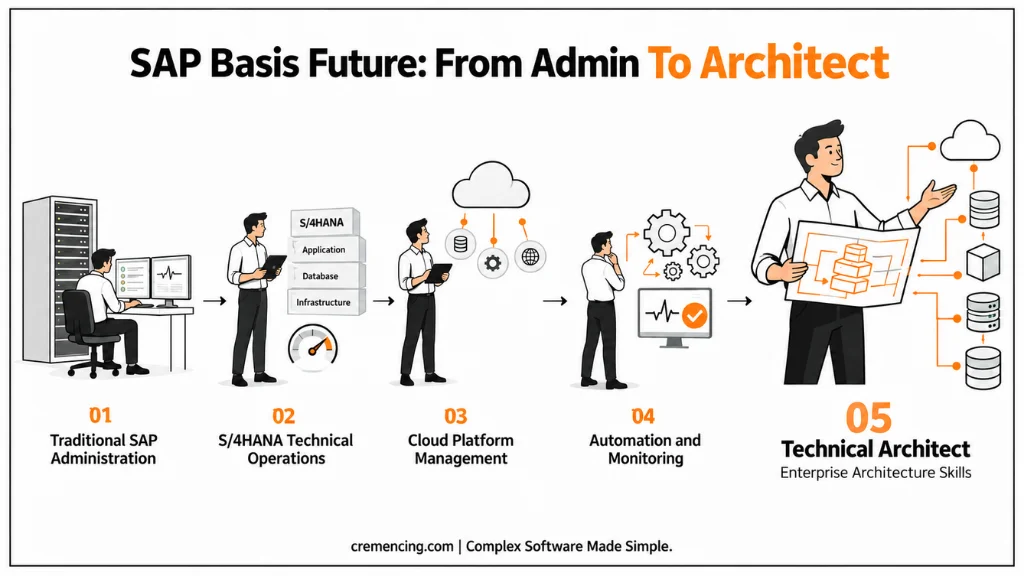
Until recently, Basis administrators were mostly concerned with traditional ABAP application servers, database administration and system maintenance in SAP ECC environments. These skills are all still relevant, but there are also new skills demanded by S/4HANA.
As more SAP Basis professionals are involved in S/4HANA systems, they need more knowledge on:
- SAP HANA administration
- System conversion projects
- S/4HANA upgrades
- SAP Fiori technical architecture
- Embedded analytics components
- Cloud connectivity
For instance, in the context of an SAP ECC to S/4HANA conversion, Basis teams participate in technical preparation, system checks, migration execution, upgrade activities and post-conversion validation.
The role also shifts towards application teams. There are integration, custom development, security role and user experience changes associated with S/4HANA implementations. Basis professionals must work closely with developers, security experts, and the architecture to support the entire technical environment.
SAP S/4HANA does not eliminate the need for Basis expertise, however. Changes the nature of expertise needed.
SAP Basis and SAP HANA Skills Become More Important
One of the biggest changes in modern SAP administration is the importance of SAP HANA knowledge. Since SAP S/4HANA runs exclusively on SAP HANA, understanding the database layer has become an important part of the Basis skill set.
Traditional SAP Basis administrators often worked closely with separate database administrators. In many S/4HANA environments, Basis professionals need stronger knowledge of HANA administration tasks.
Important SAP HANA-related areas include:
- Database monitoring
- Backup and recovery concepts
- Performance analysis
- Memory management
- High availability configuration
- System replication concepts
This does not mean every Basis professional must become a dedicated database specialist. However, understanding how SAP HANA affects application performance and system behavior is becoming increasingly important.
For example, performance issues in S/4HANA environments may require analysis across application servers, database processes, SQL performance, and system configuration. A modern Basis professional needs the ability to investigate issues across these layers.
SAP HANA knowledge therefore represents one of the key areas that will influence future opportunities for SAP Basis professionals.
Impact of Cloud Adoption on SAP Basis Careers
Cloud adoption is one of the biggest factors influencing the future of SAP Basis. Organizations adopting SAP cloud solutions or RISE with SAP often move certain infrastructure responsibilities away from internal teams.
In traditional on-premise environments, companies controlled servers, operating systems, databases, and SAP installations directly. Cloud environments introduce shared responsibility models where SAP, cloud providers, and customers manage different parts of the landscape.
This changes the daily activities of Basis professionals.
Instead of focusing only on infrastructure maintenance, modern Basis roles increasingly involve:
- Cloud system management
- SAP service coordination
- Technical monitoring
- Integration configuration
- Environment management
- Lifecycle planning
For example, a company using SAP S/4HANA Cloud may not manage the underlying infrastructure directly, but it still requires experts who understand system availability, technical configuration, integration behavior, and operational processes.
Cloud adoption therefore changes the role from system administrator toward technical platform specialist.
SAP BTP and Automation Are Redefining SAP Basis Skills
The adoption of SAP BTP and automation technologies is changing how SAP Basis professionals approach system operations. In traditional SAP landscapes, many administrative activities were performed manually through SAP transactions and operating system-level tasks. Modern SAP environments require professionals who understand automation frameworks, cloud services, monitoring platforms, and integration technologies.
SAP BTP does not replace SAP Basis responsibilities. Instead, it introduces additional technical layers that require Basis teams to understand connectivity, authentication, service configuration, and operational management.
For example, an organization extending SAP S/4HANA functionality through SAP BTP may require Basis involvement in configuring destinations, managing connectivity through SAP Cloud Connector, monitoring services, and supporting technical communication between systems.
This creates a broader role where SAP Basis professionals work closer with enterprise architects, integration specialists, and cloud teams.
Automation is another major factor affecting the future of SAP Basis. Organizations are increasingly adopting automated monitoring, provisioning, system refresh processes, and operational workflows. Manual repetitive activities are being reduced, but this creates opportunities for Basis professionals who can design and manage automated operations.
Modern Basis professionals need to understand tools and concepts such as:
- SAP Cloud ALM monitoring
- SAP Solution Manager capabilities
- Infrastructure automation
- Cloud administration concepts
- Scripting and automation methods
- DevOps practices
As SAP landscapes connect with broader enterprise platforms, Basis teams are also increasingly involved in cross-platform coordination — for example, how SAP ServiceNow integration can end workflow bottlenecks, where technical teams manage synchronization between SAP systems and IT service management workflows.
The future of SAP Basis is therefore connected with the ability to manage intelligent and automated SAP operations rather than only performing manual administration tasks.
The Shift From SAP Basis Administrator to SAP Technical Architect
The traditional image of an SAP Basis administrator was focused on operational execution. Tasks such as system monitoring, transport movement, patch installation, and technical troubleshooting represented a large part of daily responsibilities.
Modern SAP environments require a broader perspective. SAP Basis professionals are increasingly becoming technical specialists who understand how different SAP components operate together within enterprise architecture.
A modern SAP technical operations role may involve decisions around:
- SAP landscape design
- System integration
- Cloud deployment models
- High availability strategies
- Disaster recovery planning
- Performance optimization
- Lifecycle management
For example, when an organization plans a new SAP S/4HANA implementation, Basis professionals contribute to decisions about system architecture, sizing, environments, connectivity, and operational readiness.
This requires communication with multiple teams. A Basis specialist may need to work with:
- SAP architects for landscape planning
- Security teams for access controls
- Developers for technical deployments
- Infrastructure teams for cloud environments
- Business teams for operational requirements
The role is becoming less isolated and more connected with enterprise technology decisions.
Professionals who continue developing only traditional administration skills may find fewer opportunities, while those who expand into architecture, cloud, and automation areas can continue growing.
Skills SAP Basis Professionals Need for the Future
The future of SAP Basis depends heavily on skill development. The foundation of SAP administration remains valuable, but additional capabilities are becoming increasingly important.
SAP S/4HANA Technical Knowledge
SAP S/4HANA expertise is one of the most important areas for modern Basis professionals. Organizations continuing their digital transformation require specialists who understand S/4HANA technical operations, migrations, upgrades, and system lifecycle management.
Important areas include:
- S/4HANA installation concepts
- System conversion approaches
- Technical migration activities
- Simplification item checks
- Upgrade planning
- Post-migration validation
Professionals who understand both ECC and S/4HANA environments can support organizations during transformation projects.
SAP HANA Administration
SAP HANA knowledge has become a core requirement because SAP S/4HANA depends on the HANA database platform.
Basis professionals should understand:
- HANA architecture
- Database monitoring
- Backup and recovery
- Performance troubleshooting
- Memory management
- Replication concepts
This knowledge helps Basis teams analyze issues that involve both application and database layers.
Cloud Platform Knowledge
Cloud adoption has expanded the technical responsibilities of SAP Basis teams. Professionals should understand how SAP systems operate in cloud environments.
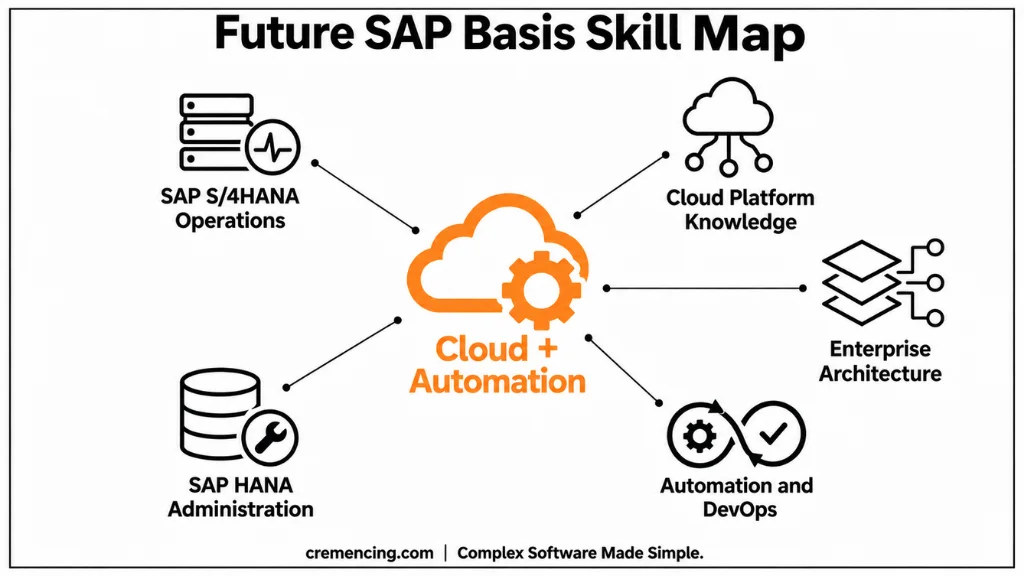
Useful knowledge areas include:
- SAP BTP architecture
- Hyperscaler concepts
- Network connectivity
- Cloud security basics
- Managed SAP services
- Hybrid landscapes
Organizations rarely operate completely isolated systems anymore. Understanding how SAP connects with cloud platforms is becoming an important skill.
Automation and DevOps Practices
Automation is changing operational processes across enterprise IT. SAP Basis professionals who understand automation can improve system management and reduce repetitive manual work.
Relevant skills include:
- Shell scripting
- PowerShell basics
- Infrastructure automation concepts
- CI/CD principles
- Monitoring automation
The goal is not to replace administrators but to allow teams to focus on more complex technical activities.
How Organizations Will Use SAP Basis Skills in the Future
Organizations will continue requiring SAP technical specialists because SAP systems remain critical components of enterprise operations. Even when companies move infrastructure to cloud platforms, they still need experts who can manage SAP application environments and ensure technical reliability.
Future SAP Basis responsibilities will increasingly include:
- SAP landscape management
- Cloud operations coordination
- Technical monitoring
- System lifecycle management
- Integration support
- Performance optimization
- Architecture collaboration
For example, an enterprise using SAP S/4HANA Cloud may rely on SAP-managed infrastructure, but internal teams still need to understand system dependencies, integration behavior, business impact of changes, and operational requirements.
The role of SAP Basis is becoming more strategic because technical decisions influence business continuity. A poorly planned upgrade, incorrect configuration, or failed integration can affect critical business processes.
Professionals who understand both SAP technology and business requirements will continue to provide value in these environments.
SAP Basis and the Growth of Managed Services
Managed services are changing how organizations operate SAP landscapes. Many companies now use SAP partners or cloud providers to handle specific technical responsibilities, including infrastructure management and system operations.
This change does not remove SAP Basis opportunities, but it changes where expertise is applied. Instead of performing every administrative task manually, Basis professionals increasingly coordinate, monitor, and optimize managed SAP environments.
A modern Basis role may involve working with:
- SAP Cloud Infrastructure
- Managed service providers
- SAP support teams
- Enterprise architecture teams
- Internal application owners
For example, during an SAP S/4HANA upgrade managed through a cloud provider, the Basis professional may coordinate technical activities, validate system readiness, monitor environments, and ensure that business teams experience minimal disruption.
This requires stronger communication skills and a broader understanding of SAP operations.
The future SAP Basis professional will not only execute technical tasks but also manage relationships between systems, providers, and business requirements.
Is SAP Basis Still a Good Career Choice?
The question does SAP Basis have a future is closely connected with whether it remains a good career choice. The answer depends on how professionals approach the role.
SAP Basis continues to be a valuable career path for people interested in enterprise systems, technical architecture, cloud platforms, and system operations. However, the role requires continuous skill development because SAP technology is moving beyond traditional ERP administration.
Professionals entering SAP Basis today should focus on building a strong foundation and gradually expanding into modern areas.
A future-ready SAP Basis learning path may include:
- SAP ECC administration fundamentals
- SAP S/4HANA technical operations
- SAP HANA database concepts
- SAP BTP architecture basics
- Cloud infrastructure understanding
- Automation and monitoring skills
- Enterprise architecture principles
This combination allows professionals to support both traditional SAP environments and modern cloud-based landscapes.
SAP Basis Future Compared With Other SAP Technical Roles
SAP Basis is not the only SAP technical role changing. Similar transformations are happening across the SAP ecosystem.
| SAP Role | Traditional Focus | Modern Direction |
| SAP Basis | System administration and maintenance | Cloud operations, architecture, automation |
| SAP ABAP Developer | Custom development | Clean core development, APIs, SAP BTP extensions |
| SAP Security Consultant | Roles and authorizations | Identity management, cloud security, governance |
| SAP Functional Consultant | Business process configuration | S/4HANA transformation and process optimization |
This comparison shows that SAP roles are evolving rather than disappearing. Technology changes the responsibilities, but organizations still require professionals with deep SAP knowledge.
SAP Basis professionals who adapt with these changes can continue building strong careers.
Conclusion
The question does SAP Basis have a future has a clear answer: the role is evolving rather than disappearing. Traditional administration tasks are changing because organizations are adopting SAP S/4HANA, SAP BTP, automation, and cloud-based operating models. However, enterprises still require professionals who understand SAP technical architecture, system operations, integrations, and lifecycle management.
The future SAP Basis professional will combine classic administration knowledge with modern skills in cloud platforms, SAP HANA, automation, and architecture. As SAP landscapes become more complex, technical expertise will remain important for maintaining reliable and secure enterprise systems. Professionals who continue learning and adapting will find new opportunities in modern SAP environments.
Frequently Asked Questions
Does SAP Basis have a future after SAP S/4HANA adoption?
Yes, SAP Basis has a future after SAP S/4HANA adoption, but the role is changing. Professionals are moving from traditional system administration toward SAP HANA operations, cloud management, automation, technical architecture, and enterprise landscape support.
Will cloud computing eliminate SAP Basis jobs?
Cloud computing will reduce some infrastructure-related tasks but will not eliminate SAP Basis roles. Organizations still need experts who understand SAP systems, technical operations, integrations, monitoring, and lifecycle management in cloud and hybrid environments.
What skills should SAP Basis professionals learn for the future?
SAP Basis professionals should learn SAP S/4HANA administration, SAP HANA, SAP BTP concepts, cloud platforms, automation, monitoring tools, and enterprise architecture. These skills help them transition from traditional administration toward modern SAP technical roles.
Is SAP Basis still relevant for SAP S/4HANA?
Yes, SAP Basis remains relevant for SAP S/4HANA because technical administration, system upgrades, monitoring, integrations, and performance management are still required. The responsibilities expand as S/4HANA introduces new architecture and cloud capabilities.
What is the future role of SAP Basis administrators?
Future SAP Basis administrators will work more as SAP technical platform specialists. Their responsibilities will include managing cloud environments, supporting architecture decisions, automating operations, and ensuring SAP systems remain reliable.
Should beginners choose SAP Basis as a career?
Beginners can choose SAP Basis as a career if they are willing to learn modern SAP technologies. Building knowledge in SAP S/4HANA, HANA databases, cloud platforms, and automation will provide better long-term opportunities.
How is SAP Basis different in cloud environments?
In cloud environments, SAP Basis focuses less on physical infrastructure management and more on SAP service operations, monitoring, configuration, integrations, and coordination with cloud providers. The technical knowledge remains important but is applied differently.
Which has more future — SAP Basis or SAP Security?
Both SAP Basis and SAP Security have strong future potential. SAP Basis focuses on technical operations and cloud platforms, while SAP Security focuses on access management and compliance. The better choice depends on individual interests and career goals.
References
SAP Help Portal offers the SAP S/4HANA Technical Implementation Guide
SAP Learning provides SAP S/4HANA Administration Learning Resources:
The SAP Help Portal also includes an SAP HANA Administration Guide:
SAP Community hosts ongoing SAP Basis Administration Discussions:
SAP BTP and Automation Are Redefining SAP Basis Skills





One Response