
Why Your SAP Upgrade Is Green and How an SAP Integration Health Check Prevents Regression Risk
Posted on February 5, 2026 by Laeeq Siddique
Your SAP upgrade was implemented on time. System checks are green. Core transactions work. Dashboards look clean. Yet shipments are delayed. Invoices aren’t flowing. Customers are calling. Operations teams are scrambling. From the outside, it appears successful. Something is quietly breaking from within the business.
This is one of the most frequent and costliest failure patterns in enterprise SAP initiatives. Not a hard outage. Not a visible defect. But due to a quiet regression from a brittle/unvalidated integration.
And right here is where SAP Integration Health Check & Regression Risk turns out to be a top management, not something technical.
The Myth of a “Green” SAP Upgrade
SAP Upgrade Most SAP Upgrades can be validated by common measures, like;
- Core SAP transactions execute successfully
- No major production incidents at the time of Go-Live.
- High passing rate of Automated test results
- System and network monitoring are working well.
From a project perspective, everything is looking good.
But from a business standpoint, success means something different:
- Are orders flowing end-to-end?
- Do third-party systems have access to correct information?
- Are time-dependent integrations working exactly as they did before?
If these questions are not directly verified and validated, then you’re organizations will introduce regression risk—operational decay due to a change.
An up-to-date or “green” SAP upgrade can still be risk-averse if the quality of the integration is taken for granted and not proven.
Why are SAP Integration Failures The Most Risky to Your Business?
And it’s the insidiousness of integration problems that makes them particularly lethal, for:
- Rarely cause immediate system crashes
- Typically get around regular SAP testing round-ups
- Only appear when there is a truly business load.
- Hit revenue, logistics, and customer confidence
In complex SAP landscapes, you would have integrations like the following:
- SAP to SAP
- SAP to non-SAP systems
- Cloud platforms, partners, and vendors
- Ageing, poorly documented legacy systems
Each integration is a potential risk during an upgrade.
Organizations lack a SAP Integration Health Check & Regression Risk-based approach that shows failures post business impact.
What Companies (and Vendors) Sometimes Forget About Risk in SAPIntegrations
From an executive perspective, the risk of SAP integration is often undervalued for three reasons:
Integrations are treated as “technical plumbing.”
As long as the core system is not changed, or new parts are kept stable, they’re taken to be either unchanging or low risk.
Focus on Testing SAP, not the Ecosystem
User Acceptance Testing tests SAP transactions, not the complete integration flow.
Ownership Is Fragmented
None of the leaders has end-to-end integration health across platforms and vendors.
This three-way mix is creating blind spots, in which the risks of regression grow unseen.
SAP Integration Health Check vs Regression Risk Simplified
An SAP Integration Health Check & Regression Risk assessment is a systematic analysis of how integrations perform both pre and post SAP changes.
It concentrates on three fundamental issues:
- What does mission-critical in terms of business needs to be integrated?
- How adaptable are they to system transitions?
- How common are “silent failures” in an SAP upgrade?
Instead of the usual system checks, which look at availability, we’re going slightly deeper in this assessment and looking into behavior, dependencies, and failure modes.
Why SAP Upgrades Cause Regression Risk in Integrations
What gets affected in such integrations is that even when the integrations are not changed directly for themselves, SAP upgrades can affect them through:
- Data structure changes
- Message format adjustments
- Timing and sequencing differences
- Authorization and security changes
- Deprecated interfaces or APIs
These are changes that don’t normally break everything all at once. Instead, they produce edge-case (no pun intended) failures that only manifest when so-and-so.
This is why it is so hard and potentially so important to manage failure risk in regression.
What Happens to the Business When You Choose to Ignore Integration Regression Risk
Unmitigated regression risk is not hypothetical to executives.
It shows up as:
- Delayed shipments and missed SLAs
- Declined order processing and the associated revenue loss
- Manual overheads that impact the cost of operation
- ‘Distrust of the computer and SAP projects
- Customer and partner reputational damage
The majority of companies only measure these losses after they have occurred.
And a proactive SAP Integration Health Check & Regression Risk approach moves away from the “fire extinguishing” talk to prevention.
A True SAP Integration Health Check – What It Should Look Like
A real SAP Integration Health Check comes with some depth, not superficial watching.
It assesses integrations along six executive-facing dimensions:
Integration Criticality Mapping
Not all integrations are equal.
This step identifies:
- What integrations are having a direct effect on revenue, logistics, compliance, or customers
- Which abends we would bring the system down for vs slow them down
- What are those really important (for the business) but abysmally documented integrations?
Executives see when and where there’s real risk to regress.
Change Sensitivity Analysis
This dimension assesses:
- How fragile each integration is as SAP evolves
- If interfaces are hardcoded to logic or not
- Foothold in the data model or timing changes
Deep testing for integration when the integrations are highly sensitive.
Regression Test Coverage
Most organisations find out too late that:
- Integration regression tests are incomplete
- Tests verify the delivery of a message, not the business result
- Third-party integrations are excluded entirely
A SAP Integration Health Check reveals the evidence of the wall that exists between perceived coverage and actual protection.
Monitoring and Failure Detection
The things that go wrong silently are the scary ones, because we don’t know when or where they’ll show up.
This assessment evaluates:
- Whether the failures are identified in-transit
- If notifications are getting to the right teams
- Lifetimes of failures that can go unnoticed
The business impact of detection maturity is directly related to Detection Maturity , and Impact is directly related.
Ownership and Accountability
Regression risk grows when:
- Integration ownership is unclear
- Multiple vendors manage different pieces
- There’s no one to take responsibility for end-to-end health, partying of the young sort too likely prevents parties on the old side and I can’t explain why.)
There is a desperate need for clarity around who owns integration outcomes—not simply components.
Recovery and Resilience Readiness
When failures occur, speed matters.
This dimension evaluates:
- Ability to replay messages
- Rollback and contingency mechanisms
- on call to respond on short notice without interruption
With that kind of recovery system, we can suffer more failures at a lower time/money cost.
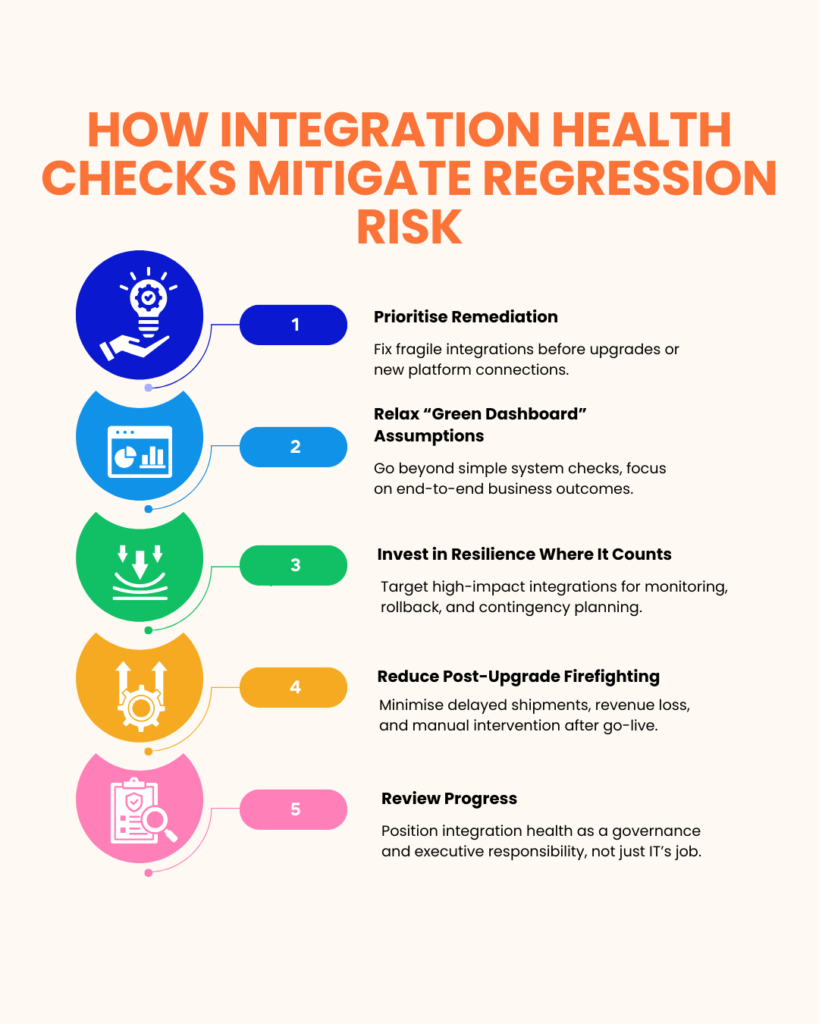
SAP Integration Health Check: How it helps to Mitigate Regression Risk
So the true appreciation of an SAP Integration Health Check is not discovery, it’s decision support.
It enables leaders to:
- Prioritise integration remediation before upgrades
- Relax go-live conditions beyond “the system is green.”
- Invest in resilience where it most counts
- Reduce post-upgrade firefighting
Instead of responding to failure, organizations build stability into the change that they seek.
When Executives Should Demand an Integration Health Check
A SAP Integration Health Check & Regression Risk Analysis is a must:
- Prior S/4HANA upgrades or support packs
- During ECC to S/4HANA transitions
- When you are connecting the SAP to new platforms, partners
- Having had many ”successful” upgrades with bad business results
If shipments back up after go-live, the check was too late.
Typical Leadership Blunders: This Strategy Eliminates
Risks are often unconsciously increased by executives:
- Treating green dashboards as indicators of success
- Assuming integrations “haven’t changed.”
- Assigning all integration risk to suppliers
- Considering error as a testing problem and not as a business risk
A well-designed SAP Integration Health Check repositions the concept of integration stability as a subject of governance and leadership.
Why This Matters More in Today’s SAP Landscapes
The more modular and cloud-enabled SAP landscapes become, the greater the risk of regression — not less!
Modern landscapes include:
- SAP BTP extensions
- Event-driven integrations
- Third-party SaaS platforms
- External partner ecosystems
Each linkage between them increases the overall contact patch for self-destructing in silence.
SAP Integration Health Check & Regression Risk is a key digital operations capability.
Conclusion: Green is NOT Safe
A greenfield SAP upgrade does not ensure business as usual. It only means that what you tested then worked. What you couldn’t test or didn’t see is what often hurts the most.
For CIOs, SAP leaders and transformation owners integration health is no longer just a technicality. It’s an indicator of operational health, revenue preservation and customer confidence. It’s not the companies that upgrade the most succeed, it’s the ones who prove what matters.
If you’re ready to take the next step in your digital transformation journey, connect with Cremencing today. Together, we’ll explore tailored solutions that drive efficiency, innovation, and growth.
Resources
S/4HANA Upgrade Overviews
SAP Integration Suite
SAP Upgrade Best Practices
📩 Subscribe to Our Newsletter
Get the latest updates, tips, and insights delivered straight to your inbox.