
In large SAP programmes, there is a constant tug of war between speed and quality — and this is exactly the tension an SAP Solution Design Authority is built to resolve. Delivery teams simply want to drive; leadership has to maintain and enforce standards & compliance, and architectural integrity.
Large SAP programmes don’t fail because delivery teams move too fast — they fail because nobody owns the design decisions that keep speed and quality from working against each other.
An SAP Solution Design Authority solves this by centralizing architectural governance without becoming the bottleneck teams fear it will be: it reviews and approves design before build, maintains consistent standards across modules and geographies, and gives delivery teams pre-approved patterns instead of forcing them to escalate every decision. Done well, an SDA doesn’t slow programmes down — it’s what makes fast, consistent delivery possible at scale.
No governing body: Lack of governance may lead to the following issues:
- Divergent design approaches across modules
- Poor integrations, no standard systems or data models
- Drag to Future Innovation because of Technical Debt
- Increasing rework and non-compliance costs
This is where an SDA (SAP Solution Design Authority) comes into play. It provides centralised governance, which does not slow down the delivery velocity for projects. On the executive side, SDA ensures that projects stay on track, are scalable, and align with the enterprise strategy.
Establishing an SAP Solution Design Authority
An SAP Solution Design Authority (SDA) operates as an architectural governing body that balances delivery speed with technical quality across enterprise SAP transformations. Rather than functioning as a traditional project management office or a restrictive approval bottleneck, an effective SDA provides delivery teams with pre-approved reference patterns, standardized data integration models, and explicit custom coding directives before development begins.
Incorporating structured decision gate reviews at key design and integration milestones prevents architectural drift, reduces custom rework, and mitigates technical debt. By delegating low-risk decisions to empowered feature teams while reserving high-impact architectural choices for central sign-off, organizations maintain consistent compliance, lower lifecycle maintenance costs, and preserve long-term scalability without sacrificing implementation velocity.
What is an SAP SDA?
SAP Solution Design Authority (SDA) is the governing body (or role) that defines and approves a governance structure and standards for Solution Design across SAP programmes.
Core responsibilities include:
- Review and sign off design before building
- Ensuring that best practice is followed whilst implementations are undertaken in an underlying architecture and SAPENSIONSCHOOLING 314 mainframe system
- Maintaining tech debt and avoiding architectural drift
- Guiding delivery teams with solid design principles and decision frameworks
The right SDA successfully balances control and agility, so teams can keep innovating at the speed they need to, but with reduced risks and maintaining consistent levels of reliability.
SAP Solution Design Authority for Big SAP Programmes: Why It Is Important?
The cost of bad solution design: Executives routinely under-report the cost of shotgun solution design. SDA provides strategic value by:
- Rework Reduction: Where design and standards meet before the first build
- Integrates Seamlessly: Same design from module to area
- Risk Prevention: No technical debt or regulatory failure
- Speedier Delivery: Its clear and authoritative voice speaks to less time spent getting teams to fight over design choices
- Evolving Strategic Fit: Ensure that SAP-based solutions are strategically aligned
Put bluntly: Without an SDA, Go You would never receive SAP reliably.
Key Requirements of a Great SAP Solution Design Authority
It is recommended that an SDA be guided by some principles for optimum results:
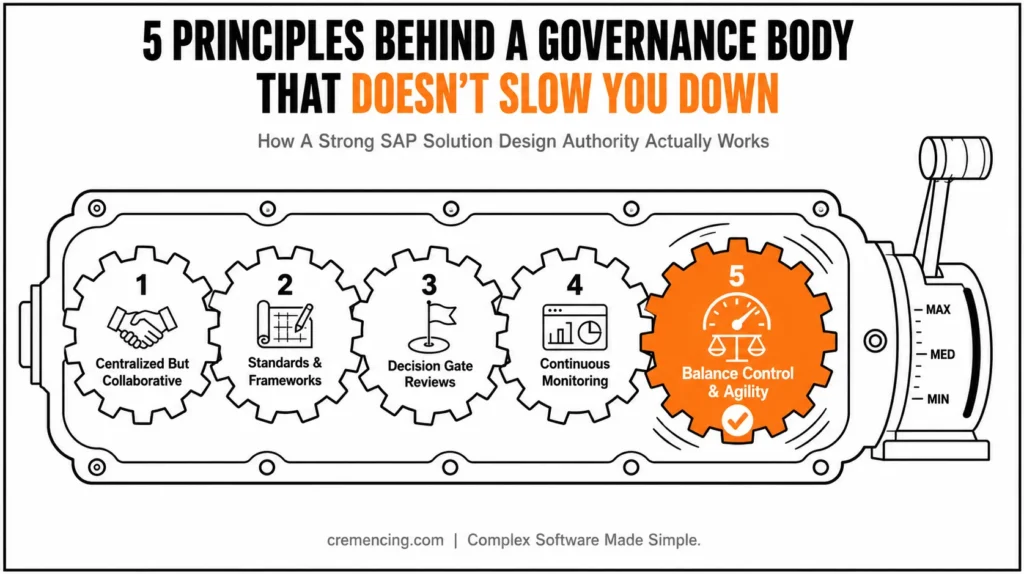
SAP Solution Design Authority: Centralized but Collaborative
The SDA has the authority, but works very closely with delivery teams:
- Provide guidance rather than micromanage
- Encourage early interaction to prevent problems later in the chain
- Encourage mixing of concepts between the technical and business sides
Standards and Frameworks
Create explicit, cross-enterprise solution design directives:
- Data models and integration patterns
- Settings and Implementation of Custom Code Conventions
- Security, compliance, and performance benchmarks
SAP Solution Design Authority Decision Gate Reviews
Use SDA checkpoints at different stopping points in the process:
- Solution design approval before development
- Integration validation before testing
- Approved scope change requests
This is what makes governance additive, rather than disruptive.
Continuous Monitoring
Supervise compliance and provide feedback to teams:
- Keep a close eye on design compliance with dashboards
- Identify recurring design deviations
- Develop lessons learned into guidelines
Supervision ensures that every new brick gets built with the old ones, so to speak.
Balance Control and Agility
The SDA is not intended to slow down delivery:
- Provide pre-approved design patterns
- Give fast design feedback and approval
- De-Light bottlenecks by pushing low-risk decisions to empowered teams
Best-in-class organisations see the SDA as an enabler, not an enforcer.
Step-by-Step SAP SDA Implementation
Leaders can follow the process to create a successful SDA:
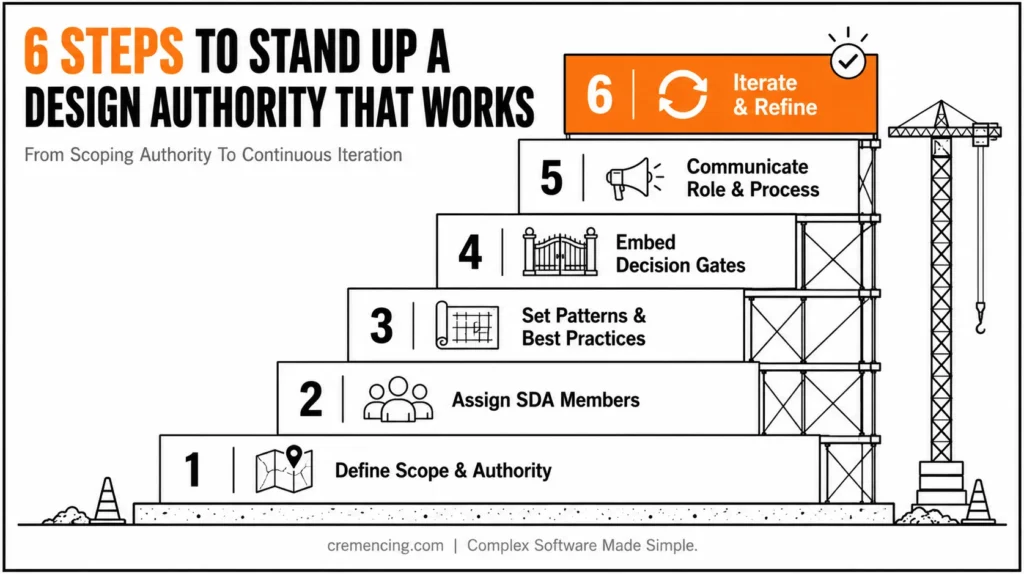
- Elaborate SDA Coverage and Autonomy: What modules, sub-systems, and design spaces belong to the domain of SDA
- SDA Responsibilities (Note 1): Enterprise architects, Solution architects, functional leads
- Set Patterns and Best Practices: Create reference patterns, templates, and design principles
- Embed Decision Gates: Be reviewed by SDA at every “decision point”
- Communicate Role and Processes Efficiently: Delivery teams should understand SDA’s role and how to engage with them
- Iterate: Refactor SDA now that we know what we know and learnt from SAP
This approach balances risk and enables delivery teams. For more insights, read our Blog on S/4 Hana Maturity Assessment
Real World Application: SAP Solution Design Authority Drives Speed Without the Penalty
What the company needed: One of the world’s largest financial services organisations had a non-standard design in multiple geographies for SAP. The delivery team just re-wrote integrations multiple times as they diverged in architecture to impact go-live.
After the establishment of the SAP Solution Design Authority:
- Universal design standards were formed for finance, procurement, and reporting components
- Review at the SDA gave immediate acceptance in high-risk locations
- Scrum teams were now able to make ALMOST risk-free decisions without escalation
Outcome: 25% faster delivery, less rework, and it preserves architectural consistency. SDA does not prevent you; integrated within it gives assurance of standards.
Executive Insights: SAP Solution Design Authority as a Key Facilitator
Business and service benefits include:
- Lower Technical Debt: The sooner you fix, the cheaper
- Better Time-to-Value: Less fighting about design in teams
- Tactical Agenda: Answers align with corporate direction, not just local OPTIMIZATIONS
- Better Risk Management: Compliance and interoperability planning on the front end
- Delivery: Clear constructs allow shipping teams to go fast and safely
SDA is not something to struggle with; it’s a scalable SAP delivery enabler.
| Without an SDA | With an SDA |
|---|---|
| Divergent design across modules | Universal design standards |
| Repeated integration rework | Reviewed, reusable patterns |
| Escalation for every decision | Empowered low-risk decisions |
| Technical debt accumulates | Debt caught and addressed early |
| Slower, inconsistent delivery | Faster, predictable delivery |
Common SAP Solution Design Authority Pitfalls to Avoid
Even seasoned SAP programs could find themselves in straits if:
- Treat SDA like the police and not go the variance
- Not pulling in delivery teams soon enough
- Let the SDA revision be a bottleneck
- UNENDED Optimisation of protocols is NOT employed
By avoiding these pitfalls, SDA can deliver fast and adhere to standard guidelines. A design authority is only effective when paired with a complete SAP business process health check to ensure compliance and continuous improvement.”
Conclusion:
The SDA: What It Takes to Govern, Maintain Velocity, and Build Trust
The SDA, AKA SAP Solution Design Authority, is the key ingredient to achieving a balance of governance and control while allowing project teams to execute at pace.
By setting exacting standards and decision gates and representing them on delivery build-up through advocacy, all SAP programs remain quality-, compliance-, and mission-strategy relevant.
Result: Fast, predictable delivery of high-value SAP.
Get your SDA framework in place, and align delivery teams with design standards, clear governance, and decision gates to move fast without compromising quality.
FAQs:
Q1: What is SAP Solution Design Authority (SDA)?
Essentially, it’s a governing body or role that governs, approves, and enforces solution design standards across SAP programs. Therefore, it becomes the central point of accountability for architectural consistency.
Q2: Why is SDA important for significant SAP transformations?
Fundamentally, it’s about consistency in your solution, less rework, and risk management while delivering value fast. As a result, organizations avoid the costly rework that comes from divergent design approaches.
Q3: How does SDA trade off between control and speed?
Specifically, it does this by providing pre-approved design patterns, fast decisions, and empowering low-risk decisions to be made by teams. Consequently, delivery teams move quickly without needing constant escalation.
Q4: Who should participate in an SDA?
Typically, enterprise architects, solution architects, functional leads, and senior SAP consultants who help determine technical alignment. Additionally, their combined expertise ensures decisions reflect both technical and business realities.
Q5: What is the role of SDA in increasing strategic alignment?
Ultimately, SDA ensures delivery is aligned with strategic business directions, meets long-term goals, and follows enterprise architecture and SAP best practices. In this way, individual project decisions stay connected to the bigger picture.
Q6: Does implementing an SDA slow down SAP delivery timelines?
Not necessarily — in fact, when designed correctly, an SDA speeds up delivery by reducing rework and design disputes. Instead of acting as a bottleneck, it provides clear, pre-approved patterns that teams can follow immediately.
Q7: What happens if an organization skips setting up an SDA?
Without one, however, teams often end up with divergent design approaches, poor integrations, and mounting technical debt. Over time, this leads to increased rework costs and slower future innovation.
Q8: How is SDA different from traditional project governance?
Unlike broader project governance, SDA focuses specifically on solution design and architectural consistency rather than budgets or timelines. Nevertheless, it still supports overall project success by preventing costly design-related delays.
Q9: Can a small SAP project benefit from an SDA, or is it only for large programmes?
Generally speaking, SDA delivers the most value on large, complex SAP programmes with multiple teams and modules. However, even smaller projects can benefit from lightweight design standards to avoid future scaling issues.
Q10: What’s the biggest mistake organizations make when setting up an SDA?
Often, the biggest mistake is treating the SDA as a policing function rather than an enabling one. Consequently, this creates friction with delivery teams instead of the collaborative, fast-moving governance an SDA is meant to provide.
Resources
SAP & Solution Design Authority
SAP Solution Architecture services overview