Introduction
A Large SAP programmes rarely fail because the technology doesn’t work. They fail because nobody had the authority — or the criteria — to stop a bad decision before it became an expensive one. SAP Decision Gate Governance solves that specific problem: it places formal, criteria-based checkpoints at each major programme milestone, so a project can’t quietly drift from kick-off to go-live without anyone re-confirming that the business case, the risk profile, and the budget still hold up.
Without it, the same pattern shows up across S/4HANA migrations and other large SAP initiatives: scope creep nobody approved, budget overruns nobody caught early, and go-live decisions made under deadline pressure rather than readiness. This guide covers how to design gates that actually work — clear criteria, defined ownership, and a repeatable review process — without turning governance into the kind of bureaucracy that slows programmes down instead of protecting them.
Strategic Framework for SAP Decision Gate Governance
Large-scale SAP transformation programs—such as S/4HANA migrations or global BTP implementations—fail primarily due to unmanaged scope creep, ambiguous accountability, and premature phase transitions. SAP Decision Gate Governance establishes non-negotiable formal quality and risk checkpoints between program phases to control investment release, enforce Clean Core principles, and ensure strategic alignment.
What is SAP Decision Gate Governance?
SAP Decision Gate Governance is a process to manage investments, risk, and change across SAP programs. The process incorporates predefined control points (gates) included in the project lifecycle at which progress can be assessed and a discontinuance or continuance and a continuity or corrective action decision made by management.
Key objectives include:
- Regulating Investment: First, release money as and when it is needed.
- Risk Management: Second, mitigate risk before proceeding to the next step.
- Change Management: Next, verify that all changes in scope and design serve business objectives.
- Ownership: Then, be explicit about who makes what decisions and is responsible for results.
For CxOs, this also provides visibility, control, and confidence that those major SAP programs are delivering, as a result, not only operational but also strategic value.
Key Aspects of the Decision Gate Governance Best Practices
In addition, several rules need to be considered and implemented when using SAP Decision Gate Governance:
Define Clear Gate Criteria for SAP Decision Gate Governance
Therefore, every gate should meet the following acceptance criteria:
- To be left for the completion of this phase
- Upon meeting the KPIs and quality targets agreed on
- Risk assessments and mitigation plans
- Budget alignment and resource availability
Consequently, the adoption of vague rules should be avoided so as not to create unnecessary delay.
Align Gates With Programme Milestones
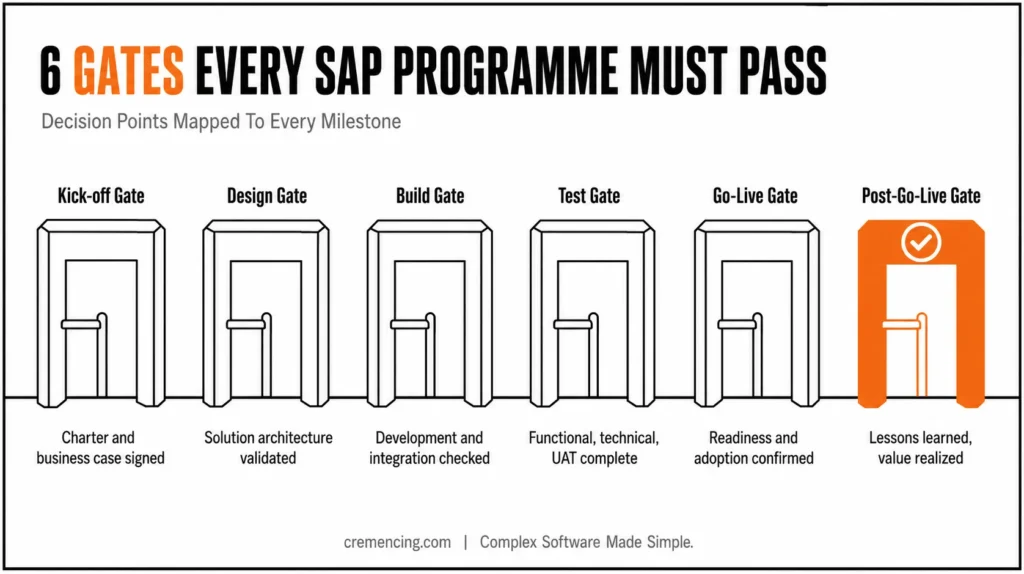
Each major programme milestone should be mirrored by decision gates:
- Kick-off Gate: Signature of programme charter and business case
- Design Gateway: Validate design and architecture of the solution
- Build Gate: Development, configuration and integration check done
- Test Gate: Make sure it is tested to all levels: functional, technical and user acceptance
- Go-Live Gate (Stage 8): Ensure readiness, adoption and operational support
- Post-Go-Live Gate: Lessons Learned, Value Realization and Stability
After that, alignment is about governance becoming the program, not an alien imposition on it.
| Gate | Programme Stage | Key Focus | Primary Owner |
|---|---|---|---|
| Kick-off Gate | Programme initiation | Business case & charter sign-off | Executive Sponsor |
| Design Gate | Solution design | Architecture & design validation | Technical/Functional Leads |
| Build Gate | Development phase | Development, configuration & integration check | Programme Lead |
| Test Gate | Testing phase | Functional, technical & UAT testing | Quality/Risk Owner |
| Go-Live Gate | Deployment | Readiness, adoption & operational support | Programme Lead + Sponsor |
| Post-Go-Live Gate | Stabilization | Lessons learned & value realization | Executive Sponsor |
Assign Ownership and Accountability
Decision-making has to be unequivocal:
- The investment and strategic alignment are signed off on by the Risk Executive sponsors
- The latter covers status, risks and recommendations and is given by Programme leads
- Risk owners validate mitigation plans
- The quality of the solution is validated by functional and technical leads
This sort of RACI model promotes accountability and reduces conflict.
Integrate Risk and Change Management
Significantly, decision gates are a neat way to start quantifying risks and screwing around with new stuff:
- Identify project or technical risk early
- Evaluate scope variation against cost, schedule and quality
- Respond appropriately, by providing intervention or escalating the situation when necessary
At the same time, it is, after all, an innovative and controlling mix that would not render us coronary-reactive firemen.
Each gate review should produce a concrete artifact, not just a discussion: an updated risk register entry with owner and mitigation status, a documented scope-variance assessment (cost, schedule, quality impact), and a clear escalation trigger — for example, any risk rated “high” that remains unmitigated for more than one gate cycle should automatically escalate to the executive sponsor rather than waiting for the next scheduled review.
Monitor and Continuously Improve
Decision gate governance is by no means an institution:
- Evaluate the barriers at every step
- Carry learned lessons into subsequent gates
- Make requirements, forms, or the like more efficient
Best practice organizations conceive of governance as a living system that changes to accommodate the complexity of the program and organization.
In practice, this means capturing two things after every gate: what worked in the review process itself (were criteria clear, was the right data available, did the right people attend) and what the gate revealed about the programme (recurring risk themes, criteria that were too vague to act on). Feed both into the next gate’s templates and criteria — a gate framework that never changes across a multi-year programme usually means lessons aren’t being captured, not that the framework was perfect from day one.
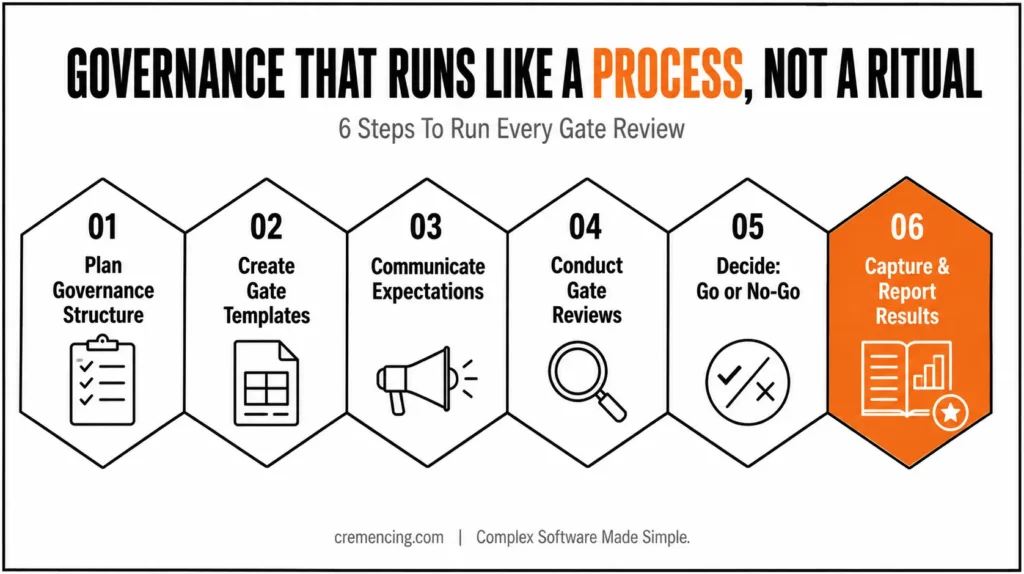
SAP Decision Gate Governance Process Step-by-Step
Executives can start with a straightforward, repeatable practice:
- Plan Governance Structure: Determine who will gate what, describe gates, criteria, roles and reports
- Create Gate Templates: Thanks to our approval templates, risk logs and KPI dashboards that are already configured
- Give Directives to the Leadership, Programme Teams, and Other Stakeholders: Communicate your expectations
- Conduct Gate Reviews: Review deliverables, risks, costs and fit to purpose
- Yes, Optimise or No: Whether to approve the program, apply adjustments (if necessary) and whether to continue running the tool
- Capture Knowledge: Learn… Feed learnings into the next phase and future programs.
- Reporting Results: Offer up short-to-the-point executive summaries to keep you in front and remain visible and confident
It makes all decisions data-driven, risk-aware, and aligned with corporate strategy.
Decision Gate Governance — Process at a Glance
- Plan governance structure (gates, criteria, roles, reporting)
- Create gate templates (approval forms, risk logs, KPI dashboards)
- Communicate expectations to leadership and programme teams
- Conduct gate reviews (deliverables, risks, costs, fit-to-purpose)
- Decide: approve, adjust, or halt
- Capture lessons learned for future gates
- Report results in concise executive summaries
Example in the Real World: Governance Avoiding Costly Mistakes
A multinational financial institution embarked on an S/4HANA project for several years. Initially, decisions were ad-hoc, so:
- Scope creep in multiple modules
- Delayed integration testing
- Budget overruns and stakeholder frustration
After SAP Decision Gate Governance is implemented, project teams
Complete the following steps:
- Open the godown only by authorized gates.
- 3 Evaluate risks logically so as not to re-engineer near the end of the schedule.
- Control the impact of changes with formal impact analysis.
As a result, the team delivered the program on time, stayed within budget, and achieved the anticipated business returns, such as a real-world example of value-added decision gate governance!
Executive Perspectives:
Proof Point Governance: Why SAP Decision Gate Governance Brings Strategic Value
In particular, some tangible benefits of SAP Decision Gate Governance would include:
Investments are in your control: Ensure the team uses resources proportionally and purposefully.
Risk Management: Be proactive in spotting and addressing problem loans before they develop into larger issues.
Change Control: Ensure that what is changing supports rather than hinders the program, while remaining aligned to objectives.
Operational Transparency: Achieve a clear picture of what is going on in your business and where operations go wrong or risk occurs.
Strategic-Secure: Help your management make mission-critical decisions with confidence, thus driving innovation and structure without chaos.
Common Pitfalls to Avoid in SAP Decision Gate Governance
A well-established company can still lose it if it is
- Regarding the gates as ritual, not oracle
- If you fail to articulate standards or criteria, the team cannot define an observable, measurable end product.
- Have gate reviews (with very little real accountability) by them
- Forget that it ever happened; be stupid in the next stages
By avoiding these pitfalls, decision gate governance is controlled, not bureaucratic.
Conclusion:
The programmes that stay on budget and on schedule aren’t the ones with the fewest problems — they’re the ones where a gate catches problems, assigns a named owner, and documents the decision, instead of letting them surface three months later as a crisis nobody planned for. That’s the actual value of SAP Decision Gate Governance: not more paperwork, but a repeatable point in the programme where someone with the authority to act actually looks at the risk, the budget, and the fit-to-purpose before the next phase starts.
Six gates, clear criteria at each one, and named ownership from kick-off through post-go-live — that structure is what separates a controlled SAP transformation from an expensive one. Pair it with a thorough SAP business process health check across the organization, and decision gates stop being a checkpoint exercise and start being the mechanism that keeps the whole programme honest.
FAQs:
Q1: What is SAP Decision Gate Governance?
It is a methodology for facilitating milestone decisions in SAP programs to handle investment, risk, and change.
Q2: Why is it critical in large SAP programs?
It provides oversight, reduces risk, controls scope changes and offers execs visibility into complex initiatives.
Q3: How do we structure decision gates?
The team uses milestones as gates: kick-off, design, build, test drive, go-live, and post-go-live—and supports each gate with clearly defined entry and exit criteria.
Q4: Who are the decision gates for?
These are the various stakeholders, such as executive sponsors, program managers, process specialists, some technical specialists, and risk or quality managers, amongst others.
Q5: Is governance at the decision gate really an innovator driver?
Yes. MHU provides a structured governance mechanism that makes it possible for organizations to innovate with vim, but never lose sight of costs, risk, and scope.
Q6: How many decision gates should a typical SAP programme have?
Most large SAP programmes work well with 5-7 gates aligned to major milestones — kick-off, design, build, test, go-live, and post-go-live. Too few gates leave blind spots between major decisions; too many turn governance into bureaucracy and slow the programme down.
Q7: What happens if a programme fails to meet gate criteria?
The gate review team can choose from three options: send the deliverable back for rework, approve conditional progress with a corrective action plan, or halt the programme until the team resolves the risks. The team should always document the decision with clear reasoning, so accountability stays traceable.
Q8: Can decision gate governance work for agile or hybrid SAP delivery models?
Yes. Gates don’t have to be rigid, waterfall-style checkpoints. In agile or hybrid delivery, teams can map gates to release cycles or major sprints, checking lighter-weight criteria more frequently to keep governance in step with iterative delivery.
Q9: How is decision gate governance different from regular project status reporting?
Status reporting is informational — it tells stakeholders where things stand. Decision gate governance acts as a control mechanism — it requires a formal go/no-go decision backed by defined criteria before the programme can proceed to the next phase.
Q10: What tools or templates help support decision gate governance?
Common enablers include gate approval templates, RACI matrices, risk and issue logs, KPI dashboards, and standardised executive summary formats. Many organisations also use tools like SAP Solution Manager to track governance activities alongside technical delivery