

Introduction
A mid-size manufacturer signs off on a “simple” SAP HEC cloud migration timeline: six months, minimal disruption, business as usual. Eight months in, the project is still running. The team underestimated data volumes, integration testing exposed dependencies nobody mapped, and the infrastructure team now manages two environments instead of one. This isn’t a rare story.
This is where SAP HEC comes into the picture, addressing these challenges. They provide a managed cloud environment, which makes it easy to migrate while recovering control of systems and processes. Organizations can focus on getting to business outcomes rather than dealing with infrastructure complexities.
SAP HANA Enterprise Cloud (HEC) exists specifically to prevent this outcome. Instead, it shifts ownership, sizing, and operational governance of the infrastructure to SAP. As a result, the organization’s IT team can focus on business outcomes rather than hardware refresh cycles and patch schedules.
However, HEC’s role in 2026 is more nuanced than being “always the right answer.” SAP is actively steering most new cloud deals toward RISE with SAP. Therefore, HEC works best today as either an existing customer’s renewal decision or a deliberate stepping stone toward a broader RISE transformation.
What Is SAP HEC
HEC combines infrastructure-as-a-service (IaaS) and platform-level management under a single subscription: SAP owns HANA database operations, defined BASIS scope, data center facilities, and SLA-backed availability, while the customer retains its own application licenses (S/4HANA, ECC, or BW) and application-layer configuration.
SAP HEC (HANA Enterprise Cloud) is a powerful solution designed to support organizations in their cloud migration journey.
- Infrastructure management by SAP
- System monitoring and maintenance
- Security and compliance support
- Integration with SAP solutions
A basic “lift-and-shift” IaaS migration exposes enterprises to fragmented vendor accountability and operational disruption. The managed private cloud architecture, originally SAP HEC and now embedded within RISE with SAP (S/4HANA Cloud, Private Edition),, solves this by delivering a dedicated, single-tenant environment under a unified SAP SLA of up to 99.9%. This gives organizations the exact bridge they need: keeping mission-critical customizations intact while adopting a “Clean Core” strategy to deploy business AI and SAP BTP extensions without risking core operations.
Organizations commonly use SAP HEC for cloud projects when they want to move to the cloud without losing control over their systems. SAP HANA Enterprise Cloud is also suitable for a hybrid environment, thus allowing enterprises to make a gradual decision rather than migrate everything in one go.
Advantages and Return On Investment
| Dimension | SAP HEC | RISE with SAP | S/4HANA Cloud, Private Edition |
| Contract model | Standalone managed private cloud subscription | Bundled subscription (infrastructure + software + tools) | Bundled cloud subscription, private/single-tenant |
| Application licenses | Customer-owned, purchased separately | Included in RISE subscription | Included in subscription |
| Best fit | Existing HEC customers renewing, or phased migration path | Net-new cloud transformations, full S/4HANA moves | Organizations wanting private-edition control without legacy HEC contract structure |
| SAP’s current sales posture | Renewal-only for most customers; not actively pitched for new deals | Primary go-forward offer for new cloud migrations | Positioned as HEC’s practical successor for new private-cloud deals |
| Governance model | Customer-defined BASIS scope, tiered SLAs | Standardized SAP-managed governance | Standardized SAP-managed governance |
What Is the Role of SAP HEC in Cloud Migration?
Step 1: Assessment and Planning
Assessment of the existing system landscape is the first step of all SAP HEC projects.
This includes:
- Identifying system dependencies
- Assessing data volumes
- Defining migration goals
Tools such as SAP Check are commonly used to measure the readiness of a system.
Step 2: System Preparation
Preparing systems for cloud deployment before migration
This involves:
- Cleaning up data
- Optimizing system performance
- Ensuring compatibility with cloud environments
Well-planned migrations mitigate risks and provide better outcomes.
Stage 3: Migrate to SAP HEC
Structured migration approaches are used to migrate the system to SAP HANA Enterprise Cloud.
During this phase:
- Data is transferred securely
- Cloud reference architectures are used to configure systems
- Testing is done for functionality purposes
These will need to be accommodated during the transition process.
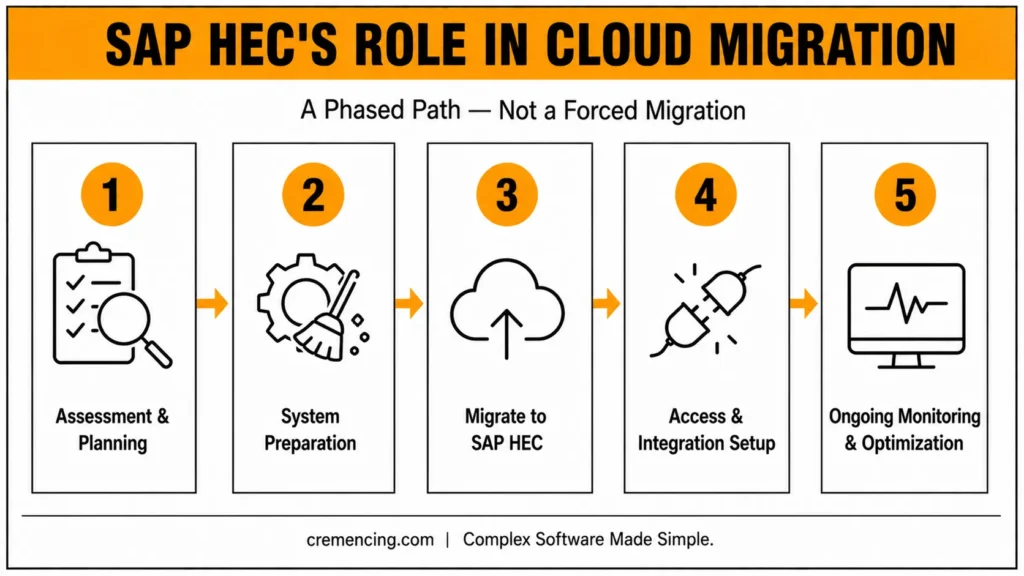
Step 4: Set Up for Access and Integration
After migration, applications are integrated into the systems.
Components such as:
- SAP HEC desktop
- SAP HEC WTS (Workplace Technology Services)
Establishing Consistent Monitoring and Optimization
Post-migration, SAP continuously monitors the system to set up a health check process.
This includes:
- Performance tracking
- Issue resolution
- System updates
Clearly defined SAP HEC roles and responsibilities validate both the efficiency of the system by SAP as well as the organization a similar roles-and-responsibilities split applies once you move to RISE.
SAP HEC – Advantages and Return On Investment
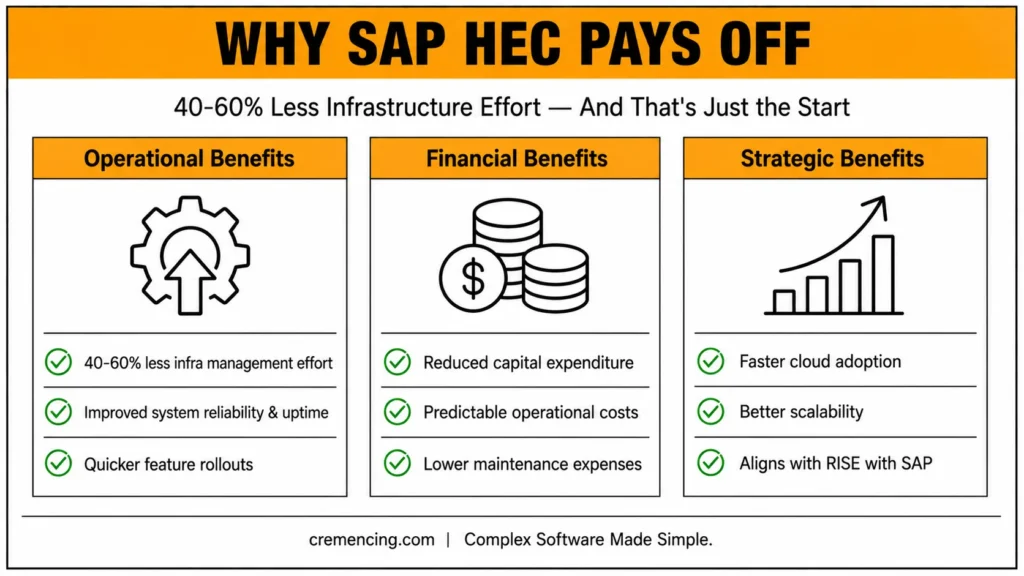
SAP HEC brings tangible benefits to operations, finance, and strategy.
Operational Benefits
- 40–60% (or more) less infrastructure management effort
- Improved system reliability and uptime
- Quicker implementation of updates and features
Financial Benefits
- Reduced capital expenditure on hardware
- Predictable operational costs
- Lower maintenance expenses
Strategic Benefits
- Faster cloud adoption
- Better scalability for growing businesses
- RISE with SAP alignment
SPH ECU a high-performance computing environment that comes from the SAP HANA Enterprise Cloud offering. A lot of organizations that use SAP HANA Enterprise Cloud are able to migrate within a shorter timeline and experience better system performance. Clearly defined SAP HEC roles and responsibilities validate both the efficiency of the system by SAP as well as the organization, a topic covered in more detail in this closer look at SAP’s cloud transformation model.
Best Practices and Common Blunders
Common Mistakes
- SAP HEC as a Hosting-only Solution
- Ignoring system readiness before migration
- Absence of clear roles and responsibilities
- Poor integration planning
- Failing to align migration with business goals
These blunders may result in delays and lower returns on investment (ROI).
Best Practices
- Set clear goals for the SAP HEC projects
- Analyze your system using SAP checks tools
- Establish strong governance and monitoring
- Migrate with your long-term SAP strategy in mind
Stick to these practices for a successful cloud migration. This is especially true for organizations layering SAP BTP on top of their migrated environment.
Where Most SAP HEC Content Falls Short
When it comes to SAP HANA Enterprise Cloud, it seems there is a majority share of content covering its definition or features. Yet, it frequently misses its strategic position within cloud transformation.
What Is Often Missed
- SAP HEC is more than infrastructure it’s a migration enabler
- This is the link between on-premises systems and cloud environments
- It allows for gradual transformation instead of forced migration
- IT has become a key component in the RISE with SAP business technology strategy.
Why This Matters
Organizations that appreciate this role are leveraging the SAP HEC Platform as a stepping stone for complete cloud transformation. Rather than migrating at risk, they can take a phased and organic approach.
Conclusion
The Role of SAP HEC in Modern Cloud Migration Strategies It hides the complexities of infrastructure management and lets businesses keep their eye on business goals.
SAP HEC helps businesses simplify their systems, improve performance, and confidently accelerate their journey to cloud technologies. It serves as a middleware between legacy systems and cloud-ready solutions.
SAP HEC Platform is not merely a traditional service that every organization needs to have when they start venturing into the cloud, but more of a strategic advantage and an enabler for organic growth and transformation wherever it makes sense.
FAQ Section
What are SAP HEC’s roles and responsibilities?
Infrastructure stays with SAP, while businesses instead focus on what matters most — business processes and day-to-day system usage.
What does migrating from SAP HEC to RISE with SAP involve?
In practice, this means moving from HEC environments into RISE with SAP for a more comprehensive cloud transformation.
Is SAP HEC still available for new customers in 2026?
Yes — SAP hasn’t announced an end-of-life date for HEC, and existing contracts continue to be supported. However, most new cloud deals are now steered toward RISE with SAP instead.
What’s the difference between SAP HEC and RISE with SAP?
Under HEC, organizations bring their own SAP application licenses to a standalone managed private cloud subscription. RISE with SAP, by contrast, bundles infrastructure, licensing, and tooling into one subscription.
How long does a typical SAP HEC migration take?
Timelines vary significantly based on data volume, system complexity, and pre-migration cleanup. As a result, any fixed-timeline promise should be treated with caution until scoped against a real readiness assessment.
Does SAP HEC support S/4HANA specifically?
HEC supports S/4HANA, SAP Business Suite, and SAP NetWeaver BW, alongside select third-party applications, running either in SAP-owned data centers or on major hyperscalers.
What happens to application licenses when moving from HEC to RISE?
Since HEC customers own their licenses separately, a move to RISE typically requires a formal licensing conversion rather than a simple infrastructure swap.
Who should consider HEC over RISE with SAP right now?
Generally, this fits organizations mid-contract on HEC who aren’t ready for a full RISE transformation or those who specifically want to keep application licenses separate rather than bundled. transformation or