The functional specification says, “Build the report.” You still don’t know which data source is safe. On ECC 6.0, direct table access may be acceptable for a controlled custom report; on SAP S/4HANA 2025 FPS01, the same SAP technical consultant must consider released CDS views, RAP, Fiori, APIs, authorization, ATC findings, and clean-core rules before writing code, and by the end you’ll know what the role owns, which SAP technical modules define the main career paths, and which skills turn a requirement into a supportable production solution.
What Is an SAP Technical Consultant?
An SAP technical consultant translates business needs into technical SAP solutions that can be tested, moved, run, and maintained. This can be development, integration, data migration, system administration, security, performance analysis, or all of the above.
The word “consultant” is defined by SAP as someone who offers technical assistance and information about processes, suggests system integration and configuration, and participates in integrated-system planning. That’s a more general definition than what consulting entails, as opposed to writing software or setting it up for one application.
A programmer can be given a complete specification and write it up right. An SAP technical consultant has to evaluate whether the specification is complete, whether there’s a standard SAP solution available, whether the design will fit the target release, or whether there’s an unnecessary upgrade or support risk.
Why does the SAP Technical Consultant Role Matter?
The role also differs from a functional consultant. A functional consultant concentrates on business-process design and application configuration in areas such as FI, MM, SD, PP, or HCM. The SAP technical consultant concentrates on how the system will execute, integrate, secure, expose, deploy, and support the requirement.
Both roles still need working knowledge of each other’s responsibilities. A technically correct interface is wrong if it sends the wrong business status, and a valid functional design is incomplete if it ignores performance, integration, authorization, or support requirements.
The phrase “SAP technical modules” can confuse. Functional areas are normally called modules, while ABAP, Basis, integration, Fiori, security, BTP, workflow, data migration, BW, and HANA are more accurately described as technical specializations, platforms, or workstreams.
Employers may still use SAP technical modules in job descriptions and course searches, but they normally recruit for a defined technical track. A vacancy may use the same job title for an ABAP developer, a Basis administrator, an integration specialist, a security consultant, or a mixed technical-delivery consultant.
The role matters because SAP requirements rarely stay inside one object. A blocked-sales-order report can involve sales-process rules, authorization checks, data-volume limits, output design, transport control, testing, and production support.
An experienced SAP technical consultant sees those dependencies before development starts. That reduces rework during integration testing, user acceptance testing, and go-live support.
How Does the SAP Technical Consultant Role Work?
1. Requirement Analysis Comes Before Development
The first deliverable is not code. It is a clarified requirement with defined users, process scope, data sources, volumes, security rules, error handling, output, acceptance criteria, and support ownership.
A strong SAP technical consultant asks what “blocked” means before creating a report. Does the user mean a delivery block, billing block, credit block, incomplete document, failed output, or workflow hold?
Each answer points to different fields, APIs, status logic, authorization checks, and business owners. Starting development before clarifying that definition creates technically correct code that solves the wrong problem.
The consultant also challenges unnecessary custom development. If a standard Fiori application, analytical query, workflow, or released API already satisfies the requirement, adding another Z object increases testing and maintenance without creating enough business value.
Consulting skills include knowing when not to build.
2. Technical Design Selects the Correct Extension Pattern
After clarifying the requirement, the consultant chooses the technical design. In ECC 6.0, that may be a classical ABAP report, BAdI, user exit, IDoc extension, RFC-enabled function module, workflow, or background program.
Those SAP technical skills are still relevant, as a lot of organizations still have big ECC environments. They are also relevant and applicable in the conversion phase as the existing custom code needs to be evaluated, fixed, maintained, replaced, or phased out.
For SAP S/4HANA 2025 FPS01, the design conversation becomes even more interesting as a result of more elements that can be used: CDS view entities, OData services, Fiori elements, RAP business objects, released APIs, events, ABAP Cloud, and side-by-side SAP BTP extensions.
SAP considers RAP to be its long-term strategic approach to modern ABAP development. It is used to support SAP Fiori applications and Web APIs via CDS models, business objects, behaviour definitions, ABAP implementations, service definitions, and service bindings. Not sure if this path or the functional side is the better fit? Compare it against the functional consultant career path.
ABAP Cloud is not available in every system in the same way. It is the ABAP development model for the SAP BTP ABAP environment and SAP S/4HANA Cloud Public Edition, while SAP S/4HANA and Private Edition support it as an alternative to classic ABAP from release 2022.
A capable SAP technical consultant checks the actual product, release, ABAP language version, released objects, and extensibility option. Calling every recently written program “cloud ready” does not make it lifecycle-stable.
3. Build Work Depends on the Technical Specialisation
An ABAP and S/4HANA development specialist works with ABAP Objects, enhancements, forms, workflows, CDS, OData, RAP, unit tests, ATC, debugging, and performance analysis. That specialist must understand the application process well enough to avoid encoding incorrect business assumptions.
back-endA Fiori specialist works across SAPUI5 or Fiori elements, annotations, launchpad content, OData services, roles, browser diagnostics, and backend errors. Modern Fiori delivery often crosses front-end and ABAP responsibilities, so project teams must define ownership clearly.
A Basis consultant handles system installations, upgrades, patches, clients, copies, transports, background processing, availability, and technical performance. A security consultant builds and creates roles, authorization objects, segregation-of-duties controls, and audit evidence.
An IDoc, RFC, BAPI, SOAP, REST, OData, API, event, and SAP Integration Suite integration consultant. According to SAP, Integration Suite is an integration platform that integrates cloud and on-premises applications, services, processes, events, and data.
A data-focused SAP technical consultant can be involved in Migration Cockpit, extraction, reconciliation, SAP Data Services, BW or BW/4HANA, HANA models, data quality, and analytics. A BTP consultant can have a specialization in side-by-side extensions, CAP, ABAP environment, SAP Build, destinations, Cloud Connector, workflow and platform security.
A consultant does not need to be an expert in every technical aspect of SAP. The best profile is T-shaped, that is deep knowledge in one track, broad knowledge of surrounding technologies, and sufficient process knowledge to work with others in designing.
4. Testing Proves More Than Successful Activation
A successful syntax check does not prove that a solution works. The SAP technical consultant prepares positive tests, negative tests, authorization tests, volume tests, and error-handling tests.
The consultant also confirms that logs and messages give support teams enough information to diagnose failures. A generic “processing failed” message creates unnecessary support work because it does not identify the document, interface, step, or cause.
For ABAP work, unit testing should cover isolated business logic where practical. The ABAP Test Cockpit, known as ATC, should identify syntax, security, performance, and clean-core concerns according to the organization’s configured check variants.
Integration work requires payload validation, retry handling, duplicate-message protection, alerting, and monitoring. A successful test message does not prove that the interface can handle malformed data, unavailable targets, duplicate events, or high transaction volumes.
Documentation is part of the technical result. A supportable delivery normally includes the technical design, object list, dependencies, authorizations, configuration, unit-test evidence, transport details, schedule, monitoring steps, and known limitations.
5. Deployment and Production Support Complete the Lifecycle
The SAP technical consultant prepares or reviews transports, confirms import orders, supports quality-system testing, and coordinates production deployment. The work does not end when the transport returns code zero.
The consultant validates the business result and checks logs, jobs, dumps, interfaces, and performance. A technically successful import can still leave a missing role, inactive service, incorrect destination, or incomplete configuration.
During production incidents, the SAP technical consultant separates symptoms from root cause. A failed report may result from missing authorization, invalid master data, a changed interface, a transport-sequence error, a database-access problem, or incorrect custom logic.
Senior consultants do more than resolve the immediate ticket. They identify repeated failure patterns, improve monitoring, remove avoidable custom code, and recommend changes to design standards or delivery controls.
6. How to Prioritise the Learning Path
Start with the technical foundation that matches your target role. Prior to diving deep into RAP or SAP BTP, the aspiring SAP ABAP consultant should acquire the skill sets of data modeling, modularization, object-oriented ABAP, debugging, enhancement, output, interfaces, and performance.
The system architecture, transports, jobs, monitoring, upgrades, databases, operating systems, HA, and cloud operations are some of the priorities a Basis candidate should emphasize. Message structures, mappings, APIs, authentication, and error handling should be done in the beginning of an integration candidate.
Then add one adjacent skill that improves delivery. An ABAP specialist benefits from functional-process knowledge and integration basics. An integration consultant benefits from API security, message monitoring, and data mapping.
A Fiori specialist needs enough ABAP and OData knowledge to diagnose back-end failures instead of treating every issue as a browser problem. A Basis specialist benefits from understanding application dependencies and business-critical processing windows.
Use project evidence to prove the skill. Build a report with authorization checks, a CDS-based query, a basic RAP service, or an integration flow with error handling and monitoring.
Document the requirement, design decision, test cases, expected output, and limitations. Those artifacts demonstrate SAP technical consulting ability more effectively than a list of course names.
Certification can structure learning, but it does not replace system practice. A credible SAP technical consultant can explain why a design was chosen, what alternatives were rejected, how the solution was tested, and how support will identify a failure after go-live.
7. Which Skills Matter Most?
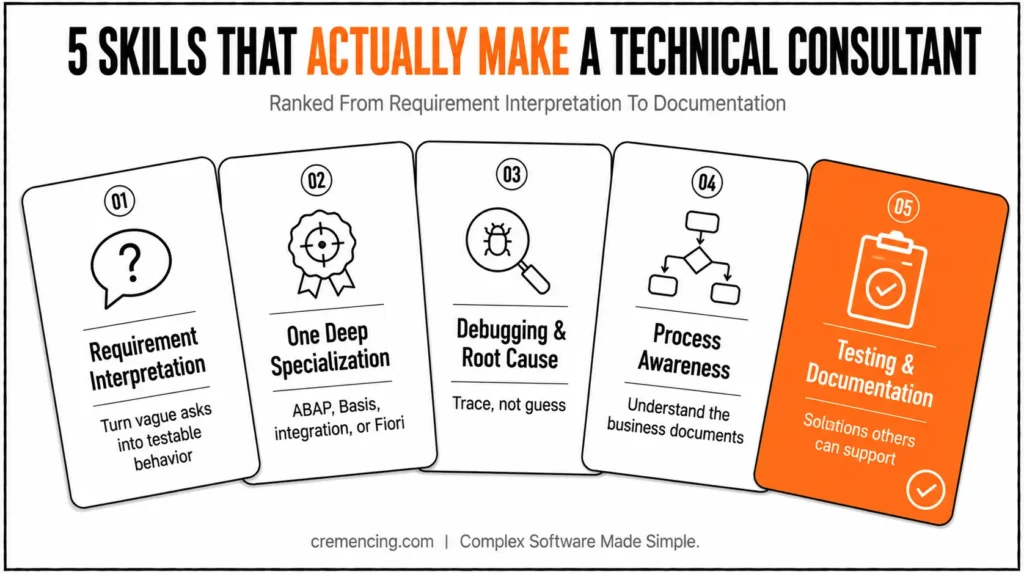
The first skill is requirement interpretation. You must turn phrases such as “show blocked orders” or “automate approval” into precise, testable behavior.
The second is one deep SAP technical specialization. Employers gain more value from strong ABAP, Basis, integration, Fiori, security, data, or BTP capability than from a shallow list of twenty product names.
The third is debugging and root-cause analysis. Production support requires reading the runtime context, tracing data, checking authorisations, following interface messages, and distinguishing configuration problems from code defects.
The fourth is process awareness. An SAP technical consultant does not need to configure every functional module but must understand the business documents, organizational structures, statuses, and controls affected by the solution.
The fifth is testing and documentation. A solution that only its author can operate creates future support costs.
For modern S/4HANA development, object-oriented ABAP, CDS, RAP, OData, Fiori concepts, released APIs, ADT, ATC, clean-core principles, and API-based integration increasingly matter.
SAP S/4HANA Private Edition 2025 FPS01 is documented as the February 2026 feature pack stack. Articles that stop at classical reports and user exits no longer describe the complete SAP development landscape.
Senior SAP technical consultant skills include estimation, solution architecture, security-by-design, performance engineering, data-migration strategy, code review, clean-core governance, stakeholder workshops, mentoring, and production root-cause analysis.
These skills determine whether a technically correct component fits the wider program. Most of the skills map directly to the SAP tools list technical teams are expected to know.
When to Use an SAP Technical Consultant vs. Alternatives
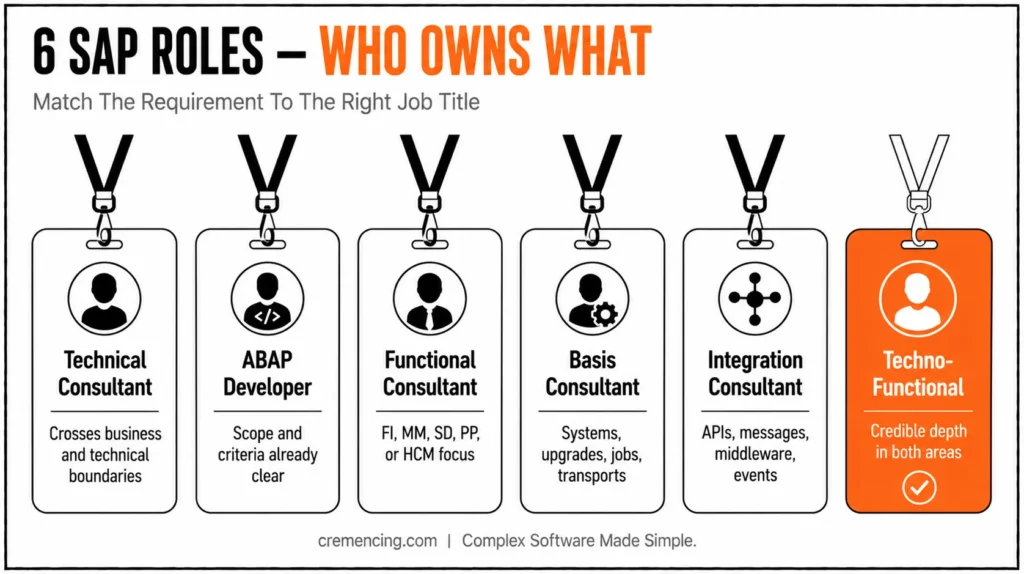
Use an SAP technical consultant when the requirement crosses business rules and technical implementation. This includes custom development, system integration, data migration, performance issues, technical upgrades, Fiori services, security-sensitive extensions, and production defects whose source is not yet clear.
| Role | Primary responsibility | Use this role when |
| SAP technical consultant | Connects requirements, design, build, testing, deployment, and support | The solution crosses business and technical boundaries |
| SAP ABAP developer | Implements approved ABAP designs | Scope, data sources, and acceptance criteria are already clear |
| SAP functional consultant | Designs processes and configures functional applications | The main requirement concerns FI, MM, SD, PP, HCM, or another business area |
| SAP Basis consultant | Operates and maintains the technical platform | The work concerns systems, upgrades, performance, jobs, transports, or availability |
| SAP integration consultant | Designs and operates interfaces | The main challenge involves APIs, messages, middleware, events, or connectivity |
| Techno-functional consultant | Combines process configuration and technical delivery | One person has credible depth in both area. |
Conclusion
An SAP technical consultant is not simply an ABAP programmer with a broader title. The role connects requirements, architecture, development, integration, security, testing, deployment, and support. Build deep expertise in one SAP technical track; learn the business processes around it, and add current S/4HANA skills such as CDS, RAP, released APIs, ATC, clean core, and SAP BTP where they fit your target role.
A pure ABAP developer is a good fit when the design, data source, acceptance criteria, and technical boundaries are already approved. A functional consultant should own process design and application configuration.A Basis administrator should own platform operations, while a specialist integration or security consultant should lead work requiring deep expertise in those domains. The SAP technical consultant coordinates with them rather than claiming ownership of every technical task.
The job title alone does not prove breadth. Some employers use “SAP technical consultant” as a synonym for “ABAP developer,” while others expect one person to cover development, interfaces, migration, testing, documentation, and support.
The SAP technical consultant role fits people who enjoy diagnosing unclear problems, discussing requirements, making design trade-offs, implementing or reviewing solutions, and supporting the result after go-live. Choose a narrower developer role when you prefer implementation depth with fewer client, estimation, process, and production-support responsibilities.
Frequently Asked Questions
Source note: Questions 1–4 were identified from SAP Community discussions, question 8 from Stack Overflow, and questions 5–7 from the search-intent research. The research interface could not independently capture Google’s live autocomplete feed, so an editor should verify those three exact phrasings before publication.
1. What Is the Difference Between an SAP Technical Consultant and a Functional Consultant?
A functional consultant designs business processes and configures SAP applications, while an SAP technical consultant builds, integrates, secures, tests, and supports the technical solution. Both need process awareness, but their primary deliverables differ: configuration and process design versus code, services, interfaces, technical controls, and deployment support.
2. What Is the Future of the SAP Technical Consultant Role?
The role is expanding rather than disappearing. Classic ABAP and Basis skills still support existing estates, while RAP, CDS, Fiori, released APIs, SAP BTP, Integration Suite, clean core, and AI-assisted development are increasing in importance. Consultants who combine technical depth with architecture and process knowledge remain valuable.
3. Should an ABAP Technical Consultant Learn MM or SD?
Yes, but aim for process understanding before full configuration depth. An SAP ABAP consultant supporting sales should understand sales documents, partners, pricing, delivery, billing, and status flow. That knowledge improves requirements, debugging, and testing without requiring the consultant to become the project’s SD configuration owner.
4. Which Career Options Are Available to an Experienced SAP Technical Person?
Experienced professionals can move into technical architecture, integration architecture, development leadership, Basis or cloud operations, security, data migration, BTP development, Fiori, performance engineering, clean-core governance, technical project management, or techno-functional consulting. The best move usually builds on existing depth rather than abandoning it completely.
5. What Does an SAP Technical Consultant Do Daily?
Daily work can include requirement discussions, technical design, coding or configuration, debugging, unit testing, code review, interface monitoring, transport preparation, defect resolution, and documentation. The exact balance depends on whether the consultant specializes in ABAP, Basis, integration, security, Fiori, BTP, data, or another SAP technical area.
6. What Skills Are Required for an SAP Technical Consultant?
The essential skills are requirement interpretation, one deep technical specialization, debugging, process awareness, testing, documentation, and communication. For modern S/4HANA roles, CDS, RAP, OData, Fiori, released APIs, ADT, ATC, clean-core principles, API integration, and SAP BTP can significantly improve employability.