
Passing a senior SAP S/4HANA interview is not about memorizing SAP S/4HANA interview questions or proving that you can define ACDOCA, Business Partner, Fiori, or Clean Core. Those definitions are only the starting point. The harder test is whether you can explain what changed, why SAP changed it, and what you would do when the change affects a real project.
That is where many experienced candidates lose ground. Although they know ECC, remember the classic tables, and can describe S/4HANA features, they may still struggle when an interviewer asks what happens during a conversion, how custom code should be analyzed, why MATDOC matters, or when a particular extensibility approach makes sense.
This collection focuses on those senior-level questions. It connects S/4HANA architecture, Finance, master data, Fiori, analytics, migration, Clean Core, and custom-code remediation to the decisions an experienced consultant is expected to explain.
Why SAP S/4HANA Interviews Have Changed
Senior SAP S/4HANA interview questions are no longer limited to basic definitions. Instead, interviewers increasingly test whether candidates can connect SAP S/4HANA concepts to real business and technical decisions.
They are judged on their ability to solve business and technical issues in a real business environment. Therefore, the following SAP S4 HANA interview questions are commonly asked when interviewing for:
- Senior SAP Consultants
- Solution Architects
- SAP Technical Leads
- SAP ABAP on HANA Developers
- S/4HANA Migration Consultants
Core SAP S/4HANA Interview Questions for Senior Consultants
1. What Is SAP S/4HANA and How Does It Differ From SAP ECC?
Answer
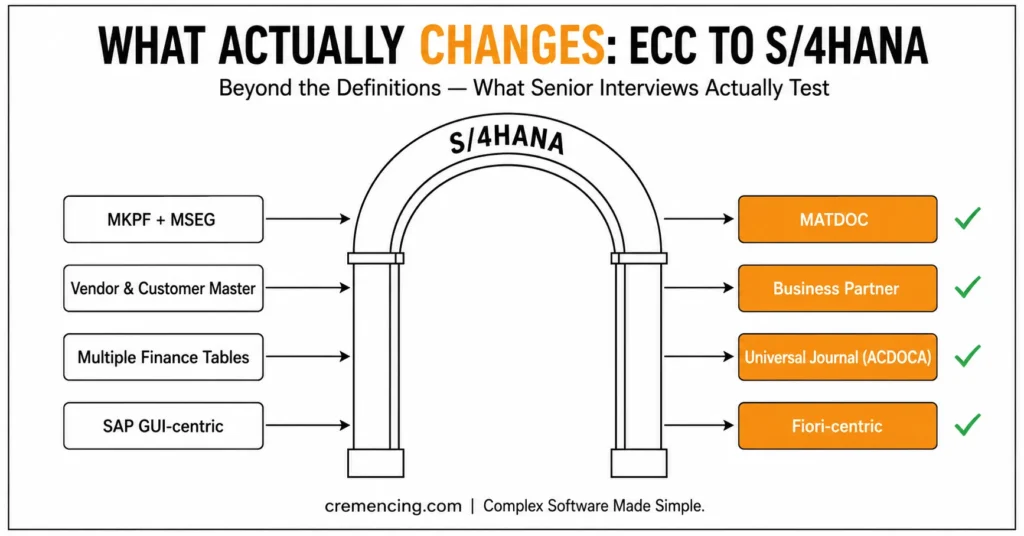
This is one of the most important SAP S/4HANA interview questions because it tests whether you understand the architectural and business differences between ECC and S/4HANA. SAP S/4HANA is SAP’s next-generation ERP suite designed specifically for the SAP HANA in-memory database.
Unlike SAP ECC, SAP S/4HANA introduces simplified data models in several application areas, reducing redundant persistence and enabling calculations or analytics directly on the HANA database. Examples include the Universal Journal in Finance and MATDOC in Inventory Management. If the interviewer moves from S/4HANA architecture into ABAP-specific scenarios, custom-code performance becomes another important senior-level topic, so reviewing ABAP performance tuning can help strengthen your preparation.
Major differences include:
| ECC | SAP S/4HANA |
| Multiple finance tables | Universal Journal (ACDOCA) |
| Vendor and Customer Master | Business Partner |
| MKPF + MSEG | MATDOC |
| SAP GUI-centric | Fiori-centric |
| Traditional reporting | Embedded Analytics |
Interviewers usually ask this question to check whether you understand the business value behind S/4HANA rather than simply listing features.
2. What is the Universal Journal (ACDOCA)?
Answer
The Universal Journal is one of the most important innovations in SAP S/4HANA Finance.
SAP S/4HANA consolidates many FI and CO line-item structures into the Universal Journal table ACDOCA. However, not every historical accounting table disappears; for example, BSEG and BKPF remain relevant.
Examples include:
- BSEG
- COEP
- FAGLFLEXA
- ANEP
SAP S/4HANA consolidates this information into ACDOCA.
Benefits include:
- Real-time reporting
- Reduced reconciliation effort
- Faster financial close
- Single source of truth
A senior-level answer should explain both the technical architecture and business benefits. If the interviewer moves from S/4HANA migration into ABAP-specific scenarios, custom-code performance becomes another important senior-level topic.
3. Why did SAP introduce the Business Partner approach?
Answer
SAP S/4HANA adopts the Business Partner model as the leading object for customer and supplier master data management. During conversion, customer and supplier records must be integrated with their corresponding Business Partners through Customer/Vendor Integration (CVI).
A business partner provides the following:
- Single master record
- Centralized maintenance
- Consistent integration
- Simplified master data governance
In migration projects, business partner conversion is often one of the most critical activities.
Senior interviewers frequently ask about CVI (Customer-Vendor Integration) challenges because many projects encounter data consistency issues during conversion.
4. What is MATDOC and why was it introduced?
Answer
MATDOC is the new inventory management table in SAP S/4HANA.
In ECC, inventory documents were spread across:
- MKPF
- MSEG
SAP simplified inventory management by introducing MATDOC.
Benefits include:
- Reduced table complexity
- Better performance
- Simplified reporting
- Improved analytics
Candidates should understand that MATDOC is part of SAP’s overall data model simplification strategy.
5. What are Simplification Items in SAP S/4HANA?
Answer
Simplification items identify functional and technical changes between ECC and SAP S/4HANA.
Examples include:
- Credit Management changes
- Business Partner adoption
- Material Ledger requirements
- Finance architecture changes
Before migration, organizations run simplification item checks to identify required remediation activities. Interviewers often ask this question when evaluating migration experience.
6. What is SAP Fiori, and why is it important?
Answer
SAP Fiori is SAP’s user experience and design system for business applications. In S/4HANA, Fiori apps can use technologies such as SAPUI5 and SAP Fiori elements and are commonly launched through the SAP Fiori Launchpad.
Advantages include:
- Mobile access
- Improved user experience
- Task-based navigation
- Embedded analytics
- Faster adoption
A strong answer should mention:
- Fiori Launchpad
- OData Services
- SAP Gateway
- CDS-based analytical applications
7. What is Embedded Analytics?
Answer
SAP S/4HANA Embedded Analytics provides operational analytics directly in the S/4HANA environment, using CDS-based Virtual Data Models and HANA processing. Users can access analytical and transactional applications through the Fiori launchpad without requiring separate data replication for many scenarios.
Traditional SAP environments often required the following:
- SAP BW
- Data extraction
- Separate reporting systems
Embedded analytics uses the following:
- CDS Views
- HANA processing
- Real-time operational data
This reduces reporting latency and provides live business insights.
8. How Do Greenfield and Brownfield Differ in SAP S4 HANA Interview Questions?
Answer
Greenfield means implementing SAP S/4HANA from scratch, whereas brownfield means converting an existing ECC system to SAP S/4HANA. In contrast, selective data transition combines elements of both approaches, allowing organizations to move specific data and processes. Therefore, in SAP S/4HANA interview questions focused on migration, candidates should explain when this hybrid approach makes sense.
Brownfield means converting an existing ECC system to SAP S/4HANA.
| Greenfield | Brownfield |
| New implementation | System conversion |
| Redesign processes | Retain processes |
| Longer deployment | Faster migration |
| Higher flexibility | Lower disruption |
A senior consultant should also mention selective data transition as a hybrid approach. If your interview focuses specifically on migration strategy, custom-code remediation, and project experience, prepare these ECC-to-S/4HANA scenarios separately.
9. What is Clean Core in SAP S/4HANA?
Answer
Clean Core is SAP’s recommendation to minimize modifications within the core ERP system.
Rather than modifying standard SAP objects, organizations should instead consider the following extension options:
- Key User Extensibility
- Developer Extensibility
- SAP BTP Extensions
- Side-by-Side Development
The goal is to reduce upgrade effort and maintain compatibility with future SAP releases. This topic appears frequently in current SAP S/4HANA interviews.
10. What is SAP Activate Methodology?
Answer
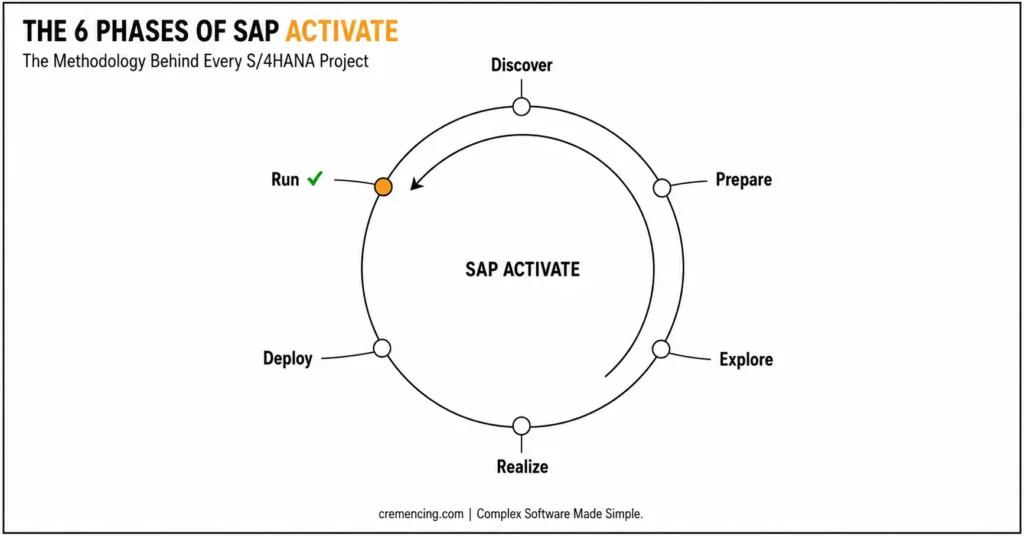
SAP Activate is SAP’s implementation methodology for SAP S/4HANA projects. It provides a structured approach to planning, configuring, deploying, and operating SAP solutions. The methodology includes the following phases:
- Discover
- Prepare
- Explore
- Realize
- Deploy
- Run
Senior consultants should also explain how Fit-to-Standard workshops are used during the Explore phase. Furthermore, these workshops help teams evaluate standard SAP processes and reduce unnecessary customizations.
11. How would you approach custom code remediation during an S/4HANA conversion?
Answer
“A strong custom-code remediation approach starts by establishing the migration scope and analyzing custom-code usage and S/4HANA compatibility. ATC with S/4HANA readiness checks is a key technical analysis mechanism, complemented by Simplification Items and SAP’s custom code migration capabilities.
ATC identifies:
- Obsolete tables
- Compatibility issues
- Simplification impacts
- HANA readiness problems
Next, prioritize findings based on business impact.
Finally, replace direct database access with supported S/4HANA objects where required. In addition, a strong answer should mention ATC, Simplification Database, and custom code migration apps.
| Senior interview topic | Weak answer | A strong answer should include |
|---|---|---|
| ACDOCA | “It replaces finance tables.” | Explain Universal Journal, FI/CO integration, and remaining tables such as BSEG/BKPF |
| MATDOC | “It is the new MSEG.” | Explain the simplified MM-IM model and compatibility views |
| Business Partner | “BP replaces vendors/customers.” | Explain BP as leading object and CVI |
| Fiori | “Fiori is a GUI replacement.” | Explain UX, launchpad, app technologies, OData and architecture |
| Clean Core | “Don’t modify SAP.” | Explain extension models and lifecycle implications |
| Custom code | “Run ATC and fix errors.” | Explain usage, Simplification Items, prioritization and redesign |
| Migration | “Brownfield is faster.” | Explain business, data, custom code, and process trade-offs |
| Analytics | “S/4HANA is real-time.” | Explain CDS/VDM, embedded analytics and when replication is still needed |
12. What are the biggest challenges during business partner conversion?
Answer
Common challenges include:
- Duplicate master records
- Inconsistent customer/vendor mappings
- Missing mandatory BP attributes
- CVI synchronization failures
Successful projects begin with data cleansing long before conversion starts.
Senior consultants who have completed migrations often discuss governance and data ownership during this answer. A senior consultant should also understand the practical decisions involved in each migration path; therefore, reviewing ECC-to-S/4HANA interview scenarios can help you prepare for deeper migration questions.
Conclusion
Senior SAP S/4HANA interviews are no longer won by memorizing isolated definitions. The stronger candidate is the one who can connect a technical change to a project decision.
If an interviewer asks about ACDOCA, explain what changed in the finance data model and what remains. When the discussion shifts to Business Partner, focus on CVI and its conversion implications. For Clean Core, explain how you would choose between in-app, developer, and side-by-side extensibility. When custom code comes up, go beyond ATC by explaining how you would prioritize findings, usage, simplification items, and redesign.
The current interview questions in SAP S4HANA are more about practical experience and less about definitions from textbooks. Senior candidates should know about migration strategies, clean core principles, business partner conversion, extensibility options, embedded analytics, and ABAP on HANA development techniques. SAP S4 HANA Interview Questions: Proven Answers.
For positions like an architect, technical lead, or senior consultant, focus on getting ready for scenarios rather than memorizing facts. Knowing the “how and why” of an organization’s decision to use SAP S/4HANA and how they can overcome the issues that accompany it will set you apart from candidates who just know the theory.
Frequently Asked Questions
1. What is the difference between SAP ECC and SAP S/4HANA?
SAP S/4HANA uses a simplified data model and runs exclusively on the SAP HANA database. Unlike ECC, it introduces innovations such as the Universal Journal, the business partner approach, embedded analytics, and SAP Fiori. This is one of the most common SAP S4 HANA interview questions for experienced candidates.
2. What are the most important SAP S/4HANA tables to know for interviews?
Senior candidates should be familiar with:
- ACDOCA (Universal Journal)
- MATDOC (Inventory Documents)
- BUT000 (Business Partner)
- BKPF (Accounting Document Header)
- BSEG (Accounting Document Segment)
- MARA (Material Master)
Interviewers often use these tables to assess practical project experience
3. What distinguishes selective data transition, Brownfield, and greenfield?
Greenfield calls for an entirely new implementation. Brownfield maintains current configurations while converting an ECC system into SAP S/4HANA. By combining aspects of both strategies, Selective Data Transition enables businesses to move specific data and procedures.
4. Why does SAP S/4HANA require a business partner?
SAP implemented a single Business Partner model in place of distinct customer and vendor master records. This facilitates integration, enhances master data governance, and supports contemporary business procedures. During SAP S4 HANA interview Q&A sessions, business partner conversion is frequently covered.
5. What are ATC checks in SAP S/4HANA conversion projects?
ABAP Test Cockpit (ATC) checks analyze custom code for compatibility issues before migration. ATC identifies obsolete objects, direct database access problems, and simplification item impacts. It is one of the most important tools used during S/4HANA conversion projects.
6. What ABAP skills are most important for SAP S/4HANA interviews?
Organizations increasingly look for experience with:
- CDS Views
- AMDP
- Open SQL Enhancements
- RAP Framework
- Eclipse ADT
- OData Services
- Code Pushdown
These topics appear frequently in ABAP S4 HANA interview questions.
7. What is the difference between SAP S/4HANA Public Cloud and Private Cloud in an interview?
Public Edition follows a more restrictive cloud development model and emphasizes ABAP Cloud and released APIs. Private Edition provides greater compatibility with traditional SAP technologies, although clean-core principles still influence extension decisions. Always state which deployment model you are discussing.
8. Why are CDS views important in SAP S/4HANA interviews?
CDS views provide semantic data models used extensively for analytics, application development, and service scenarios. A senior answer should explain not only what CDS is, but when to use a standard CDS view, when to extend one, and when another architecture such as RAP is appropriate.