Here’s the direct answer to what separates a senior candidate from a mid-level one in ABAP S/4HANA interview questions: it isn’t knowing more terms, it’s knowing which tool to reach for first and being able to defend that choice under pushback. Many ABAP S4HANA interview questions still begin with internal tables, ALV, BAPIs, and elementary CDS definitions.
Those topics matter, but they don’t show whether you can make safe decisions in a current S/4HANA project.
A senior interview usually moves quickly toward simplified data models, released APIs, clean core, RAP, ATC findings, and evidence-based performance work — and the candidates who struggle aren’t the ones who don’t know these concepts, they’re the ones who can’t connect a concept to a project decision.
This guide targets developers with roughly three or more years of ABAP experience, and its ABAP S4HANA interview questions focus on decisions you can defend. It covers SAP S/4HANA 2022–2025 for private edition and on-premise systems while calling out ABAP Cloud restrictions where they change the answer.
Modernizing ABAP S/4HANA Codebases
Evaluating senior ABAP developers requires assessing architectural choice over syntax knowledge, particularly regarding SAP S/4HANA migration patterns and extension models.
Experienced engineers prioritize released APIs, virtual data models built with Core Data Services (CDS) view entities, and the ABAP RESTful Application Programming Model (RAP) over legacy ABAP patterns.
Understanding these architectural components enables developers to enforce Clean Core principles, preventing technical debt during system upgrades.
Furthermore, senior candidates utilize tools such as the ABAP Test Cockpit (ATC) and SQL Monitor to analyze runtime execution paths, verify database behavior, and fix performance bottlenecks based on empirical system trace data.
What Advanced ABAP S/4HANA Interview Questions Test
Advanced ABAP S4HANA interview questions are not about memorizing facts; they are about applying them. An interviewer would like to know how you select an approach, what kinds of assumptions you test, what risk you cannot take, and how you demonstrate that the outcome is correct.
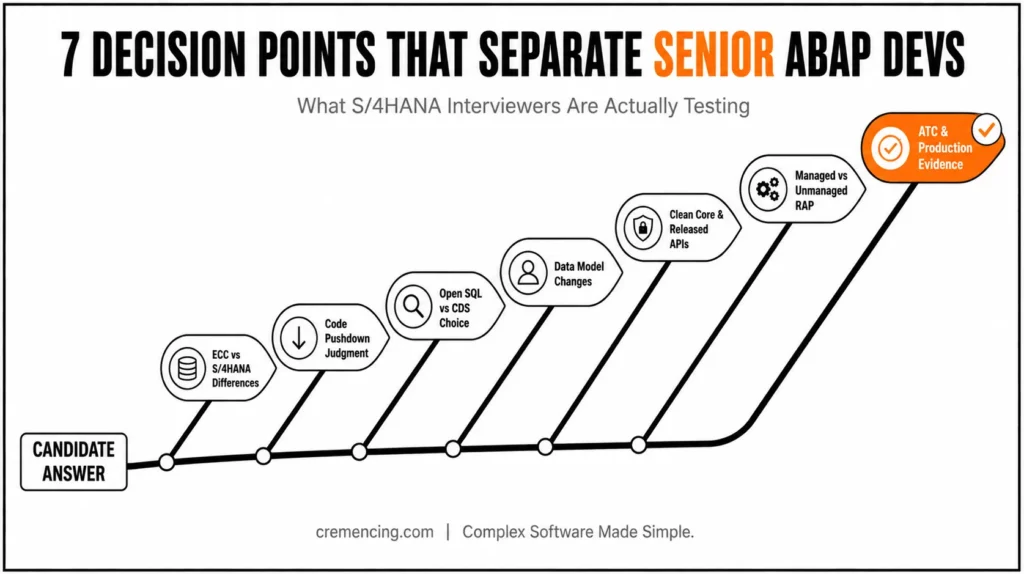
In the case of ABAP S4HANA interview questions, a good answer goes in four steps: definition, selection criteria, project example, and limitation. This is a distinction made between an experienced developer and a guy who has memorized some definitions.
1. In ABAP S/4HANA Interview Questions: How Is S/4HANA ABAP Different from Classic ECC ABAP?
The bad answer to ABAP S4HANA interview questions is “S/4HANA runs on HANA, so ABAP is faster.” The better answer is to answer the question in a way that explains the role of a HANA-only database platform, the simplified application data model, the increased importance of virtual data models based on CDS, the modern service development, and the more limited choice of extensions.
Classic ABAP code may still compile after conversion, yet direct reads from changed tables can return incomplete data, compatibility views can hide redesign work, and old enhancement techniques can create upgrade risk. Good ABAP S4HANA interview questions, therefore, test whether you inspect simplification items, released interfaces, and actual SQL behavior before changing code.
2.ABAP S/4HANA Interview Questions on Code Pushdown: When Is It the Wrong Choice?
Code pushdown means moving filtering, aggregation, joins, and calculations closer to SAP HANA instead of transferring large datasets to the ABAP application server. Open SQL, CDS view entities, table functions, and AMDP can all support this goal at different levels.
Pushdown becomes a poor choice when the dataset is already small, the logic depends heavily on ABAP-only APIs, or SQLScript would make a simple rule harder to maintain and test. A good answer to ABAP S4HANA interview questions starts with measurable cost: database time, transferred rows, repeated executions, and execution plan—not a blanket rule to move everything into HANA.
3.ABAP S/4HANA Interview Questions: When Should Open SQL Remain the First Choice?
Use Open SQL when it can express the required joins, filters, aggregations, and calculations clearly. It keeps database access inside the ABAP language, benefits from static checks, and avoids database-specific SQLScript.
Move toward CDS when the data model should be reusable, semantically annotated, authorized through DCL, or exposed through analytical and service layers. Consider AMDP only when Open SQL and CDS cannot express a proven performance-critical requirement clearly.
4. ABAP S/4HANA Interview Questions: What Changed in the S/4HANA Data Model?
For these ABAP S4HANA interview questions, an experienced answer names both the principle and examples. S/4HANA removes aggregates and redundant index tables in several areas, introduces structures such as ACDOCA and MATDOC, and uses Business Partner as a central object in customer and supplier integration.
The interviewer’s real question is whether you will search for a supported successor before rebuilding old logic. Directly replacing one ECC table with another table is often weaker than consuming a released CDS view, business API, or application service designed for the current model.
How S/4HANA ABAP Works: The Architecture Behind ABAP S/4HANA Interview Questions
The hardest ABAP S4HANA interview questions connect four layers: data modeling, business behavior, service exposure, and extension governance. You need to explain how those layers cooperate, not discuss CDS, RAP, and clean core as unrelated terms.
CDS View Entities and the Virtual Data Model in ABAP S/4HANA Interview Questions
For ABAP S/4HANA interview questions on the virtual data model, start here: a CDS view entity defines a reusable data model over tables or other CDS entities. It supports associations, expressions, annotations, and semantic information, and SAP identifies view entities as the successor to DDIC-based CDS views.
When ABAP S4HANA interview questions cover CDS, distinguish an association from a join. A join fixes the relationship into the current query, while an association defines a reusable relationship that a consumer can follow when needed; the generated SQL still depends on how the association is consumed.
Also distinguish CDS authorization from program authorization. DCL can restrict rows when a protected CDS entity is consumed under normal authorization handling, but it doesn’t remove the need to design business authorizations, test access paths, and understand privileged-access exceptions.
Clean core and released APIs
A clean core means keeping custom extensions away from unstable SAP internals so upgrades require fewer repairs. For SAP S/4HANA 2022 and later, private-edition and on-premise customers can use ABAP Cloud alongside classic ABAP, although existing custom code and gaps in released APIs often require a controlled coexistence model.
A strong response to ABAP S4HANA interview questions explains how you check an object’s API state in ABAP Development Tools, search SAP Business Accelerator Hub or released objects, and prefer a released CDS entity, class, interface, BAdI, or service. You don’t assume that an object is safe because its name starts with “I_” or because it worked in the last release.
When no released API exists, document the gap and evaluate an approved wrapper, a classic extension in a controlled package, an SAP request for API enablement, or a side-by-side service. The correct choice depends on release, lifecycle, transaction boundaries, performance, and supportability.
RAP business objects and transaction handling
RAP provides the architecture for transactional Fiori applications, OData services, and Web APIs using CDS data models, behavior definitions, implementations, and service bindings. SAP positions RAP as part of ABAP Cloud and supports it across S/4HANA, S/4HANA Cloud, and the SAP BTP ABAP environment, subject to product and release scope.
Managed RAP lets the framework handle standard persistence, transactional buffering, and save sequencing. Unmanaged RAP makes the developer implement essential transactional behaviour and suits scenarios that must integrate existing business logic.
ABAP S4HANA interview questions often ask why a legacy API that executes COMMIT WORK can cause trouble inside RAP. RAP owns the logical unit of work and save sequence, so a nested commit can persist partial changes before validations or other business objects finish.
A sound design uses RAP behaviour, EML, a transactional API without internal commits, or a controlled asynchronous boundary. RAP behaviour definitions build directly on object-oriented concepts; if classes, interfaces, and encapsulation feel shaky, brush up with our OOP ABAP interview questions guide before tackling RAP.
ATC, custom-code adaptation, and production evidence
Among the ABAP S/4HANA interview questions on tooling, ATC often comes up: the ABAP Test Cockpit checks repository objects for areas such as syntax, security, performance, naming, and S/4HANA simplification impacts. During migration, ATC identifies critical use of simplified SAP objects and helps teams plan code adaptation.
Don’t say, “We fix all ATC findings in order.” Prioritize syntax and functional blockers, writes to changed data models, high-usage objects, security findings, and expensive SQL paths; then handle low-risk style findings according to project policy.
For performance, name the tool and the evidence it produces. ST05 traces SQL for a controlled execution, SAT measures ABAP runtime, and SQL Monitor collects productive SQL usage so you can identify statements that execute often or process excessive rows.
SAP’s ADT SQL Monitor view supports threshold-based identification of statements that need analysis.
Practical Code Walkthrough for ABAP S/4HANA Interview Questions
The best ABAP S4HANA interview questions ask you to read or improve code, and strong ABAP S4HANA interview questions expect verification rather than guesswork. Explain the defect first, show the corrected pattern, and state how you would verify it in the target system.
Scenario 1: Replace direct table assumptions with a released CDS entity
Suppose a report reads sales-order items and the project follows clean-core rules. Start by checking the API state and field availability for the target release; I_SalesOrderItem is documented as a released CDS view with keys SalesOrder and SalesOrderItem.
PARAMETERS p_vbeln TYPE vbeln_va.
” Use a released S/4HANA interface view instead of a private table contract
SELECT FROM I_SalesOrderItem
FIELDS SalesOrder,
SalesOrderItem,
Material,
RequestedQuantity
WHERE SalesOrder = @p_vbeln
INTO TABLE @DATA(lt_items). ” S/4HANA 1909+ required
IF lt_items IS INITIAL.
MESSAGE ‘No sales-order items found’ TYPE ‘S’.
ENDIF.
The important interview point isn’t the inline declaration. It is the dependency decision: you consume a released interface and verify its supported capabilities, authorizations, deprecations, and release state instead of treating an SAP table as a permanent API.
Scenario 2: Avoid a SELECT inside a loop
Many ABAP S4HANA interview questions show one header list followed by one database read per row. The defect is repeated round trips and repeated parsing or execution overhead, not the LOOP statement by itself.
TYPES ty_sales_order_range TYPE RANGE OF vbeln_va.
DATA lt_sales_orders TYPE ty_sales_order_range.
” Build one range so the database receives one set-oriented request
lt_sales_orders = VALUE #(
( sign = ‘I’ option = ‘EQ’ low = ‘0000004711’ )
( sign = ‘I’ option = ‘EQ’ low = ‘0000004712’ )
).
SELECT FROM I_SalesOrderItem
FIELDS SalesOrder,
SalesOrderItem,
Material,
RequestedQuantity
WHERE SalesOrder IN @lt_sales_orders
INTO TABLE @DATA(lt_order_items). ” S/4HANA 1909+ required
Don’t promise that the second version is always faster. Run a representative trace, compare execution count and transferred rows, inspect indexes or access paths, and check whether the selected columns and filters match the business need.
Scenario 3: Model reusable data with a CDS view entity
Use a CDS view entity when several consumers need the same business projection or semantic model. The following example creates a small projection over a released sales-order item interface.
@EndUserText.label: ‘Sales Order Item Interview View’
@AccessControl.authorizationCheck: #CHECK
define view entity ZI_SalesOrderItemInterview
as select from I_SalesOrderItem
{
key SalesOrder,
key SalesOrderItem,
Material,
RequestedQuantity,
SalesOrderItemCategory
}
The code is only one part of the answer. You should also explain the DCL strategy, naming and package rules, whether consumers need a projection layer, and whether the base interface is released for the intended use in the target release.
Scenario 4: Define RAP behavior instead of coding a free-form save
In RAP-focused ABAP S4HANA interview questions, the following behavior definition shows the shape of a managed RAP object. The custom table and entity names are placeholders for project objects, but the pattern demonstrates framework-owned CRUD and an explicit business action.
managed implementation in class zbp_i_interview unique;
strict ( 2 ); ” S/4HANA 2022+ project pattern
define behavior for ZI_InterviewQuestion alias InterviewQuestion
persistent table zint_question
lock master
authorization master ( instance )
{
create;
update;
delete;
field ( readonly ) QuestionUUID;
action markReviewed result [1] $self;
mapping for zint_question
{
QuestionUUID = question_uuid;
QuestionText = question_text;
ReviewStatus = review_status;
}
}
A strong interview answer adds that validations protect consistency, determinations derive values, actions represent business operations, and the save sequence remains under RAP control. Don’t insert an explicit commit into an action handler just because a classic function module once required it.
Scenario 5: Explain when AMDP is justified
AMDP lets an ABAP class contain SQLScript that runs as a database procedure on SAP HANA. SAP describes it as an optimization pattern and notes that ADT provides the editing environment.
In ABAP S4HANA interview questions, say that AMDP is not the default for every calculation. Use it after traces show a database-intensive operation that Open SQL or CDS cannot express adequately, and account for SQLScript skills, HANA dependency, debugging, authorization, testing, and clean-core release contracts.
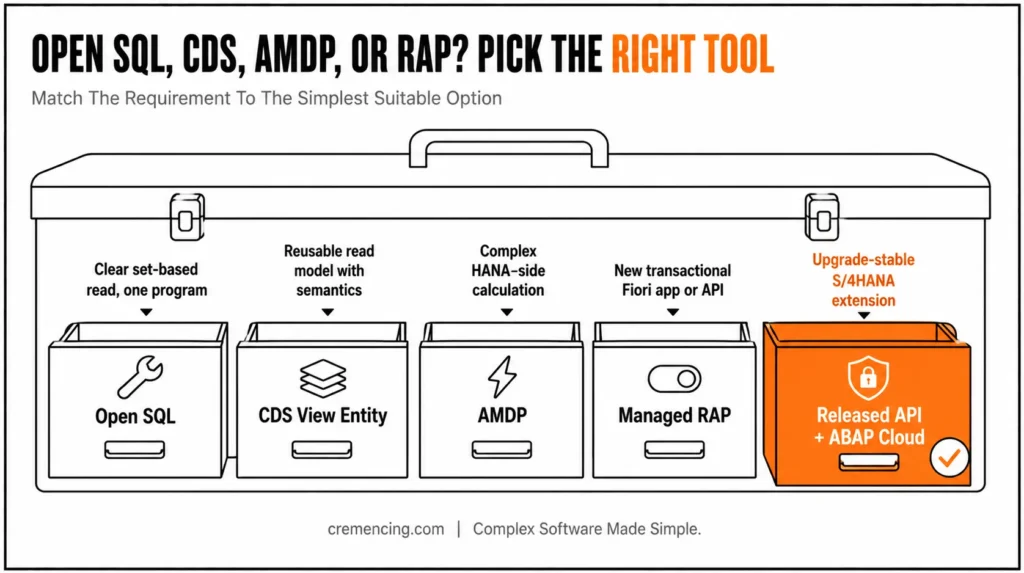
- Small, well-defined read → Open SQL
- Reusable, semantically annotated model needed by multiple consumers → CDS view entity
- Proven, HANA-intensive calculation Open SQL/CDS can’t express → AMDP
- New transactional Fiori app or API, framework can own persistence → Managed RAP
- Existing business logic must remain source of truth → Unmanaged RAP
- No released API covers the need → document the gap, evaluate a wrapper or side-by-side service
When to Use Each S/4HANA Development Option: A Framework for ABAP S/4HANA Interview Questions
In these ABAP S/4HANA interview questions, candidates often lose points by naming the most modern tool instead of the simplest suitable tool. Use the following comparison to structure answers to ABAP S4HANA interview questions.
| Requirement | Preferred starting point | Use an alternative when | Main risk to mention |
| Clear set-based read for one program | Open SQL | Several consumers need one semantic model | Repeated or over-broad reads |
| Reusable read model with semantics | CDS view entity | Logic can’t be expressed in CDS | Layering and authorization mistakes |
| Complex HANA-side calculation | AMDP or CDS table function | Open SQL or CDS already meets the need | SQLScript dependency and harder testing |
| New transactional Fiori app or API | Managed RAP | Existing transactional logic must be integrated | Misunderstanding the save sequence |
| Wrap complex legacy behaviour | Unmanaged RAP | Standard managed persistence is sufficient | Too much custom transaction code |
| Upgrade-stable S/4HANA extension | Released API with ABAP Cloud | No released API covers the requirement | Dependency on SAP internals |
| Conversion impact analysis | ATC plus simplification content | Planning-level scope is still unclear | Treating every finding as equal |
Open SQL versus CDS, ask who owns the model and how many consumers need it. For managed versus unmanaged RAP, ask whether the framework can own persistence or whether existing behavior must remain the source of truth.
Extension Architecture
On-stack versus side-by-side extensions, ask about transaction consistency, latency, data volume, lifecycle, user experience, and released API availability. A side-by-side design isn’t automatically cleaner if it copies large datasets or breaks a transaction that must remain atomic.
For performance, choose tools after defining the symptom. Use transaction ST05, which records SQL trace data for a controlled execution, when you need statement-level database evidence. Use transaction SAT, which performs ABAP runtime analysis, when application-server processing may dominate. SAP S4 HANA Interview Questions Proven Answers.
The decision-first style is what experienced ABAP developers should show in their S/4HANA interview questions. It also allows you to have an answer when the interview changes the question in the middle of the conversation.
Conclusion
The best ABAP S/4HANA interview questions are not just about syntax, CDS terms, or HANA concepts. Interviewers seek to determine if you can be technically correct while working within a project’s limitations, such as release dates, simplifying data models, clean core needs, available APIs, transaction boundaries, performance requirements, and upgrade risk.
Be ready to describe how you would choose a released CDS view or business API to use, how you would choose between classic ABAP and ABAP Cloud, managed or unmanaged RAP behaviour, and your response if you did not find a released interface that fits the need.
It is also important to be prepared to talk about migration of custom code, ATC results and compatibility views, obsolete table access, and tools like ST05, SAT, and SQL Monitor for analyzing performance. It’s not enough to have a definition; a good answer relates the concept to a genuine requirement, a design decision, and a known limitation.
In the interview, start with a direct answer and then mention the following assumptions for the SAP S/4HANA release and deployment that you are considering and that impact your decision.
Describe why you chose one approach rather than the other, and identify technical risks, and describe how you would test functionality, authorization behavior, transaction consistency, and runtime performance.
This is a mode that shows that you can not just repeat ABAP interview questions & answers, but you can also use modern ABAP knowledge for decisions that are still supportable, measurable, and upgrade-safe in an actual SAP landscape.
Frequently Asked Questions
1. What is the difference between SAP Readiness Check and ATC?
SAP Readiness Check gives planning-level visibility into conversion impact, while ATC performs detailed custom-code checks against repository objects. For S/4HANA custom code migration, use Readiness Check to estimate scope and ATC to identify actionable findings, affected objects, and remediation work.
2. What is the difference between managed and unmanaged RAP?
Managed RAP delegates standard persistence and much of the transaction lifecycle to the framework. Unmanaged RAP requires the developer to implement core behaviour and is useful when RAP must integrate established business logic; this distinction appears frequently in RAP interview questions.
3. What should developers do when no released SAP API exists?
Don’t access an internal object without review. For clean-core ABAP development, assess an approved wrapper, a controlled classic extension, a side-by-side implementation, or an API enablement request, then record the lifecycle risk and apply ATC governance.
4. Can ADT Quick Fixes automate S/4HANA code adaptation?
ADT Quick Fixes can automate or semi-automate supported adaptation patterns, but they don’t replace functional review and regression testing. SAP Community documentation lists prerequisites and supported findings, so confirm your S/4HANA release and ADT version before planning mass remediation.
5. What is the difference between ABAP on HANA and S/4HANA ABAP?
ABAP on HANA is ABAP development optimized for the SAP HANA database. However, it is wider than the database-based SAP ABAP on HANA interview questions with the S/4HANA application model, simplifications, VDM, released APIs, RAP, and extension rules.
6. Does an S/4HANA ABAP developer need to have the RAP certification?
It is not required to use RAP for all maintenance tasks, reports, or classic applications in an on-premise system. It is, however, a fundamental model for any new transactional services and Fiori applications in ABAP Cloud, and new ABAP S4HANA interview questions are testing RAP architecture more and more.
7. What is a compatibility view, and why does it matter in S/4HANA migration?
A compatibility view lets classic ABAP code that reads an old ECC table structure continue to work after conversion, even though the underlying data has moved to a simplified table. It matters because compatibility views can mask the fact that a proper redesign toward the new data model hasn’t actually happened yet.
What is a simplification item, and how does it relate to ATC?
A simplification item documents a specific functional or technical change introduced in S/4HANA that can affect existing custom code or configuration. ATC checks can flag custom code that touches an area covered by a simplification item, helping teams prioritize what needs review before or during conversion.
How should a candidate answer a question about SQL Monitor versus ST05?
ST05 captures a detailed SQL trace for one controlled execution, making it useful for debugging a specific known scenario. SQL Monitor, by contrast, collects aggregated productive SQL usage over time across the system, which makes it better suited to finding statements that run frequently or process excessive rows in real production usage.
Why do interviewers ask about EML (Entity Manipulation Language) in RAP-focused ABAP S/4HANA interview questions?
EML is the ABAP syntax used to interact with RAP business objects — reading, creating, updating, and triggering actions — in a way that respects the framework’s transactional boundaries. Interviewers ask about it because using EML correctly, rather than bypassing it with direct table access, is central to keeping a RAP-based application upgrade-stable.
References
ABAP RESTful Application Programming Model