

Introduction
The issue with most SAP RISE projects isn’t technology — it’s unclear SAP RISE roles responsibilities. Teams overlap. Responsibilities are assumed, not defined. Nothing gets decided because no one owns it.The issue with SAP RISE projects is less about the technology and more about roles being unclear. Teams overlap. Responsibilities are assumed, not defined. Nothing gets decided because no one owns it.
However, the result is missed deadlines, budget overruns, and permanent chaos across business, IT, and implementation partners. Although SAP RISE is touted as the model of transformation made simpler, it can get convoluted without precise roles and responsibilities.
This is why understanding who does what, SAP, partners, and the rest of your team is so critical. In fact, SAP RISE roles and responsibilities are critical for project success. As a result, they help prevent misalignment, reduce confusion, and ensure a smooth implementation process.
In this blog, we will be covering the required SAP RISE role and responsibilities, the coordination between them, and how that structure is going to help your project be easier to deliver with less returns in a quick amount of time.
Rising Enterprise Demand for Applied Cloud Architecture
Recent industry analyses show that active SAP S/4HANA migrations increased sharply to 40% of enterprises. Meanwhile, 58% of organizations now adopt private cloud architectures to manage modern enterprise workloads. Consequently, SAP architectural roles continue to expand year-over-year as enterprises actively prioritize applied integration capabilities. Industry data further indicates that vendor-certified SAP experts earn a 15% to 30% premium over non-certified peers.
What Are SAP RISE Roles & Responsibilities?
SAP RISE roles and responsibilities outline the distribution of work, ownership, and decision-making among all stakeholders in an SAP transformation project.
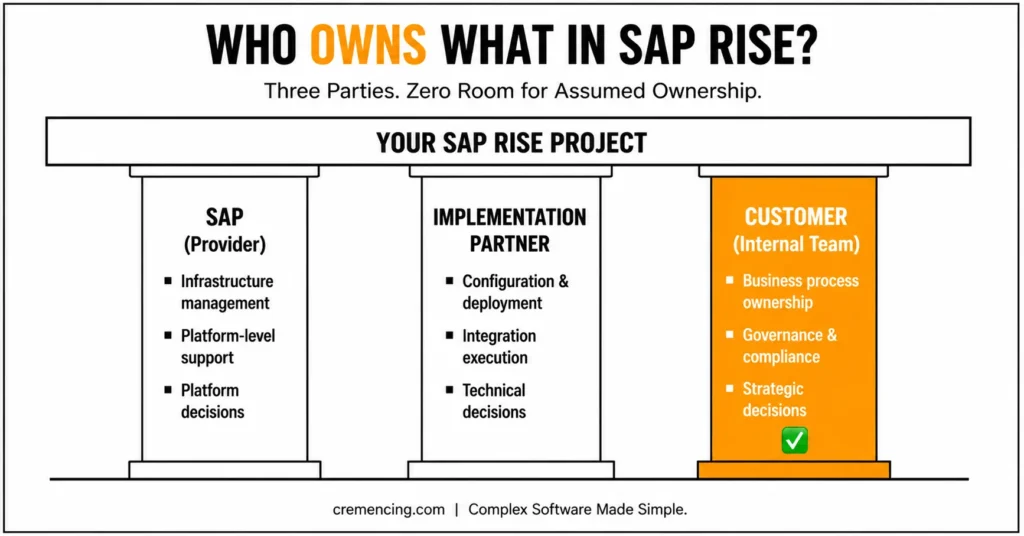
Moreover, a traditional SAP RISE model encompasses three distinct stakeholder groups:
- SAP (as the service provider)
- Implementation partner
- Customer (your internal team)
Groups have separate responsibilities over:
- Infrastructure management
- Application support
- Business process design
- Integration and customization
- Security and compliance
When there is no clarity around roles, then these responsibilities tend to overlap, resulting in the following:
- Delays in issue resolution
- Confusion in ownership
- Increased project risk
As a result, the framework brings accountability, dials down decision-making time, and eases execution. For more insights, read our blog on SAP Basis Roles
| Area | SAP (Provider) | Implementation Partner | Customer (Internal Team) |
|---|---|---|---|
| Infrastructure Management | Owns and maintains | Not involved | Not involved |
| Application Support | Platform-level support | Configuration-level support | Business-level support |
| Business Process Design | Not involved | Advises and configures | Owns and decides |
| Integration & Customization | Provides platform tools | Executes integration/customization | Approves and validates |
| Security & Compliance | Infrastructure security | Application-level security setup | Governance and compliance ownership |
| Decision-Making | Platform-related decisions | Technical/configuration decisions | Business and strategic decisions |
Step-by-Step Guide on How SAP RISE Roles and Responsibilities Work
Step 1 — Determine Ownership with All Stakeholders
Begin by clearly delineating responsibilities across:
- SAP (cloud infrastructure, platform services)
- Implementation partner (configuration, deployment, customization)
- Internal team (mode of operations, such as business process, approvals, governance)
Additionally, it forms a basis for accountability.
Step 2 — Implement a RACI Matrix
Use a RACI model to define:
- Responsible — who executes tasks
- Accountable — who owns outcomes
- Consulted — who provides input
- Informed — who needs updates
This removes ambiguity in decision-making.
Step 3 — Align the Roles of Business and IT
Ensure alignment between:
- Business stakeholders (process owners, finance, operations)
- IT teams (integration, security, architecture)
Misalignment at this level is one of the key causes of project delays.
Step 4 — Specify SAP vs Partner Responsibilities
Clearly delineate what SAP does and what your implementation partner will do.
Typical split:
- SAP: infrastructure, uptime, platform services
- Partner: configuration, customization, integration
This prevents gaps and overlaps.
Step 5 — Define Governance and Escalation Streams
Define:
- Decision-making hierarchy
- Escalation channels
- Approval workflows
It also ensures that issues can be resolved quickly without any bottlenecks.
Step 6 — Track and Modify Roles Throughout the Project
Roles are not static.
As the project evolves:
- Adjust responsibilities based on progress
- Reassign ownership where needed
- Ensure accountability remains clear
Finally, this ensures project agility and adaptability.
Value Proposition and Return on Investment of Well-Defined SAP RISE Roles
Establishing SAP RISE roles and responsibilities is more than a planning step; consequently
It will impact the project outcome
Key Benefits
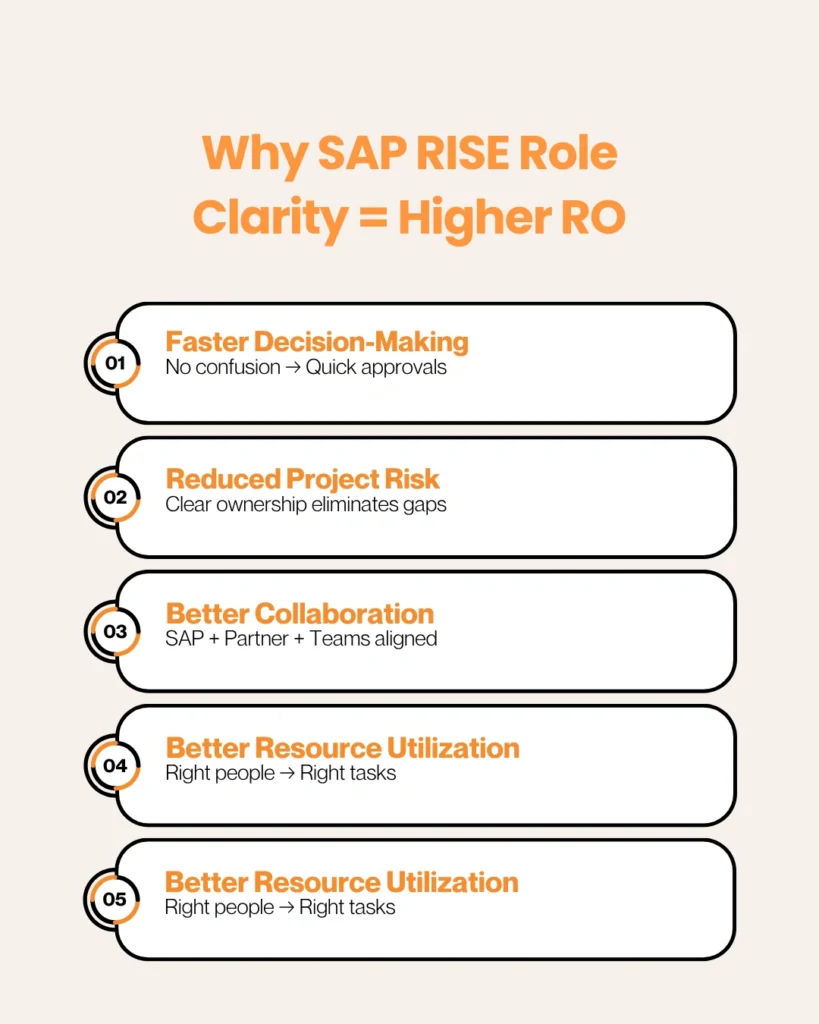
- Faster decision-making
- Well-defined ownership minimizes approval and implementation lag
- Reduced project risks
- Eliminates confusion and missed responsibilities
- Improved collaboration
- Aligns SAP, partners, and internal teams
- Better resource utilization
- Ensures appropriate people do appropriate tasks
- Higher project transparency
So there is no confusion, everyone knows their role and expectations
ROI Impact
- Decrease project delays by 30%
- Improve delivery timelines by 20–25%
- Lower rework and miscommunication costs
- Increase overall project success rates
These enhancements can lead to substantial cost savings with a more rapid at-scale return on investment (ROI) for extensive SAP transformations.
Mistakes to Avoid in Planning Your SAP RISE Role
Projects fail even if they are planned as well as possible due to unclear and ill-managed roles.
Mistake #1: Thinking SAP Does It All
SAP controls the infrastructure, not your business processes or customizations.
Mistake #2: Undefined Internal Ownership
When there are no clear internal roles, decision-making is delayed, and accountability disappears.
Mistake #3: Overlapping Responsibilities
Confusion rises when multiple teams handle similar tasks.
Mistake #4: No Governance Structure
Decisions are bottlenecked with a lack of hierarchy.
Mistake #5: Ignoring Role Evolution
What did they learn about roles evolving through the project?
Best Practices
- Define roles before project kickoff
- Use a RACI matrix for clarity
- Document responsibilities clearly
- Review and update roles regularly
- Ensure alignment across all stakeholders
How Most SAP RISE Projects Are Still Failing
Most guides enumerate roles, but they don’t explain why projects still fail. To solve this, the real problem isn’t defining roles, it’s executing them.
What Most Teams Miss
- No enforcement of defined roles
- Lack of accountability tracking
- Poor communication between stakeholders
- No visibility into decision ownership
What High-Performing Projects Do Differently
- Track accountability in real time
- Use governance frameworks actively
- Conduct regular role alignment reviews
- Embed task control for undertaking KPIs
Result:
They aren’t just naming roles, they’re making sure those drive execution.
We assist organizations in establishing clear responsibilities, constructing governance frameworks, and enabling seamless SAP implementations. Let us set your project up for success!
Conclusion
SAP RISE Roles & Responsibilities are key to a successful transformation. Even the best technology will not have an impact if no one owns it. Many more places, roles, stakeholders, and strong governance to define roles, align on vision and goals to solve for confusion, risks, and speed up your project timeline.
For more insights, read our blog on SAP Rise Roles
FAQ
SAP RISE Roles and Responsibilities
They lay out what tasks and ownership will be managed by SAP, implementation partners, and internal teams in an SAP transformation.
What role each party plays in SAP RISE?
- Infrastructure and platform as a service managed by SAP
- Implementation is handled through partners
- Process and governance will be internal
What is the importance of roles in SAP RISE projects?
Clearly defined roles eliminate confusion, minimize delays, and enhance project efficiency.
What is the RACI matrix in SAP projects?
RACI is a framework making the purpose to provide definition of responsibility, accountability, consultation and communication for each task.
How to Mitigate Role Conflicts in SAP RISE?
Through the clarity of roles, understanding across stakeholders and strong governance structures.
Who is responsible for security in an SAP RISE project?
Security is a shared responsibility — SAP manages the underlying cloud infrastructure security, while the customer and implementation partner are responsible for application-level security, access controls, and compliance with business-specific regulations.
Can roles and responsibilities change during an SAP RISE project?
Yes. Roles are not fixed and should be reviewed and adjusted as the project progresses, especially during phase transitions like design, build, testing, and go-live.
What happens if SAP RISE roles are not clearly defined from the start?
Projects without clear roles typically experience delayed decision-making, duplicated effort, missed deadlines, and increased costs due to rework and miscommunication.
Who owns business process decisions in SAP RISE?
Business process decisions remain the responsibility of the customer’s internal team, since SAP and implementation partners support execution but do not own business strategy or process ownership.
How often should SAP RISE roles be reviewed during a project?
Roles should be reviewed at every major project milestone or phase gate, rather than only once at project kickoff, to ensure accountability stays aligned as the project evolves.