

Introduction
The majority of developers view SAP Joule ABAP code generation as a tool that produces ABAP code in S/4HANA that is ready for production. This is the assumption that does not hold in real projects.
Joule is not a substitute for ABAP Development Tools (ADT) or ABAP Workbench in SAP S/4HANA 2023+ environments. However, it produces structured development artifacts that still require validation, cleaning, and transport approval.
With the rise of AI in ABAP Development, SAP developers are now moving from manual coding toward AI-assisted development workflows in S/4HANA. As a result, there is a skill gap. Governance, architecture rules, and runtime safety are still enforced by SAP
What SAP Joule ABAP Code Generation Is and Why It Matters
SAP Joule ABAP code generation is an AI capability that transforms natural language instructions into ABAP-related artifacts like CDS views, RAP objects, and scaffolding ABAP code in SAP Build Code.
Example input:
“Create a CDS view for sales order header with customer name”
Instead of writing ABAP manually, Joule generates structured output.
But here is what most explanations miss:
Joule does NOT directly execute or deploy ABAP code into S/4HANA runtime.
It produces intermediate artifacts that still pass through:
- SAP Build Code validation layer
- SAP BTP deployment pipeline
- S/4HANA clean core checks
- Developer approval in ADT (Eclipse)
So sap abap joule is not a replacement for ABAP development. It is an AI-assisted scaffolding system.
How SAP Joule ABAP Code Generation Works
The real execution model is layered across SAP BTP and S/4HANA.
Step-by-step internal flow:
- The developer writes a natural language prompt
- Joule interprets intent using an AI model layer
- SAP Build Code converts intent into ABAP artifacts
- Clean Core rules validate structure
- ADT (Eclipse) receives generated objects
- Developer activates objects in the S/4HANA backend
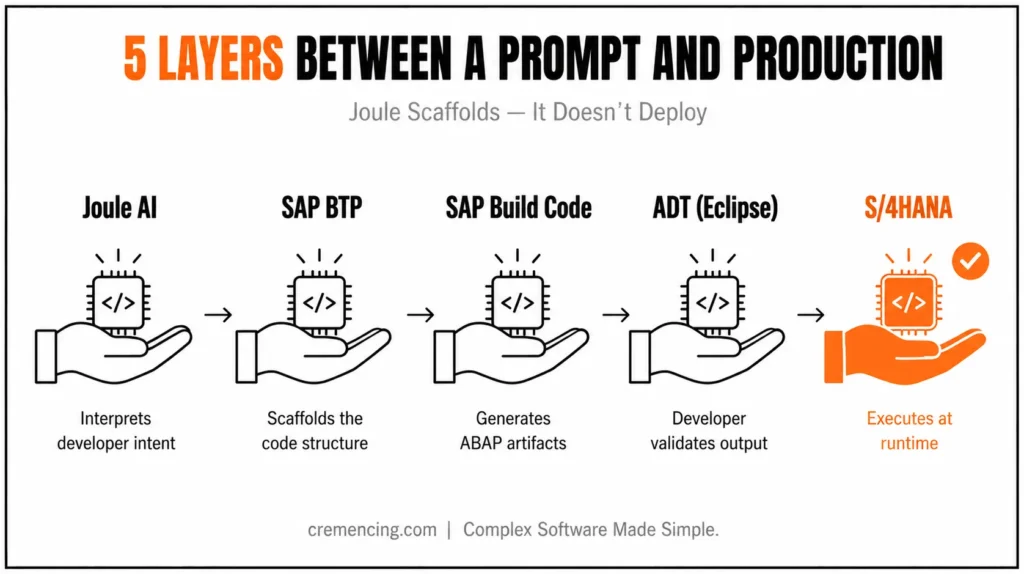
Architecture view
| Layer | Responsibility |
| Joule AI | Intent interpretation |
| SAP BTP | Code scaffolding |
| SAP Build Code | ABAP artifact generation |
| ADT (Eclipse) | Developer validation |
| S/4HANA | Runtime execution |
Critical gap competitors miss
SAP Joule code generation does NOT optimize SQL or performance automatically.
It only generates structure like:
- CDS views
- RAP behavior definitions
- Basic ABAP skeletons
Performance tuning still depends on ABAP developers.
How AI in ABAP Development Is Changing S/4HANA Projects
The role of ABAP developers is changing as AI becomes part of modern SAP development workflows. AI in ABAP development is not replacing developers; instead, it is helping them reduce repetitive coding tasks, generate initial development structures, and focus more on architecture, validation, and business logic.
In S/4HANA projects, AI-assisted tools like SAP Joule can help developers create basic ABAP artifacts, CDS view structures, and RAP-related scaffolding from natural language instructions. This allows teams to move faster during the early development phase.
However, generated output still requires expert review. Developers must validate:
- Data model accuracy
- CDS view design
- Performance impact
- Authorization logic
- Clean Core compliance
- Transport readiness
The biggest shift is that developers are moving from being only code writers to becoming solution reviewers and technical decision-makers. AI-assisted development is also changing the tools developers use, with modern workflows moving toward ABAP development in VS Code and cloud-based development environments.
For example, instead of manually creating every line of ABAP code, a developer can use AI assistance to generate a starting structure and then refine it according to S/4HANA standards. This reduces development time while keeping control over system quality and performance.
In the future, successful SAP developers will not only need strong ABAP skills but also the ability to guide, review, and optimize AI-generated solutions within enterprise environments. AI in ABAP development is changing the workflow, but human expertise remains essential for building reliable S/4HANA systems. Even with the rise of AI-powered ABAP development, developers still need strong debugging skills to validate generated code and identify hidden issues before deployment.
Practical ABAP Code Generation Workflow
Let’s simulate a real scenario using the SAP Build Code Joule add-on.
Step 1 — Natural language prompt
Developer input:
“Generate CDS view for sales order and customer details”
Step 2 — Joule generated CDS view
@AbapCatalog.sqlViewName: ‘ZSO_CUST’
@EndUserText.label: ‘Sales Order Customer View’
@AccessControl.authorizationCheck: #CHECK
define view Z_I_SalesOrderCustomer
as select from vbak // Sales order header table
inner join kna1 // Customer master table
on vbak.kunnr = kna1.kunnr
{
vbak.vbeln, // Sales Order Number
vbak.erdat, // Created Date
kna1.name1 // Customer Name
}
This is a typical output of sap joule abap code generation.
Step 3 — Developer validation in ADT
Developer opens ADT (Eclipse ABAP Development Tools):
- Checks syntax consistency
- Validates join logic
- Ensures clean core compliance
- Reviews performance impact
Step 4 — Activation in S/4HANA
Once approved:
- CDS view activates
- SQL view is auto-generated
- Data becomes available for RAP/Fiori
Key insight
sap abap joule reduces manual coding but not decision-making.
Developers still control:
- Data model design
- Performance optimization
- Authorization logic
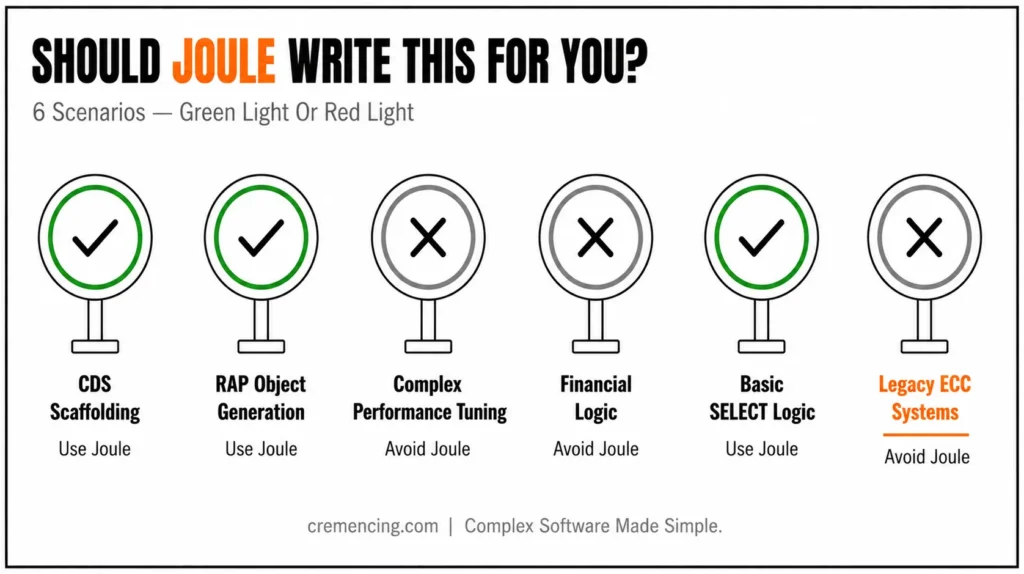
When to Use It vs When NOT To
| Scenario | Use Joule | Avoid Joule |
| CDS scaffolding | Yes | No |
| RAP object generation | Yes | No |
| Complex performance tuning | No | Yes |
| Financial logic | No | Yes |
| Basic SELECT logic | Yes | No |
| Legacy ECC systems | No | Yes |
Clean Core constraint
In S/4HANA, all generated code must follow:
- No direct table updates
- CDS-based access preferred
- RAP model compliance required
Conclusion
Indeed, the true essence of the SAP Joule ABAP code generation is not about automatic writing of ABAP code but about scaffolding and supporting the ABAP developer in ABAP code generation in AI-assisted development in SAP BTP. Joule should help you to move faster at the design and boilerplate level but won’t guarantee correctness in a live S/4HANA system.
Joule enables faster development, while engineers using ABAP still have control over the architecture, performance, and clean core compliance. Ultimately, AI in ABAP Development does not replace ABAP expertise; it changes how developers design, validate, and optimize solutions. Even AI-generated code needs quality checks; here’s what SLIN catches before you ship.
Joule accelerates development, but ABAP engineers still control architecture, performance, and clean core compliance. Every generated CDS view, RAP object, or ABAP skeleton still needs validation in ADT, testing through real data, and alignment with transport and governance rules.
The shift is not from coding to no coding. It is from writing everything manually to validating AI-generated design decisions inside S/4HANA. That shift changes the developer’s role from “syntax writer” to “system reviewer,” where understanding data models, performance behavior, and clean core constraints becomes more important than typing every line.
In real projects, this means developers who only accept generated code without review will introduce hidden performance issues, incorrect joins, or architecture violations. On the other hand, developers who understand both ABAP fundamentals and Joule-generated output will significantly reduce delivery time while still keeping system stability intact.
Frequently Asked Questions
1. What is SAP Joule ABAP code generation?
It is an AI-based capability where SAP Joule generates ABAP-related artifacts using natural language input inside SAP BTP and SAP Build Code environments.
2. Does SAP Joule replace ABAP developers?
No. sap abap joule assists developers but does not replace design decisions, debugging, or performance tuning in S/4HANA systems.
3. Is SAP Joule available in ECC?
No. SAP Joule code generation is only available in S/4HANA and SAP BTP-enabled landscapes
4. Can Joule generate production-ready ABAP?
Not directly. All generated code must be validated in ADT and approved before transport to production.
5. What is SAP Build Code in this context?
SAP Build Code is the execution layer where sap build code joule add on converts prompts into structured ABAP artifacts.
6. Is Joule safe for enterprise systems?
Only after validation. AI-generated code must pass clean core checks and developer review.





2 Responses