

Introduction
There’s a common assumption around SAP custom application development that it’s inherently risky — that every custom object is technical debt waiting to break at the next upgrade, and the ‘safe’ answer is always to stay as close to standard as possible. That advice isn’t wrong, exactly, but it’s incomplete. Standardised SAP functionality covers common, well-defined processes well.
It rarely covers the specific workflow that makes one business run differently from its competitors — and forcing that workflow to bend around standard system limits doesn’t eliminate risk; it just relocates it into manual workarounds, spreadsheets, and inefficiencies that never show up on an upgrade impact report.
SAP custom application development exists to close exactly that gap — not by customising everything, but by building targeted solutions where standard genuinely falls short. This guide covers how that process actually works, what real returns look like, and where most guidance on this topic stops short.
Protecting Upgrades with Clean Core
Modern SAP custom development relies on Clean Core architecture to decouple custom extensions from the underlying SAP S/4HANA digital core. By utilizing the SAP ABAP RESTful Application Programming Model (RAP) and SAP Business Technology Platform (BTP), organizations can build custom side-by-side or on-stack extensions via published, upgrade-stable APIs rather than modifying standard SAP objects.
This approach preserves standard functionality during system updates while eliminating the technical debt traditionally associated with legacy ABAP modifications. Consequently, enterprises achieve business-specific workflow customization without risking system stability or incurring high maintenance overhead during future SAP release upgrades.
What Are SAP Custom Development Services
SAP custom application development refers to solutions built according to specific business needs within the SAP environment. Moreover, these services augment standard SAP functionality with custom programs, enhancements, and integrations.
SAP development uses tools such as ABAP, SAP Fiori, and SAP Business Technology Platform to create and modify applications within the SAP ecosystem.
Yahan table ko proper markdown format mein align kiya gaya hai:
| Scenario | Standard SAP Fits | Custom Development Fits |
|---|---|---|
| Common, industry-standard process | ✅ | |
| Unique workflow tied to competitive advantage | ✅ | |
| Frequent manual workarounds already in place | ✅ | |
| Integration with a non-standard third-party system | ✅ | |
| Simple reporting need covered by existing SAP tools | ✅ |
The main aspects of custom SAP development include
- Custom reports and dashboards
- Workflow automation solutions
- Enhancements to existing SAP modules
- Integration with third-party systems
- Development of user-specific applications
An SAP custom development programs minimise the need for manual interventions and external tools to support business processes efficiently. Rather than shaping business processes around system limitations, this approach allows organisations to align technology with business goals.
How SAP Custom Development Services Function
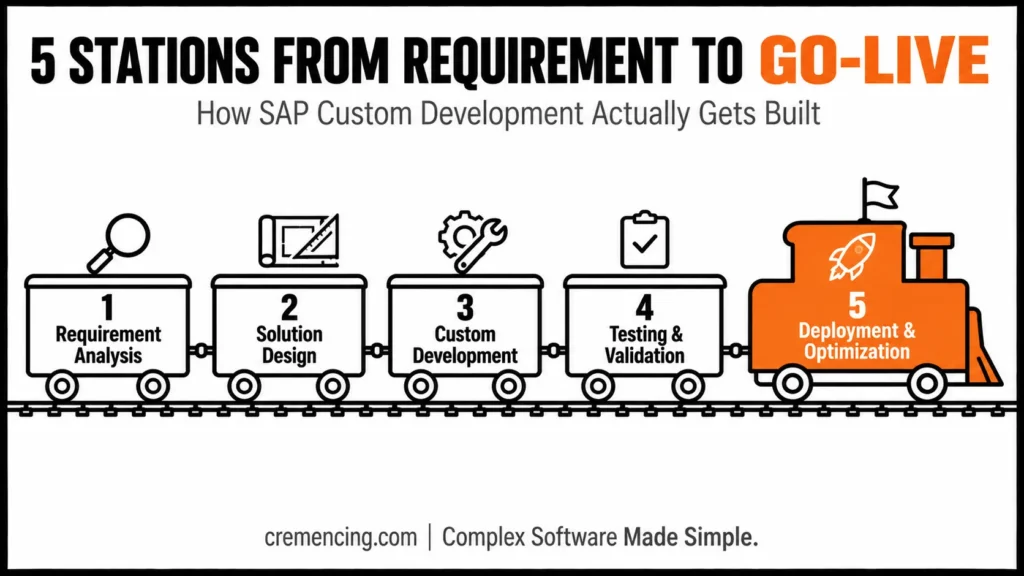
- Requirement Analysis → define the business gap, not the technical solution
- Solution Design → plan for scalability before writing any code
- Custom Development → build using ABAP, RAP, or BTP depending on target platform
- Testing & Validation → functional, performance, and user acceptance testing
- Deployment & Optimization → monitor, collect feedback, iterate
Step 1: Requirement Analysis
It starts with the assessment of business needs and gaps in the current SAP landscape.
This includes:
- Understanding current workflows
- Identifying inefficiencies
- Defining desired outcomes
In Addition, avoid costly misalignment by delivering requirements that give clear business value.
Step 2: Solution Design
A solution architecture is designed based on the requirements.
This involves:
- Defining system changes
- Designing workflows and data structures
- Planning integration points
Good design is a good, scalable implementation and rework-free.
Step 3: Custom Development
However, the solution is built by developers using SAP technologies like ABAP or SAP BTP.
Examples include:
- Custom applications
- Automated workflows
- Data processing programs
As a result, you are able to turn business requirements into functional solutions.
Step 4: Testing & Validation
Testing the Solution: Test to make sure it works as expected.
Testing includes:
- Functional testing
- Performance testing
- User acceptance testing
These stages allow for reliability and reduce risks when deployment comes into play.
Step 5: Deployment and Optimization
Deploy the solution in the live environment.
After deployment:
- Performance is monitored
- Feedback is collected
- Continuous improvements are made
Consequently, it guarantees success and adaptability in the long run. Also, learn SAP custom development limitations.
Each step depends on the one before it — a solution built without a clear requirement analysis, for example, tends to solve the wrong problem efficiently rather than the right problem at all. Organizations that skip straight to development after a rough conversation with stakeholders are the ones most likely to end up in the ‘over-customization’ mistake covered below.
Benefits and Return on Investment of SAP Custom Application Development
SAP custom application development provides quantifiable performance across various segments.
Operational Benefits
- 40–70% reduction in manual work
- Faster process execution
- Improved workflow automation
- Reduced dependency on external tools
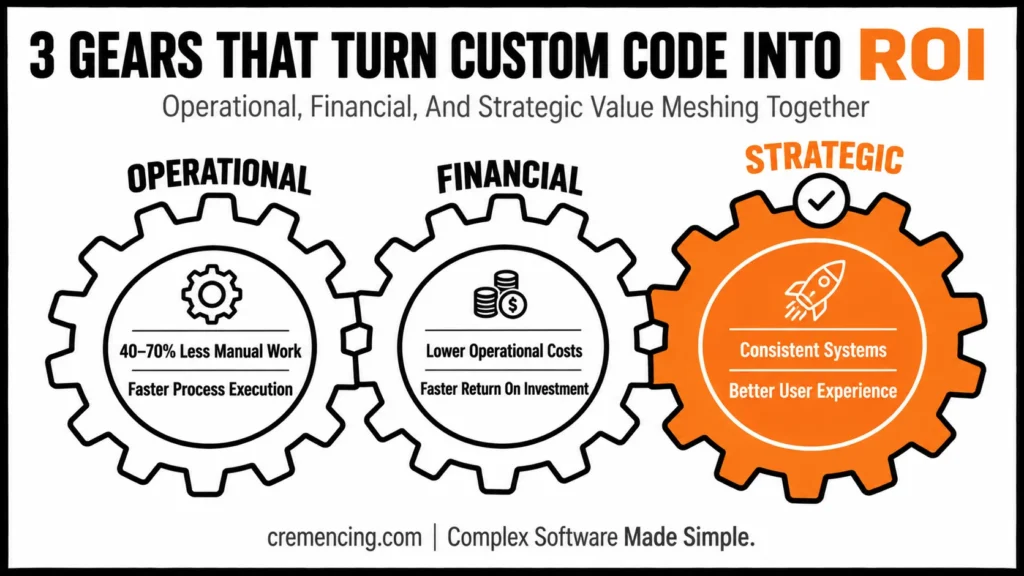
Financial Benefits
- Lower operational costs
- Less need for extra software licenses
- Faster return on investment
Strategic Benefits
- More consistent systems and business processes
- Improved user experience
- Increased system flexibility
Many commercial organizations notice productivity & efficiency improvements within the first months of realizing SAP custom development investment.
Common Mistakes and Tips for Best Practices
Common Mistakes
- No clear business value in the over-customization of the system
- Ignoring standard SAP capabilities
- Lack of proper documentation
- Poor testing before deployment
- Not considering long-term scalability
Such errors are costly, both in terms of value and maintenance steps.
Best Practices
- Business complexity is more important than technical ambiguity
- Reuse standard SAP capabilities wherever possible
- So when you develop something custom, try to keep the scope small and maintainable
- Document all custom solutions
- Regularly review and optimize developments
This balanced approach makes sure that custom development contributes positively rather than unnecessarily complicating the process. If you’re wondering when custom development is worth it, read our breakdown of why standard SAP is not a solution for most enterprise scenarios.
What the Majority of Content Fails to Cover for SAP Custom Development
SAP Custom Development – When Technicalities are not enough? Most of the topics in SAP custom development are related to coding, tools used, or certification. But they fail to see the business side of things.
Key Insights Often Overlooked
- New whitepaper: Bridging the gap between tech & business through custom development
- Over-customization can reduce system flexibility
- Lay out other pillars of Integration between Custom and Standard features
- Long-term care should be considered early on
The Real Difference
Developers build features as part of the basic development. Over the years, strategic custom development has assisted in enhancing business performance.
Those who grasp this distinction improve and enjoy a stronger ROI!
The practical takeaway is that a successful custom development program isn’t measured by how much was built, but by how precisely it was scoped. A single well-targeted enhancement that removes a genuine bottleneck usually delivers more value than a broad customization effort that touches many processes lightly.
Conclusion
SAP Custom Development Services: An Overview. Organizations hire SAP custom development services to derive maximum value out of their SAP systems. Companies may create efficiency in operations, reduce costs and enhance organizational performance.
Custom SAP development, on the other hand, does not fall into the trap of generic solutions and enables you to create systems that can support processes occurring in the companies involved (business integration, analytics, or tools supporting specific orders as well as general experiences). Doing so improves operational efficiency and lays the groundwork for future growth.
Having difficulty aligning your SAP system with your business requirements. With SAP custom development services, you can create the solutions that align with your processes
FAQ Section
What is SAP development?
SAP development refers to the creation and customization of applications in the SAP environment to fulfil business requirements.
SAP Custom Development Services—What do you mean?
These are services that customize SAP systems via custom programs, workflows, and integrations.
IS SAP better than standard solutions?
Low latency would be useful in special business cases where standard solutions cannot meet.
How much does SAP custom development typically cost?
Cost depends heavily on scope — a small enhancement to an existing module costs far less than building a new custom application with integrations. Organizations should scope requirements clearly before estimating, since undefined scope is one of the most common causes of budget overruns.
Does custom SAP development affect future upgrades?
It can, depending on how the customization is built. Development that follows Clean Core principles — using released APIs and extension frameworks like RAP rather than direct modifications to standard objects — is designed to remain upgrade-stable, while direct core modifications carry more upgrade risk.
What’s the difference between SAP customization and SAP configuration?
Configuration adjusts existing standard SAP settings and parameters without writing new code, while customization involves building new objects, programs, or enhancements when configuration alone can’t meet a business requirement.
Who typically performs SAP custom development — internal teams or external partners?
Both approaches are common. Internal teams offer deeper business context and faster iteration, while external SAP partners often bring specialized technical expertise and broader implementation experience, particularly for complex integrations.
How long does a typical custom development project take?
Timelines vary by scope — a small enhancement might take a few weeks, while a comprehensive custom application with multiple integrations can take several months. Clear requirement analysis upfront tends to shorten the overall timeline by reducing rework.
Can custom SAP development be reversed or removed later if no longer needed?
Generally yes, though the complexity depends on how deeply the customization is integrated with other processes. Well-documented, modular custom development is significantly easier to retire or replace than deeply embedded, undocumented modifications.
What skills are needed for SAP custom development?
Common skills include ABAP development, CDS view and RAP modeling for S/4HANA and BTP-based development, Fiori/UI5 for user interfaces, and a solid understanding of the specific SAP modules being extended.