
SAP Business Process Continuity: Why Your System Needs an Ecosystem Approach
Posted on February 6, 2026 by Laeeq Siddique

The Hidden Risk No SAP Status Report Will Show
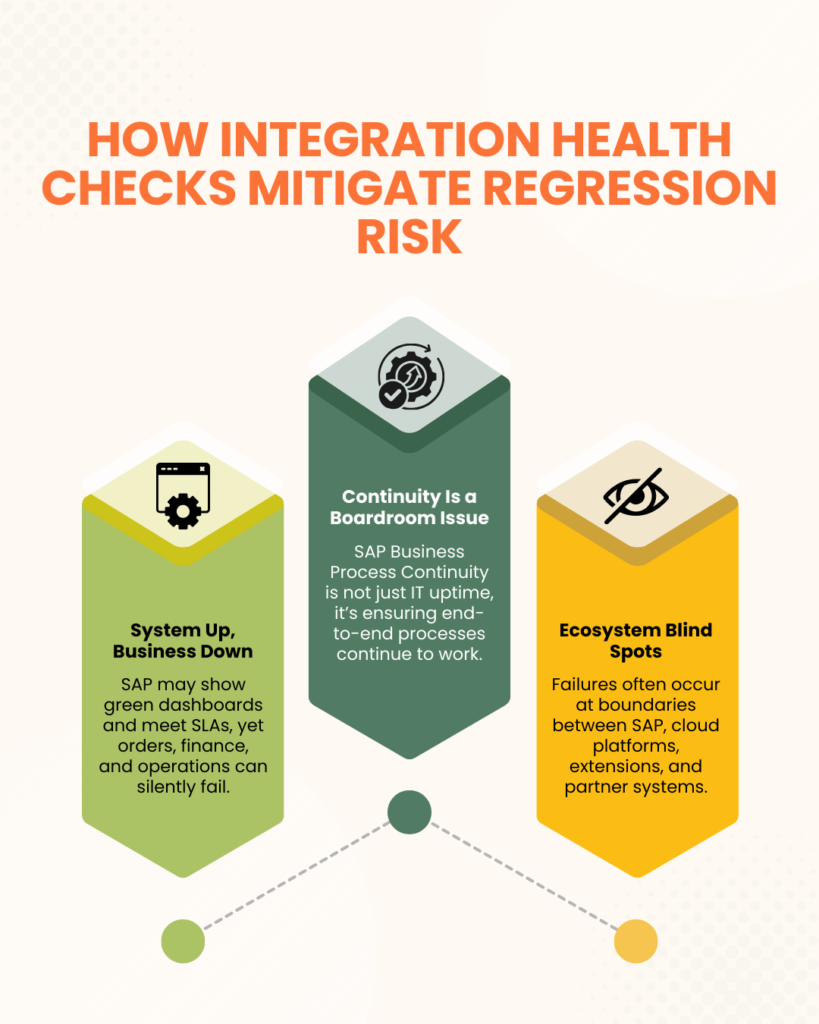
Your SAP system is up. Dashboards are green. SLAs are technically met.
And yet orders are delayed, the finance department is reconciling manually, customer promises are in jeopardy, and business teams are developing workarounds under SAP’s radar.
That’s how it is at so many businesses today. In reality, this is not because SAP is a failure but because everyone is treating it like another system instead of a business ecosystem.
This is the point at which SAP Business Process Continuity becomes a Board Room issue, and ceases to be an IT theme.
In a world of S/4HANA migrations, cloud extensions, integrations and 3rd party platforms, continuity is no longer just about system availability. Furthermore, whether something changes, and an end-to-end business process continues to work.
SAPinsider
For a long time, SAP Business Process Continuity was primarily associated with disaster recovery, system outages or infrastructure breakdowns. That definition is outdated.
Today, continuity risk comes from:
- SAP upgrades and enhancement packs
- Cloud Integration changes, adapting data across cloud and on prem system. With its billions of transactions, B2B cloud integration constantly raises new dilemmas.
- Custom extensions developed for the SAP BTP
- 3PLs, finance systems, HR and CRM applications
- Transformation-driven rapid process redesign
Executives are being hit with a hard truth:
Your SAP system can be technically “Green” while your business processes wither on the vine.
SAP Business Process Continuity is simply the continuation of those critical business outcomes: order fulfillment, billing, payroll, compliance and reporting across your entire SAP landscape, not just within ECC or S/4HANA.
Thinking of SAP as a System, Rather Than an Ecosystem
In fact, the majority of organizations still treat SAP as a monolithic system of record. In fact, SAP has become a focal point in a relatively crowded ecosystem that consists of:
- S/4HANA (core digital backbone)
- SAP BTP extensions and workflows
- SAP Integration Suite and middleware
- Non-SAP SaaS platforms
- Legacy apps remain essential to business operations
- Outside partners, vendors, and data feeds
When SAP is siloed:
- The review is based on a system, not on a process‐by‐process basis
- They’re testing transactions, not results
- Ownership is fragmented across teams
- The business risk is unseen until you have a running production service
And it is exactly at these ecosystem borders that SAP Business Process Continuity comes to a halt.
SAP Business Process Continuity
Fundamentally, Contemporary Business Process Continuity in SAP answers one single question:
Will My Core Business Processes Make It?
It focuses on:
- End-to-end process integrity and not module stability.
- Knowledge of cross-system dependencies, not testing in a silo.
- Business impact visibility was the goal, not success metrics in technical terms.
This includes continuity across:
- Order-to-Cash
- Procure-to-Pay
- Record-to-Report
- Hire-to-Retire
- Plan-to-Produce
If anything goes wrong with a step any where in the process, even outside of SAP the whole process is broken.
Traditional SAP Governance Doesn’t Work for Continuity
The majority of SAP governance models are tuned for:
- Change approvals
- Transport management
- Release cycles
- Technical testing
They are not engineered to support continuity at the ecosystem level.
Common gaps include:
- The lack of a living map of process dependencies
- Limited knowledge of the effect of integration failure
- Only regression into SAP is targeted
- Business users were brought in too late or not at all
Consequently, organizations become aware of continuity problems only when:
- Customers complain
- Revenue is delayed
- Finance numbers don’t reconcile
- Manual workarounds become permanent
At that moment, work is damage control, not prevention.
The SAP Business Process Continuity based on the Ecosystem Approach
It’s an ecosystem paradigm shift in terms of IT: where you used to ensure SAP or IT prostitution (keepin’ that system runnin’) we are now in the business defence game (defendin’ that business – or cultural -l flow).
This method is based on three principles:
Processes First, Systems Second
Continuity planning begins with identifying:
- Mission-critical business processes
- Business outcomes that cannot fail
- Revenue, compliance, or customer impact
Processes are not drawn up for existing SAP systems, but SAP is designed based on the processes.
Visibility Across Integration Boundaries
The majority of process failures occur at handoffs:
- SAP to third-party systems
- SAP to cloud platforms
- SAP to partners
The dependency relations are made explicit within an ecosystem approach, and updated regularly.
For more insights read our blog SAP Integration Governance Ownerships
Readiness to Change as a Continuity Measure
Any change to SAP – upgrade, patch, extension, or even integration creates an availability risk.
The question shifts from:
“Did the change deploy successfully?”
to:
“Did the business process make it through the change?
S4HANA - Business Process Continuity by SAP
S/4HANA transformations increase the risk of continuity because they involve:
- Simplified data models
- New integration patterns
- Embedded analytics
- Event-driven architectures
- Side-by-side extensions
Organizations often focus heavily on:
- Migration timelines
- Code remediation
- Functional readiness
But lack of continuity normally appears after go-live, before:
- Real transaction volumes hit
- External systems behave differently
- Edge cases appear
- Manual controls disappear
Without the view into the ecosystem, SAP Business Process Continuity ends up being reactive and not even close to strategic. For mroe insights read our blog on SAP Legacy
What Senior Executives Need to Ask About SAP High Availability
We’ve been discussing the public health situation with our friends, colleagues and partners in the last few days.
You don’t have to be a CIO, an enterprise architect or a transformation leader to demand answers to these questions:
- What are today’s most vulnerable business processes?
- What are the areas where we depend on undocumented integrations or working by hand?
- What’s the impact to the business if one interface fails quietly?
- Can we foresee the risk of continuity before SAP release after the current one?
In the absence of clear responses to these questions, SAP Business Process Continuity remains something that is implied and not controlled.
Quantifying SAP Business Process Continuity That Goes Beyond Uptime
Continuity maturity can be defined by the following:
- Process-level risk mapping
- Integration dependency transparency
- Regression risk awareness
- Business-aligned testing strategies
- Clear ownership of end-to-end outcomes
Organizations with strong continuity:
- Find bugs before business users do
- Recover faster with less disruption
- Confidently execute SAP upgrades
- Reduce manual workarounds over time
Why Continuity Is a Competitive Edge, Not Just Risk Management
Companies that are Successful in SAP Business Process Continuity:
- Nimble while you pivot with less risk of transformation
- Adopt innovation without destabilizing operations
- Gain trust from business stakeholders
- Reduce hidden operational costs
In comparison, companies that lack discipline of continuity:
- Delay upgrades out of fear
- Accumulate technical and process debt
- Count on heroics when he releases all his movies
- Accept instability as “normal”
Continuity isn’t the absence of change — it’s safe, predictable change.
Final Thought: Process, Not SAP, Powers Your Business
SAP will continue to evolve. It will become a more complex ecosystem. Rather, change speeds up, it does not slow down.
The one thing that can be done to achieve this goal is to consider SAP as a living system and resolve SAP Business Process Continuity as a strategic capability rather than some sort of technical afterthought.
If your SAP landscape is getting more complicated and you haven’t changed with the times in how you ensure continuity, that’s risk.
Now is the time to:
- Evaluate the continuity in process, not just system
- Reveal hidden dependencies in your SAP environment
- Slip on your cashmere slippers, and let’s take a quick and easy stroll down the low risk path Prepare your company for upgrades, integrations & innovation with no interruption
Learn how a systematic SAP Business Process Continuity assessment can allow you to see risk before the business does.
📩 Subscribe to Our Newsletter
Get the latest updates, tips, and insights delivered straight to your inbox.