
Studying real-world enterprise SAP implementation lessons shows that companies must join financial and operational processes for global scale. Large companies using SAP can’t afford disconnected systems. However, operating these processes in a global operation is challenging.
Several companies like Nestlé, BMW Group and Unilever illustrate the various motivations for implementing SAP solutions. Their choices go beyond just choosing SAP ERP software, however.
Large companies have several business applications, a number of factories, subsidiaries and warehouses. Their technology teams need to orchestrate transactions while keeping financial records and business rules accurate and consistent.
The SAP architectures they design need to address data ownership, process standardisation, integration and operational continuity.
These examples illustrate 7 lessons that matter to businesses more than ERP selection itself, regardless of their size or the software being used. These enterprise SAP implementation lessons show why large businesses need connected systems.
Quick Answer
Key enterprise SAP implementation lessons show that major companies select SAP for coordinated business processes, consistent financial information, and controlled integration within complex operations. There are functions that SAP applications offer, such as manufacturing and procurement, finance, and HRM.To make SAP implementations successful, businesses need standardization, architecture decisions, data governance, and long-term operational ownership.
What Are the Core Enterprise SAP Implementation Lessons?
Businesses that use SAP usually deal with operations that include departments or various locations. Their need for enterprise resource planning, or ERP, is more than buying, selling, or keeping track of financial transactions.
An ERP architecture needs to be consistent across these integrated processes.
SAP S/4HANA enables core financial and operational transactions. Other SAP apps focus on procurement, workforce management, integration, and analytics.
But there is no simple one-to-one relationship between several SAP products and an integrated enterprise.
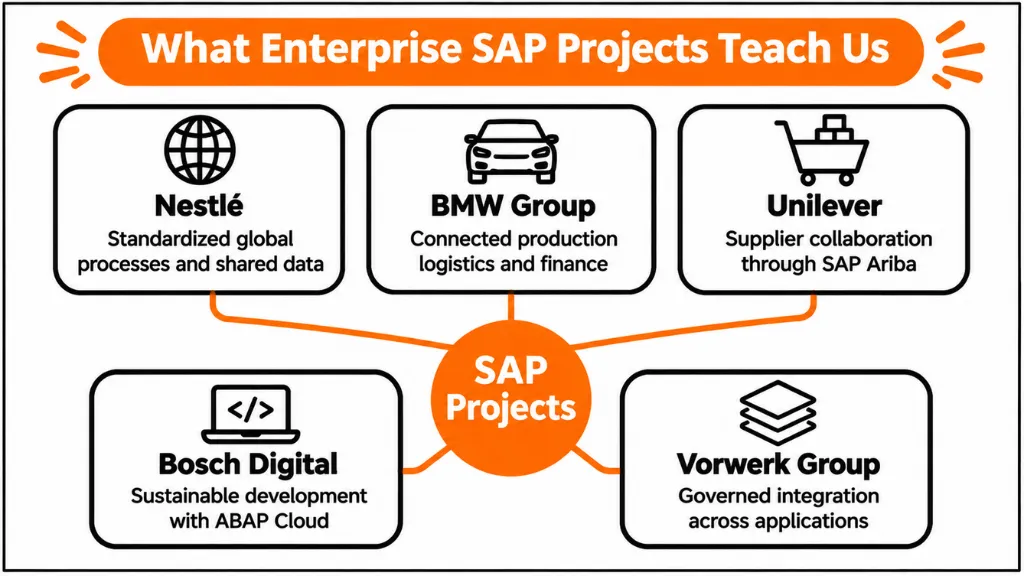
Here are some of the large companies with existing SAP implementations and the projects they have documented.
| Company | Documented SAP Initiative | Main ERP Lesson |
| Nestlé | Cloud transformation and SAP S/4HANA Cloud Private Edition | Consistent processes and common information. |
| BMW Group | Production logistics and central finance based on SAP S/4HANA. | The difficulty of connecting and governing operations. |
| Unilever | SAP Ariba procurement solutions | Supplier co-operation and purchasing management |
| Bosch Digital | The ABAP cloud development model and SAP BTP capabilities. | Sustainable application development |
| Vorwerk Group | SAP Integration Suite and SAP BTP | The ability to manage connections across applications. |
These examples do not represent all of the applications that each company has, but rather are examples of publicly reported SAP initiatives.
The lesson learned is that large organizations choose to implement SAP to address a known problem in their operations.
Manufacturers and consumer-products companies can experience the same enterprise integration needs, but leverage different SAP applications.
Enterprise SAP Implementation Lessons 1: Standardize Business Processes
The first lesson is that when scaling up, it is important to standardize business processes first.
In the case of large organizations, it can be challenging when they have multiple subsidiaries that run their business differently for similar transactions.
Inventory levels can vary from one location to another. There can also be variability in the finance team reporting structure and/or its approval process.
These differences make consolidation and process governance hard to achieve.
- How Global Enterprises Achieve Process Standardization
- How Global Enterprises Achieve Process Standardization
- How Global Enterprises Achieve Process Standardization
- How Global Enterprises Achieve Process Standardization
- How Global Enterprises Achieve Process Standardization
HOW GLOBAL Enterprises Achieve Process Standardization
Global companies using SAP, such as Nestlé, prove that standardization is key to success.
Nestlé is involved in many countries, brands and business activities.
Nestlé’s published customer story indicates that the company started to standardise its ERP environment across the globe over 20 years ago.
The company later extended its cloud transformation journey to financial, workforce, customer and operational applications using SAP technology.
In 2025, SAP delivered a significant upgrade for the SAP S/4HANA Cloud Private Edition (P.E.), encompassing 112 countries.
The scale you see represents the importance of having standardized processes.
Each business unit can continue to have individual requirements, but adhere to common enterprise transaction principles.
However, teams do not need to standardize every workflow.
Even with these principles in mind, there could be some specific tax rules, regulatory requirements, and operational differences which may make it necessary to have controlled local configurations. One of the key enterprise SAP implementation lessons is the value of standardized business processes.
The Architectural Lesson
The first step to ERP standardization is designing the business processes.
For instance, a company must determine how purchase orders relate to goods receipts and supplier invoices, prior to setting up approval rules.
Teams can set up document relationships, require specific data, and establish financial controls using a common process template.
Teams should then base local variations on documented governance rules. Otherwise, each implementation team can have setups for the same business requirement.
Lesson, for ERP buyers: If you need to bring ERP into departments, subsidiaries, or countries, make sure to standardize the transactions first.
Lesson 2: SAP and Financial Data Governance
When business units have different account structures and definitions of transactions, it becomes difficult to make financial reports.
It’s not just about gathering financial data from multiple applications.
- Harmonizing Financial Data Across Global Operations
- Harmonizing Financial Data Across Global Operations
HARMONIZING Financial Data Across Global Operations
Financial functions should know how systems compute the numbers and if the definitions stay the same. One of the key enterprise SAP implementation lessons is the value of standardized business processes.
BMW Group and Enterprise SAP Implementation Lessons in Finance
Furthermore, companies using SAP like BMW Group focus on financial harmonization with SAP S/4HANA Cloud Private Edition and SAP S/4HANA Cloud Private Edition for central finance.
According to SAP’s 2026 customer material, the firm is striving to increase financial process standardization and comparability throughout its organization.
The documented project links information from 15 key logistics and sales source systems.
This is an important architectural concept: it is not always necessary to replace all of the source applications to get centralized financial visibility.
Organizations can, however, define boundaries for financial integration and governance.
The importance of the meaning of transactions.
Suppose that two subsidiaries are accounting for freight costs.
One firm records the costs as part of inventory. The other records them under a different operating expense classification.
Each method can be used for specific accounting needs.
But in consolidated reporting, definitions and reconciliation requirements are needed.
The architecture of an ERP system should define the objects allowed in the Finance module, the linking logic, and who is responsible for posting transactions to them.
In the case of SAP S/4HANA, they could relate to company code, general ledger structures, controlling assignments, and the Universal Journal.
Developers should not view financial mappings as a simple field transformation.
They impact the accounting meaning and the precision of accounting reports.
Lesson for ERP buyers: Look at financial data governance and reconciliation needs in addition to ERP reporting.
Lesson 3: How Companies Using SAP Connect Supply Chain and Manufacturing
Practical enterprise SAP implementation lessons prove there is a need for efficient data sharing between procurement, inventory, production, and logistics
A production order can’t work without materials and parts coming in.
With those processes relying on standalone applications, it can become challenging to identify operational delays. Another important enterprise SAP implementation lesson is to scale ERP without increasing core complexity.
BMW Group’s Production Logistics Transformation
In July 2025, SAP announced that the BMW Group will migrate its production logistics at its Regensburg plant to SAP S/4HANA.
It covers all aspects of the parts supply chain, from ordering, receiving, and warehousing to delivery to production.
It shows how ERP processes can help in manufacturing execution by coordinating logistics information.
But ERP is not a tool built to manage every single task on the factory floor.
Factories can still use specialized manufacturing execution systems for machine-level activities and production confirmations.
The structure or design of the architecture should specify the interaction of those systems with respect to business transactions.
A Manufacturing Transaction Example
Suppose a manufacturer is about to place an order for production.
The ERP application determines the material requirements and checks procurement or stock availability.
A warehouse process then assists in moving components towards production.
Confirmations and goods movements follow production activity and update the production operational records.
The technical teams are responsible for determining the application that is responsible for each transaction.
Teams might need reconciliation if a warehouse application confirms material movement after the ERP transaction has been made.
Therefore integration design should take into consideration the order of processing, error recovery handling, and the status of transactions.
Lesson for ERP buyers: Do not just look at individual application workflows. Look at end-to-end business transactions.
Enterprise SAP Implementation Lessons 4: Integration and Data Ownership
Enterprise companies using SAP rarely run their ERP in isolation.
Customer relationship management applications, supplier networks, warehouse systems, analytics applications and industry-specific software are all applications that organizations may connect to ERP.
Having clear ownership of business data is essential to connecting those applications.
Managing Data Ownership Across Connected Systems
Vorwerk Group, an SAP customer, uses SAP Business Technology Platform and SAP Integration Suite to connect SAP and third-party applications.
This is a typical enterprise architecture need. Another important enterprise SAP implementation lesson is to scale ERP without increasing core complexity.
Specialized processes can be performed by external systems, and SAP can be used for core transactions.
For instance, a customer-facing application can take an order, and SAP S/4HANA handles the fulfillment and posting of financials.
The integration should define who is responsible for the order status and other business documents.
API Connectivity vs. Transaction Reliability in SAP Lessons
An interface can authenticate and pass data to the other end, yet the business processing can still fail.
Assume that an outside application enters an order into ERP.
SAP creates the order, but the confirmation does not reach the sender.
The sender can issue the request again, which can create a duplicate.
Production integration requires proper transaction tracking and prevention of duplicate records.
The integration should also include enough monitoring data so support staff can quickly determine what went wrong when a transaction fails.
The integration should also include enough monitoring data so that it can be used to determine what went wrong wheThe integration should also include enough monitoring data so support staff can quickly determine what went wrong when a transaction fails.n a transaction fails.
Consider message sequencing and retry behavior for asynchronous processing.
Lesson for ERP buyers: Evaluate the complete integration life cycle, from ownership to failures, retries and monitoring in operation.
Lesson 5: How Companies Using SAP Scale ERP Without Core Complexity
Large businesses often need features that standard ERP configurations cannot provide.
But any major changes to the basic application functionality may lead to maintenance issues in the long term.
Custom development should thus be based on a controlled architectural approach.
Bosch Digital and Modern SAP Development
Modern companies using SAP, including Bosch Digital, adopt ABAP Cloud and generative AI development.
The project is about modernizing development practices in a large developer environment.
This shows how SAP’s clean-core principle applies in practice.
Organizations should leverage supported extensibility techniques rather than creating needless application objects.
Extensions are possible depending on the deployment model and the supported development capabilities for SAP S/4HANA.
Extensions can also be run side by side, as needed, on SAP Business Technology Platform.
Determine where to place custom logic.
Consider a business that needs specialized customer risk scoring.
The resulting risk decision may be required in the core ERP processes.
The algorithm for scoring, however, may change rapidly or be based on an external analytical model.
A side-by-side application can compute the score and share it via a supported service.
ERP would then consume the output in an approved business process.
That separation can reduce the coupling between specialized logic and the ERP core.
But there are security, availability, and integration concerns with externalizing logic.
The appropriate placement will vary based on transaction consistency, latency, support needs, and extensibility needs.
Lesson for ERP buyers: Check for future upgradeability without tying your own hands.
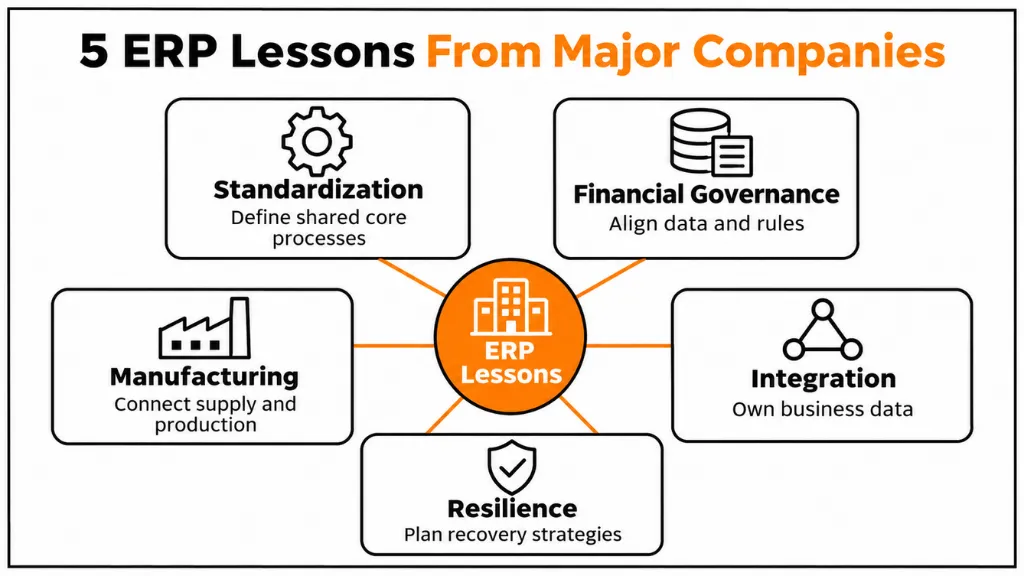
Lesson 6: Building Operational Resilience with SAP
Large organizations cannot treat the availability of ERP as only a technical issue.
A critical outage can cause disruption in manufacturing, procurement, financial processing or customer fulfillment.
Operational resilience means not only that infrastructure is reliable, but also that teams manage business recovery processes effectively.
Nestlé’s Cloud Transformation.
According to SAP, they helped Nestlé move a wide range of applications and data to the cloud across the world.
The program entailed closing down data centers and rationalizing infrastructure.
SAP also claims excellent system availability in the documented customer program.
But availability of infrastructure cannot solve application or integration problems.
An ERP service can continue without any problems while an external warehouse interface stops receiving messages.
Production support needs to, therefore, keep an eye on business transactions, not just on the health of the systems.
The only thing that can help with recovery is transaction-level visibility.
Consider an invoice interface that stops working after a transaction is accepted from another system. It might not be enough to start the connection again.
The support team needs to make sure the document was not already added by the system that received it. If this step is skipped, it could cause invoices or mismatched accounts. A good system should include identifiers, details about the process, automatic attempts to fix issues, and a way to check everything again.
Security and authorization need to be easy to manage when it comes to operations.
Technical groups need to know the services they are working with, the access details they are using, and what happens if monitoring stops working.
Advice for people buying ERP systems: Make sure that the ability to recover the protection of data and support for running the system are all considered right from the start of the design process.
Enterprise SAP Implementation Lessons 7: Long-Term Architecture Decisions
Big companies don’t select ERP only because of their immediate needs.
They need to be prepared to support future organizational transformation, acquisition, new operating models, and changing application needs.
But growth planning doesn’t mean choosing each possible SAP capability.
Planning a Scalable SAP Architecture for Future Growth
The architecture should be proportional to business requirements.
Enterprise SAP Implementation Lessons for ERP Roadmaps
For a company, this can be a first deployment of SAP S/4HANA for financial and procurement processes.
Later, it could add more warehouse applications, analytics functionality, or supplier integration.
For every new capability, additional data relationships and operational responsibilities come into existence.
Managing Data Relationships as the Business Grows
If there is no roadmap, then individual projects can create incompatible interfaces and duplicate master data.
The architecture governance should then establish extension standards, integration principles, and data ownership and responsibility.
Product support, release compatibility, and organizational readiness should also be taken into account in the roadmap.
When choosing a suitable SAP solution, businesses need to consider the following factors:
An ERP evaluation should look at the operating model that they are expecting, not the number of product features that are there.
The business needs to define important transaction flows, essential financial controls, integration needs, and development needs.
The technical teams can then match these requirements with supported SAP capabilities.
Teams should use a focused proof of concept to validate one business-critical process.
For instance, they could test a manufacturer buying, receiving, and consuming a stocked item, and posting the financial transaction.
An exception should be included in the test as well, for example, an integration response failure.
This example shows more about the architecture than about a demonstration of features. Lesson for ERP buyers: Choose the ERP architecture that aligns with your business model and set up governance for changes. These enterprise SAP implementation lessons help businesses make better long-term architecture decisions.
Key Takeaways from Enterprise SAP Implementation Lessons
- The benefit of standardization is uniformity of operations. In multiple organizations, businesses running on SAP may require a common business process.
- Ownership of financial and operational data is needed. Consistent reporting is not ensured by shared software.
- Reliability when integrating is a must. APIs need to provide data exchange, recovery, monitoring, and control.
- Long-term maintainability matters. ERP sustainability is affected by clean-core principles, architectural governance, and support planning.
Conclusion
Complex operations demand coordinated processes, uniform financial data, and dependable integration—features that make SAP a favorite among major companies. The case studies of Nestlé, BMW Group, Bosch, and other entities demonstrate that ERP value goes beyond software capabilities.A variety of architecture decisions, standardization, extension design, and operational governance shape long-term outcomes.
Those considering SAP ERP should look at what other businesses decided when implementing ERP, and not just their names. Once teams map one critical business transaction, they should determine who owns the data and what dependencies exist across various transactions, and then verify whether the proposed ERP architecture can support that transaction reliably. These enterprise SAP implementation lessons can guide businesses planning long-term ERP improvements.
Frequently Asked Questions
1. Which major companies use SAP?
Nestlé, BMW Group, Unilever, Bosch and Vorwerk Group are all major companies that use SAP. Some apply SAP capabilities in enterprise resource planning, and others in procurement, integration or development. Each organisation requires a different SAP architecture according to its operational requirements.
2. Why is it that large companies prefer SAP?
SAP is typically adopted by large enterprises for enterprise resource planning, to ensure seamless business workflows, synchronisation of transactions, and financial governance. SAP applications cover finance, manufacturing, procurement, supply chain, and more. But standardization of the process, the reliability of business data integration, and business data ownership are equally important for successful adoption.
3. Do Fortune 500 companies use SAP?
Yes. According to SAP, more than ninety percent of Fortune 500 companies rely on SAP solutions. That figure does not automatically mean that SAP has SAP S/4HANA implementations. Before assuming that every SAP customer uses the ERP architecture, I suggest that businesses first look at documented product deployments.
4. Why do manufacturing companies use SAP?
SAP is used by manufacturing companies to manage and coordinate purchasing, material availability, inventory, production-related transactions, and financial reporting. SAP S/4HANA can be used for connected operational processes, while specialty applications can be used for other manufacturing activities. The primary architecture requirement is that transactions are consistently owned by ERP, warehouse and production systems.
5. Is SAP superior to other ERP systems?
SAP isn’t necessarily superior to all other ERP solutions. Its applicability is dependent on the business processes, expected capabilities, integration architecture, cost of ownership and internal expertise. Enterprises should not rely solely on vendor reputation. They should decide based on supported functionality and technical restrictions, using documented requirements and realistic transaction testing.
6. What Can Businesses Learn from Companies Using SAP?
Businesses should look at why the biggest SAP customers decide to standardise processes, control data, manage integrations, and review extensions. The same lessons help medium businesses as well. Small organisations should follow the architectural rules at a scale that fits them. Small organisations should only use features that’re reliable and that can grow with small organisations, in the future.
7. What are the main challenges of implementing SAP in companies?
Large companies often face challenges, such as data migration, process standardization, system integration, and employee training. Different departments may also follow business rules. Therefore, companies need to plan clear data ownership and a reliable implementation strategy.
8. What role does SAP S/4HANA play in large enterprises?
I see that SAP S/4HANA helps businesses run their tasks, such as keeping track of money, buying supplies, managing stock, and making products. SAP S/4HANA provides a shared ERP environment where each department can use the business data.
9. Why is SAP integration important for large organizations?
Large organizations rely on different applications to handle their everyday tasks. By using SAP integration, these systems can share business data. Work together on transactions. This also makes it easier for teams to track mistakes, control who owns the data, and cut down on records.
10. How does SAP support business growth and expansion?
SAP supports business growth by connecting important business processes and providing consistent operational information. As a company expands into new markets or locations, it can extend its ERP environment to support additional requirements. However, proper governance and planning remain important.