

Introduction
Cloud computing strategy is critical when organizations need to modernize infrastructure without creating higher costs, security gaps, or unnecessary architectural complexity. Therefore, a cloud migration can succeed technically and still fail strategically if teams do not define which workloads should move, where they should run, how they should integrate, and how the organization will govern them afterward.
That challenge affects CIOs, IT managers, enterprise architects, and SAP teams modernizing systems across public, private, hybrid, or multi-cloud environments. A strong cloud computing strategy connects business outcomes to workload decisions and then turns those decisions into an architecture, migration approach, security model, and operating framework.
What Really Is Cloud Computing Strategy?
A cloud computing strategy is a well-defined framework to guide the adoption, management, and optimization of cloud technologies with respect to business objectives.
It addresses important questions like the following:
- Over what kind of cloud model do we work (public, private, or hybrid cloud)?
- Security and compliance. What do we call all that storage?
- Which architecture is capable of scaling and delivering performance?
Elements of a Cloud Computing Strategy
Ensuring cloud supports company goals: business alignment
Architecture Design − Define how the system is structured and integrated
Governance – Policies for usage, costs, and security
Migration strategy – The way the systems are migrated to the cloud
A strong strategy is not simply something technical; it’s a business enabler. For SAP workloads specifically, cloud strategy should also account for the infrastructure and operating model surrounding the ERP environment.
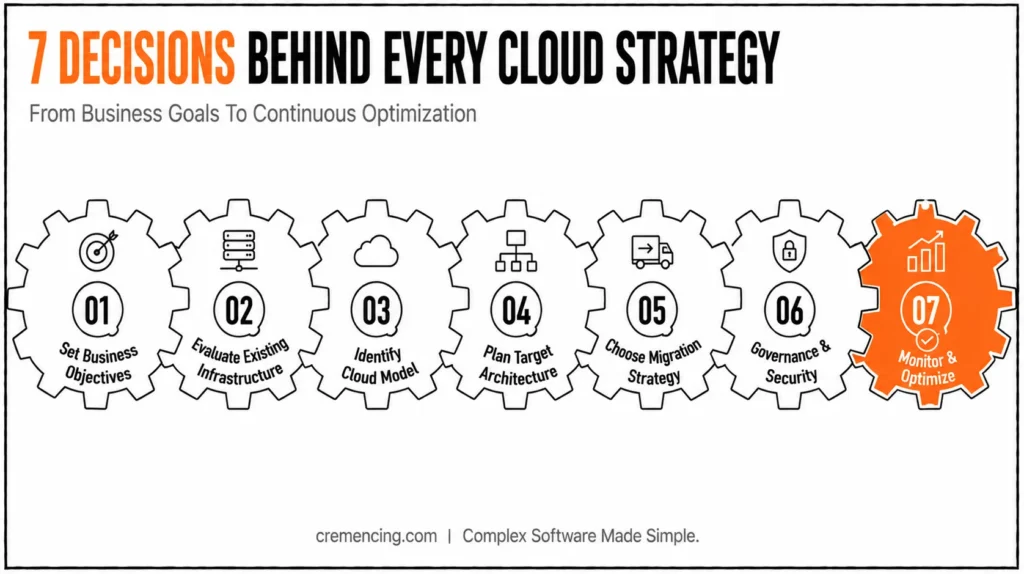
How Does Cloud Computing Strategy Work?
Step 1: Set Your Business Objectives
Start by identifying:
First, start by identifying your core business goals, such as growth targets, customer experience improvements, and operational challenges.
Example:
Checkout latency is slowed for 50% less time on average at an e-commerce company.
Step 2: Evaluate existing infrastructure
Next, assess your current systems, including applications, data storage, and integration dependencies.
This means you can decide what is eligible to migrate, be replaced, or stay as is.
Step 3: Identify a Suitable Cloud Model
After that, choose the right cloud model based on your needs. Options include public cloud, private cloud, or hybrid cloud.
Cloud strategy example:
Hybrid cloud is typically used by banks for a balance of security and scalability.
Step 4: Plan Target Architecture
Then, define your target architecture, including microservices vs monolithic design, API-first approach, and data flow structure.
Emphasize scalability, durability, and performance.
Step 5: Migration Strategy Plan
Once the architecture is defined, choose a migration approach such as lift-and-shift, replatforming, or refactoring.
They come with varying degrees of difficulty and cost.
Step 6: Governance & Security
Next, establish strong governance policies, including identity and access management, encryption, and compliance controls. For SAP-centric environments, cloud governance should also cover BTP accounts, services, integrations, security controls, and ownership; our SAP BTP governance model explores these decisions in more detail.
Step 7: Monitor & Optimize
Finally, continuously monitor performance, cost, and system reliability using cloud tools.
In fact, optimization is not a one-time step it is an ongoing process for long-term efficiency.
| Architecture layer | Decisions to make |
|---|---|
| Identity | SSO, federation, privileged access, workload identities |
| Network | VPC/VNet structure, segmentation, private connectivity, ingress/egress |
| Compute | VMs, containers, serverless, managed platforms |
| Application | Monolith, modular application, microservices, event-driven components |
| Data | Relational databases, object storage, caching, replication, retention |
| Integration | APIs, messaging, events, ETL/data pipelines |
| Security | Encryption, secrets, vulnerability management, security monitoring |
| Operations | Logging, metrics, tracing, alerting, incident response |
| Resilience | Availability zones, backups, RTO, RPO, disaster recovery |
| Governance | Policies, tagging, ownership, cost controls, compliance |
Capitalizing on Cloud Computing Strategy Benefits and ROI
An effective cloud computing strategy creates quantifiable business benefits.
Cost Efficiency
Reduce infrastructure costs by 20–40%. Moreover, pay-as-you-go pricing eliminates overprovisioning.
Scalability
Handle traffic spikes without downtime. Scale resources dynamically
Faster Time-to-Market
Deploy applications 50% faster. Accelerate product development cycles
Improved Reliability
For instance, high availability and disaster recovery. Reduced downtime and service interruptions
Enhanced Security
Built-in security tools. Centralized monitoring and threat detection
Cloud Computing Strategy Mistakes & Best Practices
Mistakes to Avoid
Organizations can create unnecessary complexity when they move to the cloud without a clear strategy. Therefore, avoid these common mistakes:
- First, migrating everything without prioritizing workloads
- Additionally, ignoring ongoing cloud cost management
- Furthermore, operating without clear governance policies
- Finally, overengineering the architecture without a clear business need
Best Practices
Organizations should instead begin with a clearly defined roadmap for cloud computing strategy and implementation. From there, they can build a more controlled and sustainable cloud environment:
Finally, regularly review and optimize workloads, computing strategy mistakes & best practices.
First, use automation wherever possible
Next, adopt a modular and scalable architecture.
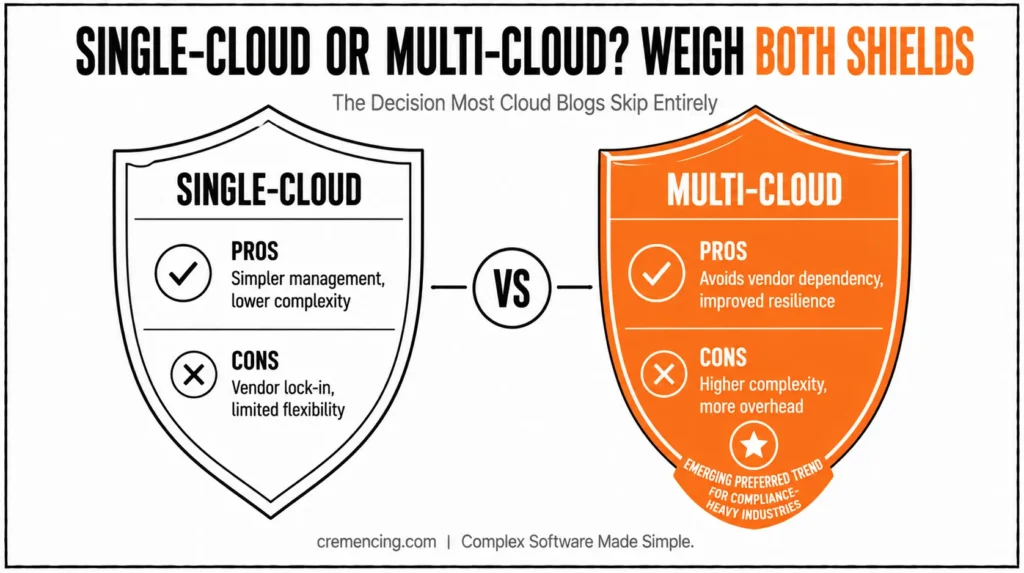
Multi-Cloud vs Single-Cloud Decision Framework
| Decision factor | Single cloud | Multi-cloud |
|---|---|---|
| Operational complexity | Lower | Higher |
| Provider specialization | Strong within one ecosystem | Can combine provider strengths |
| Portability | Lower | Potentially higher |
| Skills requirement | More focused | Broader |
| Governance | Simpler to standardize | More complex |
| Resilience | Depends on architecture | Can diversify provider dependency |
| Cost management | Easier to consolidate | Requires cross-provider visibility |
| Best fit | Focused enterprise strategy | Specific regulatory, resilience, or workload requirements |
Decision rule: Do not select multi-cloud merely to avoid vendor lock-in. Select it when the business case, regulatory requirement, resilience model, or workload characteristics justify the additional operational complexity.
Furthermore, AWS architecture guidance emphasizes evaluating workload scope, dependencies, disruption impact, and prioritized risks when assessing architecture decisions.
Cloud Strategy Decision Check
Business
- What business outcome must cloud adoption improve?
- How will success be measured?
- Which workloads directly support that outcome?
Architecture
- Which cloud model fits each workload?
- What are the application and data dependencies?
- What are the RTO and RPO requirements?
- Is microservices complexity actually justified?
Security
- Who owns identity and privileged access?
- Where can sensitive data reside?
- Which controls are mandatory before production?
Operations
- Who owns each workload?
- How will logs, metrics, and alerts be managed?
- How will incidents and changes be handled?
Financial
- What is the current baseline cost?
- What is the expected total cost after migration?
- How will utilization and cloud spend be reviewed?
Cloud Computing Strategy in Practice
Netflix: Global Cloud Scalability
- Uses AWS for global scalability
- Microservices architecture
- Auto-scaling for traffic spikes
Airbnb: Cloud-Native Infrastructure
- Cloud-native architecture
- Data-driven infrastructure decisions
- Focus on performance optimization
Enterprise ERP Migration: Hybrid Cloud
- Migrate legacy systems to a hybrid cloud
- Reduced operational costs by 30%
- Improved system uptime
These cloud computing strategy examples demonstrate how strategy varies by industry and based on requirements. For more insight, read our blog on 7 SAP CPI Cloud Integrations.
Conclusion
A cloud computing strategy is ultimately a decision framework, not a migration checklist. Therefore, the strongest strategy aligns business objectives with workload decisions and carries them consistently through architecture, migration, governance, security, and ongoing operations.
The architecture should reflect the workload rather than follow a trend. For example, some applications may justify cloud-native services or microservices, while others may be better served by a simpler architecture. Likewise, single-cloud, hybrid, and multi-cloud models each create different trade-offs in cost, resilience, portability, and operational complexity.
Modern ecclesiastical planning all begins with a well-developed cloud computing strategy. Consequently, it ensures your systems are scalable, intelligent, secure, and driving towards business goals.
Whether that be choosing the appropriate cloud model, architecting for clouds, or writing performant code, each of those decisions is key here. Therefore, organizations realize success in the public cloud when they are strategy-first and implementation-second.
FAQ
What is a cloud computing strategy?
It is a strategy that describes how an organization leverages cloud technologies to meet its business requirements.
Why is cloud strategy important?
This leads to better resource usage, lower costs, and more efficient system function.
What are some types of cloud strategies?
This includes hybrid cloud configurations, multi-cloud environments, and cloud-native architecture.
What statistical-based data should be on a cloud computing strategy?
Architecture design, governance, migration plans, and cost management must be included in all the silver bullets.
Where could I come by a PDF on cloud computing methods?
Several providers provide guides for download reliable sources can be found below in the resources section.
Is multi-cloud better than single-cloud?
Not automatically. Multi-cloud can provide specific resilience, regulatory, or workload-placement benefits, but it also increases operational and governance complexity.
What should a cloud migration strategy include?
It should include workload discovery, dependency analysis, migration-wave planning, migration patterns, security, testing, cutover planning, rollback, operations, and cost management.
How do you measure whether a cloud strategy is successful?
Measure business and technical outcomes against a baseline. Useful metrics include cost per workload, deployment frequency, availability, latency, incident rates, recovery time, and security compliance.