
Introduction
In the rapidly changing tech world, companies require the correct environment to leverage SAP Business Technology Platform (BTP) solution. With a variety of environments at your disposal, the right one can offer scalability, flexibility, and efficiency. SAP BTP Environment provides varieties of environments to satisfy various business requirements.
In this blog we’re going to walk you through SAP BTP environments, the capabilities they provide compared with what competing clouds offer and establish which environment is best for your business so you can make a well-informed choice that results in long-term success.
SAP BTP Meaning And The Importance Of Choosing The Right Environment
SAP BTP is a bundle of technology that lets companies innovate, integrate and scale. It is a single platform for creation and deployment of cloud applications and data and see it work the same way across all environments.
Your SAP BTP environment describes the settings in which you operate your business applications and data services, as these may change according to your enterprise rationale.
Types of SAP BTP Environments
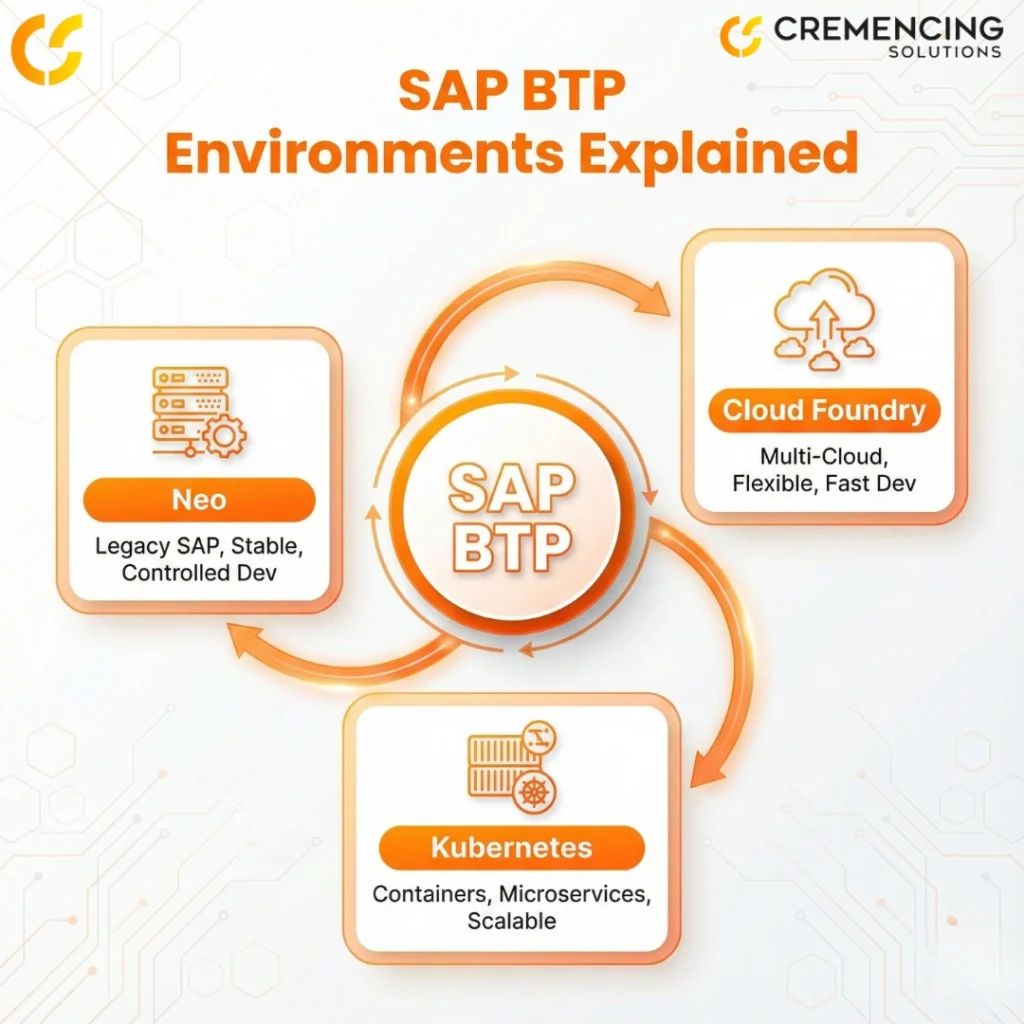
- Cloud Foundry Runtime: Offering a multi-cloud environment, flexibility, scalability and an open source platform.
- Kubernetes Environment: A containerized environment which is ideally suited for companies requiring microservices architecture and resizable containerized applications.
- Neo Environment: A legacy environment that still hosts some of the older SAP applications, and you have greater control over app development here.
Things to Consider When Choosing the Correct SAP BTP Environment
Selecting the best environment depends on a number of details related to your business objectives, technology stack, and scalability needs. Here’s what to know for business.
Scalability and Flexibility
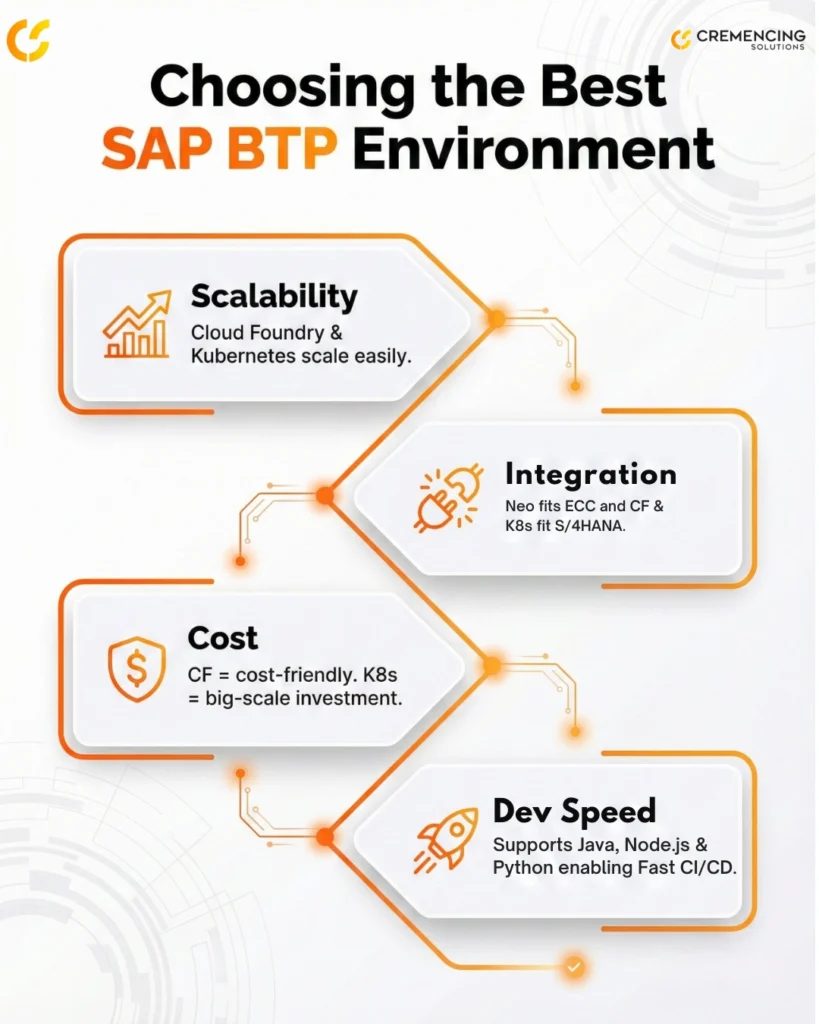
Cloud Foundry and Kubernetes environments are perfect for companies who need scalability and flexibility to handle, as well as deploy cloud-native apps.
If you are looking to be able to scale your resources in and out depending on the demand, and use more than one cloud provider, these two sandbox environments will offer you that flexibility.
Integration with SAP Solutions
For these organizations, Neo Environment is the better option as it can be integrated easily with older SAP systems such as ECC.
If your organization is using SAP S/4HANA or other modern SAP applications, Cloud Foundry and Kubernetes are ideal since they offer better integration options with newer versions of SAP solutions.
Cost Efficiency
Cloud Foundry is also a very good fit for smaller companies or companies that are price sensitive because of the cost structure and it can be deployed to public cloud providers.
Bigger businesses with more sophisticated requirements could have experiences that would warrant a bet on Kubernetes, particularly in the case of mission-critical, containerized apps, but they would also need to invest heavily up front to do so.
Development Speed and Flexibility
Java, Node.js, Python, and more. This can really save you some development time.
Perfect for DevOps teams – this makes it ideal for DevOps teams that value automated deployment and CI/CD pipelines, as it allows applications to reach the market quicker.
Selecting the Right SAP BTP Environment for Your Enterprise
Following is a list of the main SAP BTP environments and how they serve various business requirements:
| SAP BTP Environment | Ideal For | Key Benefits |
| Cloud Foundry | Businesses needing flexibility, rapid development | Multicloud support, support for many programming languages, open-sources approach |
| Kubernetes | Organizations with microservices and containerized apps | High scalability, microservices architecture ready, containerized management |
| Neo | For companies on older SAP systems such as SAP ECC | Perfect for your legacy SAP installations, seamless tie-in towards SAP’s historically based applications |
What Factors Determine Your Choice of SAP BTP Environment?
Your Existing SAP Infrastructure
In the case that your business is deeply integrated into SAP ECC and you have to operate such legacy systems, then Neo will remain your go to place.
If you are preparing for your migration to SAP S/4HANA and adopt cloud-native tools then Cloud Foundry or Kubernetes would be the better choice.
Business Growth and Future-Proofing
If a business expects to grow in the future, they can benefit from containerized applications that are flexible and scalable. K8s is only appropriate for co-packers with an eye toward significant expansion.
Where enterprises embark on a fuzzy journey to cloud or contorted dance through the world of cloud-native, Cloud Foundry provides a glidepath.
Conclusion
It is important to choose the correct SAP BTP environment so that your business can scale, innovate and prepare for what’s next, without having to pay the penalty of managing complexity or inadvertently compromising on flexibility.
Whether you need flexibility, agility or seamless integration with SAP applications and systems (and Cloud Foundry apps running on Kyma, Kubernetes container schedulers, and Neo), there are unique capabilities to each of them which could best serve your app.
By giving these factors careful consideration, you can make the right decision so that your business can leverage its sales strategy to produce the best return on investment for your company.
If you’re ready to take the next step in your digital transformation journey, connect with Cremencing today. Together, we’ll explore tailored solutions that drive efficiency, innovation, and growth.
Fore more insights read our blog How Easy It Can Be to Manage APIs Using the SAP BTP API Lifecycle Tools
FAQs
What are the SAP BTP environments?
SAP BTP environments are the runtime options in which you build and run applications on SAP Business Technology Platform. The main options are the Cloud Foundry environment, the Kyma environment, the ABAP environment and the legacy Neo environment. Each one supports different programming models, so the choice depends on your skills and use case.
Which SAP BTP environment should I choose?
Choose by workload and team skills instead of company size. Cloud Foundry suits applications in Node.js, Java or Python, Kyma suits container-based microservices and event-driven extensions, and the ABAP environment suits teams that extend SAP S/4HANA with ABAP Cloud. SAP recommends the multi-cloud environments for new projects instead of Neo.
What is the difference between Cloud Foundry and Kyma?
Cloud Foundry is a platform-as-a-service that deploys applications from code, so developers do not manage containers. Kyma is a Kubernetes-based runtime where teams package workloads as containers and use microservices and eventing. Kyma offers more control and flexibility, whereas Cloud Foundry needs less operational effort.
Is the SAP BTP Neo environment still supported?
Neo is SAP’s older, SAP-proprietary environment, and SAP positions the multi-cloud environments, such as Cloud Foundry and Kyma, as the strategic choice for new projects. Existing Neo customers should check SAP’s current lifecycle information and plan a migration, because the available services and regions differ from those in the multi-cloud environments.
Can SAP BTP environments connect to SAP ECC?
Yes. Every SAP BTP environment can connect to SAP ECC or on-premise SAP S/4HANA through SAP Cloud Connector together with the Destination service, and this is not limited to Neo. The available services and APIs depend on the system release, so check the ECC support package level and the OData or RFC interfaces first.
Is it possible to switch between SAP BTP environments?
You can move applications between SAP BTP environments, but this is a migration project and not a simple switch. A move from Neo to Cloud Foundry requires changes to the application, the services and the security configuration, so plan an assessment, a test phase and a cutover. SAP provides migration guidance for this scenario.
Is Cloud Foundry suitable for small businesses?
It can be, because Cloud Foundry lets teams deploy applications without managing infrastructure, and it supports several programming languages. Cost depends on the services you consume and on your SAP BTP contract model, not only on the environment, so estimate the service usage before you decide between the SAP BTP environments.
When do I need the SAP BTP ABAP environment?
Use the ABAP environment when ABAP developers build cloud-ready extensions or apps with ABAP Cloud, for example side-by-side extensions to SAP S/4HANA that follow the clean core approach. It runs on SAP HANA Cloud and restricts development to released APIs, which keeps upgrades stable and extensions maintainable.
Resources
If you would like to learn more about SAP BTP, and make the best decision for your business, here’s a few resources to guide your decision: