

ABAP vs Java is no longer a simple choice between two programming languages for SAP professionals. As S/4HANA, SAP BTP, ABAP Cloud, RAP, and cloud-based extensions continue shaping SAP development, the better career path depends on where you want to build and which technologies your target projects require.
Most people consider their career span, the impact on technology, and salary when selecting between ABAP and Java. Reports, function modules, BAdIs, and IDocs are still very much alive in ECC 6.0 and continue to extensively use ABAP. The technologies of S/4HANA, ABAP Cloud, and SAP BTP, however, allow for S/4HANA applications and workflow orchestration and custom Fiori apps to be integrated side by side with CAP (Cloud Application Programming Model).
Core transactional business logic continues to be critical in ABAP, whereas the flexibility of cloud-native development, microservices, and integrations via APIs is achieved using Java. Taking a look at careers in SAP vs Java, the fact that both are transactional should be considered, and extension opportunities offered within each language. The combination of ABAP for SAP core and Java for modern and scalable solutions is the best approach for 2026.
ABAP Vs Java Comparison
| Decision area | Classic ABAP | ABAP Cloud / RAP | Java / CAP |
|---|---|---|---|
| Primary environment | ECC, S/4HANA on-premise/private cloud | S/4HANA Cloud, S/4HANA/private cloud, BTP ABAP environment | SAP BTP |
| Main role | SAP core development and maintenance | Cloud-ready SAP applications and extensions | Side-by-side applications and services |
| SAP data access | Classic repository/database access according to system rules | Released APIs and objects | APIs/services exposed by SAP or other systems |
| Modern programming model | ABAP Objects, Open SQL, enhancements | CDS + RAP + ABAP Cloud | CAP + Java/Spring Boot |
| Clean-core alignment | Depends on implementation | Designed for lifecycle-stable/cloud-ready development | Strong fit for side-by-side extension patterns |
| Best career fit | ECC/S/4HANA core specialist | Modern ABAP/S/4HANA developer | BTP/cloud application developer |
| Strongest combination | Classic ABAP + modernization skills | ABAP Cloud + RAP + CDS | Java + CAP + APIs/integration |
ABAP-Centric Careers
Historically, ABAP was the sole focus of SAP careers. The developers worked well with all the internal tables in SAP: SE38, SE11, SE37, ST22, and SM59. Additionally, the main skills were user exits, function modules, reports and BADIs. ABAP was essential for all transactional processes on ECC 6.0 systems, providing the rules of business, authorizations and data consistency. Optimising database access, an in-depth knowledge of the internals of SAP and the ability to debug complex transactions/batch jobs were all significant for career progression.
Furthermore, some ABAP vs Java for SAP development specialists were paid very competitively, especially in companies with extensive ECC landscapes. Additionally, the core business processes needed to be maintained. However, the knowledge of modern programming models, cloud-based programming, and new integration tools was limited to just ABAP. As a result, in hybrid or cloud projects, developers who did not learn other languages, such as Java or Python, had fewer opportunities than those who did. 5 Mistakes that break your program.
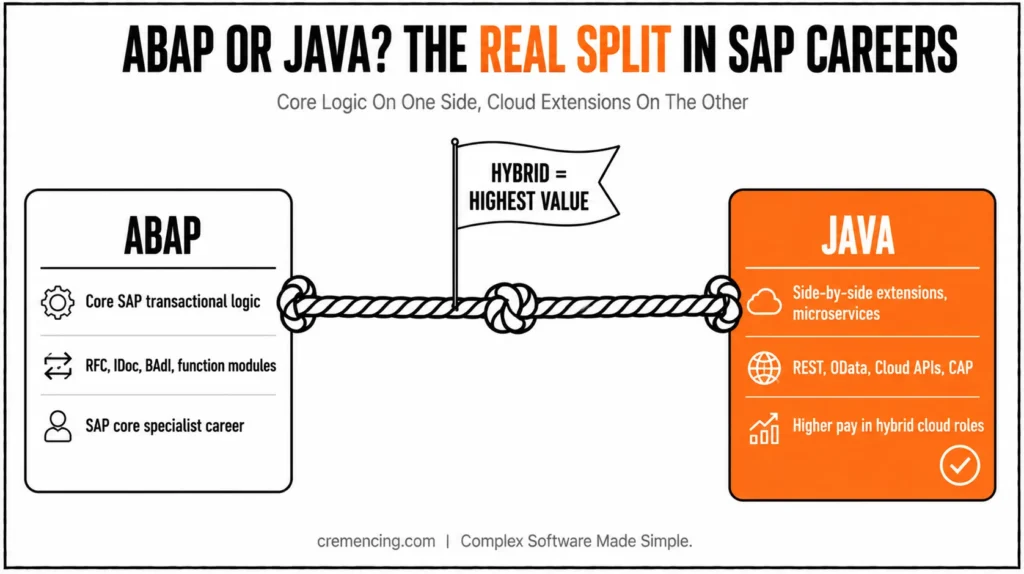
Nevertheless, ABAP-based knowledge continued to be a basis for development, modernization projects, and reliable consulting work in SAP ecosystems that is future-proof and upgrade-safe, thereby ensuring enterprise SAP stability. For more on how to get ABAP jobs.
REPORT zsales_report.
DATA: lv_sales TYPE vbak-vbeln,
lv_cust TYPE kna1-name1.
SELECT SINGLE vbeln kunnr
INTO (lv_sales, lv_cust)
FROM vbak
JOIN kna1 ON kna1~kunnr = vbak~kunnr
WHERE vbak~vbeln = ‘5000000010’.
WRITE: / ‘Sales Order:’, lv_sales, ‘Customer:’, lv_cust.
Limitations of the ABAP-only path:
- Focused only on SAP core; no cloud experience.
- Limited exposure to microservices, REST APIs, or Fiori extensions.
- Career growth is capped to SAP core projects.
- Salary potential lower in hybrid or cloud roles compared to developers with Java skills.
Java Integration & Hybrid Skills
Java allows SAP developers to build side-by-side cloud applications, integrate with CAP, develop Fiori apps, and orchestrate services on SAP BTP. However, combining ABAP and Java creates a hybrid skill set, capable of handling core SAP logic and modern extensions.
package com.sap.btp.demo;
import com.sap.cloud.sdk.s4hana.datamodel.odata.namespaces.salesorder. Sales Order;
import com.sap.cloud.sdk.s4hana.datamodel.odata.services. DefaultSalesOrderService;
public class SalesOrderFetcher {
public static void main(String[] args) {
DefaultSalesOrderService service = new DefaultSalesOrderService();
SalesOrder order = service.getAllSalesOrder()
.top(1)
.execute()
.get(0);
System.out.println(“Sales Order: ” + order. getSalesOrder());
}
}
Advantages of hybrid ABAP + Java careers:
- Upgrade-safe core via ABAP; cloud-native flexibility via Java.
- High demand in S/4HANA modernization, BTP, and API-driven projects.
- Increased salary potential in hybrid roles, blending SAP vs Java skills.
- Enables developers to implement automation, AI, and analytics outside the SAP transactional core.
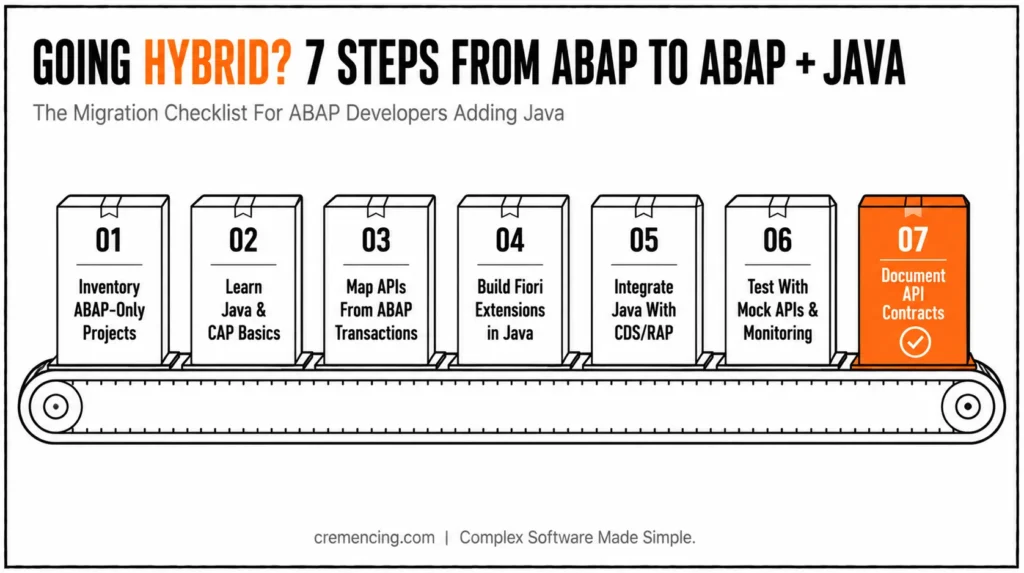
Migration Checklist for ABAP Developers Considering Java
- Inventory ABAP-only projects and assess where Java microservices can extend functionality.
- Learn Java basics, object-oriented programming, and SAP BTP CAP framework.
- Map core ABAP transactions that can expose APIs for Java consumption.
- Develop side-by-side applications for Fiori extensions using Java.
- Integrate Java services with ABAP CDS views and RAP objects for transactional consistency.
- Test hybrid solutions with mock APIs, batch jobs, and performance monitoring.
- Document API contracts to maintain upgrade-safe boundaries between ABAP core and Java extensions.
Developers working with SAP BTP often need to understand where different technologies fit. Learn more about SAP BTP Language
Conclusion:
Therefore, ABAP vs Java is not simply about switching between two programming languages. It is about planning your SAP career and building proficiency in the technologies that support modern SAP landscapes. Meanwhile, ABAP remains essential for core SAP processes and enterprise business logic. Compared with Java, ABAP is particularly important for SAP application logic and transactional processing, while modern ABAP Cloud, CDS, and RAP development can support clean-core and upgrade-stable development. Java, on the other hand, provides flexibility for cloud-based applications, APIs, microservices, and BTP-based side-by-side extensions. As a result, understanding both ABAP and Java for SAP development can help developers work across different layers of an SAP landscape.
Moreover, developers who build hybrid skills can work with both SAP core development and cloud-based extensions. In SAP modernization projects, this combination can expand the range of technical responsibilities and create opportunities to work on integration, APIs, BTP, and modern application development. By understanding ABAP compared with Java, developers can determine where each technology fits best: ABAP for SAP-centric business logic and Java for suitable cloud applications and side-by-side extensions.
Aside from that, hybrid SAP developers can contribute to digital transformation initiatives involving Fiori applications, REST/OData services, APIs, automation, and modern extension architectures. The Java vs ABAP decision therefore depends largely on the project, SAP landscape, and career direction. ABAP remains highly relevant for SAP core development, while Java can complement it in BTP and cloud application scenarios. Ultimately, the strongest SAP career path is not about choosing one language over the other, but knowing when to use ABAP, when to use Java, and how both technologies fit into a modern SAP architecture.
Frequently Asked Questions
- ABAP vs. Java: Which should I learn first?
Learn ABAP first for core transactional SAP logic. Java complements ABAP for cloud extensions and modernization, enabling hybrid careers. - SAP vs. Java salary which is higher?
ABAP salaries are stable for core SAP projects. Java + ABAP hybrid roles typically command higher compensation in cloud/BTP projects. - SAP ABAP vs. Java career prospects?
ABAP remains critical for the S/4HANA core; Java opens opportunities for cloud-native projects and API-based services. Hybrid expertise is most valuable. - Can ABAP developers transition to Java?
Yes, ABAP developers can learn Java for BTP, CAP, and side-by-side applications without leaving SAP core expertise behind. - Is ABAP still worth learning for S/4HANA?
Yes. Modern SAP development still includes ABAP, but the relevant skill set increasingly includes CDS, RAP, released APIs, and ABAP Cloud rather than only classic report programming. - Is Java replacing ABAP in SAP?
No. SAP supports multiple development models. ABAP remains central to SAP development, while Java can be used for CAP-based applications and services on SAP BTP. - Should an ABAP developer learn Java or RAP first?
For an ABAP developer targeting modern SAP development, RAP and CDS are usually the more direct next step because they extend the existing ABAP skill set into the ABAP Cloud development model. Java/CAP becomes particularly useful when the target role involves BTP side-by-side application development.