

Introduction
SAP performance tuning interview questions test more than your knowledge of ABAP syntax. They show whether you can identify performance bottlenecks, troubleshoot database and application-layer issues, and choose the right optimization approach in real SAP environments.
That distinction separates memorized ABAP performance tips from real performance-tuning knowledge. In an ECC system, an expensive database read, large data transfer, or inefficient internal-table operation may be the bottleneck. In an S/4HANA system, the same report may require SQL trace analysis, runtime profiling, execution-plan analysis, or a redesign using ABAP SQL and CDS. SAP provides tools such as ST05 and SAT specifically to investigate these different layers.
This guide focuses on the questions interviewers use to test that reasoning. Instead of memorizing isolated rules, you will need to explain what you would measure. Therefore, what evidence would you look for, and why does a particular optimization fits the workload.
How ABAP Performance Works in ECC vs S/4HANA
The important interview distinction is not “ECC is slow, and S/4HANA is fast.” It is where the workload executes and how you prove the bottleneck.
In both environments, ABAP sends requests to the database and handles some processing in the application server. It can also spend time working with internal tables, methods, data conversions, and other application logic. However, S/4HANA offers more opportunities to process data directly in the database because it runs on SAP HANA. As a result, developers can use ABAP SQL, CDS, and other HANA-based technologies to move suitable processing closer to the database.
That means a strong interview answer should follow the evidence:
- Database-heavy problem: start with ST05 or SQL monitoring and inspect expensive or frequently executed SQL.
- ABAP-heavy problem: use SAT or the ABAP Profiler to identify hotspots in methods, loops, and other runtime blocks.
- Mixed SQL and ABAP problem: use a combined trace such as ST12 where appropriate.
- Long-running production workload: use SQL monitoring and workload information rather than relying only on a short developer-system test.
- Potential pushdown opportunity: first understand the existing SQL and runtime cost, then evaluate whether ABAP SQL or CDS provides a better design.
SAP’s current ABAP Platform documentation specifically identifies SAT and ST05 as standard tools for analyzing ABAP runtime and database access, while SQL monitoring provides longer-term workload information.
This is the reasoning interviewers should hear: measure first, identify the cost centre, change the design, and and then measure again.
What Are ABAP Performance Tuning Interview Questions?
ABAP performance tuning interview questions test how well you understand runtime behavior, database interaction, and memory usage inside SAP application server architecture.
These questions typically focus on how ABAP interacts with the NetWeaver application layer and the underlying database. In contrast, ECC relies more heavily on application-layer processing, while S/4HANA benefits from in-memory processing and a simplified data model.
Interviewers use these questions to evaluate three core skills:
- Understanding of SQL execution inside ABAP
- Awareness of SAP kernel and database optimization layers
- Ability to redesign logic using CDS or AMDP in S/4HANA
A strong answer always connects code behaviour with system internals, not just syntax-level advice.
How ABAP Performance Works in ECC vs S/4HANA Internals
To answer ABAP performance tuning interview questions correctly, you must understand how execution differs across SAP releases.
In ECC systems, performance bottlenecks usually come from:
- Large dataset transfers from DB to ABAP memory
- Nested loops with internal tables
- Missing indexes causing full table scans
In S/4HANA, the architecture changes:
- Data is stored in-memory (HANA)
- Aggregation happens at database level
- CDS views and AMDP shift logic away from ABAP layer
Key runtime difference
ECC relies heavily on application server filtering.
S/4HANA pushes computation to the database layer using SQL pushdown.
This means a query like:
SELECT * FROM ekpo INTO TABLE lt_ekpo.
behaves very differently in ECC vs HANA. In HANA, the cost is not only I/O, but also unnecessary column retrieval from large in-memory tables.
Tool-based execution flow
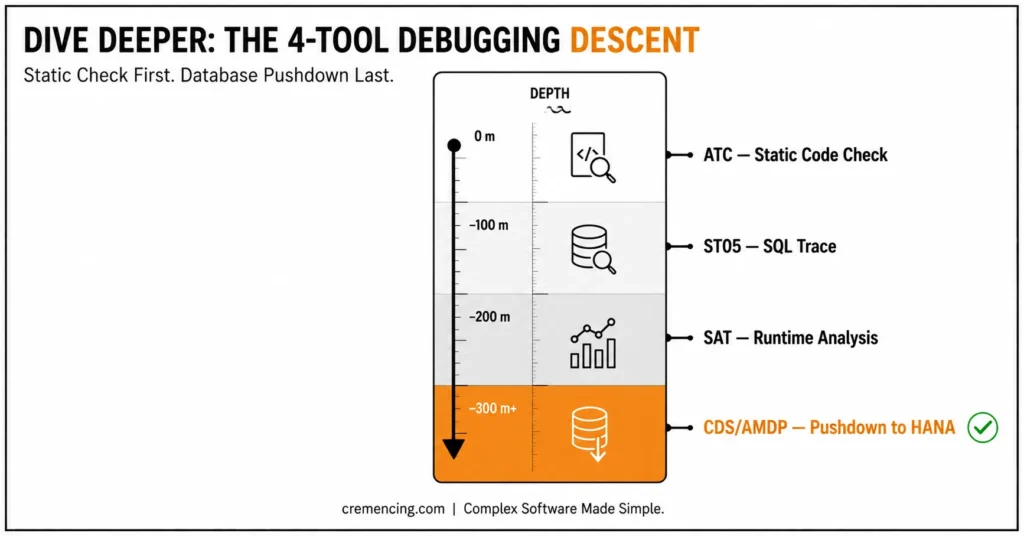
A correct debugging sequence in interviews:
- ATC (ABAP Test Cockpit) → static code check
- ST05 → SQL trace for database analysis
- SAT → runtime analysis for ABAP processing time
- CDS/AMDP evaluation → pushdown opportunity
ABAP Test Cockpit is now the first filter before runtime testing in modern S/4HANA projects
Practical Code Walkthrough for Performance Optimization
This is where most candidates fail in ABAP performance tuning interview questions they explain concepts but cannot show working optimization.
Problem 1: SELECT * inefficiency
Bad Approach (ECC style)
DATA: lt_ekpo TYPE TABLE OF ekpo.
SELECT * FROM ekpo INTO TABLE lt_ekpo.
” Pulls unnecessary columns → high memory + network cost
Optimized Approach
DATA: lt_ekpo TYPE TABLE OF ekpo.
SELECT ebeln, ebelp, matnr
FROM ekpo
INTO TABLE @lt_ekpo
WHERE bukrs = ‘1000’.
” Only required fields are fetched → reduces DB load
This reduces buffer pressure and improves network transfer efficiency.
Problem 2: FOR ALL ENTRIES, trap
This is one of the most tested interview scenarios.
Dangerous Code
DATA: lt_vbak TYPE TABLE OF vbak,
lt_vbap TYPE TABLE OF vbap.
” Driver table
SELECT * FROM vbak INTO TABLE lt_vbak.
” Risk: empty driver table
SELECT * FROM vbap
INTO TABLE lt_vbap
FOR ALL ENTRIES IN lt_vbak
WHERE vbeln = lt_vbak-vbeln.
Critical issue
If lt_vbak is empty, SAP ignores WHERE condition and returns the entire VBAP table.
Safe version
IF lt_vbak IS NOT INITIAL.
SELECT * FROM vbap
INTO TABLE lt_vbap
FOR ALL ENTRIES IN lt_vbak
WHERE vbeln = lt_vbak-vbeln.
ENDIF.
This single check prevents full-table scans in production.
Problem 3: Modern S/4HANA CDS Pushdown
In S/4HANA, interviewers expect CDS awareness.
” CDS view replaces ABAP filtering logic
SELECT * FROM zsales_cds_view
INTO TABLE @DATA(lt_sales).
Instead of looping in ABAP, logic is moved into CDS definition.
This is a core expectation in modern ABAP performance tuning interview questions.
Problem 4: AMDP for heavy computation
CLASS zcl_sales_amdp DEFINITION
PUBLIC CREATE PUBLIC.
PUBLIC SECTION.
INTERFACES if_amdp_marker_hdb.
CLASS-METHODS get_sales
IMPORTING VALUE(iv_year) TYPE i
EXPORTING VALUE(et_data) TYPE TABLE OF zsales.
ENDCLASS.
CLASS zcl_sales_amdp IMPLEMENTATION.
METHOD get_sales BY DATABASE PROCEDURE
FOR HDB LANGUAGE SQLSCRIPT.
et_data =
SELECT * FROM zsales
WHERE gjahr = :iv_year;
ENDMETHOD.
ENDCLASS.
This shifts processing fully to the HANA engine.
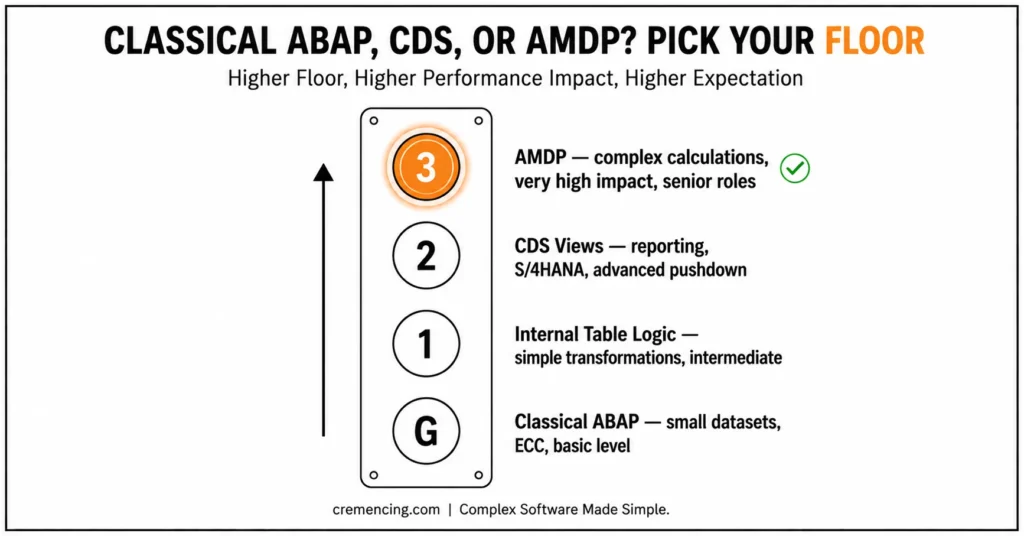
Classical ABAP vs CDS vs AMDP
| Approach | Best fit | What to verify | Interview-level answer |
|---|---|---|---|
| ABAP SQL + application logic | Requirements that are straightforward in ABAP | SQL executions, transferred rows, ABAP runtime | Start with the simplest design that meets the requirement |
| CDS | Reusable data models, joins, filtering, calculations and consumption scenarios suited to CDS | SQL workload, data volume, semantics and resulting plan | Explain why the logic belongs in the data model |
| AMDP | HANA-specific SQLScript processing with a justified use case | SQLScript cost, HANA dependency, maintainability | Explain why ABAP SQL/CDS is insufficient or inappropriate |
| Existing classical ABAP | Legacy code or logic that is already efficient | Actual runtime and database cost | Do not rewrite solely because newer technology exists |
ABAP Performance Interview Quick Reference
ST05 → “Is the database access expensive or repeated?”
SAT / ABAP Profiler → “Where is ABAP runtime being spent?”
ST12 → “Do I need ABAP and SQL tracing together?”
SQL Monitor → “Which SQL statements are expensive or frequently executed over time?”
ATC → “Does static analysis identify code or quality risks?”
Execution-plan analysis → “Why is this SQL statement expensive?”
Interview formula:
Measure → isolate the bottleneck → change one thing → measure again.
SAP’s current documentation describes ST05 and SAT as core tools for SQL and ABAP runtime analysis and provides SQL statement/trace analysis for deeper database investigation. For a deeper look at the SQL patterns that quietly increase database workload, see our guide to ABAP SELECT performance and the mistakes that slow down your code.
Conclusion
The ABAP performance tuning interview questions are no longer ones where you have to memorize tips, but rather ones that will require you to understand system behavior. The emphasis of ECC is database reduction; S/4HANA is pushdown via CDS and AMDP.
You can explain tools, demonstrate code fixes, and argue the architectural decisions, and you are already at a senior level. The main point is not to link ABAP logic with syntax rules; it is to link ABAP logic with runtime execution. Explore the checklist interviewers expect you to know.
More and more, interviewers demand that developers be able to determine bottlenecks, evaluate execution plans, and select an appropriate optimization method for a specific business environment. Knowing the performance, internal table processing, buffering concepts, parallel processing, and HANA native approaches to development can make a huge difference in your interview results.
Overall, a combination of theory and practical troubleshooting is the best preparation strategy. For example, when you examine real-world performance problems, track changes in performance, and understand why each optimization was performed, you build a stronger understanding of ABAP performance. As a result, you can answer interview questions with greater confidence and demonstrate the mindset of a seasoned ABAP professional.
Frequently Asked Questions
1. What are ABAP performance tuning interview questions?
They test how you optimize SQL, internal tables, and runtime execution. They focus on ABAP performance optimization techniques like indexing, buffering, and pushdown strategies.
2. What is ST05 in ABAP performance analysis?
ST05 SQL Trace is used to analyze database queries and identify slow SQL execution paths in ABAP programs.
3. How do you optimize SELECT statements in ABAP?
Use field-specific SELECT instead of SELECT *, ensure proper WHERE clauses, and avoid unnecessary data transfers from database to application layer.
4. What is FOR ALL ENTRIES in ABAP?
It is used to filter database results based on an internal table, but requires careful empty-check handling to avoid full-table reads.
5. What is SAT in ABAP performance?
SAT Runtime Analysis measures ABAP execution time and helps identify expensive internal operations like loops and method calls.
6. What is ABAP Test Cockpit used for?
ATC performs static code checks and identifies performance risks before runtime execution in modern SAP systems.
7. What is CDS in S/4HANA performance tuning?
CDS views push logic to the database layer, reducing ABAP processing and improving query execution speed in HANA systems.
8. How is AMDP different from normal ABAP?
AMDP executes logic directly in HANA using SQLScript, making it suitable for complex aggregations and high-volume datasets.