Introduction
The SAP Data Foundation is changing in 2026 as SAP expands Business Data Cloud and reshapes how organizations manage, integrate, and govern enterprise data. This distinction matters especially for SAP data architects, CIOs, analytics teams, and organizations deciding whether to continue with an existing Datasphere landscape or move toward a more integrated Business Data Cloud setup.
Importantly, SAP describes Datasphere as a key component of Business Data Cloud, rather than as a product that is being discarded. At the same time, existing Datasphere customers can continue using their services, while SAP provides a path toward the broader managed BDC experience.
Therefore, the real 2026 question is not “What replaces Datasphere?” Instead, it is “What role does Datasphere play inside SAP Business Data Cloud, and when should an organization move toward the broader platform?” To answer that question, this article breaks down the distinction, explains the architecture behind it, and examines the transition considerations. Furthermore, it outlines the key decisions SAP teams should make before changing their data strategy.
What Does SAP Have as a New Data Foundation?
SAP’s new data foundation is a next-generation architecture that expands on Datasphere as part of SAP Business Data Cloud, rather than replacing it outright. Its main objectives are to:
- Move enterprise data to a single location to access data faster and integrate it better.
- Enhance scalability as the volumes of data grow.
- Increase AI and analytics to obtain real-time insights.
- Minimize complexity in multi-cloud and hybrid environments.
| Capability | SAP Datasphere | SAP Business Data Cloud |
|---|---|---|
| Data integration | Core capability | Included as part of broader platform |
| Semantic modeling | Core capability | Uses Datasphere capabilities |
| Data products | Yes | Yes, with broader managed ecosystem |
| Business data fabric | Technology foundation | Broader managed architecture/solution |
| SAP BW modernization | Can participate through relevant capabilities | Major BDC use case |
| SAP Databricks | Integration/ecosystem option | Included capability |
| SAP HANA Cloud | Related data platform | Included in BDC ecosystem |
| AI/data context | Business semantics and governed data | Broader foundation for AI and agents |
| Existing Datasphere customers | Continue using service | Can transition over time |
| Physical centralization required | No | No |
Companies that use this as the base would be able to enjoy an improved level of operational efficiency, simplified architecture, and a platform that would future-proof data strategy in AI and advanced analytics.
What Does SAP Business Data Cloud Change for Datasphere?
The important distinction is between replacement and convergence.
SAP Business Data Cloud is a fully managed SaaS solution designed to unify and govern SAP data while connecting third-party data. SAP Datasphere remains a core component that provides capabilities around data integration, semantic modeling, data warehousing, data products, and preservation of business context.
For an existing Datasphere customer, this means the architecture decision is not automatically a migration away from Datasphere. SAP states that existing Datasphere customers can continue their services without interruption. Over time, customers can choose to transition their current solutions into the fully managed Business Data Cloud environment.
The practical difference is therefore broader than a product-name change:
- SAP Datasphere provides the data integration, modeling, semantic and data-product capabilities used to create business-ready data.
- SAP Business Data Cloud adds the broader managed environment and brings together capabilities including Datasphere, SAP Analytics Cloud, SAP Business Warehouse, SAP Databricks, SAP HANA Cloud and SAP Master Data Governance.
- Business data fabric describes the architectural approach of connecting data and business context across distributed landscapes rather than forcing every source into one physical repository.
That distinction also changes how organizations should approach migration. Before making a move, teams should assess what they already have in Datasphere, identify which BDC capabilities they actually need, and determine whether the commercial and operational benefits of a managed BDC environment justify the transition.
At the same time, there is an important technical consideration. SAP’s current architecture does not require all enterprise data to be physically centralized. Instead, Datasphere and Business Data Cloud support integration patterns that connect distributed data sources while preserving the semantics and business context needed for consistent analytics and decision-making.
If your SAP landscape is already moving toward a broader cloud architecture, review our guide to SAP BTP Governance Model and Guidance Framework for Cloud Architecture Strategy before defining the data-platform operating model.
How the New SAP Data Foundation Works
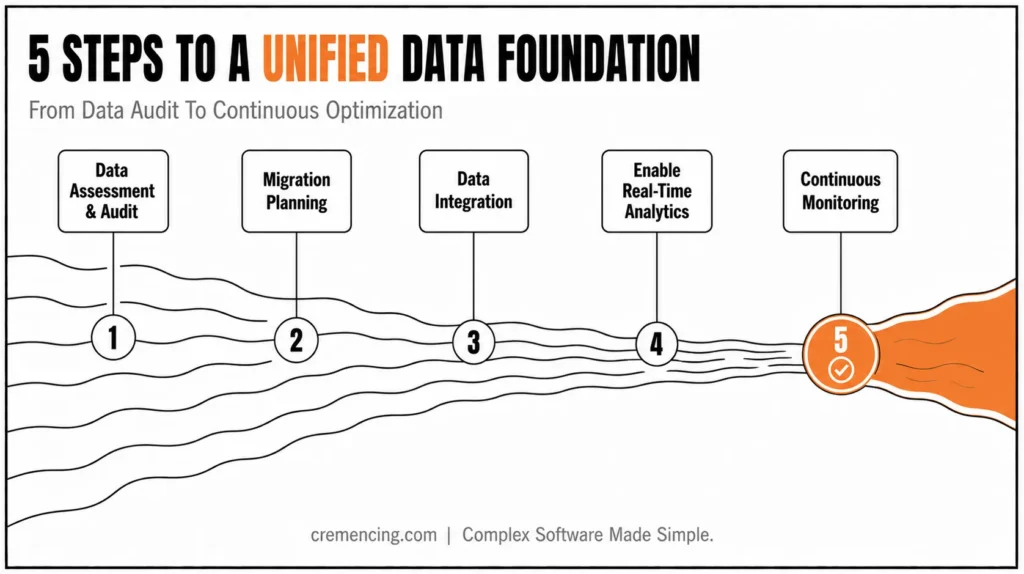
The new foundation of SAP proposes an organized method of enterprise data management. Here is a step-by-step procedure:
Step1 : Data Assessment & Audit
To ensure that the data sets are audited before migration, companies need to have both structured and unstructured data audited before migration. Key tasks:
- Determine unnecessary, outdated, or erroneous information.
- Dependencies and data sources of maps.
- Determine integration priorities
Step 2: Migration Planning.
The migration should be planned in phases to reduce the impact. This includes:
- Choosing cloud or hybrid deployment models.
- Specification of cutover strategies and fallback plans.
- Migration should be planned to occur during periods of low impact.
Step 3- Data Integration.
The new foundation links all the sources of enterprise data, such as SAP S/4HANA, third-party applications, and legacy systems. Integration steps include:
- Setting up APIs and ETL pipes.
- Setting data validation rules.
- Installing automated synchronization.
Step 4: Enabling Real-Time Analytics.
Upon integration, the platform complements AI-powered analytics, dashboards, and reporting tools. Organizations can:
- Real-time tracking of KPIs.
- Run predictive analytics to supply chain or sales forecasting.
- Create reports that are compliant and generate them in real time.
Step 5: Constant monitoring and optimization.
The platform keeps on checking performance, security, and data quality. Automated alerts and AI suggestions assist:
- Minim storage and compute expenses.
- Enhance query performance and analytics performance.
- Ensure compliance and data governance.
Benefits & ROI of SAP’s New Data Foundation
The transition to the new database can be associated with quantifiable advantages:
- Operational Efficiency: Optimizes processes, decreasing delays in processes by 30–40%
- Data Accuracy: Minimizes errors with automated validation and centralization
- Speed of analytics: Real-time reporting can enhance decision-making by up to 50%.
- Cost Savings: 20-25% in costs are saved through reduced duplication and improved cloud resource management.
- Scalability: When it comes to increasing the size of datasets, it does not require extra infrastructure overhead.
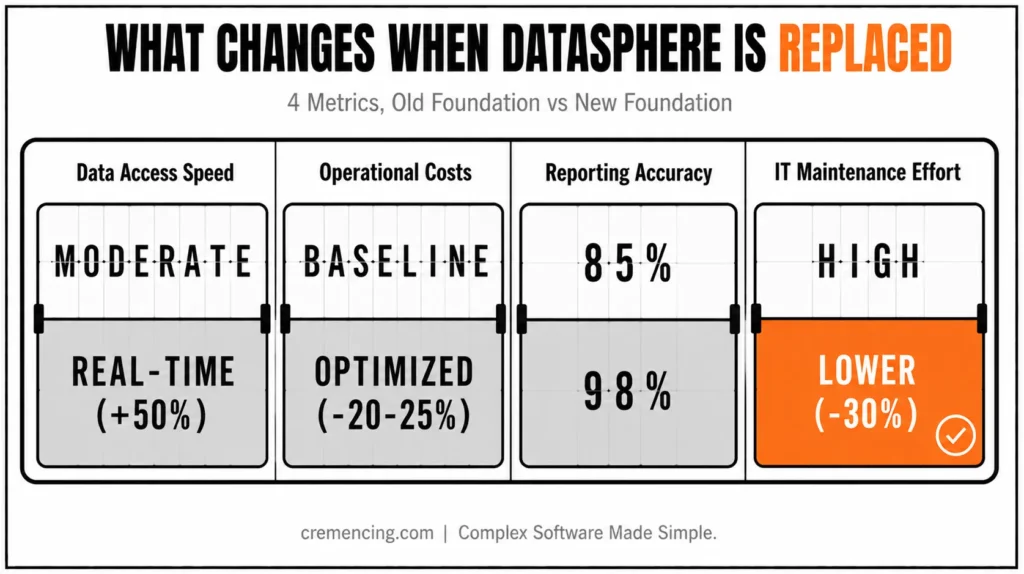
| Metric | Current Datasphere | New SAP Foundation | Improvement |
| Data Access Speed | Moderate | Real-time | +50% faster |
| Operational Costs | Baseline | Optimized | -20–25% |
| Reporting Accuracy | 85% | 98% | +13% |
| IT Maintenance Effort | High | Lower | Reduced by 30% |
Centralizing data, automating governance, and supporting advanced analytics enable companies to change the decision-making process and have a competitive advantage.
Traps and Ideal Practices.
Even sophisticated databases are to be implemented with thought.
Common Mistakes:
- Discussing the migration as a mere lift-and-shift.
- Leaving legacy system dependencies.
- Ignoring security and compliance issues.
- Underestimate user training and adoption requirements.
Best Practices:
- Carry out comprehensive pre-migration data audits.
- Implement project incremental rollout plans to reduce risk.
- Ensure compliance, privacy, and governance are a priority on day one.
- Train employees and stakeholders on the new platform.
- Check performance on a continuous basis in order to have the opportunity to optimise performance.
Neglected Opportunities Competitors Miss.
Most of the businesses are interested in simple migration without taking advantage of the sophisticated features:
- AI-Enhanced Decision-Making: Leveraging AI to predict demand, optimize supply chains, and identify anomalies proactively.
- Cross-Platform Integration: Integrating non-SAP systems to take advantage of enterprise-wide understanding.
- Predictive Maintenance and IoT Analytics: To predict the failure of equipment and to increase the uptime of operational equipment.
With the exploration of these areas, companies would be able to maximize ROI and gain a strategic advantage that competitors tend to overlook. The integration layer also matters: see our guide to SAP Integration APIs for a deeper look at how SAP systems should exchange data without creating unnecessary architectural coupling.
Conclusion
SAP’s expansion of its data foundation through Business Data Cloud marks a significant shift in enterprise data management. The new data foundation will be defined by centralized access, real-time analytics, integration with AI, and enhanced scalability. Proactive companies are able to save on operational costs, enhance the accuracy of their data, and speed up decision-making.
By avoiding some of the most obvious errors, following best practices, and cashing in on some of the least known opportunities, such as cross-platform integration and AI-enhanced insights, organizations will fully benefit from this transition.
The move toward SAP Business Data Cloud is not just a technical upgrade but a chance to transform the way business is conducted, increase efficiency, and future-proof your business.The time has come to initiate planning for a migration to the next-generation data foundation of SAP, where you can smoothly migrate the business with less disruption.
Frequently Asked Questions.
Q1: What will be replacing Datasphere in 2026?
SAP is rolling out a new, next-generation, cloud-native data foundation — SAP Business Data Cloud — that builds on Datasphere rather than replacing it, offering centralized and real-time data management as part of a broader managed platform.
Q2: What is the benefit of the new foundation to analytics?
It allows real-time dashboards, AI-driven insights, predictive analytics, and integrated reporting across various business units.
Q3: Does it require migration to the new platform?
Not immediately. Existing Datasphere customers can continue using their services without interruption. However, to take advantage of the broader managed capabilities in SAP Business Data Cloud, organisations will eventually want to plan a transition — on their own timeline, based on their roadmap and requirements.
Q4: What kind of companies are most advantageous?
The most significant gains are done by large enterprises, which have complex data ecosystems, but even middle-sized businesses are benefiting due to greater efficiency and analytics.
Q5: What can companies do to prepare the migration?
Audit the data, map all the systems, define migration phases, and train teams on the new platform to have the smooth transition.
Q6: Will SAP Datasphere stop working after 2026?
No. Companies should not assume that Datasphere will suddenly stop working in 2026. SAP’s data strategy is evolving, so organisations should assess their existing Datasphere architecture, future requirements, and available transition paths before making migration decisions.
Q7: What happens to existing data and integrations in Datasphere?
Existing data models, integrations, pipelines, and analytics should be assessed before any transition. Companies need to identify which assets can be reused, which require redesign, and which can be retired as part of the new data architecture.
Q8: How will the new SAP data foundation support AI?
The new data foundation is designed to make business data more accessible and usable for AI and advanced analytics. Better integration of governed business data can help organisations build AI use cases using consistent business context and trusted information.
Q9: How long does a Datasphere transition take?
The timeline depends on the size and complexity of the existing environment. Organisations with many data sources, custom models, integrations, and reporting workloads should expect a phased transition rather than a single migration event.
Q10: Should companies migrate immediately or wait?
Companies should avoid rushing into migration without understanding their current Datasphere environment and SAP’s evolving roadmap. A better approach is to assess existing workloads, identify future requirements, evaluate available transition options, and create a phased data strategy.
Resources
SAP Datasphere Overview
SAP Community: Data Management
Forrester Report: Enterprise Data Strategy.