
Introduction
The SAP ECC support end date is a hard deadline: mainstream maintenance for ECC 6.0 ends in 2027. Extended maintenance can push that to 2030, and a further paid extension is available through 2033 for some customers — but every year you wait inside that window, your migration options narrow and your execution cost climbs.
For organizations still running ECC, the SAP ECC support end date isn’t a distant technical footnote — it’s the deadline that determines whether your S/4HANA move happens on your terms or under emergency pressure. This guide breaks down what each phase of that timeline actually means, the migration paths available, and the hidden costs of treating “extended support” as a reason to wait.
Strategic Imperatives Behind the SAP ECC Deadline
The upcoming December 31, 2027 end of mainstream maintenance forces enterprises to resolve technical debt before steep support surcharges take effect. Delaying the transition to S/4HANA drastically increases commercial risks due to rising consulting fees, a severe shortage of certified migration talent, and the phase-out of legacy compatibility tools. By acting early, organizations eliminate operational compliance exposure while securing the resources required for a smooth, cost-effective transformation.
SAP ECC End of Support Date
According to SAP SNS, details the details for SAP S/4HANA transition timelines, which you will see mentioned in announcements to follow.
SAP ECC 6.0 Timeline Cheat Sheet
- Mainstream maintenance ends: 2027
- Extended maintenance option: through 2030
- Further extended option (select customers): through 2033
- Recommended starting tool: SAP Readiness Check
- Recommended technical cutover tool: SUM with DMO (brownfield)
Important Dates for SAP ECC 6.0 Releases
- Original support end date: 2027
- Extended support option: until 2030
- Extended support (for some): Through 2033
All these dates matter for SAP ECC 6.0, which is the most used ERP software around the world for all industries.
Once support ends, companies face:
- No security updates
- No legal or compliance patches
- Limited technical assistance
This means the SAP ECC support end date represents a critical milestone for IT and business leaders alike.
Step-by-step chronology of SAP ECC Support end date
All of this information is helpful, step by step, to understand the damage and plan accordingly.
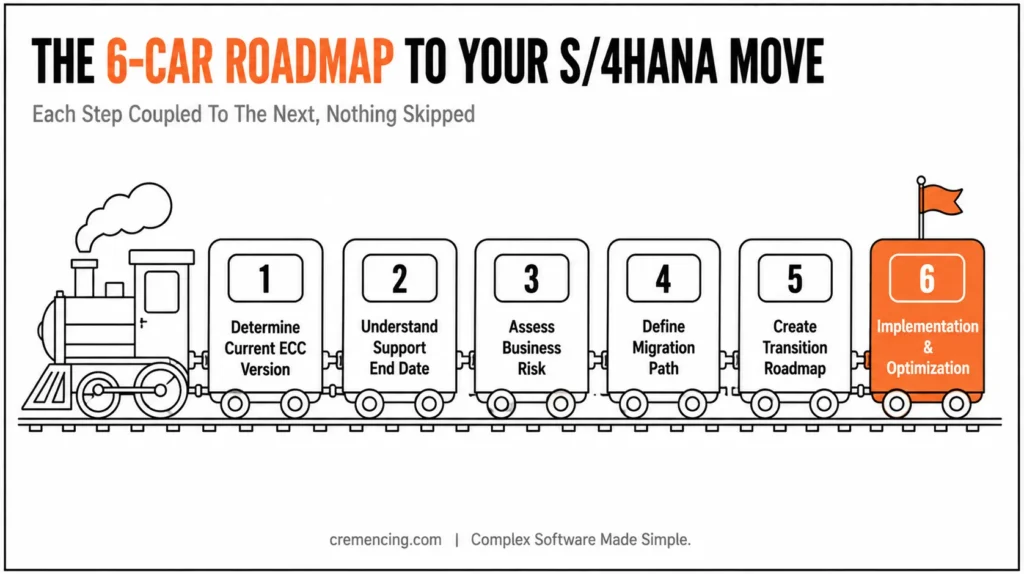
Step 1 – Determine Your Current ECC Version
Start by checking:
- If you are running SAP ECC 6.0
- Current enhancement pack level
- Custom developments in your system
This defines your starting point.
Beyond checking your enhancement pack level, run SAP Readiness Check early in this phase — it scans your system for custom code impact, add-on compatibility, and simplification item relevance before you commit to a migration path. This is the tool SAP itself recommends as the starting point for any ECC-to-S/4HANA assessment.
Step 2 – Understand the SAP ECC Support End Date
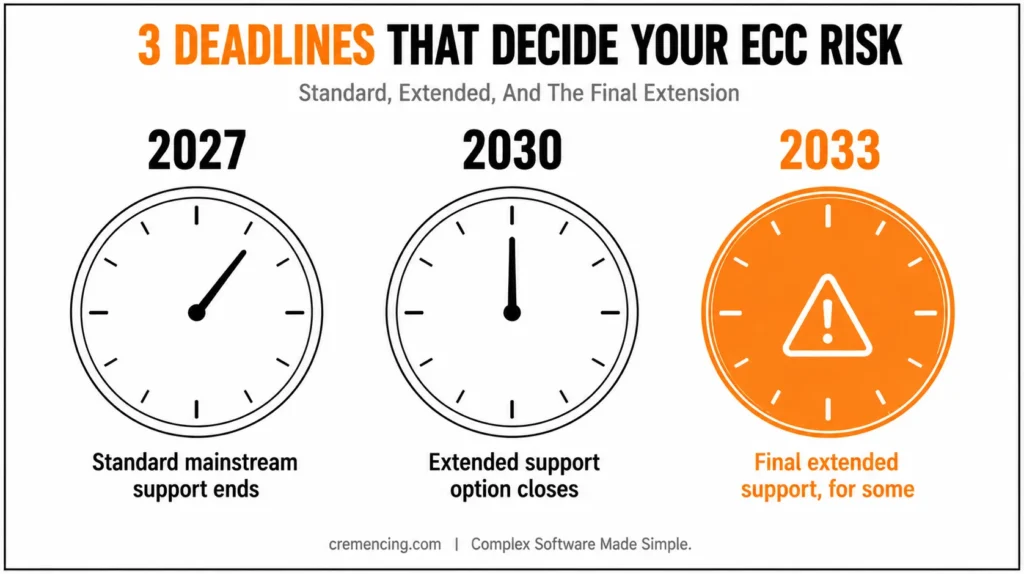
Map out your system against the key timelines:
- Standard support until 2027
- Extended support until 2030
- Extended support, optional until 2033
There are costs and support implications for each phase.
Step 3 – Assess Business Risk
Delaying action increases risk:
- Security vulnerabilities
- Compliance issues
- Integration limitations
This step is often underestimated.
Step 4 — Define Your Migration Path
Organizations typically choose:
- System conversion (Brownfield)
- New implementation (Greenfield)
- Landscape transformation
These have varying complexity and cost.
The three paths carry meaningfully different cost and timeline profiles. Brownfield (system conversion) preserves existing configuration and custom code, converting the technical foundation in place — fastest path, but carries forward existing technical debt. Greenfield (new implementation) rebuilds on S/4HANA best-practice processes from scratch — cleanest result, but the longest and most resource-intensive. Landscape transformation (selective data transition) sits between the two, letting you consolidate or restructure specific processes or company codes during the move. The Custom Code Migration app (within SAP Readiness Check or as a standalone Fiori app) is the standard tool for scoping how much custom ABAP will need remediation under whichever path you choose.
| Migration Path | Best For | Timeline | Custom Code Impact |
|---|---|---|---|
| Brownfield (System Conversion) | Preserving existing processes/config | Fastest | Carries forward — needs remediation via Custom Code Migration app |
| Greenfield (New Implementation) | Rebuilding on S/4HANA best practices | Longest | Minimal — rebuilt clean |
| Landscape Transformation | Consolidating systems/company codes during the move | Moderate | Selective — depends on scope |
Step 5 – Create a Transition Roadmap
Create a structured plan:
- Timeline for migration
- Budget estimation
- Resource planning
This ensures controlled execution.
Step 6 — Implementation and Optimization
Migration is not just technical. It includes:
- Data validation
- Process optimization
- User training
This step determines long-term success.
Technical cutover typically runs through Software Update Manager (SUM) with the Database Migration Option (DMO) for brownfield conversions moving to SAP HANA in the same step. Post-conversion, data validation should cross-check key financial and logistics tables against pre-migration baselines before user acceptance testing begins — skipping this step is a common source of go-live surprises.
Why Acting Before the SAP ECC Support End Date Makes Sense
Those organizations that act early will have measurable advantages.
Key Benefits
- Avoid last-minute migration costs
- Reduce system downtime risks
- Improve operational efficiency
- Access modern SAP capabilities
Quantifiable Outcomes
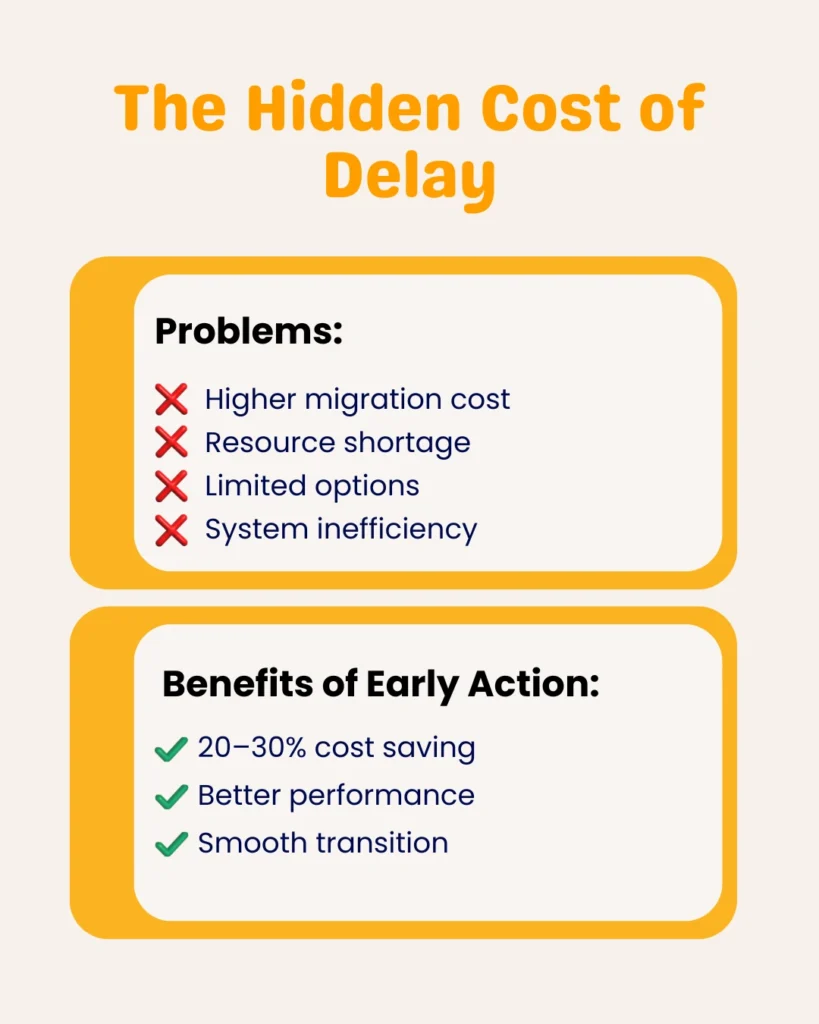
- Cut 20–30% off your migration costs when planned in advance
- 40% performance increase following modernization
- Decrease maintenance overhead
Business Impact
- Faster innovation cycles
- Better data-driven decision making
- Improved compliance and security
Timely planning to turn the SAP ECC support retirement date from a risk to an opportunity. For more insight, read it SAP ECC to S/4 Hana
Common Mistakes Companies Make Before SAP ECC End of Support
Several organizations fail to appreciate the significance of the deadline.
Common Mistakes
- Blooded in steps, that’s only focusing on extended support.
- Procrastinating planning until the last minute
- Underestimating migration complexity
- Ignoring custom code impact
Migration should not be regarded solely as a technical project.
Best Practices
- Start planning early
- Conduct system assessments
- Develop IT strategy in line with business goals
- Optimize processes during migration
- Engage experienced SAP partners
These mistakes could have you taking on unnecessary risk and cost.
Waiting Beyond SAP ECC Support End Date Is Costly
Most of these discussions center on deadlines, but they leave out the hidden costs of delay.
Hidden Costs Include
- Increased licensing and support fees
- Excelling in consulting costs higher at demand
- Resource shortages closer to deadlines
- Operational inefficiencies from outdated systems
Strategic Insight
The longer organizations wait:
- The fewer migration options remain
- The more costly the execution cost
- The more risk of disruption
This is why waiting can be more expensive than you think.
Conclusion:
The SAP ECC support end date isn’t one deadline — it’s three, each narrowing your options a little further: 2027 for mainstream maintenance, 2030 for standard extended support, and 2033 for the further extension available to select customers. Treating the later dates as breathing room is the single biggest mistake in this post’s “Common Mistakes” list, because migration complexity and consulting costs both rise as the deadline compresses, not the other way around.
Start with an honest assessment of your current ECC version and custom code footprint, choose the migration path that matches your actual risk tolerance — brownfield, greenfield, or landscape transformation — and build your roadmap now, while 2027 still gives you room to execute on your own timeline rather than SAP’s.
FAQ Section
SAP ECC — When will the support finally come to an end?
Mainstream support will conclude in 2027, and extended options come to a close either in 2030 or 2033, depending on differing agreements.
SAP ECC End Of Support 2027: What To Do Next?
SAP will no longer be issuing any updates, patches or providing official support for the product, which serves as a higher level security and compliance risk.
What follows after SAP ECC 2030?
Not that, but unsupported and raises operational risk.
What should I do in advance to the deadline?
In moving to S/4HANA, there are three options: System Conversion or New Implementation or Transformation.
Is extended support enough?
Extended support simply postpones the inevitable — it doesn’t eliminate the need to migrate.
What happens if I don’t migrate before the SAP ECC end of support date?
Once mainstream and extended support both lapse, SAP stops issuing security patches, legal/compliance updates, and official technical support for your system — leaving it exposed to unresolved vulnerabilities and compliance gaps.
Is SAP ECC end of life the same as SAP ECC end of support?
Not exactly. “End of support” refers specifically to SAP no longer providing patches and assistance; “end of life” is often used more broadly to describe the point where continuing on ECC becomes operationally and strategically unviable, even if some support options remain.
How long does a typical SAP S/4HANA migration take?
Timelines vary significantly by path and system complexity — brownfield conversions are generally faster than greenfield rebuilds, but both depend heavily on custom code volume, data quality, and organizational readiness.
What’s the real difference between Brownfield and Greenfield migration?
Brownfield converts your existing ECC system in place, preserving configuration and custom code. Greenfield starts fresh on S/4HANA best-practice processes, leaving legacy configuration and technical debt behind.
If I’ve already renewed my ECC maintenance contract, does that extend my support timeline?
A maintenance contract renewal doesn’t override SAP’s published end-of-support dates for the ECC product line itself — it typically governs service terms within whatever support phase you’re currently in.