

Bottle-Cooler Tracker:
A Real-World Example of SAP Custom Development
Three weeks ago, I joined a discovery workshop that started as a routine SAP request. Our company leaves branded bottle coolers at convenience stores. Some units belong to us, others belong to the retailers, yet every service visit must land in SAP Plant Maintenance, and the cost needs to flow back into Sales and Distribution for billing.What looked like a basic integration task quickly revealed the need for custom development to handle real-world complexity across modules.
What seemed simple on paper quickly became a case study in custom development—showing why it’s still essential, even in a low-code, AI-driven world.
The reflex plan on the call was simple:
“Spin up a Fiori app, plug it into Plant Maintenance, and we are done.”
Twenty minutes later, that idea had unraveled:
- Service techs demanded offline sync, barcode scan, and pinch-zoom maps.
- Finance wanted nightly part-usage postings into Materials Management and automatic cost allocation in FI.
- Legal reminded us that store-owned equipment needed different warranty rules than company-owned units.
Suddenly, the question was bigger than “Fiori or not.” We had to decide whether to build, buy, or blend a custom development extension, and that single project exposed every choice most ERP leaders face right now.
The budget myth at the heart of “just buy it”
Board slides repeat two comfortable ideas:
- AI coding assistants make typing code almost free, so development budgets can shrink.
- Marketplace apps go live faster than anything custom, so buying must be safer.
Both claims skip the ninety per cent of effort that happens before anyone touches a keyboard: and that’s where thoughtful custom development makes the real difference. Understanding master data, mapping cross-module flows, drafting security, writing tests, and matching real user quirks. In the cooler project, pure keyboard time came to less than a tenth of the schedule. The heavy lifting sat in design, integration, and smart custom development planning.
Why Custom Development Often Beats Vendor Toolboxes
User experience moves faster than standard Fiori
Service engineers work on poor cellular coverage. They expect instant camera capture, offline sync, and map clustering. A lightweight React Native library gave us an offline prototype in forty-eight hours. Recreating those interactions with current UI5 controls would have required custom extensions and additional testing cycle
Integration reality
Plant Maintenance, Sales and Distribution, and Finance do not care which framework renders the screen. If the app calls SAP OData or REST services with clean payloads and valid authentication, posting works, and audit logs stay intact. That freed us to treat SAP as the process backbone and prioritize lightweight custom development over bloated toolkits.
Talent supply
We located three React contractors within five days. Senior UI5 resources quoted six-week lead times. Velocity, not ideology, led us to React for the cooler pilot.
Modern Tooling Reshapes the Cost Curve in Custom Development
| New accelerator | What changed | Cooler-tracker impact | Sources |
| AI coding assistants | Accenture measured a 15 percent increase in merge rate and an 8.7 percent rise in pull-request volume after rolling out GitHub Copilot. | Generated React forms, validation scaffolds, and unit tests in minutes, so the team focused on SAP API calls. | github.blog |
| VIBE editors | Windsurf and Cursor create complete Node or CAP workspaces, with linting and CI scripts, in minutes. | Our skeleton app, API stubs, and pipeline landed before lunch on day one. | businessinsider.comreuters.com |
| Ready-made CI pipelines | Community recipes push UI5 or Node apps straight to SAP Business Technology Platform, removing manual transports. | Each Git commit is deployed to a BTP trial subaccount for field demos. | businessinsider.com |
Typing is now an easy slice of work, yet design decisions still need experts who speak SAP tables and processes.
Migration pressure you cannot outsource away
Industry watchers keep highlighting slow progress toward S/4HANA. Gartner told The Register that only thirty-seven percent of ECC customers had licensed S/4HANA by 2024, barely up from the year before.
SmartShift’s benchmark across large landscapes shows more than thirty thousand custom objects and over three million lines of bespoke code in an average ECC system.
In the cooler tracker alone, we found five custom tables that would break during a greenfield migration. No shelf product could read those tables without extra connectors custom development was still necessary for compatibility. Buying was not magic; custom fit still mattered.
People still decide success or failure.
Despite modern tools, successful custom development still depends on people who understand SAP end-to-end.
- Explains how Equipment (table EQUI) links to service contracts in SD.
- Traces a repair from PM through MM for parts and FI for cost.
- Handles a “payload too large” error posting a photo-rich maintenance order.
- Keeps CDS views versioned while sandboxes are refreshed.
- Recovers when a support package renames a core domain and 400 Z programs fail.
Five prompts that reveal real depth
- “Walk me from EQUI to warranty billing in SD.”
- “Show the API chain that moves a part from PM work order to MM goods issue.”
- “Describe your handler for a 4xx status on PM_ORDER_SAVE.”
- “Outline your CDS transport pipeline across DEV, QAS, and PRD.”
- “Tell me about a support package that broke custom code and how you fixed it.”
Clear answers mean experience. Vague ones mean risk.
Build for fit, not for force
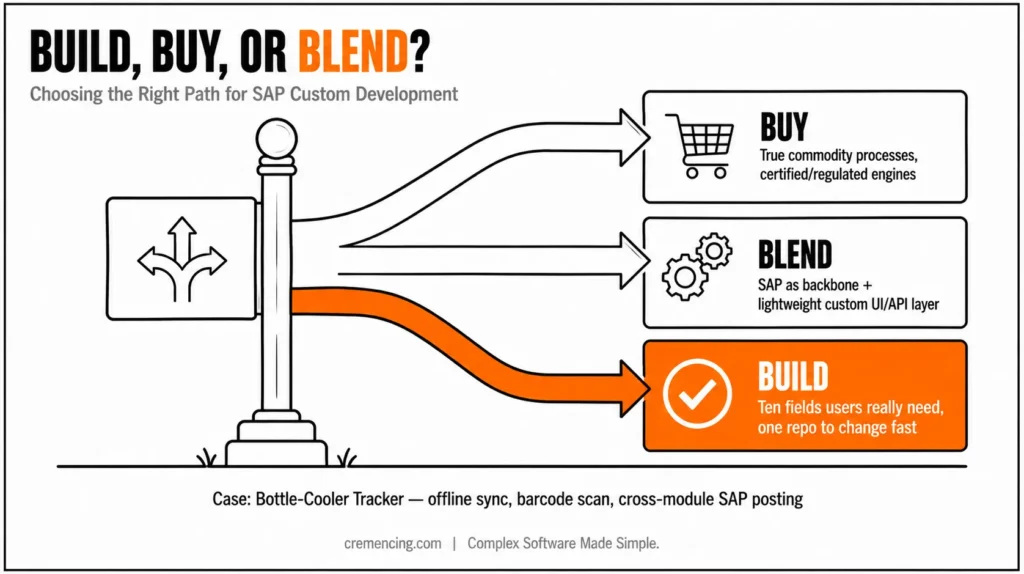
Buying wins when the process is a true commodity, such as payroll in one legal jurisdiction, or when regulation mandates a certified engine. Everywhere else, a slim extension built against SAP APIs often wins long term.
When to Choose Custom Development Over Shelf Apps
| Custom extension | Shelf product |
| Ten fields users really need | Forty fields built for “most” companies |
| One repository, one pull request to change | Vendor backlog, quarterly roadmap |
| Hosting plus routine support | Per user renewal and tier bumps |
In the cooler tracker, the packaged add-ons’ first-year licence and change orders crossed six figures. The lean React and Node build was scoped at roughly half that number, and technicians preferred its workflow.
A five-step playbook you can start today
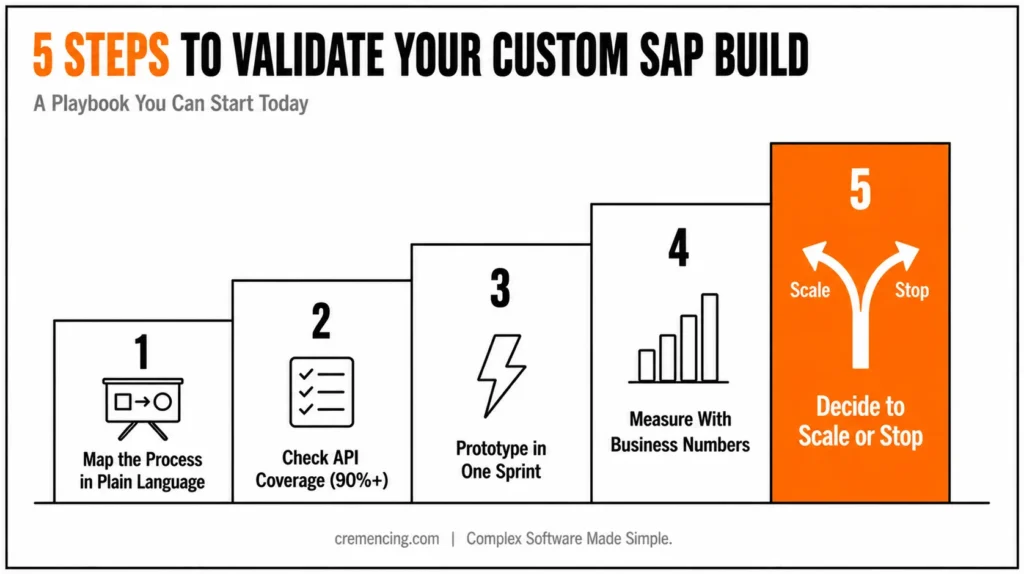
- Map the process in plain language
Bring the business owner, a domain expert, and your development experts into one room. One whiteboard, one hour, no jargon. - Check API coverage
If published SAP APIs cover at least ninety percent of the required data, the project can start now. - Prototype in one sprint
React or Flutter for the interface, direct SAP API calls for transactions, and a slim Node layer only if extra logic is essential. The cooler pilot fit into a single two week sprint. - Measure with business numbers
Track repair cycle time, parts usage accuracy, or support calls avoided. Use metrics that a CFO recognizes. - Decide to scale or stop
If the needle moves, harden the build. If not, the experiment cost weeks instead of quarters.
Windsurf and Cursor in sixty seconds
| Tool | Why it matters | Sources |
| Windsurf | AI native IDE. OpenAI has agreed to purchase Windsurf for three billion dollars, its largest acquisition, aiming to embed deep coding support inside ChatGPT. | reuters.com |
| Cursor | Anysphere’s editor has over fifteen hundred Amazon engineers in a pilot Slack. Amazon is studying an internal rollout, while the tool is valued at around nine billion dollars. | businessinsider.com |
Both editors sit on Git, understand TypeScript and ABAP, and feed any CI pipeline, making them ideal for blended SAP plus open source stacks. They speed up teams that already know what they are building; they do not replace that knowledge.
Closing thought
Coding has never been easier, yet turning insight into running software still demands experts who understand the ERP end-to-end. AI can accelerate development, generate code, and reduce repetitive work, but it does not replace the architectural decisions that determine how an SAP system performs, integrates, scales, and evolves.
For SAP teams, the real opportunity is not simply to write more code faster. It is to build the right extensions, protect the clean core, and connect custom development to actual business processes. That means understanding where standard S/4HANA capabilities are enough, where extensions add measurable value, and where custom code could create unnecessary technical debt.
Use AI tools, move fast, and keep your core clean, but never swap engineering judgment for shortcuts. Review generated code, enforce development standards, test integrations, and consider the long-term impact of every extension. A faster development cycle only creates value when the resulting solution remains secure, maintainable, and compatible with future SAP releases.
Invest in custom development that fits your process rather than forcing the business to work around technical limitations. When SAP development combines strong architecture, clean-core principles, and practical business understanding, your applications can deliver value well beyond the next upgrade window.
FAQs
1. Why did the bottle-cooler tracking process require SAP custom development?
The process involved multiple business scenarios that standard SAP functionality did not fully cover. Cooler ownership, service visits, plant maintenance records, and billing requirements had to work together. Custom development helped connect these processes while keeping the business workflow aligned with SAP.
2. How can SAP track assets that belong to different parties?
SAP can model equipment and technical objects with relevant master data, ownership information, locations, and service history. Custom development can extend this model when the business needs additional rules for distinguishing company-owned equipment from retailer-owned units.
3. How does SAP Plant Maintenance fit into the bottle-cooler process?
Plant Maintenance can manage the technical objects, service notifications, maintenance orders, and service history associated with the coolers. The custom solution can connect the field-service event to the correct SAP object and downstream business processes.
4. How can service costs flow from plant maintenance to Sales and Distribution?
The integration can transfer relevant service and cost information into the appropriate SD billing process. The exact design depends on the organization’s pricing, order, settlement, and billing requirements.
5. Can SAP custom development support both company-owned and retailer-owned equipment?
Yes. A custom solution can apply different business rules based on equipment ownership. For example, the process could determine who is responsible for service costs, which customer or location should receive the charge, and whether the visit should generate a billing transaction.
6. What SAP modules can be involved in a bottle-cooler tracking solution?
Plant Maintenance is central to equipment and service management, while Sales and Distribution can support customer-related processes and billing. Depending on the business design, Finance, Controlling, Inventory Management, and other SAP components may also participate.
7. What makes this type of SAP integration more complex than a simple interface?
The challenge is not only moving data between systems. The solution must preserve business context across equipment ownership, service activities, locations, costs, customers, and billing. Each event must reach the correct SAP object and trigger the appropriate downstream process.
8. When should a business consider custom development instead of changing its process to fit standard SAP?
Custom development can make sense when a business requirement is strategically important, cannot be handled adequately through standard configuration or supported extensibility, and has clear long-term value. The design should still follow clean-core and maintainability principles.