Authored by Mr. Laeeq Siddique — Leading SAP S/4HANA Innovation & Strategy
S/4HANA on-premise vs. cloud is one of the most important decisions businesses face when planning their SAP transition. Choosing between S/4HANA On-Premise vs Cloud affects your organization’s cost, scalability, control, and compliance. Although SAP strongly encourages cloud adoption, many enterprises still prefer the on-premise model. Understanding the pros and cons of S/4HANA on-premise vs. cloud is essential for making an informed decision.
We will explore the historical context, challenges, and reasoning behind each approach to guide businesses in making the best choice for their needs.
A Detailed History of SAP ERP
From SAP R/1 to R/3
To fully understand S/4HANA and its deployment options, it helps to examine the evolution of SAP’s ERP systems. It all started in the 1970s with SAP R/1, an ERP system designed for mainframe computers. While innovative for its time, R/1 lacked the flexibility needed by growing businesses. SAP quickly iterated with R/2, which offered enhanced functionalities and supported batch processing. These systems laid the groundwork for the biggest enterprise software in the world.
The Shift to Client-Server ERP
R/3 introduced the client-server architecture, which revolutionized ERP systems by making them more scalable and accessible. It allowed businesses of varying sizes to implement ERP solutions tailored to their needs. R/3 was a pioneer in enabling integration across business processes, providing an integrated platform for finance, logistics, manufacturing, and other enterprise functions.
From ECC to SAP HANA
Building on the success of R/3, SAP launched ECC (ERP Central Component) as part of the SAP Business Suite. ECC became the backbone of enterprise operations for almost two decades. Its modular architecture allowed businesses to implement only the functionalities they required, making it versatile and cost-effective.
As data volumes and demand for real-time analytics increased, SAP introduced SAP HANA as the database foundation for its next-generation ERP architecture. Earlier SAP ERP releases could run on multiple database platforms, while SAP S/4HANA was designed specifically for SAP HANA.
The Arrival of SAP S/4HANA
Enter SAP S/4HANA, introduced to address these challenges. By leveraging the in-memory database SAP HANA, S/4HANA offered high-speed transactional processing and real-time analytics capabilities. This new system was designed for the digital age and introduced a simplified data model, making it easier for businesses to manage their operations.
From On-Premise to Cloud
SAP S/4HANA was initially offered as an on-premise product with perpetual licensing. SAP subsequently expanded its portfolio with cloud deployment options, giving organizations different choices for infrastructure ownership, customization, upgrades, and operating models.
The Case for On-Premise S/4HANA
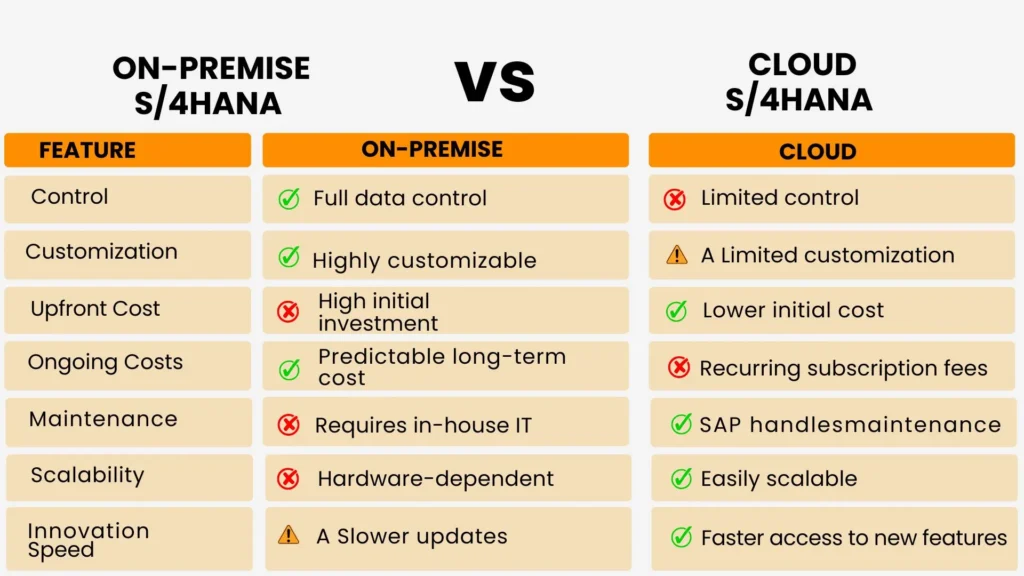
While SAP emphasizes its cloud offerings, on-premise deployments continue to provide compelling advantages. One of the most significant benefits is data control. Industries such as healthcare, finance, and government often have stringent data sovereignty requirements. On-premise systems give organizations full control over their data, ensuring compliance with regional and industry-specific regulations.
Customizability is another critical factor. On-premise deployments allow businesses to tailor their ERP systems to meet unique operational needs. For example, a manufacturing company with specialized workflows can adapt S/4HANA to fit its processes seamlessly. This level of customization is often difficult or impossible to achieve with standardized cloud solutions.
Cost predictability also makes on-premises systems attractive. While the upfront costs for hardware and licenses are significant, these systems offer long-term financial stability. Businesses avoid the recurring subscription fees associated with cloud solutions, which can escalate over time, especially for large enterprises.
For organizations transitioning from SAP ECC, on-premise deployments often simplify the migration process. By leveraging existing hardware, licenses, and integrations, businesses can reduce disruptions and maintain continuity.
S/4HANA Deployment Models at a Glance
| Decision Area | S/4HANA On-Premise | S/4HANA Cloud Private Edition | S/4HANA Cloud Public Edition |
|---|---|---|---|
| Infrastructure | Customer-managed or hosted | SAP/partner/IaaS-managed depending on agreement | SAP-managed |
| Licensing | Perpetual | Subscription | Subscription |
| Customization | Broadest flexibility | Broad extensibility with cloud-oriented clean-core model | Controlled extensibility |
| Upgrade control | Customer manages | SAP installs according to service model | SAP-managed |
| Release cadence | Two-year release cycle | Two-year release cycle | Two upgrades per year |
| Functional scope | Broad | Comparable to S/4HANA | Smaller but expanding |
| Classic ABAP | Available | Available, with cloud-oriented extensibility encouraged | Restricted cloud development model |
| Infrastructure control | Highest | Lower | Lowest |
| Cloud operating model | No | Yes | Yes |
| Typical transformation path | Conversion, new implementation, selective transition | Conversion, lift-and-shift, new implementation, selective transition | Primarily new implementation |
Challenges of On-Premise Deployments
Despite their advantages, on-premise systems come with their own set of challenges. One of the primary concerns is the initial investment required. The costs of acquiring hardware, licenses, and infrastructure can be prohibitive, particularly for small and medium-sized enterprises.
Maintenance responsibilities are another drawback. Organizations must manage updates, security patches, and system monitoring, which require skilled IT personnel. For businesses without robust IT teams, this can lead to increased operational strain.
Additionally, SAP’s focus on cloud innovation means that some new features and updates are prioritized for cloud platforms. On-premise users may experience delays in accessing advanced functionalities like AI-powered analytics or predictive maintenance tools, or Joule (SAP’s co-pilot). This delay can hinder competitiveness in fast-moving industries.
Why SAP Promotes the Cloud
SAP’s current portfolio separates SAP S/4HANA Cloud Public Edition, SAP S/4HANA Cloud Private Edition, and SAP S/4HANA on-premises. The differences extend beyond hosting. They include software release cadence, infrastructure responsibility, upgrade ownership, licensing, functional scope, and extensibility.
Public Edition follows a more standardized operating model. SAP manages the upgrades, and customers work within the available configuration and extensibility framework. Private Edition provides a broader functional scope and greater flexibility, including more extensive extensibility options, while moving infrastructure and technical operations toward a managed cloud model.
This distinction matters for ECC customers with significant custom ABAP. A move to Private Edition does not automatically eliminate existing custom development, but it does increase the importance of clean-core practices, released APIs, upgrade-stable extensibility, and side-by-side development. SAP’s extensibility guidance specifically describes the use of public APIs and BTP to separate new extensions from the SAP core.
For businesses evaluating cloud solutions, the integration capabilities of SAP BTP can help businesses scale confidently while managing costs. Learn more about how SAP BTP pricing works here.
Clearing Misconceptions About On-Premise Availability
A common misconception is that SAP no longer supports on-premise S/4HANA deployments. This is incorrect. On-premise licenses remain available and are actively supported. SAP has committed to supporting these systems until at least 2040, providing long-term assurance for businesses that choose this option.
The misconception often stems from sales tactics. Because cloud solutions align more closely with SAP’s strategic goals, sales teams and partners may prioritize promoting them. Businesses should engage directly with SAP or consult independent experts to obtain accurate information.
Future Roadmap for S/4HANA
SAP’s commitment to innovation ensures that both on-premise and cloud customers have access to evolving technologies. The company has outlined a roadmap that focuses on enhancing integration, advancing AI and machine learning, and streamlining operations through automation.
On-premise customers can expect continued support, but SAP’s faster innovation cycles are more pronounced in the cloud. Businesses should plan for periodic upgrades to stay competitive, regardless of deployment choice.
Key Considerations When Choosing
Deciding between on-premise and cloud requires a thorough assessment of organizational needs. For industries where data privacy and compliance are critical, on-premise systems are often the best choice. Conversely, businesses seeking rapid scalability and access to the latest innovations may find cloud solutions more suitable.
A Step-by-Step Decision Framework
- Assess Business Requirements
- Identify your operational needs, focusing on data privacy, compliance, and scalability.
- Analyze Costs
- Conduct a detailed cost analysis, considering both short-term and long-term expenses.
- Evaluate IT Capabilities
- Determine whether your team has the expertise to manage on-premise systems or if managed services would be more effective.
- Engage Stakeholders
- Involve key decision-makers across departments to ensure alignment.
- Consult Experts
- Seek advice from SAP consultants and independent experts for an unbiased perspective.
Cost Breakdown Analysis
For on-premise systems, the upfront investment includes hardware, software licenses, and setup costs. Maintenance and IT staffing also add to the total cost. Over 10 years, these costs stabilize, offering predictability.
Cloud deployments have lower initial costs but ongoing subscription fees can accumulate. Businesses must also consider costs for additional services, such as enhanced support or extended storage. A detailed cost analysis should compare these factors to determine the best financial fit.
Cloud costs on your mind? Dive into SAP BTP pricing for a clear picture of what to expect.
Exploring a Hybrid Approach
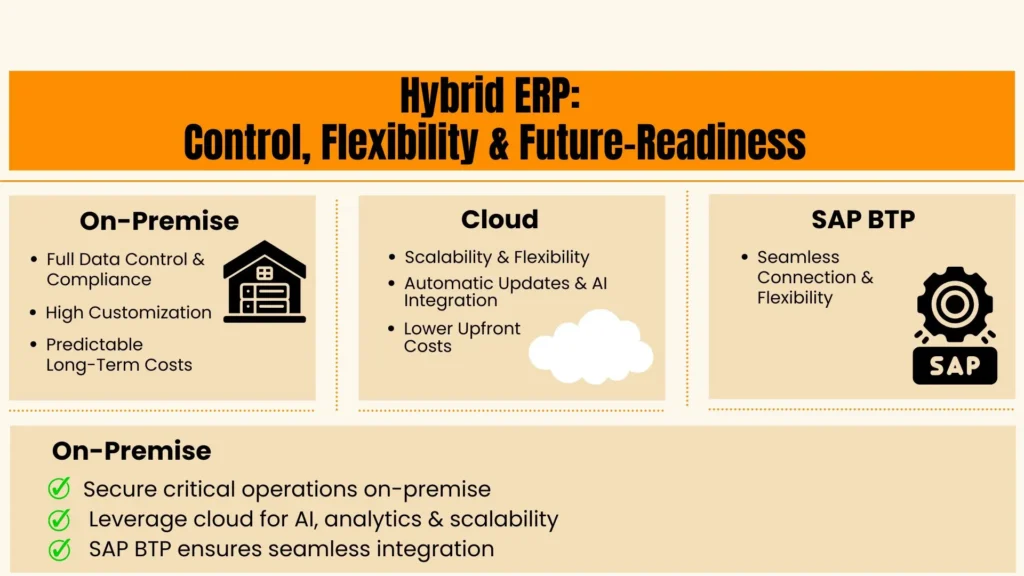
For businesses looking to combine the advantages of both on-premise and cloud, a hybrid model offers an ideal solution. Core operations can remain on-premise, providing stability and control. Non-critical functions, such as analytics or customer engagement, can be managed through cloud solutions to leverage new technologies.
SAP’s Business Technology Platform (BTP) facilitates this approach by enabling seamless integration between on-premise and cloud systems. This allows businesses to enjoy the benefits of both without significant disruptions.
Enhanced Hybrid Model Explanation
A successful hybrid model requires a well-planned strategy. Businesses should identify which processes benefit from on-premise control versus those that thrive in a cloud environment. For instance, critical data-intensive operations like financial reporting might remain on-premise, while customer-facing applications could be moved to the cloud. Ensuring a robust network infrastructure and leveraging tools like SAP Cloud Connector can streamline this dual approach.
Final Thought
Final Thought
The decision between S/4HANA on-premise and cloud should start with business and IT requirements, not with a preference for one deployment model. On-premise provides greater control over infrastructure, customization, release timing, and the overall operating environment. That control can matter for organizations with complex processes, strict infrastructure requirements, or extensive existing SAP investments.
S/4HANA Cloud changes the operating model by shifting more infrastructure and lifecycle responsibilities to SAP. Cloud Public Edition favors a more standardized approach with controlled extensibility and frequent innovation, while Cloud Private Edition provides greater flexibility for organizations that need a broader functional and technical scope. The right choice therefore depends on how much control, customization, standardization, and operational responsibility the organization wants to retain.
For ECC customers planning their S/4HANA transition, the decision should also consider existing custom code, integrations, data volumes, security requirements, compliance obligations, internal SAP skills, and the expected cost of ownership. A hybrid architecture can also support a phased approach when some workloads or capabilities need to remain on-premise while cloud services handle other requirements.
The goal is not simply to move SAP to a different hosting model. It is to establish an S/4HANA architecture that supports the organization’s operating model today while remaining adaptable as SAP releases new capabilities. A structured assessment of deployment options, custom
About the Author:
Laeeq Siddique is a seasoned SAP technical consultant with extensive expertise in SAP S/4HANA, BTP, and advanced SAP technologies. With a proven track record of delivering innovative solutions across industries, he excels in streamlining processes, implementing seamless integrations, and guiding teams toward achieving exceptional results in SAP implementations.
FAQS
1. Will moving to the cloud limit customization?
The level of customization depends on the S/4HANA cloud deployment model. Public Edition follows a more standardized approach with controlled extensibility, while Private Edition provides broader customization and extensibility options. On-premise offers the greatest control over traditional custom development.
2. Are there hidden costs in cloud deployments?
Cloud deployments can involve costs beyond the base subscription, including additional services, storage, integration, implementation, support, and data-related requirements. Organizations should evaluate the full total cost of ownership rather than comparing subscription fees alone.
3. How does the hybrid SAP model work?
A hybrid model combines on-premise SAP workloads with cloud services. For example, an organization can retain its core S/4HANA environment on-premise while using SAP BTP for extensions, integrations, analytics, or other cloud capabilities.
4. What happens to existing customizations when moving to the cloud?
Existing customizations may require assessment and remediation before moving to a cloud deployment. Some custom developments can be retained in Private Edition, while others may need redesign, replacement with standard functionality, or relocation to SAP BTP to support a clean-core strategy.
5. Is data migration from on-premise to cloud seamless?
Data migration is not automatically seamless. Organizations typically need to address data mapping, data quality, transformation, validation, historical data requirements, and reconciliation. The migration effort also depends on the selected implementation approach and target S/4HANA deployment model.
6. Is SAP S/4HANA on-premise still supported?
Yes. SAP continues to maintain S/4HANA on-premise releases. SAP has committed to ensuring that at least one S/4HANA release remains in maintenance through the end of 2040. Organizations still need to track the maintenance timeline of their specific release.
7. What is the difference between S/4HANA Cloud Public Edition and Private Edition?
Public Edition provides a more standardized cloud ERP model with controlled configuration and extensibility. Private Edition provides a broader functional scope and greater flexibility for organizations with complex processes, existing customizations, or more demanding transformation requirements.
8. Is S/4HANA Cloud cheaper than on-premise?
There is no universal cost advantage. On-premise typically requires greater upfront investment in infrastructure, licenses, implementation, and IT operations, while cloud introduces recurring subscription and service costs. A proper comparison should evaluate total cost of ownership over the expected system lifecycle.
9. Which S/4HANA deployment model is better for ECC customers?
The appropriate model depends on the ECC landscape, custom-code footprint, business-process requirements, compliance needs, integration architecture, infrastructure capabilities, and desired level of operational control. ECC customers should evaluate these factors before selecting on-premise, Private Edition, or Public Edition.
10. Can SAP BTP support an S/4HANA hybrid architecture?
Yes. SAP BTP can support hybrid architectures through integration, application development, extensions, automation, and data capabilities. Organizations can use BTP to connect S/4HANA with external applications and build extensions without placing every customization directly inside the ERP core.