
Introduction
SAP Greenfield vs. Brownfield is an important decision for organizations moving from SAP ECC to SAP S/4HANA. Specifically, companies must decide whether to build a completely new system or convert their existing SAP environment. However, both approaches offer different benefits, challenges, and opportunities for business transformation. For this reason, choosing the right approach requires more than simply comparing implementation costs.
Additionally, organizations must consider project timelines, existing business processes, historical data, customization, security, and future growth. Furthermore, they should evaluate how these factors affect their long-term business objectives.. Ultimately, understanding these considerations helps businesses select a migration strategy that supports their future goals..
The SAP Greenfield vs Brownfield decision affects much more than implementation cost. Moreover, it influences business processes, project timelines, data management, and future growth. It determines how much of the existing SAP landscape an organization retains, how business processes change, which historical data moves forward, and how much transformation employees must manage.
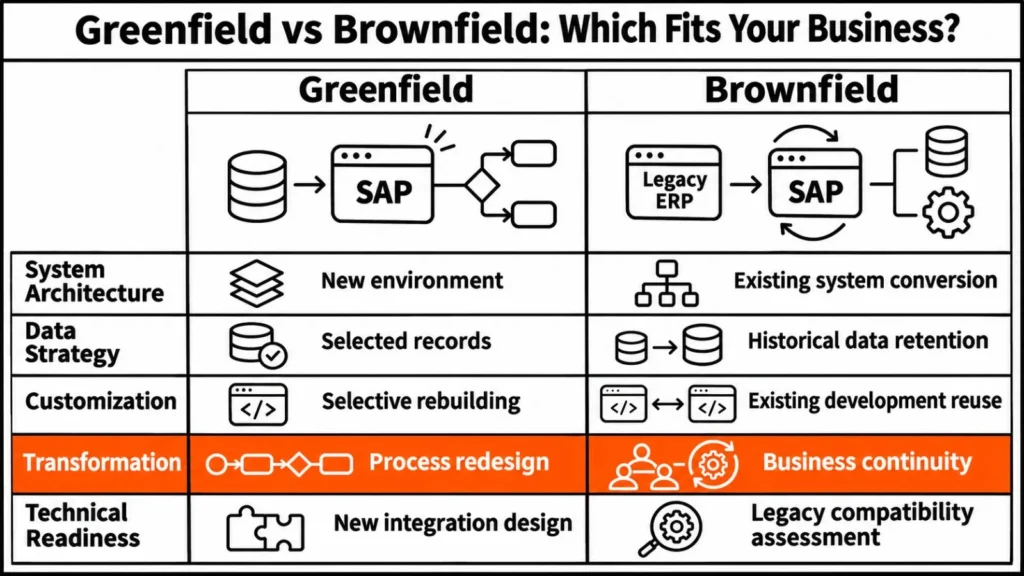
A Greenfield implementation creates a new SAP S/4HANA environment from the beginning. It gives organizations the opportunity to redesign business processes, remove unnecessary customizations, and adopt SAP Best Practices.
In contrast, a Brownfield implementation converts an existing SAP ERP system to SAP S/4HANA while retaining relevant configurations, customizations, business processes, and historical data. Consequently, organizations can preserve important business information and maintain continuity during migration.
There is also a third option: Bluefield, also known as selective data migration. Moreover, this approach combines elements of both methods, allowing organizations to select which processes and data should move into the new environment.
Project timelines, business continuity, data management, technical complexity, security requirements, and future business objectives all influence the decision.
Consequently, this guide explains the differences between SAP Greenfield, Brownfield, and Bluefield while highlighting seven important trade-offs organizations should evaluate before selecting their SAP S/4HANA migration strategy.
What Is SAP S/4HANA?
SAP S/4HANA is an enterprise resource planning (ERP) system developed by SAP. It helps organizations manage important business activities, including:
- Finance and accounting
- Procurement
- Manufacturing
- Supply chain and logistics
- Sales and distribution
- Operations and planning
- Human resources
SAP S/4HANA is the successor to SAP ECC and runs on the SAP HANA in-memory database. Organizations can operate it on-premises or in the cloud.
As a result, it connects business activities through an integrated system, allowing departments to work with shared business information.
Why Organizations Are Moving to SAP S/4HANA
Moreover, organizations also consider SAP S/4HANA to modernize older ERP environments and prepare their technology for changing business requirements.
The main reasons include:
Modernizing older ERP systems:
Moreover, older systems can become difficult to maintain when they contain outdated technology, extensive customizations, and processes that no longer support business requirements.
Accessing real-time data and analytics:
Organizations need timely information across finance, operations, supply chains, and planning to support business decisions.
Simplifying business operations:
Reviewing existing workflows provides an opportunity to remove unnecessary processes, outdated customizations, and disconnected systems.
Supporting business growth:
Organizations need systems that can support changing business activities, additional users, growing data volumes, and future technology requirements.
The migration strategy determines how an organization moves from its existing SAP environment to this new ERP platform.
Understanding SAP Greenfield vs Brownfield and Bluefield Migration Approaches
There are three main implementation approaches organizations can consider when moving to SAP S/4HANA. However, choosing between SAP Greenfield and Brownfield requires businesses to review their current systems, future goals, and migration needs.
Greenfield: New Implementation
Greenfield means implementing SAP S/4HANA as a completely new system.
Organizations redesign their business processes, configure the new environment, and decide which data and system components should move forward.
Furthermore, this approach allows organizations to remove outdated customizations, simplify workflows, and adopt SAP Best Practices.
Meanwhile, organizations retain relevant business processes, historical data, configurations, and customizations instead of rebuilding the entire environment.
The objective is to modernize the existing SAP environment while reducing changes to established business operations.
Bluefield: Selective Data Migration
Bluefield combines elements of Greenfield and Brownfield.
Organizations select which data, processes, and system components should move into the new SAP S/4HANA environment.
Some processes can be redesigned while other established processes remain in place.
For example, this approach is particularly relevant to organizations with multiple SAP systems, complex landscapes, and large volumes of business data.
SAP Greenfield vs Brownfield: Implementation and Business Transformation
What Is an SAP S/4HANA Greenfield Implementation?
A Greenfield implementation creates SAP S/4HANA from scratch.
Instead, organizations establish a new ERP system based on their current and future business requirements rather than converting the existing environment.
This approach involves reengineering business processes and workflows. Existing customizations, legacy code, and unnecessary configurations do not automatically move into the new environment
Therefore, organizations can review their existing developments and identify whether SAP S/4HANA already offers the required functionality through its core features and best practices.
Key Features of Greenfield Implementation
New System Implementation
The organization creates a completely new SAP S/4HANA environment rather than upgrading the existing system.
Business Process Redesign
Existing processes are reviewed to determine what should continue, change, or be removed. Organizations can redesign workflows according to their future operating requirements.
Data Cleansing and Migration
Organizations select the historical and business information required in the new environment. Unnecessary, outdated, or duplicate records can be left behind.
Greater Process Standardization
Different departments, business units, and regions can adopt common processes through SAP Best Practices and standardized system configurations.
Reduced Legacy Customization
Unnecessary custom developments and outdated system settings can be removed instead of being carried into the new environment.
Advantages of SAP Greenfield Implementation
- Complete process redesign: Organizations can rebuild business workflows around their current and future requirements.
- Reduced system complexity: Removing outdated customizations and unnecessary processes can create a simpler environment.
- Improved data quality: Selective data migration provides an opportunity to review and clean historical information.
- SAP Best Practices: Organizations can adopt standardized processes and preconfigured templates.
- Future technology adoption: The new environment provides flexibility to introduce technologies such as AI, automation, and digital supply chain capabilities.
- Scalability: Organizations can design their system architecture around future business growth and changing requirements.
Standardizing processes and using preconfigured templates can also contribute to lower total cost of ownership (TCO) and faster time-to-value.
Challenges of SAP Greenfield Implementation
Higher Initial Investment
A complete reimplementation requires resources for system configuration, infrastructure, process redesign, data migration, testing, and user training.
Longer Project Duration
Organizations must define new requirements, design processes, configure the system, migrate relevant data, and complete testing before go-live.
Organizational Change Management
Employees may need to adopt entirely different workflows and responsibilities. This requires training, stakeholder involvement, and organizational change management.
Data Migration Complexity
Organizations must identify which historical records and business information are required in the new system. Moving relevant information to a completely new environment requires careful planning.
SAP Greenfield Deployment Options: On-Premise and Cloud
Greenfield implementations can be deployed on-premises or in the cloud.
- On-premises deployment: Provides greater control, customization options, and support for complex regulatory requirements. However, it requires higher upfront investment and ongoing maintenance.
- Cloud deployment: Provides scalability, lower upfront infrastructure requirements, and quicker time-to-value. However, organizations with extensive customization or specific compliance requirements may find some cloud options less suitable.
- Hybrid deployment: Combines elements of on-premises and cloud environments, balancing customization and control with cloud flexibility.
SAP Greenfield vs Brownfield: Conversion and Existing System Migration
What Is a Brownfield Implementation in SAP?
A Brownfield implementation converts an existing SAP ERP system into SAP S/4HANA.
Similarly, organizations build on their existing SAP landscape while retaining relevant business processes, configurations, customizations, and historical data instead of creating a completely new environment.
For example, this approach suits businesses that want to modernize their ERP technology without completely redesigning their existing operations.
Organizations can also review existing processes and make necessary adjustments during the conversion.
Key Features of SAP Brownfield Conversion
Existing System Conversion
The existing SAP ERP environment is converted to SAP S/4HANA instead of being replaced by a completely new implementation.
Retention of Business Processes
Organizations can preserve established workflows that continue to support their business requirements.
Historical Data Preservation
Existing transaction records and business information can remain available after conversion.
Reuse of Existing Configurations
Relevant system settings and customizations can be retained, reducing the need to rebuild everything.
Business Continuity
Employees can continue working with familiar business processes, helping reduce disruption during the transition.
Advantages of Brownfield Implementation
- Lower implementation effort: Reusing existing configurations and processes reduces the amount of redesign required.
- Faster migration: Organizations can generally convert their existing environment in less time than a complete reimplementation.
- Reduced business disruption: Established workflows can continue with fewer operational changes.
- Historical data retention: Existing business and transaction records can remain available.
- Reuse of existing investments: Organizations can continue using relevant customizations and system configurations.
- Lower training requirements: Employees already familiar with the existing SAP environment may require less extensive training.
Disadvantages of Brownfield Implementation
Limited Process Flexibility
Retaining existing processes can make it more difficult to introduce significant operational improvements.
Technical Debt
Older customizations, outdated workflows, and unnecessary developments may continue into the new environment.
Integration Complexity
Existing interfaces and connected applications must be reviewed to ensure compatibility with SAP S/4HANA.
Existing Data Quality Issues
Historical data problems may remain after conversion if organizations do not review and address them beforehand.
Dependence on Existing System Quality
The success of a Brownfield conversion depends partly on the condition, complexity, and compatibility of the existing SAP environment.
Steps in a Brownfield Implementation
A Brownfield conversion follows a structured process.
Step 1: Preparation and Assessment
Organizations assess system readiness, analyze existing custom code, and evaluate infrastructure requirements.
Step 2: Technical Conversion
The technical conversion includes migrating the database to SAP HANA and updating the system using SAP Software Update Manager (SUM).
Step 3: Comprehensive Testing
Testing verifies that the converted environment works correctly.
The testing activities include:
- Unit testing
- Integration testing
- User Acceptance Testing (UAT)
- Performance testing
Step 4: Go-Live and User Training
After testing, organizations prepare the system for live operations, complete end-user training, and execute go-live activities.
Step 5: Post-Implementation Support
Following implementation, organizations provide ongoing support, monitor system performance, and identify areas for optimization.
SAP Greenfield vs Brownfield: 7 Trade-Offs Beyond Implementation Cost
Comparing SAP Greenfield vs Brownfield only through implementation cost does not provide a complete picture.
Both approaches affect business operations, technical architecture, data management, and organizational readiness.
The following seven trade-offs help organizations evaluate the wider implications of their migration decision.
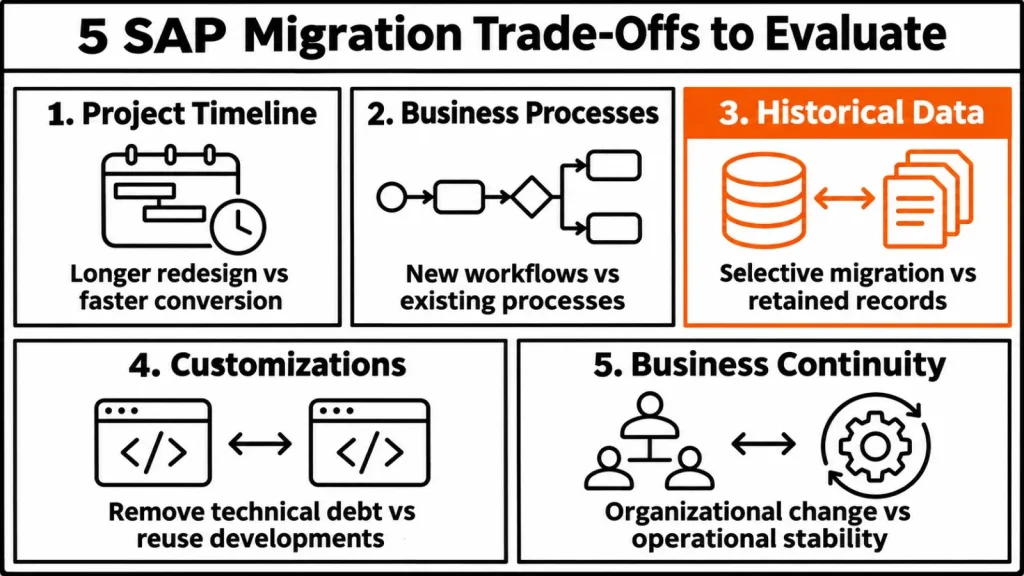
1. Project Timeline vs. Transformation Scope
The first trade-off concerns how quickly an organization needs to move to SAP S/4HANA and how much transformation it wants to complete.
Greenfield projects generally require more time because organizations must design a new system, define business processes, configure workflows, migrate data, and train employees.
Brownfield conversions can generally be completed faster because they build on existing processes and configurations.
Therefore, a shorter project timeline does not automatically mean that all business requirements will be addressed.
Organizations choosing Brownfield must still assess existing workflows, custom code, infrastructure, and system compatibility.
- Greenfield: More time for complete redesign and transformation.
- Brownfield: A shorter conversion path with greater continuity of existing operations.
2. Business Process Redesign vs. Existing Process Continuity
Greenfield and Brownfield differ significantly in how they approach business process changes.
Greenfield gives organizations the opportunity to review their entire operating model. They can remove outdated processes, redesign workflows, and adopt SAP Best Practices.
Brownfield focuses on retaining established business processes wherever possible.
For example, this can be beneficial when existing workflows already support business requirements. However, organizations may continue carrying unnecessary processes and operational inefficiencies.
The decision should depend on whether existing processes require significant improvement or can continue supporting future operations.
- Greenfield: Suitable for organizations planning major business transformation.
- Brownfield: Suitable for organizations that want to preserve established processes.
3. Historical Data Retention vs. Data Cleansing
Data management is another important difference.
Brownfield generally retains existing historical data and transaction records. This can be important for reporting, audits, legal requirements, and ongoing business operations.
Greenfield provides more control over which data moves into the new environment.
Organizations can select relevant information, review data quality, and leave unnecessary or duplicate records behind.
However, migrating selected data into a new system still requires careful planning and validation.
The decision depends on the importance of historical records and the quality of the existing data.
- Greenfield: Greater control over data selection and cleansing.
- Brownfield: Greater continuity of existing historical information.
4. Customization Reuse vs. Technical Debt
Existing customizations can influence the complexity of an SAP S/4HANA migration.
Brownfield allows organizations to retain relevant custom code and system configurations. This can reduce redevelopment work, particularly when existing customizations support important business activities.
However, unnecessary custom developments may also carry technical debt into the new environment.
Greenfield offers an opportunity to reassess existing developments and determine whether their functionality is already available in SAP S/4HANA.
Organizations can remove outdated customizations and redesign the system around their current requirements.
- Greenfield: An opportunity to reduce unnecessary customizations.
- Brownfield: Greater reuse of existing developments, subject to technical assessment.
5. Business Continuity vs. Organizational Change
The migration approach also affects employees and daily business activities.
Brownfield generally introduces fewer changes to established workflows. Employees can continue using familiar processes, which can make the transition easier.
Greenfield may introduce entirely new workflows, responsibilities, and ways of working.
This creates additional requirements for training, stakeholder involvement, and organizational change management.
Organizations must assess whether their employees and business teams are prepared to adopt new processes.
- Greenfield: Greater organizational change and training requirements.
- Brownfield: More continuity and generally fewer changes to daily operations.
6. Innovation and Future Flexibility vs. Existing System Stability
Organizations must also consider how much flexibility they need for future business and technology requirements.
Greenfield provides the opportunity to redesign the SAP environment and adopt SAP Best Practices, modern architectures, AI, automation, and other technology capabilities.
It also provides an opportunity to review connected applications, integrations, and existing in-house developments.
Brownfield focuses on converting the current environment while preserving useful existing components.
Although this supports continuity, retaining older processes and customizations may limit opportunities for wider transformation.
- Greenfield: Greater flexibility for process modernization and future technology adoption.
- Brownfield: Greater continuity with existing business solutions and system architecture.
7. Security and Controls vs. Implementation Complexity
Security and controls must be considered regardless of the selected migration approach.
According to Keri Bowman, Senior Director of Service Operations at Pathlock, the security workstream requires important activities in both Greenfield and Brownfield implementations.
These activities include:
- Designing and creating user roles.
- Installing security tools and configurations in the new environment.
- Provisioning access for users.
- Running access certifications.
- Implementing security controls.
- Updating rule sets where required.
The amount of work can differ depending on how extensively business processes and roles change.
In a Brownfield conversion, existing processes may remain relatively stable. This can reduce the amount of role redesign and rule set updates required.
In a Greenfield implementation, organizations may need entirely new roles and controls because business processes can change significantly.
For example, if a company moves Treasury functionality from SAP to another system during a Greenfield implementation, its role design and associated risk rules must be reviewed.
A Bluefield implementation may require fewer process and data strategy changes than a complete Greenfield transformation.
The key consideration is that choosing Brownfield does not eliminate security implementation activities.
- Greenfield: More extensive role redesign, control updates, and security changes may be required.
- Brownfield: Existing processes can reduce the amount of role redesign, although security implementation activities remain necessary.
- Bluefield: Selective process changes can reduce the extent of role, rule set, and control redesign.
Key Differences in SAP Greenfield vs Brownfield Implementation
The following table summarizes the main differences between the two implementation approaches.
| Comparison Aspect | Greenfield | Brownfield |
|---|---|---|
| Implementation | New SAP S/4HANA system | Conversion of existing SAP system |
| Business processes | Redesigned | Existing processes retained |
| Historical data | Selected data migrated | Existing historical records retained |
| Customizations | Reviewed and selectively rebuilt | Existing customizations assessed and retained where relevant |
| Project duration | Generally longer | Generally shorter |
| Business disruption | More organizational change | Greater operational continuity |
| Data quality | Opportunity for cleansing | Existing data issues may continue |
| Innovation | Greater flexibility | More limited by existing structures |
| User training | More extensive | Generally more manageable |
| Technical complexity | New system design and integration | Existing custom code and compatibility |
The right choice depends on the condition of the current SAP environment and the organization’s future business requirements.
SAP Greenfield vs Brownfield: Five Important Decision Factors
There is no single migration approach that works for every organization.
Before deciding, businesses should evaluate the following five factors.
1. SAP Greenfield vs Brownfield: Current Infrastructure
The existing SAP landscape is an important starting point.
If the current environment is heavily customized, outdated, or difficult to maintain, Greenfield may provide a better opportunity to simplify the system.
If the system is relatively modern, stable, and well-maintained, Brownfield may be more practical.
Organizations should also assess connected applications, existing configurations, and technical dependencies.
2. SAP Migration: Business Goals and Transformation Priorities
Organizations planning major changes to their business operations may benefit from Greenfield.
Businesses that want to retain established processes while updating their ERP technology may prefer Brownfield.
The implementation approach should support the organization’s strategic objectives rather than simply focus on the technical conversion.
3. SAP Greenfield vs Brownfield: Budget and Timeline
Greenfield generally requires more resources because it involves system design, process redesign, data migration, testing, and training.
Brownfield can reduce the amount of redesign required and may provide a faster migration path.
Organizations should evaluate their available budget, project teams, internal SAP skills, and implementation timeline.
4. SAP Migration: Data Complexity and Regulatory Requirements
Historical data requirements can significantly influence the migration decision.
Organizations that depend on extensive transaction history should assess how much information must remain accessible.
Greenfield provides an opportunity to select and cleanse data, while Brownfield generally retains existing historical information.
Regulatory requirements and industry-specific standards should also be reviewed before selecting either approach.
5. SAP Migration: Organizational Readiness and Risks
Greenfield can introduce major changes to business processes and employee responsibilities.
Organizations need sufficient change management, user training, and stakeholder support.
Brownfield generally involves fewer changes to daily workflows, making it suitable for organizations that prioritize business continuity.
The organization’s ability to manage operational disruption should therefore influence the decision.
Not every organization needs a completely new SAP system or a full conversion of its existing environment.
For these situations, Bluefield provides a middle ground. This approach gives organizations another option when comparing SAP Greenfield vs. Brownfield migration strategies.
How Bluefield SAP S/4HANA Compares with Greenfield and Brownfield
Bluefield, also known as selective data migration or selective data transition, combines Greenfield and Brownfield elements.
Organizations choose which existing data, processes, and system components should move into the new SAP S/4HANA environment.
One possible method involves copying the existing system without its data, converting it to S/4HANA, and then transferring selected legacy data into the new environment.
This provides greater control over the migration process.
Benefits of the Bluefield Migration Approach
Bluefield SAP Migration: Selective Process Redesign
Organizations can redesign specific processes while retaining other workflows that already work well.
Bluefield SAP Migration: Controlled Data Migration
Only relevant historical and business data needs to move forward.
Bluefield SAP Migration: Reduced Disruption
The organization can phase in selected changes while retaining important existing system components.
Bluefield SAP Migration: Greater Flexibility
Businesses can balance transformation requirements with operational continuity.
Challenges of Bluefield SAP Implementation
The main challenge is the complexity of managing selected Greenfield and Brownfield components together.
Organizations may require third-party tools and specialist expertise to manage data migration and integrations between the different components.
Choosing Bluefield for SAP S/4HANA Migration
Bluefield may be suitable when:
- Only relevant historical data needs to move forward.
- Selected business processes require redesign.
- Multiple SAP systems need consolidation.
- The organization wants to complete migration in planned phases.
- Some existing processes should remain unchanged while others adopt SAP Best Practices.
Large organizations with complex SAP landscapes and significant data volumes may find this approach useful.
Understanding Brownfield+ in SAP Greenfield vs Brownfield Migration
Brownfield+ is another approach described in the supplied implementation material.
It combines existing SAP system components with AI, automation, and advanced SAP toolsets.
The objective is to identify important business processes, phase out outdated components, reduce technical debt, and improve business insights.
This approach can help organizations balance implementation speed, risk priorities, and available resources while retaining important parts of their existing SAP environment.
SAP Greenfield vs Brownfield: Security and Access Control Differences
Security requirements should be evaluated separately from the decision to retain or redesign business processes.
The SAP security implementation workstream continues across Greenfield, Brownfield, and Bluefield projects.
The work includes role design, user provisioning, certifications, and security controls.
However, the amount of redesign can differ.
| Security Activity | Greenfield | Brownfield | Bluefield |
|---|---|---|---|
| Role design | Significant redesign may be required | Existing roles may need adjustments | Selective redesign |
| User provisioning | Required | Required | Required |
| Access certifications | Required | Required | Required |
| Security controls | New or updated controls | Existing controls reviewed and updated | Controls adjusted for selected changes |
| Rule set updates | Potentially significant | Generally fewer changes if processes remain stable | Fewer changes where processes remain unchanged |
Keri Bowman’s Finance and Treasury examples illustrate these differences.
In a Brownfield scenario, an organization may continue using SAP for its existing Finance and Treasury functionality. Only the roles affected by changes to SAP transactions or Fiori applications may need adjustments.
In a Greenfield scenario, an organization may move Treasury functionality to another system. This changes the role requirements and may require adjustments to the associated risk rules.
In a Bluefield scenario, an organization may retain Treasury within SAP but simplify its functionality and redesign selected processes around SAP Best Practices.
The main distinction is the extent of process change, not whether security activities are required.
Real-World SAP Greenfield vs Brownfield Implementation Experience
The supplied implementation material from Excellence Delivered (ExD) includes examples of Greenfield and Brownfield SAP S/4HANA projects.
SAP Greenfield Migration Examples by ExD
ExD describes Greenfield implementation experience across several industries, including:
- DHA and Graana in real estate.
- FFC, CHT, and Ecolean in manufacturing.
- SECMC in the energy sector.
The implementations addressed process inefficiencies, data silos, and outdated legacy systems through customized SAP S/4HANA environments.
SAP Brownfield Conversion Examples by ExD
ExD also describes its SAP S/4HANA and RISE with SAP Brownfield conversion experience.
The supplied examples include:
- Naubahar Bottling Company (FMCG – Pakistan).
- Nakilat (LNG shipping – Qatar).
- East Gate Industries (Textile Manufacturing and Retail – Pakistan).
- Al Watania (FMCG Distribution – Qatar).
The projects involved challenges associated with legacy system migration, including process inefficiencies, data inconsistencies, and integration requirements.
These examples demonstrate how the implementation approach can differ according to the organization’s existing SAP environment and business requirements.
Selecting the Best SAP Greenfield vs Brownfield Migration Strategy
Before choosing an implementation strategy, organizations should develop a clear understanding of their existing SAP environment and future requirements.
A structured assessment should include:
- Evaluate the current SAP environment: Review system complexity, existing customizations, data quality, and connected applications.
- Define business objectives: Identify whether the organization needs a complete transformation or primarily a technology upgrade.
- Assess data requirements: Determine which historical records and business information must remain available.
- Review technical dependencies: Evaluate existing configurations, custom code, infrastructure, and integration requirements.
- Assess organizational readiness: Understand the training, change management, and internal resources required.
- Compare migration approaches: Evaluate Greenfield, Brownfield, and Bluefield against the organization’s requirements.
- Build the business case: Align the selected approach with the organization’s strategic objectives, budget, and implementation timeline.
The SAP Activate methodology roadmap can support implementation planning after the business need and migration strategy have been defined.
Enterprise architecture tools such as LeanIX EAM can also help organizations connect their transformation strategy with the existing and target SAP architecture.A clear SAP Greenfield vs Brownfield strategy helps organizations align migration decisions with their long-term business goals.
Conclusion
Choosing the right SAP Greenfield vs Brownfield approach is not simply a decision about which implementation method costs less.
Greenfield provides an opportunity to redesign business processes, simplify the existing environment, improve data quality, and adopt SAP S/4HANA capabilities through a new implementation.
Brownfield allows organizations to convert their existing SAP systems while retaining relevant configurations, historical data, and established business processes. It can reduce implementation time and operational disruption, but existing inefficiencies and technical debt may remain.
Bluefield offers another option for organizations that need selective transformation and greater control over data migration.
The seven trade-offs discussed in this guide demonstrate why organizations must evaluate project timelines, process changes, data requirements, customizations, business continuity, future flexibility, and security controls before making a decision.
The most suitable approach depends on the organization’s existing SAP landscape, business objectives, technical requirements, resources, and readiness for change.
A structured assessment of these areas provides the foundation for selecting an SAP S/4HANA migration strategy that supports both current operations and future business requirements.
References and Resources
Frequently Asked Questions (FAQs)
1. What is the difference between SAP Greenfield and Brownfield?
Greenfield creates a completely new SAP S/4HANA system, allowing organizations to redesign business processes, remove unnecessary customizations, and select the data they want to migrate. Brownfield converts an existing SAP ERP system to S/4HANA while retaining relevant configurations, customizations, processes, and historical data. The main difference is how much of the existing SAP environment an organization wants to preserve.
2. What is a Greenfield implementation in SAP?
A Greenfield implementation means building a new SAP S/4HANA environment from the beginning. Organizations can redesign business processes, adopt SAP Best Practices, remove outdated customizations, and select relevant data for migration. It is particularly useful when the existing SAP environment is complex, outdated, or unable to support future business requirements.
3. What is a Brownfield implementation in SAP?
A Brownfield implementation converts an existing SAP ERP system to SAP S/4HANA. It retains relevant business processes, historical data, customizations, and configurations. This approach is suitable for organizations that want to modernize their ERP technology while maintaining established business operations and reducing the need for a complete reimplementation.
4. SAP Greenfield vs Brownfield: Understanding the Bluefield Approach
Bluefield is a hybrid migration approach that combines Greenfield and Brownfield elements. It allows organizations to select which historical data, processes, and system components should move into the new SAP S/4HANA environment. It is particularly useful for organizations with complex SAP landscapes that need selective process redesign and data migration.
5. Which is faster: Greenfield or Brownfield SAP implementation?
Brownfield implementations are generally faster because organizations convert their existing SAP systems and retain established processes and configurations. Greenfield projects usually take longer because they involve new system design, process redesign, data migration, testing, and user training. Actual project duration depends on system complexity and organizational requirements.
6. Which SAP migration approach is more cost-effective?
Brownfield is generally less expensive initially because it reuses existing configurations, processes, and data. Greenfield can require greater upfront investment due to complete system implementation, process redesign, testing, and training. However, standardizing processes and removing unnecessary customizations through Greenfield can contribute to lower total cost of ownership.
7. Does Greenfield implementation retain historical SAP data?
Greenfield does not automatically transfer all historical data from the previous SAP system. Organizations select which business information and historical records should move into the new environment. This provides an opportunity to review data quality and leave unnecessary or duplicate information behind.
8. Does Brownfield retain existing SAP customizations?
Brownfield allows organizations to retain relevant existing customizations and configurations. However, existing custom code must be reviewed to determine whether it remains suitable for SAP S/4HANA. Older developments may require updates, testing, or adjustments to work correctly in the converted environment.
9. Is SAP security implementation different in Greenfield and Brownfield projects?
Security implementation activities are required in both approaches. These include role design, user provisioning, access certifications, and security controls. Greenfield may require more extensive role redesign and rule set updates because business processes can change significantly. Brownfield may require fewer changes when existing workflows remain stable.
10. When should an organization choose Bluefield instead of Greenfield or Brownfield?
Bluefield may be appropriate when an organization wants to redesign selected processes while retaining important existing system components and historical data. It is useful when multiple SAP systems need consolidation, only relevant data should move forward, or migration needs to happen in planned phases. It may require third-party tools and specialist expertise to manage selective data migration and integration.