Most explanations of what is SAP in technology start the same way: “SAP is an ERP system.” That answer is technically true and practically useless — it tells you nothing about why a sales order can post cleanly in one company code and get stuck in another, or why two consultants can disagree for an hour about whether a problem belongs in ABAP, in configuration, or in SAP BTP.
The myth worth retiring is that SAP is one thing at all. It isn’t a database, an accounting tool, or a single application — it’s a layered technology stack where presentation, application logic, and data storage are deliberately separated, and where that separation is the entire reason the platform can enforce consistent rules across finance, sales, procurement, and supply chain at once.
This article breaks down what SAP actually is in technology — its architecture, where ABAP, SAP HANA, SAP Fiori, and SAP BTP each fit, and why understanding the layers matters more than memorizing the acronym.
Recent Research on SAP S/4HANA Transformations and Cloud ERP Adoption
Recent enterprise benchmark research highlights a decisive shift in SAP landscapes, as the valantic SAP Study 2026 (conducted with techconsult) reveals that over 70% of surveyed organizations have actively migrated to or operate on SAP S/4HANA, with 64% favoring Private Cloud deployments over traditional on-premises infrastructure and 67% adopting AI and automation in daily operations. In parallel, the SAP Developer Insights Survey 2026 demonstrates a dramatic surge in production-level AI adoption—jumping to 32% within two years—with 70% of developers leveraging AI tools daily while standardizing on “Clean Core” extension strategies using SAP BTP and ABAP Cloud to ensure seamless system upgrades.
What Is SAP in Technology and Why It Matters?
The answer to “What is SAP in technology?” is that SAP is a company, a portfolio of enterprise applications, and a technology platform that runs and integrates business operations. Originally, SAP was named “Systems, Applications, and Products in Data Processing.”
However, in day-to-day project work, “SAP” more commonly refers to the software landscape that supports finance, sales, procurement, manufacturing, supply chain, maintenance, human resources, analytics, and related processes.
ERP integrates processes that are normally isolated in different applications and spreadsheets. Can affect stock availability, delivery planning, billing, revenue, credit exposure, and financial reporting. A purchase order may result in a goods receipt, inventory update, supplier invoice, payment obligation, and accounting document.
The documents that appear depend on configuration and the actual execution of this process. The key here is that each team is interacting with the other business objects rather than having independent copies.
What Is SAP in Technology — Beyond a Database or Accounting Tool
That is why you can’t answer the question What is SAP in technology?” with “a database” or “an accounting system.” SAP HANA is a DB platform. ABAP is a programming language and an application runtime. SAP Fiori is a design system and the user-experience approach.
SAP Fiori is a design system and the user-experience approach, while SAP S/4HANA represents the ERP software line itself. On top of that, SAP BTP offers integration, application development, automation, data, analytics, AI, and platform services. For CUSTOMERS, SAP in technology refers to a proven on-premises ERP core, which can be deployed on multiple supported database platforms.
The latest enhancement package level is SAP ERP 6.0 EHP8 as reflected in SAP’s current Help Portal. The ERP application is based on SAP HANA, a simplified data model, role-based Fiori applications, embedded analytics, and newer extensibility models, which are all part of NA 2025.
The useful answer to the question of what SAP is in technology is operational: SAP records business events, validates those events against rules, updates related data, generates follow-on documents, controls user access, and exposes information to people and connected systems.
It offers a framework for a controlled transaction base, not just one application. That backbone is important to businesses, as the same rules work across company codes, plants, sales organizations, purchasing organizations, warehouses, and countries. The platform doesn’t eliminate complexity in the process, but it does provide the organization with one centralized location to set responsibility, approval, posting logic, master data, and audit evidence.
How SAP Works in Technology — The Internals
To understand what SAP is in technology, separate the landscape into presentation, application, database, integration, and operations layers. Most ABAP-based SAP systems use a three-tier client-server model at the core: the presentation layer receives user actions, the application layer executes business logic, and the database layer stores persistent data.
Additional services handle interfaces, identity, analytics, cloud extensions, monitoring, and lifecycle management. SAP retained the three-tier model when moving from SAP Business Suite to SAP S/4HANA, although many of its components have continued to change.
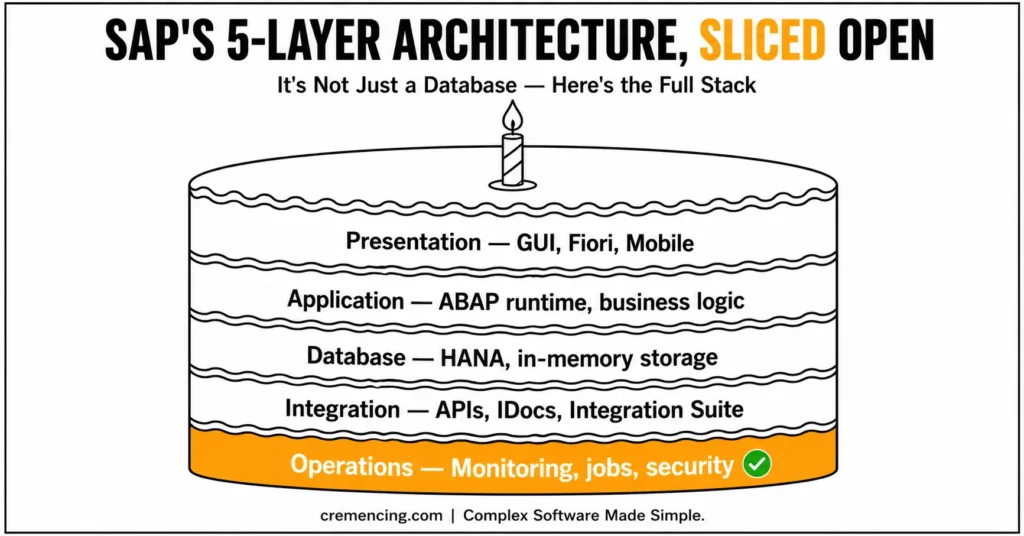
Users interact with SAP through SAP GUI, SAP Fiori applications, mobile interfaces, portals, APIs, or connected applications. ECC 6.0 projects commonly use SAP GUI transactions such as:
- VA01: Create a sales order
- ME23N: Display a purchase order
- FB03: Display an accounting document
- MMBE: Review material stock across organisational levels
SAP S/4HANA also supports many SAP GUI transactions, but its strategic user experience is SAP Fiori.
SAP Fiori is role-based. Instead of presenting every available transaction, a launchpad can provide task-focused applications, notifications, analytics, and actions for a specific job.
SAP defines the Fiori design principles as role-based, adaptive, coherent, simple, and consistent across supported devices and applications. rface does not own the underlying business transaction. It sends requests to application services, which apply authorisation checks and business rules before reading or changing data.
This distinction is central to what SAP is in technology. The screen is only one access channel.
A sales order may be created through SAP GUI, a Fiori application, an API, electronic data interchange, or an external commerce platform. The ERP application still controls the resulting document and its consistency.
The Application Layer: What Is SAP in Technology at Runtime
The application layer contains the ABAP runtime, work processes, business logic, configuration interpretation, transaction handling, update processing, and integration services used by the ERP application.
ABAP programs do more than display tables. Standard applications use business objects, function modules, classes, frameworks, enhancement points, workflows, and application services to enforce process behaviour.
SAP confirms that its application developers use ABAP to build SAP application components. Modern SAP development also uses Core Data Services, the ABAP RESTful Application Programming Model, and ABAP Development Tools in Eclipse. It normally runs in an application server work process. The program checks user permissions, validates input, reads relevant data, calculates results, and prepares database changes.
SAP’s logical unit of work keeps related changes together. The application can commit a complete transaction or roll it back when a critical step fails.
When people ask what SAP is in technology, this application layer is often what they are trying to identify. It is the engine that turns configured business rules into repeatable processing.
The same posting logic can be used by thousands of users and interfaces instead of being reimplemented in every departmental tool.
In practice, what is SAP in technology also includes configuration close to this logic. Consultants use the implementation guide, commonly accessed through transaction SPRO, to define organisational structures, document types, account determination, pricing, tolerances, output rules, and other process settings.
Customising changes application behaviour without rewriting the full standard program.
The Database Layer: What Is SAP in Technology Storage
ECC 6.0 can operate on different supported relational databases, depending on the installed release and platform. SAP S/4HANA runs on SAP HANA. row and column storage. It keeps relevant data in memory while persisting data and redo logs to durable storage. This persistence protects committed information if memory contents are lost.
The in-memory store uses compression and supports fast scans and calculations over large data volumes. Column storage can reduce the need for some additional indexes because values from the same column are stored together and can be compressed efficiently.
What is SAP in technology is still not “SAP HANA.” HANA stores and processes data, while S/4HANA supplies the ERP data model, application logic, processes, authorisations, user interfaces, and business content.
A database can execute a fast query. It does not decide whether a customer may exceed a credit limit or whether a goods movement should create an accounting document.
S/4HANA uses HANA capabilities to combine transactional processing and operational analytics more closely. Some aggregate and index structures used in older ERP designs are reduced or replaced because the system can calculate results from the primary data model. Still design efficient access patterns. In-memory processing does not make an unrestricted query safe.
Quick Reference — What Owns What
- Presentation (SAP GUI / Fiori): Displays data, sends requests — owns nothing
- Application (ABAP runtime): Business logic, authorization checks, posting rules
- Database (HANA / other RDBMS): Stores and retrieves data — no business logic
- BTP: Extensions, integration, automation — outside the ERP core by design
- Rule of thumb: If the fix is “who can see this,” it’s Fiori/roles. If it’s “what happens when this posts,” it’s ABAP/config. If it’s “connect this to something outside SAP,” it’s BTP.
How SAP Integrates Business Documents and Shared Data
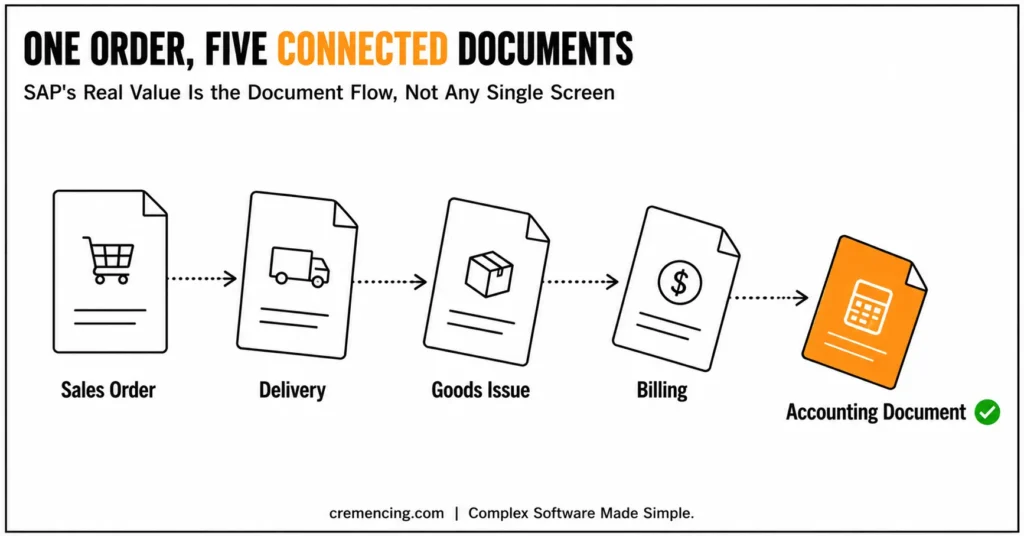
The strongest practical answer to what SAP is in technology appears in the document flow.
In an order-to-cash process, customer and material master data support the sales order. The order can create delivery requirements, picking and goods-issue activity, billing, receivables, tax entries, and profitability information.
Each stage has its own status and controls. Users can still trace the relationship between documents.
Another part of what is SAP in technology appears in procure-to-pay. Purchasing creates a purchase order, warehouse activity records receipt, invoice verification compares quantities and values, and finance records the liability.
The organisation does not need five independent spreadsheets to reconcile the same event.
Shared data does not mean every field lives in one physical table. SAP applications use many tables, views, services, and business objects.
“Single source of truth” means ownership and consistency are defined. It does not mean the entire enterprise database consists of one table.
SAP Integration, Extensions, and SAP BTP Technology
Modern SAP landscapes are rarely SAP-only. They include banks, tax services, warehouse systems, e-commerce platforms, manufacturing systems, data platforms, identity providers, and specialist cloud applications.
SAP Integration Suite, APIs, events, IDocs, RFC connections, and other technologies connect these systems according to the use case.
SAP BTP extends the answer to what SAP is in technology beyond ERP. It provides services for integration, application and agent development, automation, data, analytics, AI, security, connectivity, and operations across SAP and non-SAP applications. When a requirement belongs outside the ERP core or must span several systems. Do not use it merely to recreate a standard S/4HANA transaction on another platform.
Clean-core guidance matters here. In SAP S/4HANA 2022 and later, ABAP Cloud is available across public cloud, private cloud, and on-premise scenarios, although private-cloud and on-premise customers may still need governed classic ABAP during transition. Could prefer released APIs and extension points for upgrade-stable development.
SAP Security and Operations
A complete answer to what SAP is in technology includes security: identities, roles, authorisation objects, organisational restrictions, communication credentials, and logging.
A user may have permission to display a sales order but not change it. Another user may post in one company code but not another.
Application code must perform the relevant checks. Hiding a button alone does not protect the transaction.
Operations teams monitor jobs, interfaces, dumps, locks, updates, database health, performance, certificates, queues, and system availability. Common technical transactions include:
- SM37: Displays and analyses background jobs
- ST22: Analyses ABAP runtime errors and short dumps
- SM12: Displays logical database locks
- SM21: Displays the SAP system log
- SM13: Reviews terminated or delayed update requests
A green server does not prove that billing, payroll, interfaces, or warehouse queues completed successfully.
This operational view completes what SAP is in technology. SAP is not only software installed on a server.
It is a controlled business-processing environment that requires process ownership, technical administration, testing, monitoring, support, and change governance.
When to Use SAP Technology vs. Alternatives
Understanding what SAP in technology is does not mean SAP fits every organisation or every workload.
SAP is strongest where a business needs integrated, controlled processes across multiple functions, entities, locations, currencies, tax rules, supply chains, or regulatory environments. The value increases when a transaction must pass through several teams without losing traceability.
| Requirement | Use SAP when | Consider an alternative when |
| Core ERP | Finance, procurement, sales, manufacturing, assets, and inventory require integrated control | A smaller SaaS ERP covers the organisation’s simple processes at lower operating cost |
| Industry operations | SAP or partner content supports complex sector-specific processes | A specialist application owns the process more completely and integrates reliably |
| Custom development | The requirement must operate inside SAP business context and governed ERP objects | The application is independent, customer-facing, or better suited to a general cloud stack |
| Integration | SAP and non-SAP processes require API, event, message, or partner coordination | An existing enterprise integration platform already meets the requirement |
| Analytics | Decisions require SAP semantics, planning, and cross-process data | An existing data platform already provides governed models and ownership |
| Workflow | Approval and automation depend on SAP documents and roles | The process is departmental and already controlled by another workflow platform |
Is SAP in Technology Right for Your Business?
A multinational manufacturer shows what SAP in technology at enterprise scale. It may need material planning, purchasing, production, quality, warehouse activity, sales, service, asset maintenance, finance, and consolidation to work from related master and transaction data.
SAP can standardise the control points while allowing authorised variation by company, plant, or country. A small service company with one legal entity, limited inventory, and simple billing may not need the same platform. The licence is only part of the decision. Implementation, data cleansing, process design, integrations, testing, change management, support, and upgrades require sustained capability. The question of “what SAP is in technology?” should therefore be followed by, “Which business problem needs it?”
Do not adopt SAP because large organisations use it. Adopt it when integrated process control, scale, localisation, auditability, industry depth, or an existing SAP estate justifies the operating model.
SAP is also not the automatic choice for every extension. Keep standard behaviour in the ERP core where possible.
Why Businesses Rely on SAP in Technology: Six Practical Reasons
Use in-app extensibility for small released changes, ABAP Cloud for upgrade-stable ERP-domain development, and side-by-side services when applications need separate scaling, external access, or multi-system composition. Rely on SAP for six practical reasons.
First, integrated documents reduce manual reconciliation.
Second, central rules make processing more consistent. T
Third, authorizations separate duties and limit sensitive actions.
Fourth, configuration supports repeatable operations across organizational units.
Fifth, document flow and logs provide traceability.
Sixth, the platform supports controlled extensions and integrations when standard functionality does not cover a justified requirement.
Those advantages depend on implementation quality. Poor master data, excessive custom code, weak role design, unowned interfaces, and uncontrolled configuration can turn the same platform into a support burden. Once you understand SAP’s role in the business, the natural next step is learning what SAP ALM is and how it keeps things on track.
Conclusion
The real answer to “what is SAP in technology” isn’t a product name — it’s a design decision. By keeping presentation, business logic, and data storage in separate, governed layers, SAP makes it possible for a purchase order, a stock movement, and a financial posting to stay in sync without five departments comparing spreadsheets.
ABAP enforces the rules, HANA stores the data fast enough to make those rules useful in real time, Fiori decides who sees what, and BTP handles everything that shouldn’t live inside the core at all.
None of that guarantees value on its own — a badly configured SAP system is just an expensive way to make the same reconciliation problems harder to trace. The platform earns its reputation when an organization treats it as an architecture to be governed, not a product to be installed..
Frequently Asked Questions
1. How is SAP software used?
SAP software manages connected business processes such as sales, procurement, finance, manufacturing, inventory, and human resources. Users create or approve business documents while the SAP ERP system applies central rules and updates related information. This allows departments to share governed data instead of maintaining separate records. s an ERP system?
2. What is the difference between SAP ECC and SAP S/4HANA?
SAP ECC is the earlier ERP generation and can run on several supported databases. SAP S/4HANA runs on SAP HANA and introduces a simplified data model, Fiori applications, embedded analytics, and newer extension approaches. Many familiar processes remain, but migration requires simplification, item, and custom-code analysis. What does SAP stand for in technology?
3. What are SAP and ABAP?
SAP is the enterprise software environment; ABAP is one of its primary programming languages and application runtimes. Developers use SAP ABAP for reports, interfaces, enhancements, forms, services, and business applications. ABAP is important, but it is only one technical part of the wider SAP platform.
4. What does SAP stand for in technology?
SAP originally stood for Systems, Applications, and Products in Data Processing — the name of the company that built the ERP software, which later became synonymous with the software itself.
5. Is SAP a database or an application?
Neither on its own. SAP HANA is the database layer that stores and processes data. The ERP application — ECC or S/4HANA — is the business logic layer that runs on top of it, applying rules, validations, and workflows.
6. What’s the difference between SAP Fiori and SAP GUI?
SAP GUI presents transaction-based screens (like VA01 or ME23N) built for trained users. SAP Fiori presents role-based, task-focused apps designed for a specific job function. Both ultimately call the same underlying application logic — the interface changes, not the business rules.
7. Does SAP S/4HANA replace SAP HANA?
No. S/4HANA is the ERP application; SAP HANA is the in-memory database it runs on. Unlike ECC, which can run on multiple supported databases, S/4HANA requires SAP HANA specifically.
8. What is SAP BTP used for?
SAP BTP (Business Technology Platform) is used for integration, application and extension development, automation, and analytics that sit outside the ERP core — typically when a requirement shouldn’t or can’t be built inside S/4HANA itself.
9. Is ABAP still relevant with S/4HANA and SAP BTP?
Yes. ABAP Cloud, in particular, remains the recommended approach for upgrade-stable, in-core extensions within S/4HANA, even as more requirements move to side-by-side development on BTP.
10. What makes SAP different from a generic ERP system?
The layered architecture — separated presentation, application, and database layers, plus centralized authorization and configuration — is what lets the same business rules apply consistently across company codes, plants, and countries, rather than being reimplemented per department or region.