“SAP Brand Tools aren’t seven separate software platforms — they’re a set of resource categories covering brand voice, approved naming, trademark rules, messaging, partner marketing, campaign support, and digital assets. Marketing teams that treat them as a single checklist to consult occasionally end up publishing the wrong product name, misrepresenting a partnership, or fragmenting their brand voice across five different writers.
This guide breaks down what each of the seven categories actually covers, who on your team needs which one, and how to build a simple review process that catches these mistakes before content goes live rather than after
The important point is that SAP Brand Tools shouldn’t be treated as a single checklist. Think of them as a collection of resources that help marketing teams answer practical questions before content goes live:
- Is this SAP product name correct?
- Are we using the approved terminology?
- Does the messaging fit SAP’s communication style?
- Are we describing our SAP partnership accurately?
- Are we using the right brand assets?
- Does the campaign follow current SAP requirements?
7 SAP Brand Tools Every Marketing Team Should Know
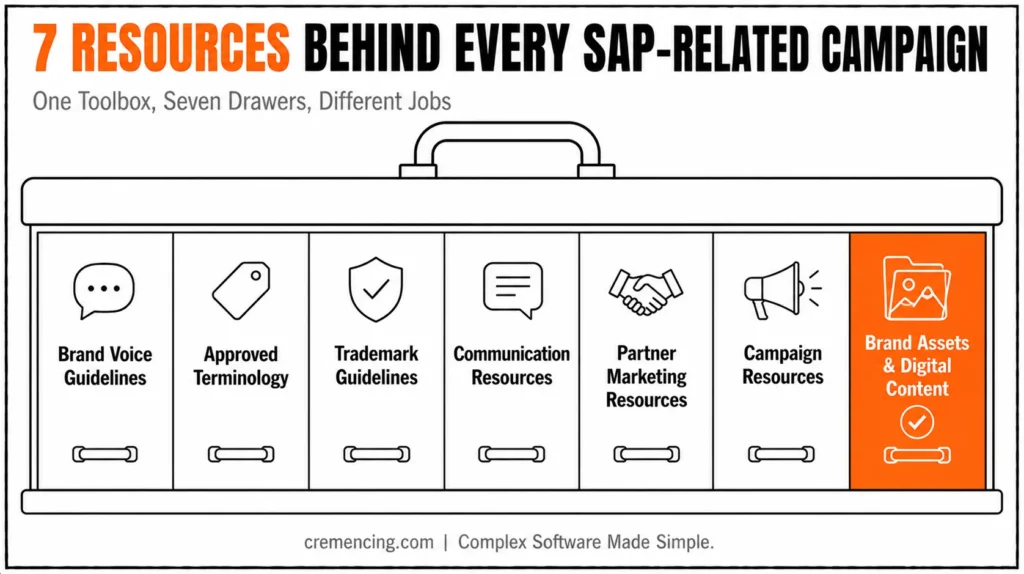
The phrase SAP Brand Tools can refer to a broader collection of SAP brand, communication, naming, and partner resources rather than seven completely separate software applications.
That distinction matters. Marketing teams often search for “tools” expecting seven standalone platforms. In practice, the more useful approach is to understand the seven major resource categories that support SAP-related marketing work.
| SAP Brand Tool / Resource | Main Purpose | Best For |
| SAP Brand Voice Guidelines | Define communication style and tone | Content teams and copywriters |
| Approved Names and SAP Terminology | Ensure correct product and solution naming | SEO and product marketing |
| Trademark and Naming Guidelines | Support compliant use of SAP trademarks | Brand and legal teams |
| Communication and Messaging Resources | Improve consistency across customer communications | Marketing and communications |
| SAP Partner Marketing Resources | Support SAP partner positioning and campaigns | SAP partners |
| Marketing and Campaign Resources | Help teams plan and execute demand-generation activities | Campaign teams |
| Brand Assets and Digital Content Resources | Support consistent visual and content presentation | Designers and content teams |
The seven categories overlap, but they solve different problems. A content writer may need brand voice guidance, while a product marketer may need approved terminology. A partner marketing manager may need partner-specific campaign resources, while a designer may need approved visual assets.
The rest of this guide breaks down each category and explains when marketing teams should use it.
1. SAP Brand Voice Guidelines
There’s more to a strong brand than just a logo. The language that is used for the descriptions of products, services, customer outcomes, and technical concepts also influences the audiences’ perceptions of the company.
In its published writing guidance, SAP outlines its brand voice in terms of the CIAO principle: Clear, Insightful, Approachable, and Optimistic. SAP also advocates a “people first” philosophy, which takes the perspective of the audience when developing content.
For marketing teams, this gives writers a practical framework.
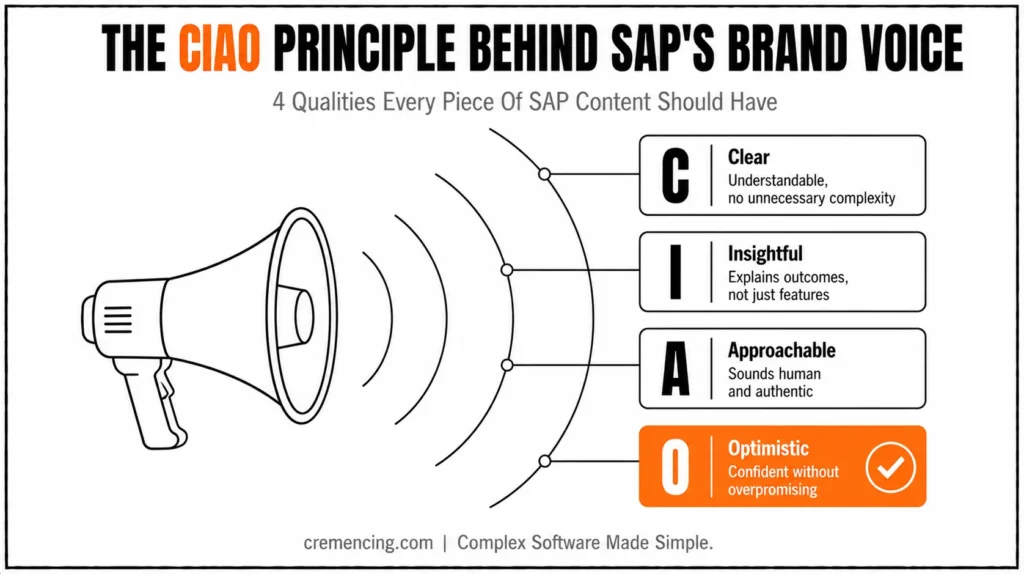
Clear
Avoid unnecessary complexity. Even when discussing enterprise software, the message should remain understandable to the intended audience.
Insightful
Content should help the reader understand a problem, opportunity, or business outcome rather than simply listing features.
Approachable
The communication should sound human and authentic instead of reading like a technical specification.
Optimistic
The message should communicate confidence without relying on exaggerated promises.
A marketing team can apply this framework to:
- Website copy
- Blog posts
- LinkedIn content
- Email campaigns
- Product descriptions
- Customer stories
- Sales presentations
- Event messaging
The biggest benefit is consistency. If five writers describe the same SAP solution in five completely different voices, the audience receives a fragmented brand experience. A shared SAP brand voice framework gives the team a common starting point. Brand accuracy matters, but so does keeping pace with the SAP tech trends reshaping how teams work more broadly.
2. Approved Names and SAP Terminology
Product naming is one of the easiest areas for marketing teams to get wrong.
SAP has a large portfolio that changes over time. Product names, solution names, acronyms, and portfolio terminology can also evolve.
A marketer who relies on an old presentation or an outdated blog post may accidentally publish terminology that no longer matches current SAP naming conventions.
SAP documentation for the Business Accelerator Hub, for example, instructs publishers to use product names as available through SAP Brand Tools or SAPterm. It also specifically references SAP Brand Tools when discussing approved names for SAP products.
For marketers, this means product naming should be checked before publishing:
That’s why checking SAP Brand Tools for approved naming resources is important.
- Identify the exact SAP product or service.
- Check the current approved name.
- Confirm capitalization and acronym usage.
- Check whether the product has been renamed or repositioned.
- Use the approved terminology consistently throughout the asset.
This matters for SEO as well.
Your audience may search for several variations of a product name, but your page should still use the correct official terminology. You can address search variations naturally in supporting content without presenting an unofficial name as the official SAP product name.
For example, a marketer researching SAP BTP may encounter older terminology, community shorthand, and current official naming. The job is to understand search intent while maintaining accurate product language.
3. SAP Trademark and Naming Guidelines
Trademark usage becomes especially important when an organization creates content that references SAP products, solutions, or its relationship with SAP.
Before publishing any of these, SAP Brand Tools should already be part of the review process. A partner’s marketing team might create:
- A website landing page
- A sales presentation
- A customer case study
- A press release
- A social media campaign
- An event banner
- A product comparison
Each asset may mention SAP trademarks or product names.
That doesn’t mean every reference can be handled casually.
SAP’s partner communication guidance explains that trademark and product-name usage is subject to SAP requirements and directs partners to SAP Brand Tools for trademark guidelines and current information.
A practical workflow looks like this:
Draft → Check product names → Check trademark requirements → Verify partnership language → Review final asset → Publish
Marketing teams should also distinguish between saying that a company works with SAP, is an SAP partner, or provides services related to SAP products. These statements can have different implications and should be checked against the organization’s actual relationship with SAP.
This is particularly important for agencies and consulting companies, which is exactly why SAP directs partners back to SAP Brand Tools for trademark guidance. A page that inaccurately implies an official SAP relationship can create a brand and compliance issue even if the rest of the content is technically correct.
4. SAP Communication and Messaging Resources
Good SAP marketing communication needs more than correct terminology.
It needs a consistent message.
This is where communication resources become useful. They help teams think about how SAP-related information should be presented to different audiences.
A technical audience may want to know:
- What does the solution do?
- How does it integrate?
- What platforms does it support?
- What business processes does it affect?
An executive audience may instead ask:
- What business problem does it solve?
- What changes for our organization?
- What value can we expect?
- What risks should we consider?
The underlying product may be the same, but the communication approach changes.
SAP’s writing guidance emphasizes understanding the audience and adopting a people-centric approach. That principle is particularly useful when marketing teams create content for different personas.
For example, a campaign about SAP S/4HANA transformation could require separate messaging for:
- CIOs
- CFOs
- IT directors
- SAP architects
- Business process owners
- Developers
The marketing team should avoid copying the same paragraph across all assets. Instead, the central message stays consistent while the supporting proof points change according to audience needs. This is one of the most practical ways to use SAP communication guidelines: as a framework for keeping the message consistent while adapting the delivery.
5. SAP Partner Marketing Resources
SAP partners often need to market their own services while accurately communicating their relationship with SAP.
That creates a unique branding challenge. The partner needs to build its own identity without confusing customers about which company provides which product or service. SAP’s partner program identifies brand resources as part of its broader partner support.
The program highlights resources related to branding guidelines, press releases, media engagement, and amplification. It also describes partner marketing resources that support brand differentiation and demand generation.
For an SAP partner marketing team, these resources can support activities such as:
- Partner website messaging
- Campaign planning
- Press communications
- Event promotion
- Social media content
- Customer references
- Demand-generation campaigns
The key is positioning.
Your company should clearly communicate what it offers while representing SAP products and partnerships accurately. IT teams manage the systems; marketing depends on seeing SAP Solution Lifecycle Management for context on how these tools stay reliable, from faster deployment to reliable maintenance.
A useful content structure is:
SAP technology or ecosystem → Customer problem → Your service or expertise → Business outcome
This keeps the message focused on the customer rather than turning every piece of content into a generic SAP product description. SAP’s partner ecosystem also provides marketing-related programs and resources designed to help partners generate demand, develop campaigns, and engage audiences.
6. SAP Marketing and Campaign Resources
Brand consistency doesn’t stop when the campaign begins. Marketing teams also need resources that support campaign execution.
Depending on the organization and SAP relationship, this may involve campaign messaging, demand-generation programs, social selling resources, website optimization, customer references, and other partner marketing activities.
SAP’s partner program describes resources covering demand generation, digital social selling, digital and website optimization, SAP Store, and SAP Partner Finder as part of its broader partner support ecosystem.
These resources matter because branding and demand generation need to work together.
Consider a typical campaign:
Step 1: The team creates a landing page.
Step 2: The team publishes LinkedIn posts.
Step 3: The team sends an email campaign.
Step 4: Sales follows up with prospects.
Step 5: The team measures leads and conversions.
If every channel uses different product names, inconsistent messaging, or conflicting value propositions, the campaign becomes harder to understand.
A consistent campaign framework helps every channel reinforce the same core message. For marketing teams, this is where SAP marketing tools and supporting resources become more valuable when treated as part of a broader campaign system rather than isolated assets. Knowing the tools is only half the job — understanding what an SAP technical consultant actually does explains who’s expected to run them.
7. SAP Brand Assets and Digital Content Resources
Visual consistency is another major part of brand management.
A marketing team may need images, presentations, diagrams, website graphics, campaign assets, or digital media.
Without a consistent approach to managing these resources, teams can quickly create duplicate files, outdated assets, or inconsistent visual experiences.
SAP’s digital asset management offering, SAP Digital Asset Management Cloud by OpenText, focuses on managing and distributing rich media and supporting brand control, rights management, version control, and access to assets from a centralized library.
This illustrates an important distinction.
SAP Brand Tools and brand guidelines help define how the brand should be represented. Digital asset management solutions help organizations manage the actual files and content used across channels.
A marketing team should therefore consider:
- Which assets are approved?
- Who owns each asset?
- Is the asset current?
- Are usage rights documented?
- Is the correct version being used?
- Can the asset be reused across campaigns?
This becomes increasingly important as teams grow.
A small marketing team may manage a few dozen assets manually. A larger enterprise or partner ecosystem may manage thousands of files across multiple markets and campaigns.
In those environments, asset governance becomes part of brand consistency.
Pre-Publish Brand Check
- Product name confirmed against SAP Brand Tools / SAPterm
- Trademark usage reviewed for the content type (case study, press release, ad, etc.)
- Partnership language accurately reflects actual SAP relationship
- Messaging matches CIAO voice (Clear, Insightful, Approachable, Optimistic)
How to Choose the Right SAP Brand Tool for Your Marketing Task
Not every marketing task requires every resource. The fastest approach is to identify the problem first.
| Your Marketing Task | Resource to Check First | Why |
| Writing a blog or landing page | SAP Brand Voice Guidelines | Keeps tone and communication consistent |
| Naming an SAP product | Approved Names and SAP Terminology | Reduces naming errors |
| Mentioning SAP trademarks | Trademark Guidelines | Supports accurate trademark usage |
| Creating customer-facing messaging | Communication Resources | Helps align the message with the audience |
| Marketing SAP-related services | Partner Marketing Resources | Supports accurate partner positioning |
| Planning a demand-generation campaign | Marketing and Campaign Resources | Helps structure campaign activities |
| Managing creative files | Brand Assets and Digital Content Resources | Supports asset consistency and governance |
The best workflow isn’t to open every resource before every task.
Instead, build a simple internal process.
First, identify the content type.
Is it a blog, landing page, presentation, campaign, press release, or social post?
Second, identify the SAP references.
Which products, solutions, technologies, or partnership claims appear in the content?
Third, check the relevant naming and brand guidance.
Confirm the terminology before the content reaches final review.
Fourth, review the audience and message.
Make sure the content explains the value in language appropriate for the intended reader.
Finally, run a brand review before publishing.
Check names, trademarks, visual assets, partnership statements, and overall messaging.
This process reduces the chance of discovering branding problems after publication.
Conclusion
The seven SAP Brand Tool categories solve different problems for different roles on a marketing team, but they share one purpose: reducing the gap between what SAP requires and what actually gets published. The teams that avoid costly corrections aren’t the ones who memorize every guideline — they’re the ones who build a simple pre-publish check into their workflow: confirm the name, check the trademark rules, verify the partnership language, and match the voice.
That five-minute habit prevents the kind of mistake that otherwise costs a full campaign revision.
Frequently Asked Questions
1. What are SAP brand tools used for?
SAP Brand Tools support teams that create SAP-related communications and marketing materials. They can help with brand voice, approved product names, trademarks, messaging, and other brand resources. The exact resources available depend on the user’s relationship with SAP, such as employee, partner, or agency access.
2. Who can use SAP Brand Tools?
Access depends on the specific resource and the user’s relationship with SAP. SAP employees, partners, and authorized agencies may have access to different resources. Teams should use the appropriate official SAP portal or resource available to their organization rather than assuming every brand asset is publicly accessible.
3. Where can I find SAP branding guidelines?
SAP branding and communication guidance is available through SAP’s official resources, while some brand-specific materials may require authorized access. SAP’s public writing guidelines provide useful guidance on tone of voice, including the Clear, Insightful, Approachable, and Optimistic principles.
4. How do I check the correct SAP product name?
Check the current approved SAP naming resources before publishing. SAP documentation specifically references SAP Brand Tools or SAPterm for approved product names. This is particularly important for product marketing, technical blogs, and partner content where outdated terminology can create confusion.
5. What is SAP Brand Voice?
SAP Brand Voice describes how SAP communicates with audiences. SAP’s public writing guidance uses the CIAO principles: Clear, Insightful, Approachable, and Optimistic. Marketing teams can use these principles to create communication that is understandable, useful, human, and confident.
6. Can SAP partners use SAP branding in marketing?
SAP partners can access partner marketing and branding resources, but they should follow the applicable SAP requirements for trademarks, product names, and partnership statements. SAP’s partner program specifically describes branding guidelines and marketing resources for partners.
Do I need SAP’s permission to mention SAP products in my marketing content?
Mentioning SAP products factually is generally acceptable, but using SAP trademarks, logos, or implying an official partnership requires following SAP’s trademark and naming guidelines, especially for agencies and consulting companies.
What’s the difference between SAP Brand Tools and SAP Digital Asset Management?
SAP Brand Tools define how the brand should be represented — voice, naming, trademark rules. Digital asset management solutions like SAP Digital Asset Management Cloud by OpenText manage the actual files, versions, and distribution of approved assets.
How often does SAP update its approved product names and terminology?
SAP’s portfolio and naming conventions evolve over time as products are renamed, repositioned, or consolidated, so marketing teams should verify terminology against current SAP Brand Tools or SAPterm before each new campaign rather than relying on past content.
Can a non-partner company reference SAP products in its marketing?
Yes, factual references to SAP products are generally fine, but companies should avoid language that implies an official SAP partnership or relationship they don’t actually have, since this can create compliance issues even when the rest of the content is accurate.