Introduction
SAP operational risk mitigation refers to the combination of governance, monitoring, change control, security controls, incident management, and dependency management used to reduce operational risk across an SAP landscape. These controls are important because they help identify and address the conditions that can cause SAP systems break or business processes to fail.
This problem affects SAP teams managing complex S/4HANA landscapes where applications, interfaces, cloud services, custom developments, jobs, and external systems must work together continuously.
The real issue, therefore, is not whether an organization has risk mitigation in place. It is whether those controls can detect the hidden dependencies and execution gaps that cause SAP systems to break in production.
In this article, we examine why SAP systems break despite established risk controls, where hidden execution and monitoring gaps appear, and how teams can connect technical monitoring with dependencies and business processes that ultimately determine whether SAP is operating reliably.
SAP Operational Risk Mitigation Overview
SAP operational risk mitigation refers to the combination of governance, monitoring, change control, security controls, incident management, and dependency management used to reduce operational risk across an SAP landscape.
It includes:
- System monitoring and alerting
- Process control governance
- Change management controls
- Access and security restrictions
- Incident and problem management frameworks
The objective is to have minimal operational disruptions so that SAP systems run in a specific, stable/predictable environment. Mitigation frameworks, on the other hand, almost always cover risks that are known. It is this gap where the system starts to fail.
How does does SAP Operational Risk Mitigation work?
A practical SAP risk process should connect governance controls with technical evidence. Instead of stopping at risk identification, teams should trace how each risk could affect production.
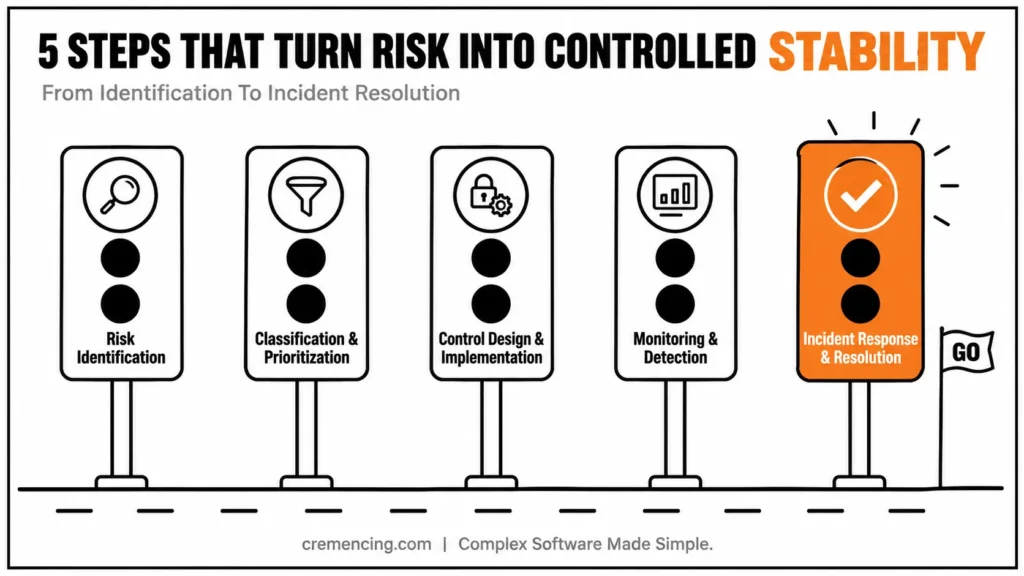
Step 1— Risk Identification
Identify risks in all SAP environments in the Enterprise
This includes:
- Infrastructure risks
- Application-level risks
- Process execution risks
- Integration risks
The problem is that many risks are not apparent when they are first mapped.
Step 2—Risk Classification and Prioritization
They are then classified according to their level of impact and likelihood once the risks have been identified.
Typical classification:
- High impact / high probability
- High impact / low probability
- Low impact / high frequency
This helps prioritize mitigation efforts.
Step 3 – Control Design and Implementation
Controls are implemented to mitigate or remove the risks.
Examples include:
- Access restrictions (SoD controls)
- Automated monitoring tools
- Workflow approvals
- System validation rules
Step 4 – Monitoring and Detection
Regular monitoring allows for problems to be caught early.
This includes:
- System health dashboards
- Log monitoring
- Alert configuration
- Exception tracking
Step 5 – Incident Response and Resolution
Structured SAP operational risk mitigation processes help teams respond quickly when failures happen.
Includes:
- Incident classification
- Root cause analysis
- System correction
- Preventive action updates
This becomes especially important when an SAP integration appears technically healthy but still produces business-process failures.
Benefits & ROI of SAP Operational Risk Mitigation
SAP operational risk mitigation delivers business value when teams connect technical controls with actual business processes.
Operational Stability Gains
- Faster incident detection and resolution
- Improved system reliability
Financial Impact
- Lower cost of system outages
- Reduced emergency support costs
- Better resource utilization
Governance Improvements
- Stronger compliance adherence
- Better audit readiness
- Reduced operational surprises
| Area | Without Mitigation | With Mitigation |
| Downtime | Frequent disruptions | Controlled stability |
| Cost | High emergency spend | Predictable IT cost |
| Risk | Reactive management | Proactive control |
Common Mistakes and Best Practices
Execution gaps >> Even the strongest SAP environments fail
Common Mistakes
- Focusing only on known risks
- Ignoring integration dependencies
- Over-reliance on monitoring tools
- Weak change management enforcement
- No real-time validation of controls
Best Practices
- Information security risk management crossing the system boundaries
- Continuously update risk models
- Combine automation with human validation
- Strengthen change impact analysis
- Do not just track operational risk incidents but also deliver trends
| Risk control | What it catches | What it can miss | Technical signal to investigate |
|---|---|---|---|
| Change management | Unauthorized or poorly governed changes | Correctly approved changes with unexpected downstream effects | Transport sequence, changed object, affected interface |
| System monitoring | Availability and technical health problems | Business-process failures while systems remain available | Health metrics + application errors |
| Integration monitoring | Failed messages and exceptions | Business impact that is not obvious from one message | Message flow and receiver status |
| Job monitoring | Failed, delayed, or abnormal jobs | Downstream business impact | Job history, runtime, dependencies |
| Access controls | Authorization and SoD risks | Process failures caused by valid but inappropriate access | Authorization failures and business context |
| Incident management | Known incidents and recurring problems | New failure patterns outside existing categories | Incident trends + root-cause analysis SAP Operational Risk Mitigation |
Why SAP Systems Break Despite Strong Risk Controls
Strong controls reduce risk, but they do not eliminate the conditions that create failures. The bigger problem is that an SAP landscape is not a single system. It is a chain of applications, interfaces, jobs, authorizations, databases, cloud services, and business processes that continuously change.
For example, a transport can be approved and tested successfully while still creating a downstream problem. A changed object may affect an interface, a background job, or a business process that was not included in the original test scenario. The transport itself is therefore not necessarily “wrong.” The risk comes from an incomplete view of its dependencies. Transport sequencing is another example of how a technically approved change can still introduce production risk when dependencies and deployment order are not controlled.
SAP’s Transport Management System is designed to organize, perform, and monitor transports between SAP systems. However, transport governance alone does not prove that every downstream business dependency has been validated.
Hidden Execution Drift That Makes SAP Systems Break
Execution drift occurs when the production environment gradually moves away from the assumptions used when controls were designed.
Common examples include:
- Emergency changes becoming permanent fixes
- Interfaces being added without updating dependency documentation
- Temporary monitoring rules remaining active after the original incident
- Batch jobs accumulating undocumented dependencies
- Teams creating manual workarounds around failed processes
- Business processes changing without corresponding technical control updates
This is why a risk register can remain “green” while operational risk increases. These execution changes are one reason SAP systems break even when the original controls are still active.
Monitoring gaps across system boundaries
A second problem appears when teams monitor individual components rather than the complete transaction path.
Consider an order process:
Customer order → SAP S/4HANA → integration layer → warehouse system → confirmation → billing
Every component can be technically available while the business process is still failing. A message can be delayed, rejected, processed by the wrong receiver, or fail because of a downstream dependency.
SAP Cloud ALM’s Integration & Exception Monitoring is designed to provide visibility into data exchange and can follow message sequences across involved components. Its Business Process Monitoring capability adds another layer by monitoring business-process KPIs and business-document information.
Job failures can become business failures
Background processing is another common blind spot.
A failed job may initially look like a technical incident. However, if that job updates inventory, creates billing documents, processes interfaces, or performs another business-critical activity, the actual impact can appear somewhere else. This dependency chain explains why SAP systems break even when individual jobs and systems appear to be operating normally.
Therefore, the investigation should not stop at:
“Which job failed?”
It should continue to:
“Which business process depended on that job, and what happened downstream?”
SAP Cloud ALM Job & Automation Monitoring can provide centralized visibility into job execution across supported SAP products, including execution status, start delays, and runtime behavior.
Controls need to evolve with the landscape.
The final problem is control aging.
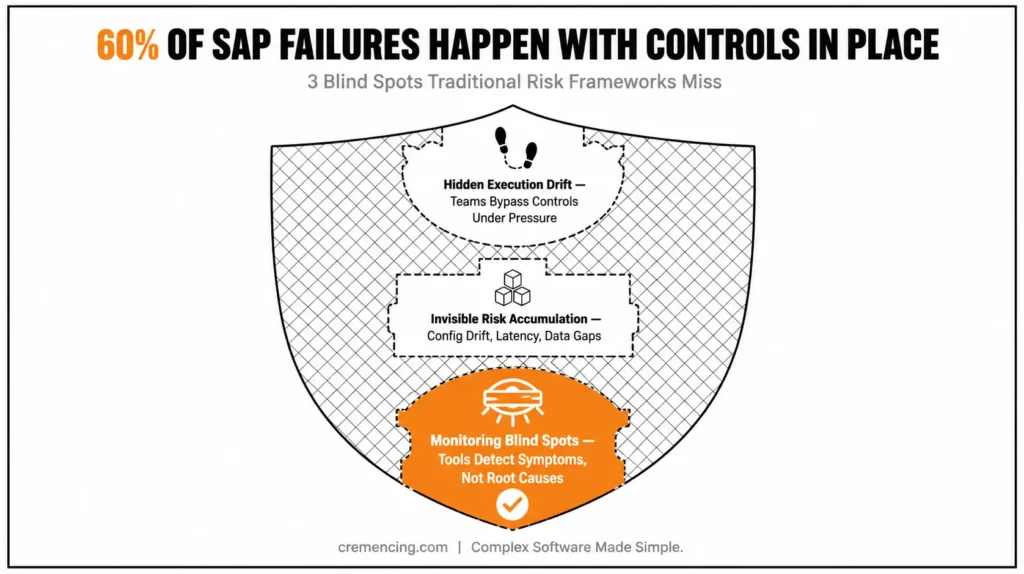
A control designed for yesterday’s landscape may not cover today’s architecture. New integrations, cloud services, extensions, interfaces, and business processes can create dependencies that did not exist when the original risk assessment was completed.
Consequently, operational resilience requires more than adding another control. Teams need to continuously compare:
Current architecture → Current dependencies → Current controls → Current monitoring → Current business impact
When those five areas remain aligned, risk mitigation becomes an operating discipline rather than a static compliance exercise.
Conclusion
Strong SAP risk mitigation can reduce exposure, but it cannot compensate for a risk model that no longer matches the production landscape. The critical issue is the gap between controls and execution. A transport can pass its approval process, a system can remain available, and an interface can appear healthy while a dependent job or business process is already failing.
That is why operational resilience needs to connect five areas: change management, system health, integration monitoring, job execution, and business-process impact.
The goal is not to eliminate every possible SAP failure. It is to detect how risk moves through the landscape, identify the dependency that turns a technical issue into a business disruption, and then update the control so the same failure is less likely to repeat.
If your SAP risk framework measures controls but cannot explain how a production failure moves from one component to another, that is the gap worth investigating next.
FAQ
Why do SAP systems continue to fail?
That is because there are still many places where hidden dependencies, gaps in execution, and an ever-changing system.
What are typical SAP operational risks?
Integration failures, config errors, change management issues and data mismatches.
What is the best way to minimize operational risk of SAP?
Through better monitoring, enhanced change control, and handling cross-system dependencies.
Can SAP systems fail even when monitoring shows green?
Yes. Technical availability does not necessarily mean that every business process is working correctly. Integration, job, authorization, and business-process failures can occur while the underlying system remains available.
What is the biggest blind spot in SAP operational risk management?
Cross-system dependencies are one of the biggest blind spots. A transaction can depend on multiple applications, interfaces, jobs, and external services, so monitoring only the SAP system may not reveal the complete failure chain.
How can SAP teams detect hidden integration failures?
Use integration and exception monitoring to track messages, exceptions, alerts, and message flows across managed components. SAP Cloud ALM provides these capabilities for supported scenarios.
How do SAP background jobs create operational risk?
A failed or delayed background job can interrupt a business process even when users can still log in to SAP. Teams should therefore connect job failures to the business transactions that depend on them.
How often should SAP operational risk controls be reviewed?
They should be reviewed whenever major architecture, integration, business-process, security, or change-management conditions change, rather than treating the risk framework as a one-time exercise.