
What Is SAP Maturity Gap and Why 67% of S/4HANA Migrations Fail Without It
Posted on February 7, 2026 by Laeeq Siddique
The SAP Transformation Question Most Avoid Until It’s Too Late
In theory, your S/4HANA initiative is solid. The business case is approved. Furthermore, the timeline is ambitious but achievable. The system integrator is confident.
And yet, months after go-live, executives start asking uncomfortable questions:
- Why do business teams continue to struggle?
- Why are processes slower rather than faster?
- Why are there so many workarounds after a “successful” migration?
The answer isn’t usually technology. It’s something subtler and far more dangerous: the SAP maturity gap.
Most S/4HANA migrations don’t fail because SAP doesn’t work. Moreover, they fail because organizations overestimate their readiness to operate digitally. However, the system moves forward but the organization doesn’t. Most S/4HANA migrations run into unexpected roadblocks, and the main culprit is often the SAP maturity gap.
What Is the SAP Maturity Gap?
At its core, the SAP maturity gap measures the difference between:
- What SAP can enable
- What your organization is actually ready to use
In addition, it emerges when companies say yes to S/4HANA, SAP BTP, Fiori, or analytics but continue to rely on:
- Legacy processes
- Fragmented ownership
- Manual controls
- Reactive governance
- Siloed decision-making
In simple terms: You digitized the platform, not how the business operates on it.
The SAP maturity gap isn’t just technical debt. It’s a mix of process, governance, operating model, and decision-making maturity outpaced by technology.
For more insigts read our blog on How to Calculate SAP Maturity Gap
Where the SAP Maturity Gap Shows Up
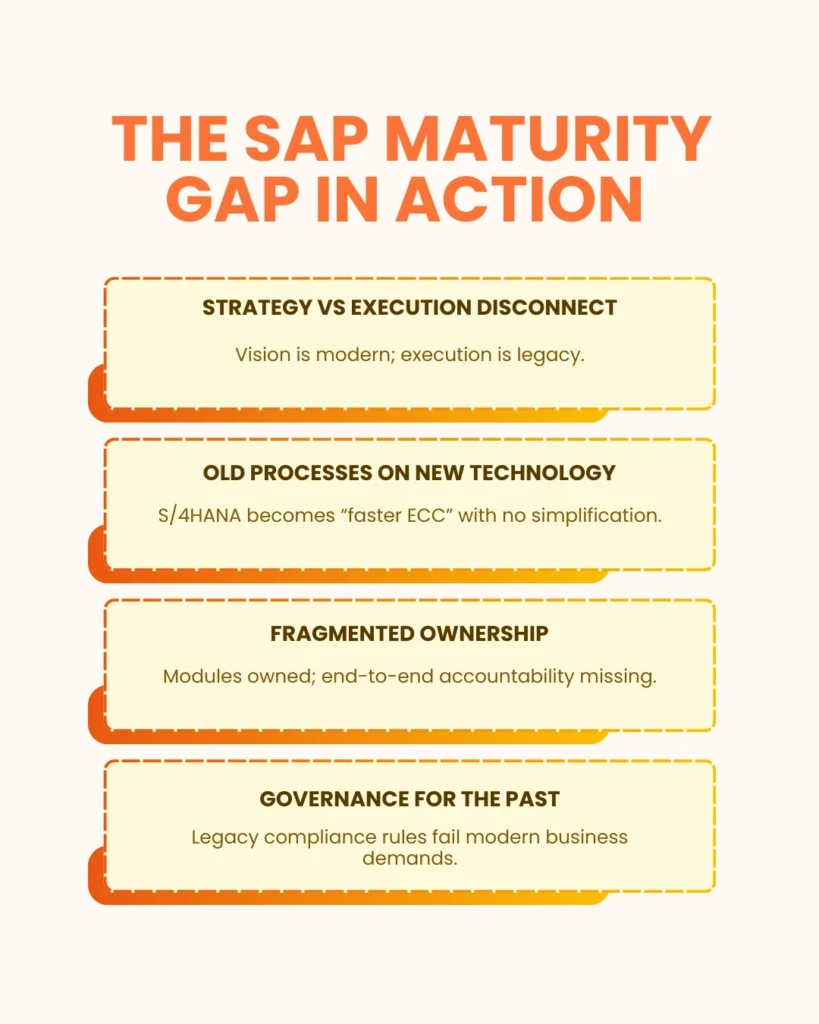
1. Strategy vs. Execution Disconnect
Leaders talk about:
- Intelligent enterprise
- Clean core
- Innovation at scale
But teams on the ground are still:
- Recreating ECC processes
- Avoiding standard SAP
- Customizing out of habit
Vision is modern; execution is not.
2. Old Processes on New Technology
Most S/4HANA projects are new in technology—but old in operations.
Common patterns:
- Rebuilding legacy process logic in S/4HANA
- Ignoring simplification for “speed”
This creates a maturity gap where new technology drives old behavior.
3. Ownership Without Accountability
S/4HANA enables:
- End-to-end processes
- Integrated data models
- Cross-functional dependencies
Yet organizations often retain:
- Module-based ownership
- Functional silos
- Fragmented accountability
When failures occur, nobody assumes full responsibility—a classic SAP maturity gap.
4. Governance Designed for the Past
Legacy governance focuses on:
- Transport approvals
- Change freezes
- Technical compliance
Modern SAP requires:
- Business-aligned decision-making
- Risk-based change management
- Continuous optimization
If governance doesn’t adapt, transformation slows even post-migration.
Why Two-Thirds of S/4HANA Migrations Fail Post Go-Live
Studies vary, but the pattern is consistent:
- Technical issues rarely cause failure.
- The real gap is never measuring SAP maturity before migrating.
Organizations often assess:
- Code volume
- Data size
- Interfaces
- Infrastructure
…but rarely consider:
- Decision maturity
- Process ownership
- Change readiness
- Integration accountability
- Business risk awareness
Without addressing these, S/4HANA exposes weaknesses long masked by ECC-era workarounds.
The Price of Ignoring the SAP Maturity Gap
Failure doesn’t always happen immediately. But over time, ignoring the gap leads to:
- Delayed adoption of innovations
- Increased manual work
- Higher support costs
- Risk-averse IT behavior
- Business distrust in SAP
Eventually, leadership concludes:
“We spent a lot of money and got no transformation we wanted.”
The problem wasn’t the investment it was the unspoken maturity void.
SAP Maturity Gap vs. Technical Readiness
Technical readiness answers:
Can the system migrate?
SAP maturity gap answers:
Will the system function effectively in our organizational context?
If the gap remains, S/4HANA is just a faster system running slower decisions.
How Leading Organizations Measure SAP Maturity
High-performing SAP organizations don’t guess—they measure.
Key dimensions include:
- Process standardization
- Integration dependency awareness
- Governance effectiveness
- Change and release discipline
- Business ownership clarity
- Data and insight usage
The goal isn’t perfection it’s honest visibility. Only then can leadership determine:
- Where to invest
- What to fix before migration
- What can wait
- What will block value realization
Bridging the Pre- and Post-Migration Gap
Successful firms treat S/4HANA as a business operating model change, not just an IT upgrade. They:
- Align change aspirations with actual organizational capacity
- Simplify processes intentionally
- Re-engineer governance for business outcomes
- Build ownership around business results
- Prepare the organization not just the system
This dramatically increases the likelihood of S/4HANA success.
Why the SAP Maturity Gap Is a Leadership Issue
IT alone cannot close the maturity gap. It requires:
- Executive sponsorship
- Business accountability
- Clear prioritization
- Willingness to reshape decision-making power
Organizations that confront the gap:
- Move faster with less risk
- Achieve higher transformation ROI
- Avoid post-go-live disappointment
Final Takeaway: S/4HANA Doesn’t Fail Expectations Do
S/4HANA isn’t the problem the SAP maturity gap is.
Without assessing maturity, companies confuse system change with business change. This misunderstanding disrupts transformation.
If your S/4HANA initiative is live or on the roadmap but value remains elusive, it’s time to face the SAP maturity gap.
Start by:
- Understanding where ambition outpaces organizational maturity
- Identifying risks invisible to technical reviews
- Mapping change objectives to business reality
A structured SAP maturity assessment can help close the gap before it’s too late and prevent transformation failure. If you’re ready to take the next step in your digital transformation journey, connect with Cremencing today. Together, we’ll explore tailored solutions that drive efficiency, innovation, and growth.
Resources
S/4HANA migration readiness & preparation
SAP Clean Core & extensibility guidance
📩 Subscribe to Our Newsletter
Get the latest updates, tips, and insights delivered straight to your inbox.