
SAP Integration Governance and the Ownership “Group Chat” Problem
Posted on February 6, 2026 by Laeeq Siddique
When Everyone Is to Blame and No One Really Is
An interface fails. Orders stop flowing. Finance numbers don’t reconcile. Within minutes, the “integration group chat” is waking up. SAP Basis blames middleware.Middleware blames the source system.The source system team swears nothing was changed.
Business users only want to know one thing: why are my shipments not moving?
This is an all too familiar story for organizations around the world each and every week.
Not that the teams trying to integrate systems are incompetent but they don’t know what their SAP Integration ownership and governance really is or it’s fragmented (dotted line real estate), or it’s just assumed.
In today’s day and age of SAP systems, integration is no longer the technical pile cushions.They are business-critical arteries.And when no one owns a problem, governance is weak or accountability is diffused.
Despite the clarity of ownership, can you guess what happens: nothing “those people”, finger-pointing, and business risk in silence.
Why Execs Need to Own & Govern Integration in SAP Land
10 years ago, SAP integrations were a breeze:
- Point-to-point
- Mostly internal
- Owned by one SAP team
That world no longer exists.
Today’s SAP environment includes:
- S/4HANA at the core
- SAP Integration Suite and APIs
- SAP BTP extensions
- CRM, HR logistics and finance SaaS platforms
- External partners and data providers
Every integration spans organizational, technical and business barriers.
That’s why SAP Integration Ownership & Governance is quietly emerging as one of the largest unmanaged risks in enterprise IT.
Executives feel the impact when:
- “Just in case” upgrades are postponed
- Incidents take days to resolve
- Trust issues with SAP for Business Lines
- Manual workarounds become permanent
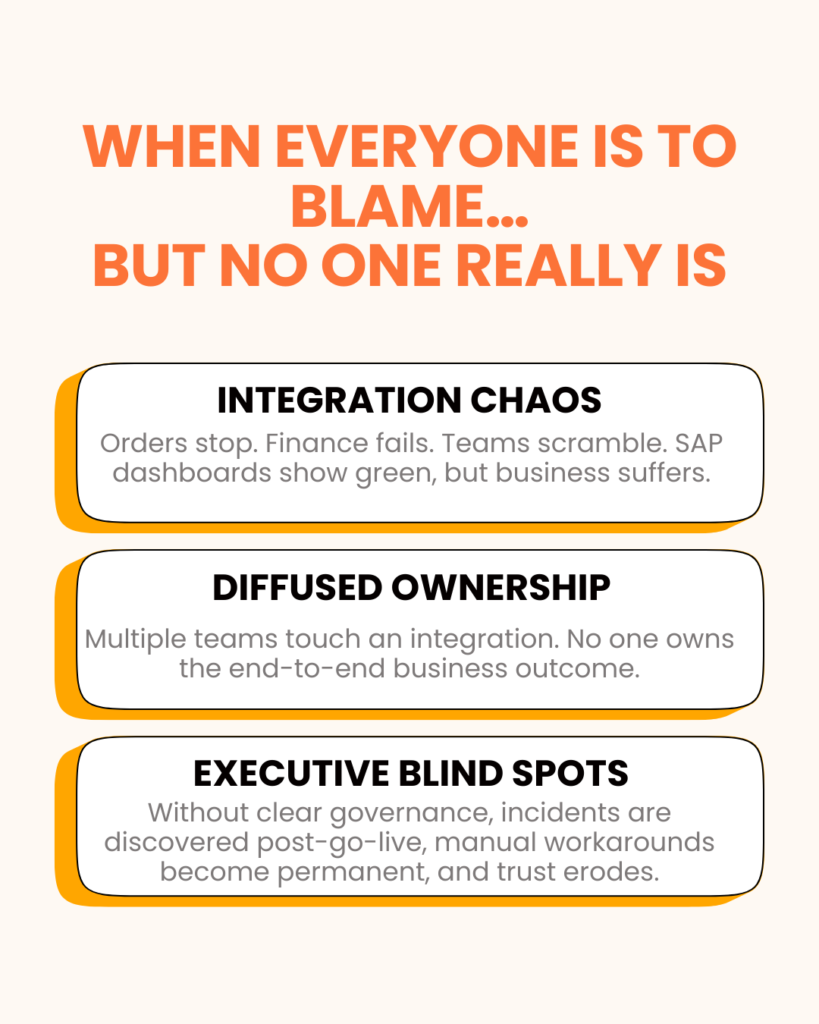
The “Group Chat” Problem Explained
The “group chat” problem isn’t one of communication.
It’s about diffused ownership.
It occurs when:
- Multiple teams touch an integration
- No one role owns the end-to-end result
- Governance is implied, not defined
In these environments:
- Everyone monitors something
- No one owns everything
- Accountability appears only during outages
For a more detailed analysis it is useful to look at the breakdown of SAP Integration Ownership & Governance: It is split among parties whose interests are conflicting:
- SAP functional teams
- Integration or middleware teams
- External vendors
- Business process owners
The result? Collective awareness without individual accountability.
And Why SAP Needs A New Integration Governance Model
The majority of SAP governance models were based on:
- Transport approvals
- Change control boards
- Functional sign-offs
- System-level testing
They assume:
- Clear system boundaries
- Stable ownership
- Predictable change cycles
Integrations violate all three assumptions:
- Span multiple systems
- Change independently
- Are impacted by vendor–controlled updates
Grey Areas: Without clear SAP Integration “Ownership & Governance” – integrations are in a grey zone: critical yet uncontrolled.
Understanding the Meaning of SAP Integration Ownership & Governance
Sound Ownership and Governance of SAP Integration questions three basic points, namely:
Who Owns the Business Outcome?
Not the interface.
Not the middleware.
The business process outcome.
For example:
- Order-to-cash completion
- Invoice accuracy
- Payroll execution
- Inventory visibility
If one doesn’t, someone needs to own the business impact for a failed integration, not just the technical fix.
Who Owns Change Decisions?
There is integration risk with each SAP upgrade, enhancement or third party update.
Governance must define:
- Who assesses integration impact
- Who approves changes
- Who validates readiness
Without this, your integration risk is found post go-live not pre.
Who Owns Lifecycle Accountability?
Integrations are living assets.
Ownership includes:
- Documentation
- Monitoring
- Incident response
- Regression testing
- Continuous improvement
If ownership stops short of go-live, governance is by definition already a failure.
The Price of Poor SAP Integration Governance (That Nobody Ever Factors In)
Negligent SAP Integration Ownership & Governance don’t often appear in the expense ledger.
Instead, it appears as:
- Prolonged incident resolution times
- Repeated production issues
- Over-testing before every release
- Fear-driven upgrade delays
- Shadow integrations built outside governance
These costs start to add up over the years:
- Lost revenue
- Higher operational expense
- Reduced agility
- Breakdown of IT-business trust
Enterprisers think of these as “typical SAP issues.”
They are not. They are governance failures.
Ownership Models That Actually Work
SAP Integration – A Strong Ownership & Governance but not Centralized.
It means clarifying responsibility.
Successful organizations employ a combination of both:
Central Governance, Distributed Execution
A core integration governance authority is established with standards, ownership and escalation directives prescribed.
Execution remains with domain-aligned teams.
This avoids bottlenecking and retains accountability.
Named Integration Owners
Each critical integration has:
- A named owner
- Clear decision rights
- Accountability for business outcomes
Possession is not implied (based on incident).
Business-Aligned Accountability
Ownership maps to:
- Business processes
- Value streams
- Operational KPIs
This makes integrations about outcomes, not tools.
Governance Is Not Control It’s Enablement
There is a common misconception that governance kills innovation.
In practice, lack of governance grinds everything to a halt.
If SAP Integration Ownership & Governance is healthy:
- Changes move faster
- Risks are visible early
- Teams collaborate with clarity
- Incidents are resolved decisively
Governance unlocks velocity by taking away ambiguity.
S/4 & you – Who Owns SAP Control & Governance in the S/4HANA World?
S/4HANA is escalating the requirement for visibility of ownership because:
- APIs replace point-to-point interfaces
- Event-driven integration increases complexity
- Cloud updates happen continuously
- Side-by-side extensions multiply dependencies
Without governance:
- Integration sprawl increases
- Regression risk grows
- Upgrade confidence declines
With governance:
- Integration becomes a strategic capability
- Change becomes predictable
- SAP is a platform, not a bottleneck
What CIOs and Enterprise Architects Need to Ask Now
If SAP Integration Ownership & Governance is into a level of maturity where its leaders can say with confidence:
- Do we own our top 20 business-critical integrations?
- How do we evaluate the integration risk prior to SAP changes?
- What are our single points of failure?
- How soon can we identify the effect on the business while an incident is ongoing?
If the answers to these questions are not clear, governance is implied — not designed
From Group Chat Chaos to Clarity on Ownership
The aim is not to have fewer messages in the group chat.
The hope is for fewer nasty surprises that one day require one.
This replaces Ownership & Governance of SAP Integration:
- Guesswork with clarity
- Escalation with accountability
- Reaction with foresight
It transforms brittle integrations into well-managed assets.
Final Thought:
Well, technological issues are not the only reason why SAP integrations fail. They take us only so far, because no one fully owns the picture.
Integration is not optional in today’s SAP Landscapes.
The new Integration ownership and governance in SAP landscapes is foundational to:
- Business continuity
- Upgrade confidence
- Digital transformation success
If ownership exists solely in a shared chat, in addition your SAP universe is already compromised. If your SAP integrations depend on tribal knowledge, moreover informal ownership or last minute coordination, this is your time to act.
Are you’re ready to take the next step in your digital transformation journey, connect with Cremencing today. Together, we’ll explore tailored solutions that drive efficiency, innovation, and growth.
Learn how a sound integration governance assessment can help you transition from reactive firefighting to predictable execution throughout your SAP landscape.
Resources
📩 Subscribe to Our Newsletter
Get the latest updates, tips, and insights delivered straight to your inbox.