
A supply chain can look efficient on paper and still struggle when demand changes, inventory gets stuck, or transportation falls behind. SAP for Supply Chain Management helps organizations address these challenges by connecting planning, procurement, production, inventory, logistics, and external partners across the supply chain.
In fact, the bigger challenge is not simply managing individual processes but connecting planning decisions with what actually happens across warehouses, transportation, and partner networks. To address this, SAP brings together planning, logistics, execution, collaboration, and analytics capabilities.
However, SAP for Supply Chain Management is not simply one application or module. Instead, its value comes from how solutions such as SAP IBP, EWM, TM, S/4HANA, and SAP Business Network work together across the supply chain.
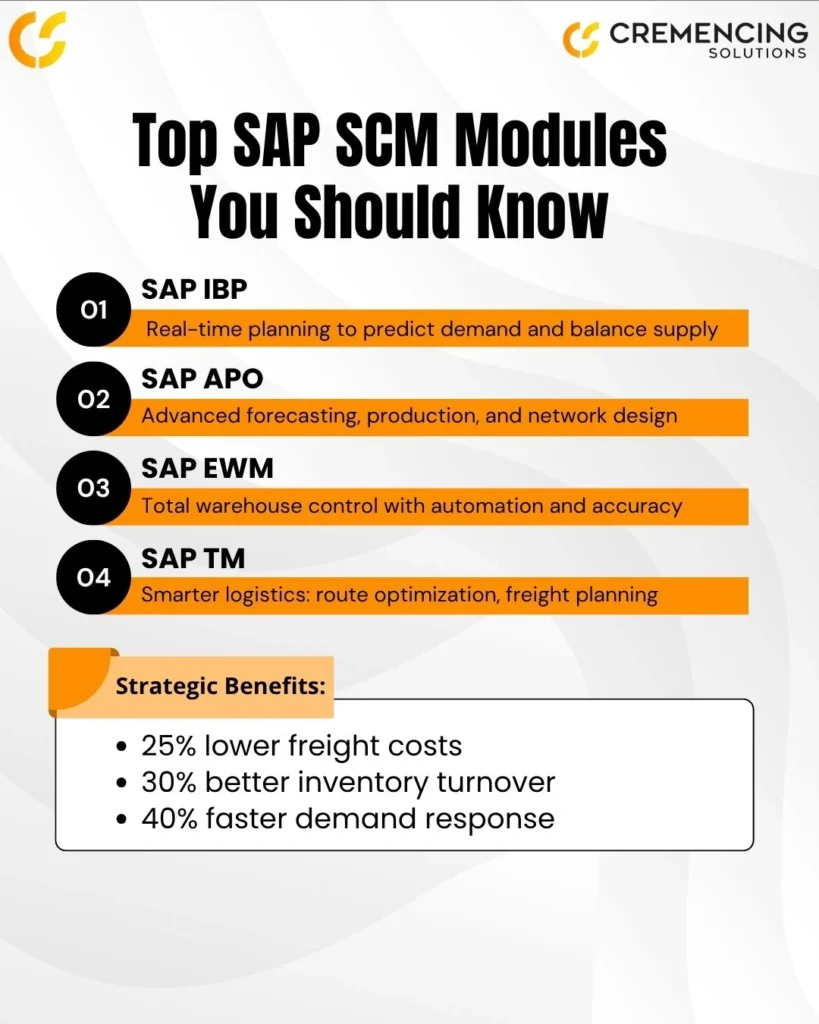
Why You Should Care:
- Today’s supply chains are complicated and exposed to disruption.
- Efficiency, automation, and immediate insight are what you’d expect.
- Gain visibility, control, and responsiveness across the enterprise with SAP SCM.
SAP for Supply Chain Management Covers:
| Key Area | Functionality |
| Planning | Demand Forecasting, Supply Planning |
| Coordination | Supplier Collaboration, Integrated Processes |
| Execution | Inventory, Warehousing, Transport Optimization |
| Analytics | Real-time Reporting, Predictive Insights |
Core SAP SCM Modules
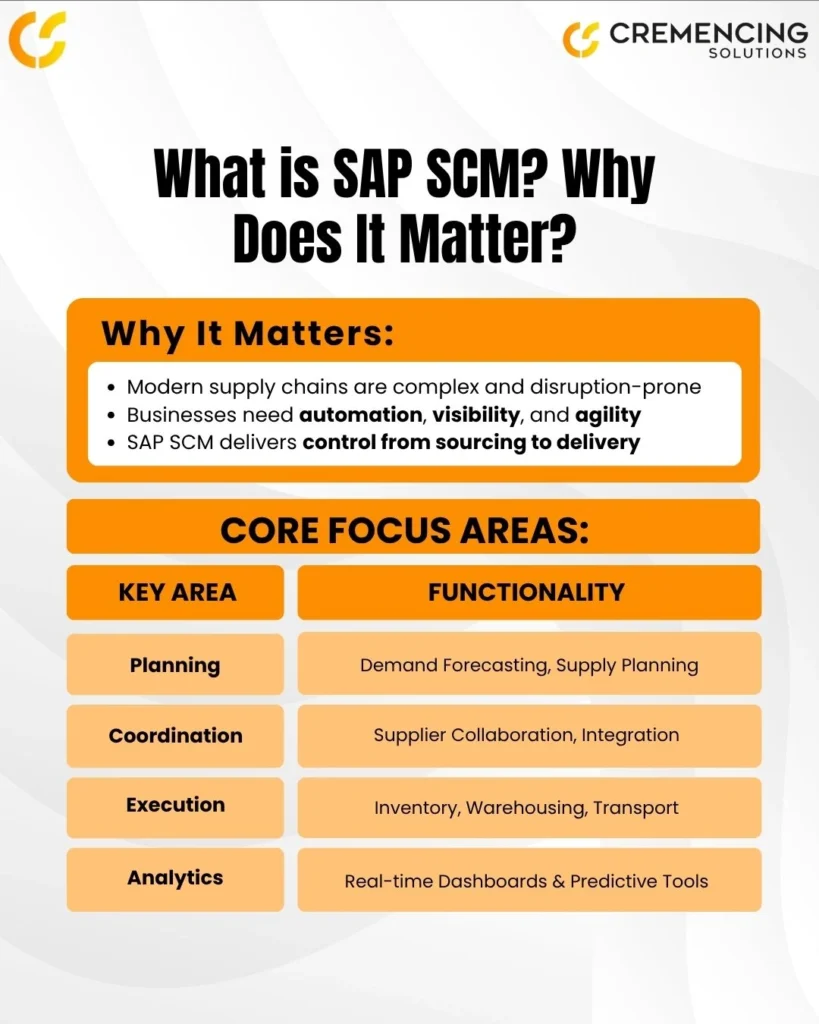
The important distinction is that these capabilities do not form one interchangeable set of “SCM modules.” They address different stages of the supply-chain lifecycle and can sit in different parts of an SAP landscape.
SAP IBP focuses on planning, including demand, supply, inventory, and sales and operations planning. SAP describes IBP as a cloud-based solution combining S&OP, demand and supply planning, replenishment, inventory planning, analytics, alerts, and what-if simulations.
SAP APO belongs mainly in the context of existing legacy landscapes. SAP documentation covers APO capabilities such as Demand Planning, Supply Network Planning, PP/DS, and Global Available-to-Promise, but organizations evaluating a new architecture should distinguish those legacy deployments from SAP’s current planning portfolio.
SAP EWM handles detailed warehouse execution. In S/4HANA landscapes, organizations can use embedded EWM or a decentralized architecture depending on operational and landscape requirements.
SAP TM manages transportation planning and execution and can integrate with EWM so transportation and warehouse processes exchange operational information.
SAP Business Network extends supply-chain collaboration beyond the enterprise by connecting trading partners and supporting information and transaction exchange.
Modern SAP supply-chain landscapes often rely on SAP BTP Integration Suite to connect S/4HANA with external applications, APIs, and other SAP services.
From Supply Chain Applications to Supply Chain Orchestration
SAP’s current supply-chain direction is moving beyond isolated planning and execution applications toward broader orchestration. In particular, SAP’s 2026 supply-chain strategy focuses on connected planning, procurement, manufacturing, logistics, external networks, and AI-supported decision-making.
At the same time, SAP Business Network provides the external collaboration layer, while SAP’s newer orchestration capabilities aim to identify risks, contextualize their impact, and coordinate actions across supply-chain processes. Together, these capabilities can help organizations connect internal operations with suppliers, logistics providers, and other external partners.
As a result, the architectural question changes for SAP teams. Rather than asking which individual SCM module should solve a problem, architects increasingly need to determine where planning, execution, partner collaboration, data, integration, and AI capabilities should sit across the landscape. Moreover, these decisions need to account for how each capability exchanges information with the rest of the SAP environment.
Ultimately, this approach helps organizations build a more connected and adaptable SAP supply-chain architecture while reducing the risk of creating isolated processes or unnecessary integrations.
Advantages of SAP in Supply Chain Management
Why integrate SAP with supply chain management? There are several strategic benefits to integrating SAP within your supply chain:
- Optimized Efficiency: Integrate all aspects of your business, from purchasing to sales.
- Predictive Accuracy: Machine learning aids in predicting dynamic demands.
- Optimization: Automation means less overstock and fewer shipping errors.
- Real-Time Visibility: Dashboards generate visibility across all supply chain sections.
- Compliance with sustainability: Consolidated capabilities monitor and reduce emissions throughout logistics operations.
Industries That Rely on SAP SCM
The adaptable nature of SAP supply chain management ensures it is invaluable regardless of the sector:
- Manufacturing – Lean manufacturing & resource booking
- Automotive – Worldwide parts sourcing and supplier coordination
- Pharmaceuticals – Regulatory compliance and temperature-controlled transportation
- Retail & eCommerce—Omnichannel Store replenishment
- “Quick turn” goods – Sales forecasting and promotions planning for high-volume promotions planning
As supply-chain landscapes expand across S/4HANA, BTP, and cloud services, centralized transport management across SAP landscapes can also help teams coordinate changes across connected environments.
Latest SAP SCM Innovations (2026 Update)
SAP’s supply-chain portfolio is evolving beyond traditional planning and execution. In particular, SAP is expanding AI, network collaboration, logistics orchestration, and real-time decision support across supply-chain operations.
AI-Powered Supply Chain Orchestration – SAP is applying AI to help identify supply-chain risks, analyze their potential impact, and support coordinated responses across planning and logistics processes.
SAP Business Network – Connects businesses with suppliers, logistics providers, and other trading partners to improve collaboration, information exchange, and supply-chain visibility.
AI-Driven Logistics Optimization – AI capabilities can support logistics decisions such as routing, rerouting, rescheduling, slotting, labor, and load optimization, helping teams respond more effectively to changing conditions.
Real-Time Supply Chain Visibility – Connected data and event information can help organizations monitor supply-chain activities, identify exceptions, and respond to disruptions earlier.
Supply Chain Sustainability – SAP’s sustainability capabilities can help organizations track and analyze environmental impacts across relevant business and supply chain processes, supporting more informed sustainability decisions.
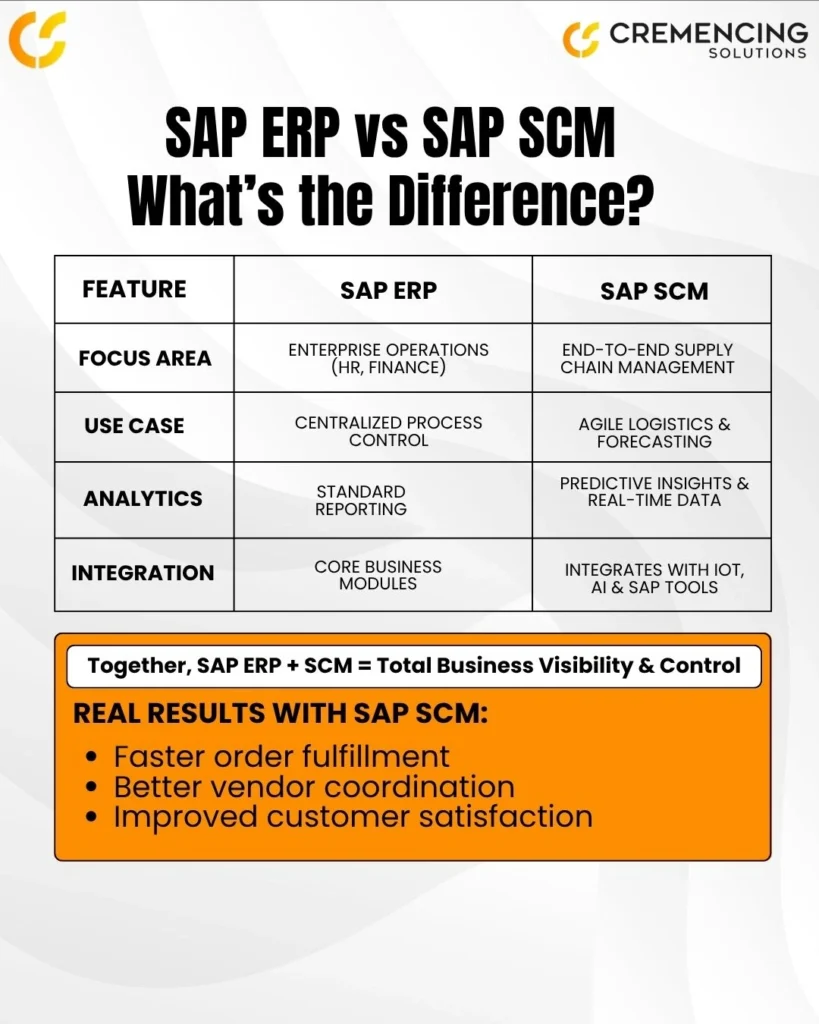
SAP ERP vs SAP Supply Chain Management
| SAP ERP | SAP SCM |
| Core suite managing HR, finance, sales, etc. | Focused exclusively on supply chain operations |
| General-purpose system | Tailored for logistics, planning and forecasting |
| Ideal for centralized control | Designed for agility and execution |
Combining SAP ERP with SAP SCM ensures end-to-end business visibility and better decision-making.
Impact of Supply Chain SAP Software That’s Real
Let’s look at some examples. It’s easy to measure clients who have applied the supply chain management powered by SAP:
- 25% less in transport costs & freight. Combine Images (up to 3)
- 30% increase in inventory turns ratio
- 40% quicker to adapt to changes in supply or demand
Better service-level agreements (SLAs) and improved customer satisfaction
Event-driven SAP integration can also help supply-chain systems respond to business events in real time However, instead of relying entirely on synchronous system-to-system calls.
Integration with Other SAP Solutions
SAP SCM integrates seamlessly with:
- SAP S/4HANA for Centralized Business Resource Planning
- • SAP Ariba for purchasing and supplier management
- SAP Analytics Cloud for live reporting and dashboards
These integrations enable companies to become data-driven and to achieve more resilient supply chains.
Where Custom SAP Development Fits
Standard SAP functionality should remain the starting point for supply-chain processes. In addition, custom development becomes relevant when a business process crosses system boundaries, requires industry-specific logic, or needs an operational experience that standard functionality does not provide.
A custom SAP supply-chain solution might connect S/4HANA with EWM, TM, IBP, SAP Business Network, or external logistics platforms. Depending on the requirement and SAP landscape, the implementation may use ABAP, released APIs, events, integration services, SAP BTP, or SAP Fiori/UI5 applications.
The architectural objective should not be to recreate SAP functionality through custom code. Ultimately, it should close the specific process gap while keeping the extension maintainable through upgrades and future S/4HANA changes.
Conclusion
In today’s connected and changing global economy, an efficient supply chain is important for keeping operations reliable and responding to changes in demand. SAP Supply Chain Management goes beyond basic supply chain software. More importantly, it connects planning, execution, logistics, collaboration, and analytics in one broader supply-chain environment. As a result, organizations can improve visibility and build more responsive and resilient operations.
Moreover, technologies such as machine learning, IoT, and advanced analytics can help supply-chain teams identify changes earlier and make better decisions. At the same time, these capabilities can help teams respond faster to operational challenges. Consequently, organizations can gain better visibility across their supply chains while finding new ways to improve efficiency and control costs.
Ultimately, the right SAP supply-chain architecture depends on the organization’s processes, existing systems, and integration needs. For this reason, companies in manufacturing, retail, logistics, and other industries can use standard SAP capabilities as a foundation. In addition, they can use targeted custom development when specific process gaps remain. This approach helps extend SAP where needed while keeping the overall supply-chain architecture practical and maintainable.
Our SAP custom development services support supply-chain implementation, integration, automation, and tailored solutions designed around your business processes. We are your expert in SAP custom development, from implementation to integration and automation.
Contact us today to receive your customized SAP supply chain management consultation:
FAQs
1. What is SAP Supply Chain Management (SCM)?
SAP Supply Chain Management (SCM) refers to SAP solutions that support supply chain planning, logistics, execution, collaboration, and analytics from demand planning through delivery.
2. What is SCM in supply chain management?
SCM stands for Supply Chain Management. It involves coordinating materials, information, suppliers, inventory, transportation, and related business processes across the supply chain.
3. What are the main functions of SAP supply chain management?
SAP supply chain capabilities cover planning, procurement and collaboration, warehouse and transportation execution, inventory management, and analytics.
4. What are the benefits of SAP Business Network?
SAP Business Network helps businesses collaborate with suppliers, logistics providers, and other trading partners by exchanging information and supporting connected supply chain processes.
5. Is SAP SCM easy to learn?
SAP SCM can take time to learn because it covers multiple business processes and SAP solutions. Practical experience with supply chain processes and relevant SAP applications can make the learning process easier.
6. What is the full form of SAP?
SAP stands for Systems, Applications, and Products in Data Processing.
7. What is the difference between SAP IBP and SAP APO?
SAP IBP is SAP’s cloud-based supply chain planning solution, while SAP APO is an established planning suite commonly found in existing SAP landscapes. Their roles should be evaluated based on the organization’s current architecture and modernization plans.
8. What is SAP EWM used for?
SAP Extended Warehouse Management (EWM) manages detailed warehouse processes such as inbound and outbound operations, inventory movements, warehouse execution, and stock visibility.
9. What is SAP TM used for?
SAP Transportation Management (TM) supports transportation planning and execution, including freight planning, transportation orders, routing, and transportation-related processes.
10. Can SAP SCM integrate with SAP S/4HANA?
Yes. SAP supply chain solutions can integrate with SAP S/4HANA to connect core business transactions with planning, warehouse, transportation, analytics, and external collaboration processes