
RISE with SAP Integration Challenges and How to Solve Each One
Posted on December 12, 2025 by Laeeq Siddique

Introduction
As they accelerate their adoption of cloud-first strategies, innovation remains at the heart of what RISE with SAP represents for organizations looking to shift into an intelligent enterprise. The all-in-one solution combines SAP’s business expertise with cloud capabilities and affords better scalability, flexibility, and performance. However, integration can be messy business for companies. Especially in a landscape where it can involve bridging incompatible systems and hidden silos to connect workflows.
In this blog, we will discuss the six most prominent RISE with SAP integration challenges and what you need to do to mitigate each one of them for a smooth running system-to-system integrations as well as operations in hybrid environments.
Understanding Integration Patterns
One of the first hurdles businesses encounter when considering how to integrate RISE with SAP is selecting which integration pattern will work best within their organization. There are a few patterns to choose from such as:
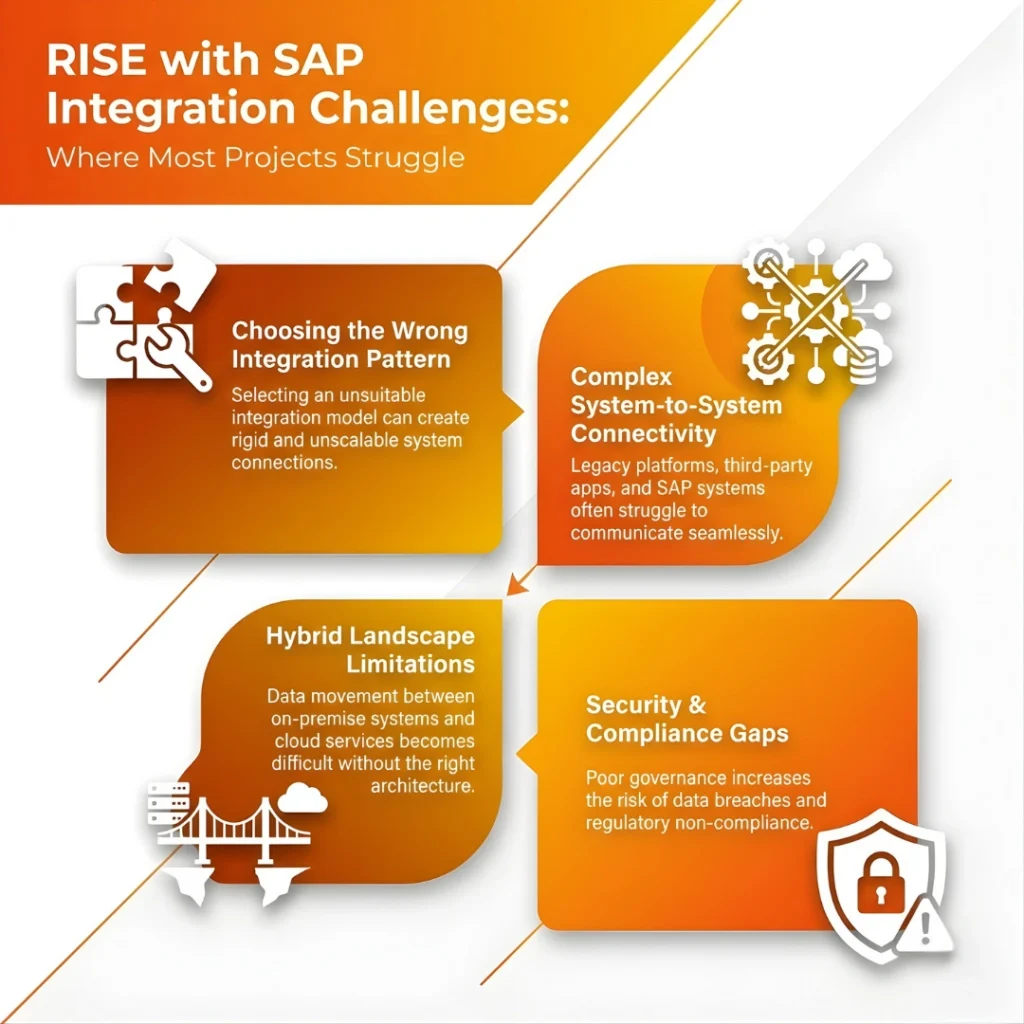
- Point-to-Point: This straightforward integration route links systems on a one-by-one basis. It works for smaller integrations but quickly becomes problematic as systems expand.
- Hub-and-spoke: A more scalable model in which all the systems connect to one central hub, which makes handling an increasing number of integrations as your environment grows much easier.
- API-led Connectivity: Connect systems by means of APIs, so modern businesses need to have access to the data in real time and they scales up as and when needed.
Solution:
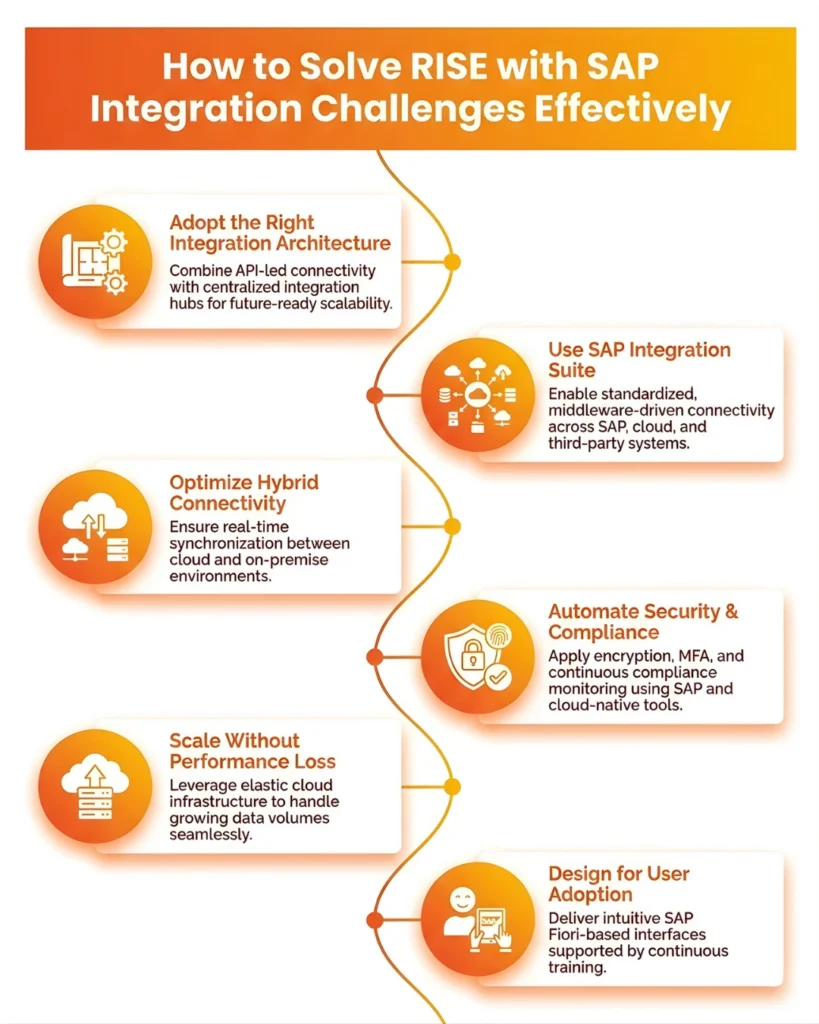
General Educate yourself on these integration patterns. By reviewing the current design of your business, what type of data it needs and where its is going in the future, you can decide which way to go. For many organizations, a hybrid model serves the business well, complementing API-led connectivity with centralized integration hubs.
Managing System-to-System Integrations
Integrating the various cloud or on-premise systems is sometimes complex during RISE with SAP integration. It’s crucial that legacy systems, third-party apps,” and modern SAP solutions collaborate freely but disparity among data formats, protocols and standards can be a barrier to integration.
Solution:
Utilize middleware like SAP Integration Suite to fill these gaps and ensure data flow between different systems is seamless. Middleware products also deliver standardization of connection and can abstract out the commonality. By simplifying a holistic integrated architecture that avoids the direct system to system integration complexity.
Adapting to Hybrid Landscapes
Today, companies are operating in hybrid environments in which cloud-based services are mixed with on-premises systems. The tricky part of integrating RISE with SAP? Connecting and transferring data smoothly between SAP’s cloud solutions and your existing on-premise infrastructure.
Answer
The SAP Integration Suite is built to optimize hybrid landscapes, and it includes capabilities to connect cloud and on-premise SAP systems. However, with this suit companies will be able to achieve real-time data synchronization to drive hybrid workloads. As a result it operate consistently across on-premises or cloud environments.
Data Security and Compliance
Enterprises are shifting to the cloud and it’s crucial that sensitive information is protected and compliant with all relevant laws and regulations. However, organizations are still subject to regulations such as GDPR, HIPAA, and SOX. While, ensuring secure governance of data from breaches and unauthorized users.
Solution:
Businesses should use strong security solutions to mitigate the risks facing them with respect to compliance issues. This can include encryption, multi-factor authentication (MFA), and access controls for sensitive data. Furthermore, with the use of SAP’s compliance manager and AWS’s security services such as AWS Security Hub, you can automate compliance controls. As well as you can continuously monitor adherence to regulations.
Scalability and Performance
The larger a company becomes, the more data it creates. Challenges of RISE with SAP integration Failing to scale systems When data increases and grows, performance may start deteriorating.
Result:
AWS allows scalability with SAP The flexible infrastructure of SAP on Amazon allows to handle the excess workload. With AWS Auto Scaling, companies can scale their infrastructure up or down to match demand automatically. “SAP cloud” is also elastic, so it can be scaled up to stretch or down to contract as needed, with no worrying about hardware limitation getting in the way.
Ensuring Seamless User Experience
User Adoption is a Silver Bullet Issue when it comes to integrating RISE with SAP. Employees may have difficulty learning to use new tools if the user interface (UI) isn’t intuitive or companies don’t roll out new systems effectively, which can ultimately hinder productivity and morale.
Result:
To offer users the best experience, companies need to offer those programs and create interfaces that are easy to use. We can optimize user adoption and facilitate the transition by utilizing SAP Fiori inspired, customized intuitive UIs. And of course, providing ongoing training and support post-integration is crucial in ensuring users are comfortable with the new system.
Conclusion
Although SAP RISE integration Challenges have some barriers, companies can address them by taking the correct steps and using SAP’s suite of tools. From choosing the right integration pattern to maintaining data security organizations accelerate their cloud journey and streamline operations.
Solving the relevant challenges with the right solutions will help organizations truly harness RISE with SAP and become intelligent enterprises that are prepared for what lies ahead.
We are specialized in SAP Custom Development and integration at Cremencing Solutions. If you are considering a new implementation of RISE with SAP, or looking to get more from your existing infrastructure, we deliver bespoke solutions that integrate smoothly and drive business performance. Get in touch with us today and begin your evolution into the RISE with SAP portfolio.
Read for more insights on SAP Integration Inside the SAP Integration Suite: Discover the Hidden Tools Behind Its Power
FAQs
What is RISE with SAP?
A: RISE with SAP is SAP’s all-in-one providing to help businesses move themselves towards a cloud-first business process. It delivers complete digitization kits including SAPS/4HANA, cloud infrastructure and digital transformation kit.
What does RISE with SAP do for my business?
A: RISE with SAP is a path for customers to embark on an accelerated transformation by offering them a single platform that combines SAP’s wide-ranging S/4 Hana ERP software with cloud data storage and infrastructure. This gives increased scalability, efficiency and relevance to business needs.
What are the typical integration scenarios with SAP?
A: The most frequent forms of integration are as follows:
- Point-to-Point: Direct lines between two systems.
- Hub-and-Spoke: A main integration hub connects various systems.
- API-Led Connectivity: Connecting systems through APIs to allow for adaptability and scalability.
Resources
📩 Subscribe to Our Newsletter
Get the latest updates, tips, and insights delivered straight to your inbox.