
How to Calculate Your SAP Maturity Gap Using the 8-Dimension Assessment Framework
Posted on February 8, 2026 by Laeeq Siddique
This is Why 90% of SAP Leaders Have No Idea How Large Their Maturity Gap Actually Is
Almost every CIO has a good feel for their own SAP landscape. They know which systems are up. They know the roadmap. Moreover, they know the budget.
But when S/4HANA projects stall, so does value realisation that is too slow, or transformation results are lackluster there is one inevitable uncomfortable truth that surfaces:
In Addition, hardly any companies actually know how large their gap is between the start to End of SAP, if at all. They assume maturity. They don’t measure it.
And lacking any established means of measuring readiness, decisions on SAP transformation are made based on gut feel, legacy, or vendor claims and not data.
This is precisely why the SAP maturity gap calculator is emerging as a must-have for business executives. It offers a data-driven view into where the organisation sits today and what it needs to change to unlock real value from S/4HANA.
What is an SAP Maturity Gap Calculator?
Definition of an SAP maturity gap calculator
The SAP maturity gap calculator is a formal assessment-based model that quantifies the delta between:
- Your present SAP operational maturity level, and
- The maturity needed to fully exploit S/4HANA and the new SAP platforms
The maturity gap calculator does not work like a top-down readiness checklist, but rates the organisation across various aspects that affect performance, risk and ROI.
It creates not some kind of generic score, but a strategic clarity device for executives.
The Importance of a Structured SAP Maturity Gap Calculator for the Executives
Assumptions Are Dangerous to Transformation
The majority of SAP programmes are based on assumptions:
- “Our processes are mature enough.”
- “Data quality problems will get better after the move.”
- “Change adoption will catch up.”
In fact, the age difference just gets bigger as time goes on.
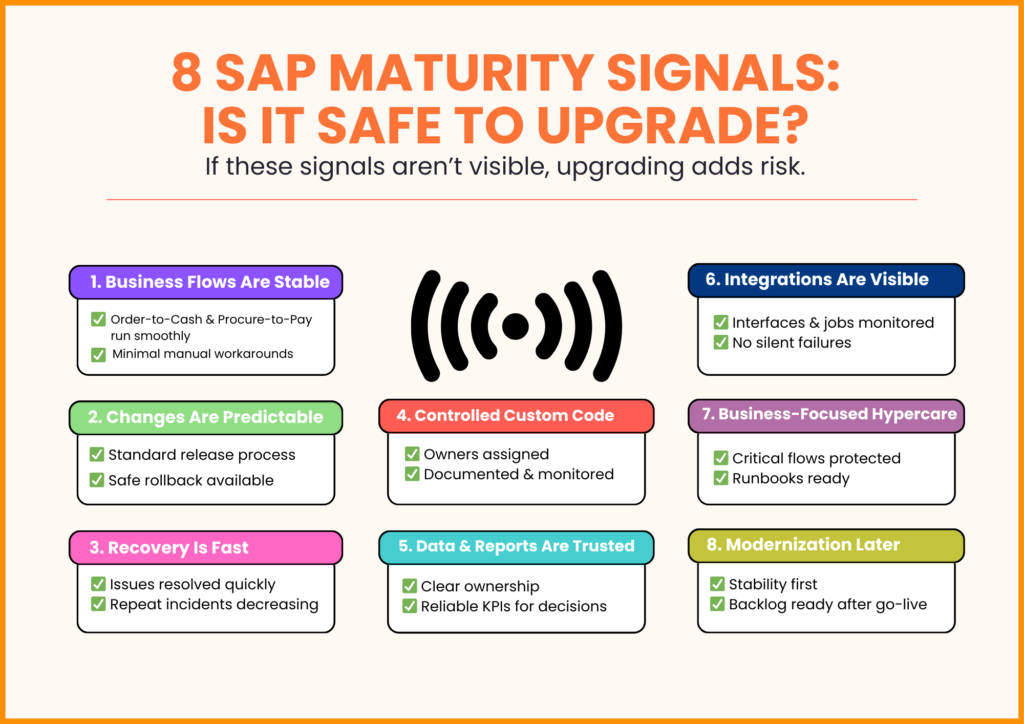
A calculator for the SAP maturity gap replaces assumptions with quantified reality so that leaders can:
- Make informed investment decisions
- Prioritise high-impact improvements
- Align SAP projects to business strategy
- Reduce post-go-live surprises
This is not an operational tool for CIOs and EA, it is a tool of governance and decision making!
The 8-Dimension SAP Maturity Gap Assessment Framework
Now it is time to reveal the 8D maturity model!
A strong SAP maturity gap calculator will assess your level of maturity across eight interdependent dimensions. Combined, they offer an integrated view on readiness, resilience and value potential.
This model is intentionally built for executive clarity – not technical detail.
Dimension 1: Maturity of SAP Architecture and Landscape
This dimension evaluates how far your SAP landscape enables the scalable, integrated standing and future change of such value.
Low maturity indicators:
- Heavy customisation
- Tight coupling between systems
- Fragile integrations
- Limited cloud or SAP BTP consumption
High maturity characteristics:
- Clean-core principles
- Modular architecture
- Integration-first design
- Platform extensibility
Why it matters:
Architecture maturity measures how fast your organization can change without breaking everything.
Dimension 2: Process Standardization and Optimization
Here and now, the SAP maturity gap calculator determines whether processes are planned for efficiency—or left for comfort.
Low maturity:
- Replicated legacy processes
- Manual workarounds
- Inconsistent workflows across regions
High maturity:
- End-to-end process ownership
- Standardised global templates
- Embedded automation
- Continuous improvement mindset
Why it matters:
S/4HANA speeds things up assuming that speed is what you’re after.
Dimension 3: Data Quality & Governance Maturity
This is the trust of data at decision time dimension.
Low maturity:
- Conflicting reports
- Poor master data governance
- Spreadsheet dependency
- Unclear data ownership
High maturity:
- Defined data governance model
- Single source of truth
- Embedded analytics
- Confidence in real-time insights
Why it matters:
Without data maturity, S/4HANA provides speed without vision.
Dimension 4: Security, Risk & Compliance Readiness
Risk management and SAP maturity are inextricably linked.
Low maturity:
- Role complexity
- Weak access controls
- Manual audit processes
- Reactive compliance management
High maturity:
- Role simplification
- Automated controls
- Continuous compliance monitoring
- Security embedded in design
Why it matters:
Contemporary SAP platforms improve transparency but open up that much more exposure if maturity is behind.
Dimension 5: Operating Model & Delivery Maturity
This dimension evaluates the manner in which SAP work is accomplished.
Low maturity:
- Project-based delivery only
- Siloed teams
- Reactive support models
High maturity:
- Product or platform-centric ownership
- Agile delivery practices
- Business-IT collaboration
- Continuous enhancement cycles
Why it matters:
S/4HANA is not a project; it’s a platform.
Dimension 6: Skills and Capability Readiness
Technology maturity without T-skills is a deception.
Low maturity:
- Dependency on external consultants
- Limited internal SAP expertise
- Opposition to a new way of doing business
High maturity:
- Strong internal capability
- Clear role evolution
- Ongoing upskilling strategy
Why it matters:
In the end, it is people who drive [the use or ignore] of SAP capabilities.
Dimension 7: Change Management & Adoption
This is the dimension that asks whether transformation sticks.
Low maturity:
- Poor communication
- Limited business engagement
- Change fatigue
High maturity:
- Clear transformation narrative
- Executive sponsorship
- Embedded change enablement
- Adoption metrics tracked
Why it matters:
Without adoption, improvements in maturity never emerge.
Dimension 8: Innovation and Value Creation
And the last dimension is about whether SAP is pushing business innovation or mere operational stability?
Low maturity:
- Single-minded in their “keeping the lights on” efforts
- No structured innovation roadmap
- SAP BTP underutilised
High maturity:
- Clear value-realisation framework
- Continuous innovation pipeline
- Business-led use cases
- Measurable outcomes
Why it matters:
This is how “maturity with SAP” becomes competitive advantage.
The SAP Maturity Gap Calculator in Practice
Each dimension is measured using specific criteria, moreover, which are normally scored on the maturity scale (e.g. initial, evolving, established, advanced).
SAP maturity gap can be measured through the comparison amongst:
- Current maturity level
vs. - Maturity needs to support the business objectives
The result:
- A quantified maturity gap
- Clear priority areas
- Actionable improvement roadmap
It enables the CX leaders to advance from opinion-oriented talks to evidence-based decisions.
SAP Maturity Gap Calculator What It Tells You That a Dashboard Does Not
Traditional SAP reporting focuses on:
- System performance
- Project milestones
- Budget tracking
A maturity gap calculator reveals:
- Structural weaknesses
- Hidden risks
- Value leakage points
- Capability constraints
It tells you why performance stalls not just where.
When is an SAP Maturity Gap Calculator Necessary?
Leading enterprises use it:
- Before S/4HANA migration: De-risk transformation
- During implementation: Course-correct early
- Post go-live: Expedite value realisation
In every instance, a calculator becomes a tactical alignment vehicle from IT to the business.
The Price for NOT Measuring Your SAP Maturity Gap
Companies that don’t carry out maturity assessment typically encounter:
- Prolonged hypercare
- Escalating support costs
- Missed innovation opportunities
- Executive dissatisfaction with SAP ROI
The irony is simple:
The price we pay to assess maturity is nothing compared to the cost of denying it.
Final Thoughts
You Can’t Fix What You Don’t Measure
SAP transformations don’t break with a bang, they break as zombified organisations unable to reach their true potential.
The SAP maturity gap calculator provides a view that helps business leaders to:
- Understand readiness honestly
- Prioritise what truly matters
- Align SAP investments with strategy
- Make S/4HANA a value platform, not just an ERP
Migration moves you forward.
The level of maturity is what limits the degree of your advancement.
Whether your organization is in the process of executing, planning, live or up and running on S/4HANA, it’s important to calculate where your current SAP maturity level resides using a methodical, multipronged framework.
If you’re ready to take the next step in your digital transformation journey, connect with Cremencing today. Together, we’ll explore tailored solutions that drive efficiency, innovation, and growth.
Resources
SAP Enterprise Architecture Maturity Model – 8 Dimensions
SAP Readiness Check for S/4HANA
📩 Subscribe to Our Newsletter
Get the latest updates, tips, and insights delivered straight to your inbox.