
FLASH SAP Methodology Explained in 8 Dimensions You Can Measure Today
Posted on February 4, 2026 by Laeeq Siddique

On paper, most SAP transformation frameworks are rather spectacular. Barely any help, executives are cut and dried in real life.
CIOs and owners overseeing SAP transformation are feeling always-on pressure to modernize faster, derisk more effectively, and demonstrate value often simultaneously. Additionally, all they’ve done before doesn’t matter; everything has to be learned again. Moreover, Googling and clicking on links isn’t going to help anyone develop or deploy new features.
That is why FLASH SAP was developed.
Instead of vague scores or generic benchmarks, FLASH SAP offers a concrete, quantifiable solution for assessing digital readiness in the areas that truly dictate SAP success. However, it enables leadership teams to understand where they are strong, where they are exposed, and what needs to change before committing to a major investment.
In this post, we decompose the FLASH SAP approach and describe the eight measurable dimensions of its study, demystifying HOW executives can begin using it today to drive more informed SAP decision-making.
Why SAP Teams Need a Measurable Readiness Methodology
SAP landscapes are now more or less complex.
Enterprises are now balancing:
- S/4HANA transformations
- SAP BTP extensions
- Hybrid and cloud architectures
- Increasing integration demands
- Tighter commercial and licensing constraints
At the same time, they want faster results, less risk, and greater clarity about accountability.
The problem? Even though the truth is that the question to which I am referring, one of the most basic but important questions any company can ask itself, is one for which most companies are incapable of obtaining an objective answer:
Are we prepared to successfully deliver the SAP roadmap now?
That’s where FLASH SAP is different. Therefore, it emphasizes readiness over ambition, which allows leaders to monitor what actually matters before the momentum of transformation becomes execution drag.
What is the FLASH SAP Method?
FLASH SAP is an executive toolset for assessing digital readiness and execution capability in an enterprise-wide SAP environment.
Its foundation is a straightforward one: The factors for success with SAP are a few critical dimensions that determine the success of an SAP initiative, and weaknesses in any one can be fatal.
Instead of trying to assess everything, FLASH SAP is focused on eight dimensions that directly impact speed of delivery, stability, and realisation of value.
Each dimension is:
- Clearly defined
- Measurable today
- Actionable for leadership
This is not a technical document on how to implement; it’s a decision-making framework for business leaders who need to govern and sequence SAP initiatives.
Why FLASH SAP is Used by Top Firms
Companies that decide to use FLASH SAP will enjoy the best of:
- IT and the business are slow to meet up
- Early identification of execution risks
- More realistic SAP roadmaps
- Better investment sequencing
- Stronger governance and accountability
Best of all, FLASH SAP removes the guesswork and debate by providing common evidence-based information”.
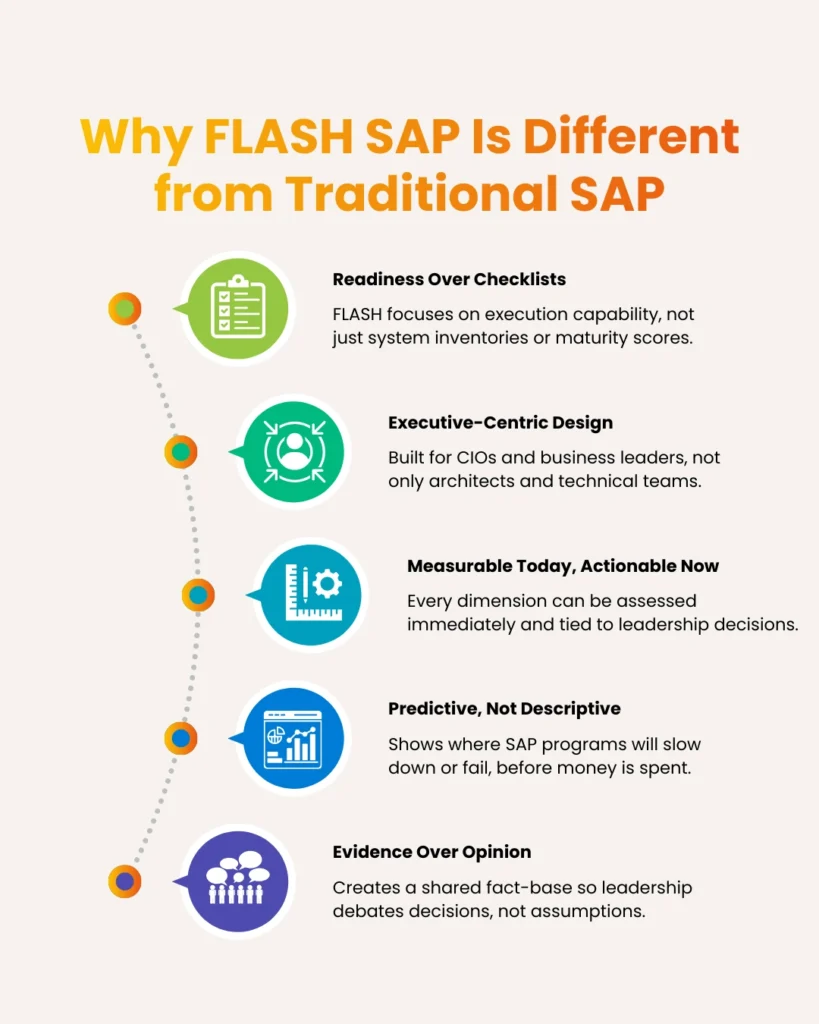
The 8 Facets of the FLASH SAP Approach
Now, let’s dive into the eight aspects that comprise FLASH SAP—and how you can measure each right now.
Strategy and Business Alignment
No SAP program is successful without strategic clarity.
This dimension measures:
- Matching of the enterprise requirements with the SAP roadmap
- Clarity of transformation objectives
- Compatibility of priorities at the executive level
Low maturity seems to be more what you expect here; SAP programs being driven by deadlines, vendor pressure, because of legacy commitments, not positive business outcomes.
What you can measure today:
- Presence of understandable business-led SAP goals
- Executive ownership and sponsorship
- SAP program alignment with enterprise KPIs
Process Design and Standardisation Discipline
PIs are all about ways of working in which SAP would add value.
FLASH SAP evaluates:
- The extent to which the process is standardised throughout the organisation
- Governance over process changes
- Willingness to work in new ways than life has known heretofore.
Companies with poor process discipline typically customise SAP to reflect their legacy activities–and make a tangled mess of change long into the future.
What you can measure today:
- Number of process variants
- Clarity: Global vs local process ownership clarity
- Frequency of process-driven customisation
Clean Core and Customisation Governance
Clean core isn’t avoiding custom development, it’s containing it.
This FLASH SAP dimension assesses:
- How we validate and approve customisations
- Separation between the core and extensions
- Long-term upgrade and maintenance impact
Healthy maturity here enables creativity but not at the expense of order.
What you can measure today:
- Percent of changes migrated to non-core
- Existence of extension design principles
- Readiness for upgrade and level of technical debt
Architecture and Integration Readiness
SAP today is architected as an animal kingdom, not a monolith.
FLASH SAP looks at:
- Integration architecture consistency
- API and event-driven patterns are merged
- Dependency visibility across systems
Low integration maturity typically means delays, unscalability, and brittle solutions are in your future.
What you can measure today:
- Integration platform usage consistency
- Manual vs automated integrations
- Visibility into system dependencies
Data, Analytics, and Decision Enablement
Decisions made by managers are often based on SAP data – but trusting in it is something many organisations find difficult to do.
This dimension evaluates:
- Data ownership and accountability
- Master data governance
- Consistency between analytics and decision requirements
A lack of maturity here has a direct impact on forecasting, compliance, and confidence in insights.
What you can measure today:
- Data ownership clarity
- Data quality issue frequency
- Executive comfort with reporting and analytics
Operating Model and Capability Readiness
Technology readiness without people’s preparedness is a risk bracket.
FLASH SAP assesses:
- Skill depth across SAP roles
- Internal vs on Vendor balance
- Change, training, and adoption readiness
This dimension is often the most influential on post-go-live performance – not project completion.
What you can measure today:
- Dependency on external resources
- Role clarity within SAP operations
- Training and change enablement coverage
Governance and Decision-Making Effectiveness
Governance determines how quickly and how safely decisions can be made.
This dimension examines:
- Decision rights clarity
- Portfolio prioritisation discipline
- Escalation and accountability models
Poor governance results in long decisions, scope creep, and meandering outcomes.
What you can measure today:
- Or What I will get from attending the class below key decisions for SAP ASAP3 minutes.work.com 10 Work.com GmbH Telefon: +49 (0) Fax: +49(0)spent on a decision-related meeting or discussion with an expe
- Overlap or vacuum between decision owners
- Portfolio alignment with strategy
Commercial and Licensing Awareness
Commercial maturity is frequently underrated and paid for later.
FLASH SAP evaluates:
- Awareness of licensing implications
- Contractual flexibility
- Convergence of technical and commercial decisions
A lot of “technical” SAP decisions have a long-term cost tail when you disregard commercial influences.
For more insights, read our Blog SAP FLASH Assessment
What you can measure today:
- Visibility into licensing usage
- Alignment between architecture and contracts
- Frequency of unplanned commercial costs
How FLASH SAP Transforms Measurement into Action
The key to the potency of FLASH SAP is not the dimensions, but how they are mixed.
Instead of rating each dimension independently, FLASH SAP focuses on:
- Cross-dimensional dependencies
- Readiness bottlenecks
- Mismatch between ambition and capability
For example:
- Good technical maturity at the expense of a poor operating model discipline
- Nadir For The Innovative Goals Amid Governance Discipline
- Pure core no extension governance
When risks materialize, these patterns provide the leadership with the opportunity to modify timing, depth, and sequences. For more insights, read our Blog on How to to ruun SAP Digital Maturity
WHEN TO USE THE FLASH SAP METHOD
The best return on investment for FLASH SAP comes at critical decision times, such as:
- Ere S/4HANA or ECC exit programmes
- Before SAP BTP or Before Extension-Inclined Projects
- After mergers, acquisitions, or restructuring
- Rinse and repeat with SAP programmes that don’t fall short
Applied early, FLASH SAP spares costly course corrections down the road.
Typical Chief Executive Blunders that FLASH SAP Helps in Preventing
FLASH SAP helps organisations avoid:
- Overloading SAP roadmaps beyond readiness
- Tackling SAP transformation as a matter of technology
- Ignoring governance and commercial risk
- Confusing activity with progress
Leaders take back control of SAP results by basing decisions on the quantifiable readiness they have.
Why FLASH SAP is now more critical than ever
With SAP landscapes getting more modular, integrated, and commercially complex, execution discipline is even more important than a bold vision.
FLASH SAP is a formal method for:
- Make readiness visible
- Align leadership
- Reduce transformation risk
- Protect long-term SAP investments
It makes maturity assessment a leadership ability, not a consulting activity. Ambition without readiness creates friction. Readiness without direction creates stagnation.
The FLASH SAP approach helps businesses find that balance by weighing the dimensions that really do drive success with SAP and deliberately taking action on them. FLASH SAP is not just another framework for CIOs and owners of SAP transformation. And it’s a useful lens for making better decisions starting today.
If you’re ready to take the next step in your digital transformation journey, connect with Cremencing today. Together, we’ll explore tailored solutions that drive efficiency, innovation, and growth.
Resources
SAP FLASH Assessment
SAP Activate Methodology
📩 Subscribe to Our Newsletter
Get the latest updates, tips, and insights delivered straight to your inbox.