
Enterprise Architecture Maturity Model for SAP: From Assessment to Implementation
Posted on February 10, 2026 by Laeeq Siddique
Why Technology Alone Won’t Power Your SAP Transformation
The narrow vision of SAP transformations is how enterprise decision-makers usually go about in their attempts to modernize:
- Deploy S/4HANA
- Migrate data
- Go-live
But months down the track, organisations are frequently floundering in slow uptake, disaggregated reporting, mounting costs, and a sub-optimal strategic result.
The missing piece? Enterprise architecture maturity.
A SCM model for SAP takes the form of a defined enterprise architecture maturity model, which provides executives with an understanding of how ready their organization is to harness technology, process, and people to deliver strategic value.
It’s in this context that SAP transformation initiatives run the risk of flipping from value drivers into expensive technical upgrades.
So, What is an Enterprise Architecture Maturity Model?
An enterprise architecture maturity model (EAMM) is a model that describes how well an organization can manage and evolve its information technology (IT) and other business assets over time.
For SAP, this evaluation checks to make sure that the enterprise:
- Aligns IT with business objectives
- Governs processes and data
- Supports innovation and transformation
- Scales SAP solutions on a corporate or group level
The maturity model is a roadmap from “as-is” to “to-be,” and supports decision-makers in choosing initiatives, allocating resources, and minimising risk of transformations.
EA Maturity: Why Would I Care If I Were An Executive?
Additionally, Enterprise architecture is not one of technology alone, but also a means to strategy.
Organisational benefits provided by a high EA maturity are:
- Reduce costs and scale SAP landscapes efficiently
- Reduce project failure risk
- Develop more agile and responsive to business change
- Enhance data-driven decision-making
Low EA maturity, on the other hand, results in siloed processes, system sprawl, As well as compliance exposure, and low ROI even if deployed correctly with everything SAP technology.
Five Stages of Enterprise Architecture Maturity
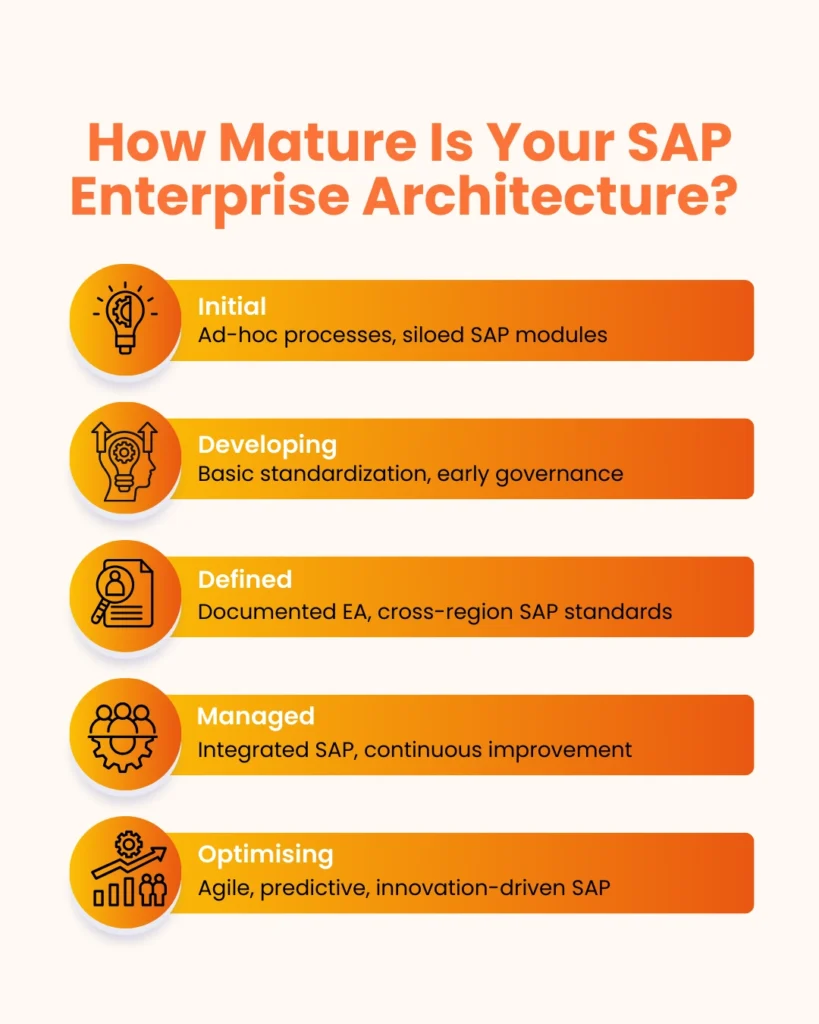
The majority of EAM maturity models discuss five levels of enterprise capability. An understanding of the various levels helps executives benchmark readiness and plan for improvement.
Level 1: Initial
- Anything goes, processes may come in externally
- Processes and systems are ad hoc
- Minimal documentation and governance
- Heavy reliance on tribal knowledge
- SAP was deployed but poorly integrated
The pressure: Risk associated with transformation is high; investments may not deliver anticipated value.
Level 2: Developing
- Basic process standardisation in place
- Initial governance frameworks applied
- Limited IT-Business alignment
- Silos of SAP modules run in functional isolation
Executive insight: Early potential for improvement, with few cross-functional savings.
Level 3: Defined
- Enterprise architecture is documented and repeatable
- Governance frameworks formalised
- Standardised SAP processes across regions
- Data governance improving
Executive summary: Organisations can scale SAP deployments, minimise duplication, and better govern compliance.
Level 4: Managed
- Integrated, optimised SAP landscape
- Business and IT are fully aligned
- Metrics on data and processes tracked for decision-making
- Continuous improvement embedded in culture
Executive summary: Transformation is predictable; ROI can be measured; innovation priorities can be set.
Level 5: Optimising
- Architecture evolution in line with strategy
- Agile, innovation-driven SAP platforms
- Predictive analytics and data-driven insights
- Enterprise-wide collaboration and governance embedded
Executive perspective: SAP is a strategic foundation for growth, innovation, and competitive differentiation.
Using the Enterprise Architecture Maturity Model in the Context of SAP
Organizations should measure maturity in key SAP dimensions to apply the model appropriately:
Process Architecture
- Is your business process standardised, optimised, and aligned with SAP best practices?
- Are workflows automated, from end to end and at scale?
Data Architecture
- Is master data consistent, trusted, and available?
- Do you utilize analytics as a real-time decision-making tool?
Application Architecture
- What is SAP functional modules and modular?
- Could the architecture be extended to cloud and SAP BTP solutions?
Technology & Infrastructure
- Will the infrastructure provide an environment conducive to performance, scalability, and cost optimization?
- Are there security, compliance, and governance measures already baked in?
Governance & Organisation
- Are the roles, responsibilities, and processes well defined?
- Is EA governance suitably linked to enterprise strategy?
- Do teams transition appropriately to change?
Implementation Roadmap for Executives
Step 1: Assess Your Current Levels of Maturity
Evaluate maturity against the model through workshops, surveys, and system analysis. Analyze strengths, weaknesses, and gaps in SAP processes, architecture, and governance.
Step 2: Define Target State
Your “to-be” architecture should align with business strategy. Establish specific targets for process improvement, data control, technology integration, and organizational capability.
Step 3: Prioritise Initiatives
Prioritize high-yield projects that eliminate maturity gaps the quickest, and provide SAP ROI.
Step 4: Execute Governance & Drive Continuous Improvement
Define strong governance mechanisms to track progress, control change, and continue evolving your SAP and enterprise architecture approach.
Step 5: Monitor Performance
Monitor risk and track performance metrics to make any changes that will enable you to achieve long-term maturity gains and become strategically aligned.
Mature Enterprise Architecture Is A Valuable Exercise for Your Business with SAP
- Diminished operational risk: A well-run architecture will not cause expensive downtime
- More nimble: Better processes and data
- Reduction in TCO: Optimized system and infrastructure mean lesser overheads
- Scalable innovation: EA maturity accelerates adoption of SAP innovations and BTP extensions
- Tangible ROI: Projects aligned with strategic priorities provide the greatest results
Common Pitfalls to Avoid
- Not having an EA maturity assessment treated as a single-time event
- Ignoring people and process and focusing exclusively on technology
- Ignoring governance and change management
- Not connecting SAP architecture to the business strategy
Good, more mature organisations bake the EA maturity model into SAP governance & transformation cycles.
In Conclusion: The Case for Enterprise Architecture Maturity in SAP Success
Implementing SAP without understanding enterprise architecture maturity is like putting a high-performance car on a junkyard infrastructure. Sure, the car may run, but it won’t get you where you’re heading maxed out — and long-term costs will be hugely inflated.
A well-structured enterprise architecture maturity model can provide executives with the means to:
- Assess readiness holistically
- Detect gaps before they prove to be expensive
- Prioritise initiatives strategically
- Align IT and business for measurable SAP value
Take Away: Evaluate your SAP Enterprise Architecture maturity today!
- Benchmark readiness across key dimensions
- Identify high-priority gaps
- Develop a roadmap for tangible business results
- View SAP not as a project, but as a strategic lever
- Assess your EA maturity today—before SAP ROI is undercut by assumptions
Resources
SAP Community on Enterprise Architecture Maturity Stages
SAP Enterprise Architecture Framework
📩 Subscribe to Our Newsletter
Get the latest updates, tips, and insights delivered straight to your inbox.