
Introduction
Most teams treat SAP integration as a checklist item: connect System A to System B, confirm data flows, move on. That mindset is exactly why so many integration layers start breaking the moment a company scales not because the connection itself failed, but because nobody designed for what happens when five connections become fifty. SAP Cloud Platform Integration (CPI), now the Cloud Integration capability inside SAP Integration Suite on SAP BTP was never meant to be just a connector.
The real challenge in integration, however, is not connecting systems; rather, it’s keeping them connected as complexity continually multiplies. SAP Cloud Platform Integration (CPI) plays a pivotal role in achieving this goal by automating processes. Furthermore, streamlining workflows ensures seamless connectivity across systems. What worked at first becomes hard to sustain; consequently, manual fixes start being put in place rather than automation.
The SAP cloud platform in the example above solves this issue by introducing a structured, scalable integration layer. Furthermore, it allows organizations to govern the flow of data, automate processes, and keep systems in sync as complexity grows.
What Does SAP Cloud Platform Integration Do
SAP Cloud Platform Integration, now known as SAP Cloud Integration, a capability within SAP Integration Suite, plays a central role in building scalable enterprise integration architecture by connecting SAP and non-SAP applications across cloud, on-premises, and hybrid environments. It enables organizations to design reusable integration flows, transform data between formats, route messages, orchestrate business processes, and securely connect internal systems through SAP Cloud Connector.
Its asynchronous messaging and JMS queues help decouple applications, manage fluctuating workloads, and improve resilience, while built-in monitoring supports the detection of failed messages and performance issues. SAP Integration Suite is a full integration platform that combines API management, event mesh, and data integration capabilities.
Key capabilities include:
- Connecting SAP and non-SAP systems
- Managing APIs through the SAP gateway
- Data transformations and systems mappings
- Multi-Type Integrations: Real-time and batch integration
- Enabling secure and scalable communication
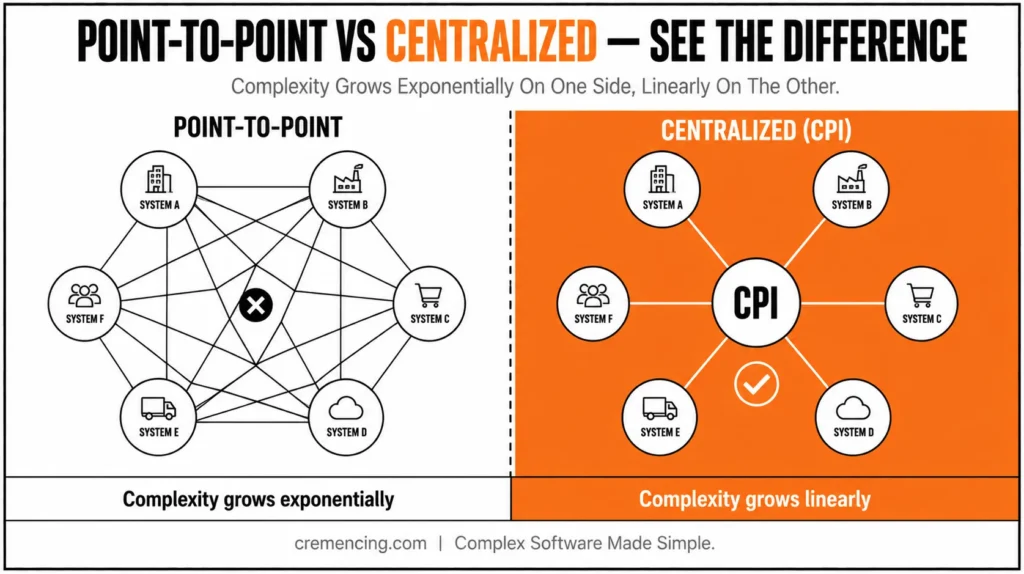
SAP cloud platform integration, centralized architecture. Instead of the point-to-point approach used in traditional integration approaches, this makes the system easier. As a result, as it grows, the integration logic can be handled easily.
Companies widely use this approach because their integration needs keep changing with digital transformation, cloud adoption, and system growth.
How SAP Cloud Platform Integration Works
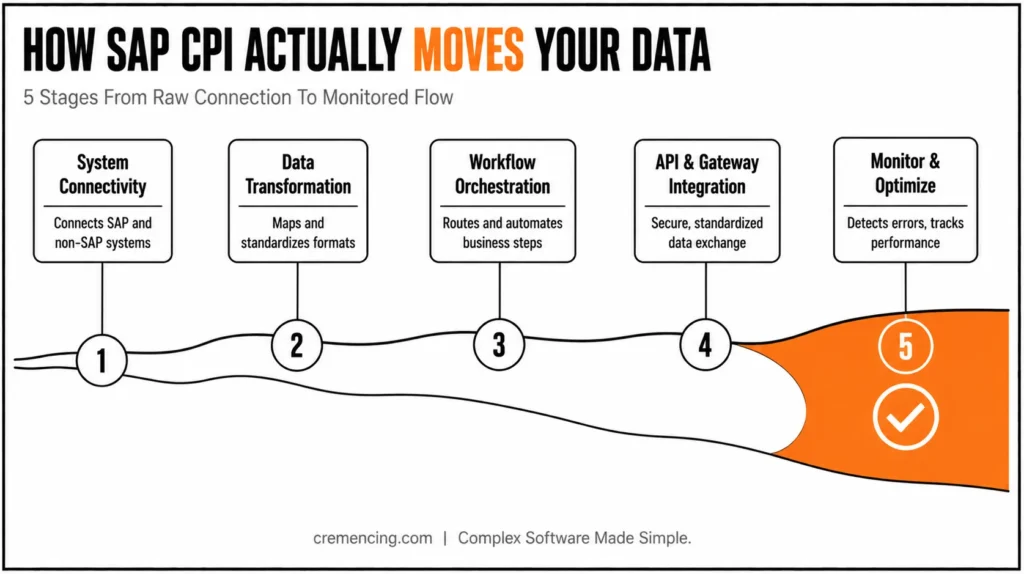
Step 1: System Connectivity
The SAP CPI system connects SAP S/4HANA, CRM platforms, third-party applications, and cloud services, enabling seamless data exchange between these systems. Moreover, this approach obviates the need for multiple direct integrations between systems by involving connections managed centrally. This simplifies the structure and helps to manage complexity.
Step 2: Data Transformation
SAP Cloud Platform Integration then transforms this data into a common structure, ensuring consistency across all connected systems.
This process includes:
- Data mapping between systems
- Validation of incoming data
- Conversion into standardized formats
This enables the data to flow seamlessly between different systems without any errors.
Step 3: Workflow Orchestration
Integration flows control the movement of data between systems. Moreover, these workflows can streamline business processes like invoice approvals, order processing, and financial reporting.
Features include:
- Business rules-based conditional routing
- Parallel processing for efficiency
- Exception handling mechanisms
This level of automation minimizes manual effort and increases process speed.
Step 4: API Management and Gateway Integration
SAP Gateway uses this data to send the request from outside SAP to your SAP system and return results.
In addition, this supports:
- Secure data exchange
- Standardized communication protocols
- Scalable integration across systems
Modern architectures demand flexible and scalable integration, for which API-centric integration is critical.
Step 5: Monitor and Integrate your jobs
SAP CPI also offers a monitoring feature for integration jobs, in addition to enabling better oversight of overall system performance.
Organizations can:
- Detect errors in real time
- Monitor processing times
- Optimize workflows
This ensures that integration systems continue to be reliable and scalable as load increases.
Benefits and Return on Investment (ROI) of SAP Cloud Platform Integration
Operational Benefits
- 40–60% faster data processing
- Reduced manual intervention in workflows
- Improved system synchronization
- Faster issue detection and resolution
Financial Benefits
- Lower integration maintenance costs
- Reduced operational overhead
- Quicker business cycles resulting in lower costs
Strategic Benefits
- Design a scalable architecture that accommodates business expansion
- Real-time data visibility across systems
- Improved decision-making capabilities
Point-to-Point Integration vs. Centralized CPI Architecture
| Factor | Point-to-Point | Centralized (CPI/Integration Suite) |
|---|---|---|
| New system added | Requires a new connection per existing system | One connection into the integration layer |
| Failure isolation | A single broken link can cascade | Errors are contained and monitored centrally |
| Monitoring | Scattered across individual interfaces | Unified monitoring dashboard |
| Governance | Ad hoc, inconsistent | Centralized security, mapping, and versioning |
| Scaling to new partners/systems | Complexity grows exponentially | Complexity grows linearly |
SAP CPI can also help organizations reduce costs by removing inefficiencies. As a result, organizations that use cloud integration effectively can often achieve a return on investment (ROI) within the first few months of deployment.
Frequent Errors and Recommended Practices
Common Mistakes
- Putting point-to-point integrations instead of a centralized design
- Ignoring scalability during initial implementation
- Overcomplicating workflows with unnecessary logic
- Lack of monitoring and governance
- Considering integration as a one-off project instead of an ongoing strategy
As a result, these errors produce long-run problems that compound with complexity in the system.
Best Practices
- Creating a unified integration strategy with the SAP Integration Suite
- Design integration flows with scalability in mind
- Standardize data formats across systems
- Use real-time monitoring and alert systems
- Keen on automation, seeking less manual intervention
- Review and optimize integration performance on an ongoing basis
Consequently, attaching to these practices guarantees that your integration architecture is effective and flexible.
What Most SAP CPI Contents Get Wrong
The vast majority of the content out there is about certification, course materials, or downloadable ultimate guide PDFs. But while these sources offer helpful nuggets of knowledge for learning, they ultimately miss the real challenge that organizations face: scalability.
However, scalability depends not only on the cloud platform itself but also on effective architecture, including reusable iFlows, API governance, secure authentication, error handling, queue management, and clear system ownership. SAP documentation explains that Cloud Integration supports enterprise-wide integration. In addition, teams can increase JMS resources beyond the default limits when they need more processing capacity.
The SAP cloud platform integration is not just merely technical but rather architectural. This is extensively utilized in corporate situations where integration requirements are perpetually changing with digitization, cloud adoption, and system scalability
What Is Commonly Missed
- Integration is approached as a tactical duty instead of an enterprise capability
- Scalability is not a requirement in the initial design
- We rarely talk about performance under high load
- Event-driven integration is often overlooked
The Real Difference
Basic integration connects systems. Scalable integration guarantees those connections stay efficient, reliable, and maintainable as complexity grows.
Organizations recognizing this are capable of constructing systems ensuring longevity and avoiding overwrites. Facing integration challenges as your systems start scaling. Meanwhile, SAP cloud platform integration lets you construct a scalable architecture that grows with your company
Conclusion
SAP The real role of SAP cloud platform integration is not only to connect systems but also to enable building a scalable integration architecture. In fact, it provides a regimented approach for managing complexity, automating workflows, and guaranteeing that identical work is performed in the same manner across all systems.
Integration can be the make-or-break component for optimal performance as companies grow. Thanks to SAP CPI’s powerful capabilities, organizations have the ability to design their applications for scalability without sacrificing efficacy or performance.
Automation and design principles used in garden-scale projects, such as resilient systems or stability patterns, extend very well into the world of orders of magnitude larger organizations with significant protocol stacks. After that, this is where SAP Cloud Platform integration comes in as a foundation for achieving this goal.
FAQ Section
What is SAP cloud platform integration used for?
It enables systems communication, workflow automation, and application data outflow management.
How do you get started with SAP Cloud Platform Integration (CPI)?
It is an envelope/middleware in the SAP integration suite with scalable and secure implementation.
Difference between SAP CPI and the integration suite?
SAP CPI belongs to SAP Integration Suite and also includes other components like API management and event mesh.
Is SAP CPI certification useful?
Yes, Certification proves the skills and enhances career prospects in integration professions.
SAP CPI course or this comprehensive guide PDF
SAP offers official training courses, certification programs, and guides in PDFs for its learning platforms.
What adapters does SAP Cloud Integration support?
It supports a wide adapter catalogue including OData, SOAP, REST, SFTP, IDoc, and RFC, along with adapters for non-SAP systems like Salesforce and SuccessFactors, letting a single integration layer connect both SAP and third-party systems.
How do you secure data in transit with SAP Cloud Integration?
Through standard mechanisms like OAuth2ClientCredentials, X.509 client certificates, and TLS-encrypted communication, each connection is secured independently, which limits the blast radius if one credential set is compromised.
Is SAP CPI being replaced by anything?
No ,SAP Cloud Integration is the current, actively developed successor to legacy PI/PO, not something being phased out itself. It’s the platform SAP is investing in going forward, rather than a stopgap.