
Introduction
RISE with SAP can be the right path for an S/4HANA transformation, but it is not automatically the best choice for every SAP customer.
The decision comes down to more than moving ERP to the cloud. IT leaders need to evaluate how much infrastructure responsibility they want to retain, how much customization the business depends on, how complex the existing integrations are, and whether the organization is ready to adopt a more standardized operating model.
That distinction matters because RISE with SAP is a guided transformation offering centered on SAP Cloud ERP Private. It combines a managed cloud foundation with SAP methodology, transformation tooling, expert guidance, and ongoing operations. For an organization coming from SAP ECC or S/4HANA on-premises, that can simplify the transformation journey. But it does not remove the need for technical assessment, custom-code reme
All of which break down to cost, flexibility, control, and long-term strategy. This is not the challenge of what the SAP transformation offering actually is. The real question is whether it’s one that works for your organization.
Why We Need to Talk About SAP RISE and What It Really Means
RISE with SAP should be evaluated as an operating and transformation model, not simply as a cloud migration package.
For existing SAP ERP customers, the current RISE journey is designed to help modernize on-premises ERP environments toward SAP Cloud ERP Private. SAP describes the journey as combining a standardized methodology, expert guidance, and an agent-led toolchain with the managed cloud environment.
A bundled offering that helps organizations transition to S/4HANA in a subscription-based, cloud-first approach
- It is not just SAP RISE that excels, but migration too. It includes:
- S/4HANA Cloud (private or public)
- Infrastructure services (e.g., SAP Rise on AWS)
- Business process intelligence tools
- Technical migration services
- Continuous innovation and support
The SAP transformation offering is essentially the acronym for RISE with SAP, the transformation-as-a-service model. That means organizations receive one contract covering infrastructure, software, and services instead of juggling vendors and systems.
That tooling can reduce execution complexity, but it should not be confused with removing the transformation work itself. Customers still need to prepare data, remediate custom code, validate integrations, test business processes, manage cutover activities, and make the architectural decisions that determine whether the resulting S/4HANA environment is maintainable. A RISE decision should begin with the current SAP landscape, not the contract.”
A Step-by-Step Guide to How SAP RISE Works
Step 1 – Business Process Discovery
SAP analyzes your current system:
- Identify inefficiencies
- Benchmark processes
- Recommend improvements
This step leverages business process intelligence tools.
Step 2 – Define Transformation Strategy
Even if it seems you have all the required components in place, a significant part of any change is what you truly want to accomplish with this transformation.
Organizations choose:
- Cloud model (private or public)
- Migration approach
- Target architecture
This is where the SAP RISE methodology comes in handy.
SAP handles:
- System conversion
- Data migration
- Technical setup
This reduces internal workload.
Step 3 – Infrastructure Configuration
Infrastructure is managed via SAP partners:
- SAP RISE on AWS
- Other hyperscalers
The need for internal infrastructure management is then removed.
Step 4 – Integration and Testing
Systems are integrated and tested:
- Validate business processes
- Ensure data accuracy
- Check system performance
This process is very important when it comes to success.
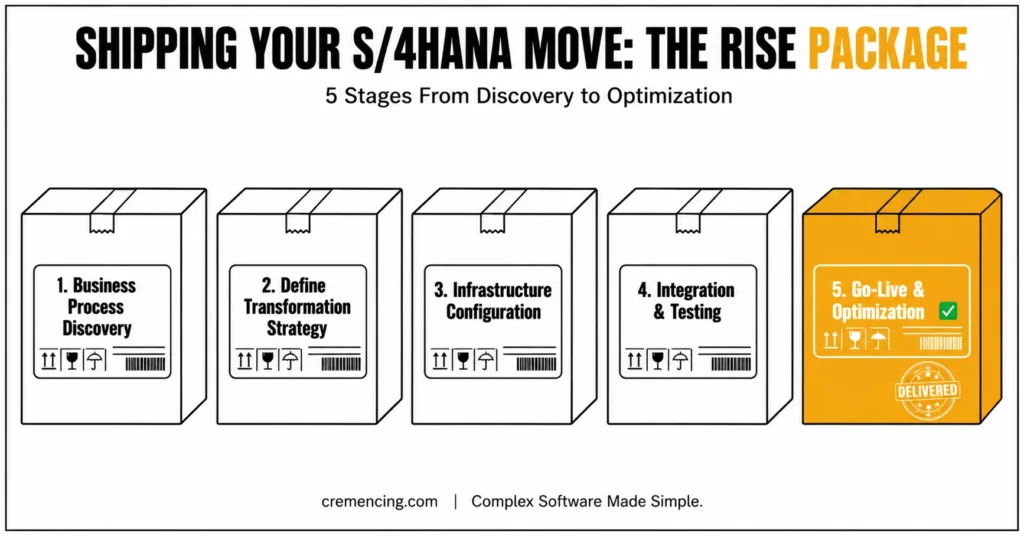
Step 5 – Go-live and Optimization
After go-live:
- Monitor system performance
- Optimize processes
- Implement continuous improvements
This ensures long-term value.
SAP RISE Benefits and ROI
There are several benefits of SAP transformation if it is implemented correctly.
Key Benefits
- Reduce infrastructure management effort by up to 40%
- Simplify vendor management
- Enable faster migration timelines
- Provide continuous system updates
Operational Benefits
- Centralized system management
- Reduced IT complexity
- Improved scalability
Business Impact
- Faster innovation cycles
- Better process visibility
- Improved decision-making
This means that for many organizations, the SAP modernization initiative simplifies the S/4HANA transformation.
| Decision factor | RISE with SAP / SAP Cloud ERP Private | Customer-managed S/4HANA |
|---|---|---|
| Cloud operating model | Managed cloud model | Customer-managed or separately managed |
| Infrastructure responsibility | Lower internal infrastructure responsibility | Greater customer responsibility |
| Customization strategy | Strong pressure toward clean-core practices | More direct control over technical environment |
| Infrastructure control | More constrained than self-managed deployment | Greater control |
| Migration tooling | SAP-provided methodology and transition tooling | Customer/partner selects and manages approach |
| Upgrade/innovation model | Cloud-oriented continuous innovation | Customer has greater responsibility for lifecycle planning |
| Internal operations effort | Potentially lower | Typically higher |
| Best fit | Organizations prioritizing managed cloud operations and transformation acceleration | Organizations requiring greater infrastructure control or a highly customized operating model |
The Misinformation That People Fall into When Selecting SAP RISE
Many organizations misunderstand SAP transformation.
Common Mistakes
- For argument’s sake, SAP RISE eliminates all complexity
- Ignoring long-term cost implications
- Not evaluating business requirements properly
- Choosing RISE without strategy alignment
- Overlooking customization needs
These mistakes often lead to:
- Higher costs
- Limited flexibility
- Implementation challenges
Best Practices
- Conduct a detailed system assessment
- Align RISE with business strategy
- Evaluate the total cost of ownership
- Understand contract structure
- Plan for future scalability
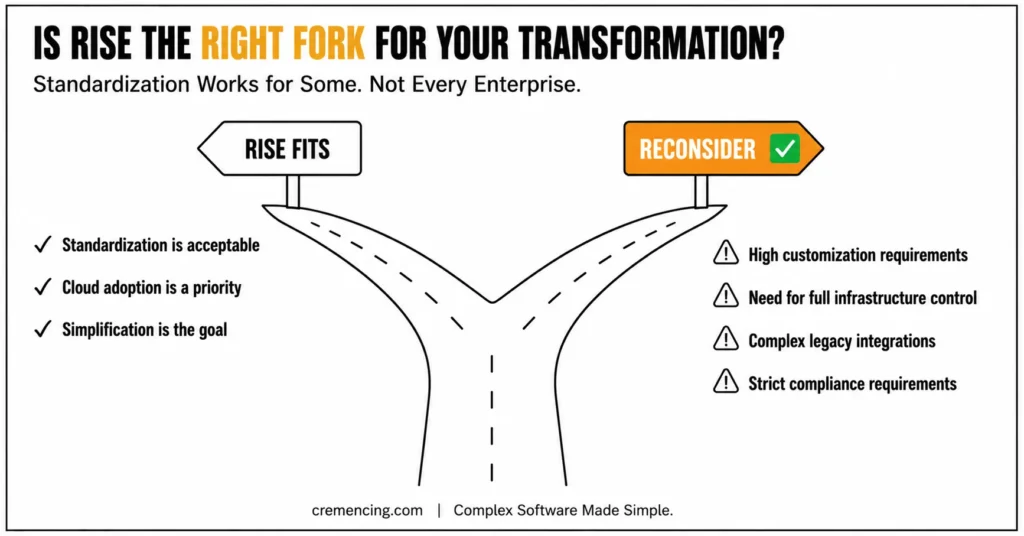
When SAP RISE doesn’t make sense
Most nondiscriminatory discussions are not about benefits but ignore limitations. An SAP modernization initiative is not right for all enterprises.
When SAP RISE May Not Fit
- High customization requirements
- Need for full infrastructure control
- Complex legacy integrations
- Strict compliance requirements
Key Insight
SAP transformation works best when:
- Standardization is acceptable
- Cloud adoption is a priority
- Simplification is the goal
Communities needing some flexibility may wish to go with different approaches.
Are you struggling to decide if SAP RISE is the right decision for your S/4HANA transformation? We help you define the path forward, evaluating options while minimizing risk. Get in touch, and let us embark on your evolutionary journey with subtlety and grace. Once you’ve committed to RISE, the next step is getting the SAP RISE governance framework, including the RACI audit and SLA alignment, right.
Conclusion
RISE with SAP can be a strong choice for an S/4HANA transformation when the organization wants a managed cloud operating model, is prepared to modernize its SAP landscape, and can work within the control and responsibility boundaries of SAP Cloud ERP Private.
But the decision should not start with the RISE contract. It should start with the existing SAP system.
Assess the custom code. Map the integrations. Validate data and migration requirements. Define the clean-core strategy. Document who owns each technical and operational responsibility. Then model the total cost across implementation and ongoing operations.
Dive into SAP RISE’s pre-configured OOTB features and implementation tools that make your S/4HANA transformation simpler, though look to modify its application as per your business needs. The right one for you relies on your company goals, system complexity, and long-term strategy.
However, there are pros and cons to the SAP modernization initiative, as well as strategies that can help mitigate risk. Organizations that take a careful look at SAP RISE may find reduced complexity and speedier transformation. However, organizations that embrace it without careful consideration may find themselves with restrictions.
Knowing the alternatives, advantages, and drawbacks will enable you to make a more informed choice.
FAQ Section
1. Is RISE with SAP mandatory for an S/4HANA transformation?
No. RISE with SAP is a transformation and cloud operating model, not a prerequisite for using SAP S/4HANA. Organizations should compare RISE with other deployment and operating approaches based on control, customization, infrastructure responsibility, cost, and transformation goals.
2. What is the difference between RISE with SAP and S/4HANA?
SAP S/4HANA is the ERP application. RISE with SAP is a guided transformation offering that helps customers modernize their SAP ERP landscape and move toward SAP Cloud ERP Private.
3. Can an SAP ECC customer move to RISE with SAP?
Yes. SAP explicitly describes RISE with SAP as a guided path for customers starting from on-premises SAP ERP, including ECC and SAP S/4HANA. The required migration approach depends on the starting system and target architecture.
4. Does RISE with SAP eliminate custom-code work?
No. Existing custom code still needs assessment and, where required, remediation or redesign for the target S/4HANA environment. SAP’s conversion guidance includes custom-code checks and follow-on activities.
5. Does RISE with SAP mean SAP performs the entire migration?
No. RISE provides methodology, tooling, managed cloud capabilities, and guidance, but customers and implementation partners still have substantial responsibilities around business processes, data, custom code, integrations, testing, and project execution.
6. Is RISE with SAP available on hyperscalers?
RISE with SAP supports cloud infrastructure options involving hyperscalers, subject to the applicable offering and architecture. SAP’s current material explicitly references hyperscaler flexibility as part of the RISE journey.