
Moving from SAP ECC to S/4HANA is not simply a database change or a technical upgrade. For an existing SAP landscape, the transition can affect data structures, custom ABAP code, integrations, business processes, security, testing, and the way users work with the system. The right migration path therefore depends on what the organization needs to preserve, redesign, or retire.
For SAP teams planning an ECC-to-S/4HANA transition, the critical work starts before the technical conversion. Readiness assessment, simplification analysis, custom-code remediation, data planning, and testing determine how much of the existing landscape can move forward. This article explains the main transition approaches and the technical stages that should shape an S/4HANA migration plan.
Why Migrate from SAP ECC to S/4HANA?
Migrating from SAP ECC to S/4HANA is not just another upgrade; instead, it is a strategic decision that can significantly affect business operations, efficiency, and long-term technology planning. Moreover, the transition can bring both benefits and challenges, depending on the organization’s existing SAP landscape, business processes, and migration approach.
At the same time, organizations need to consider how the transition will affect their data, custom code, integrations, and users. Therefore, understanding the key reasons for moving to S/4HANA is essential before planning the transition. With this in mind, here are some of the main factors to consider:
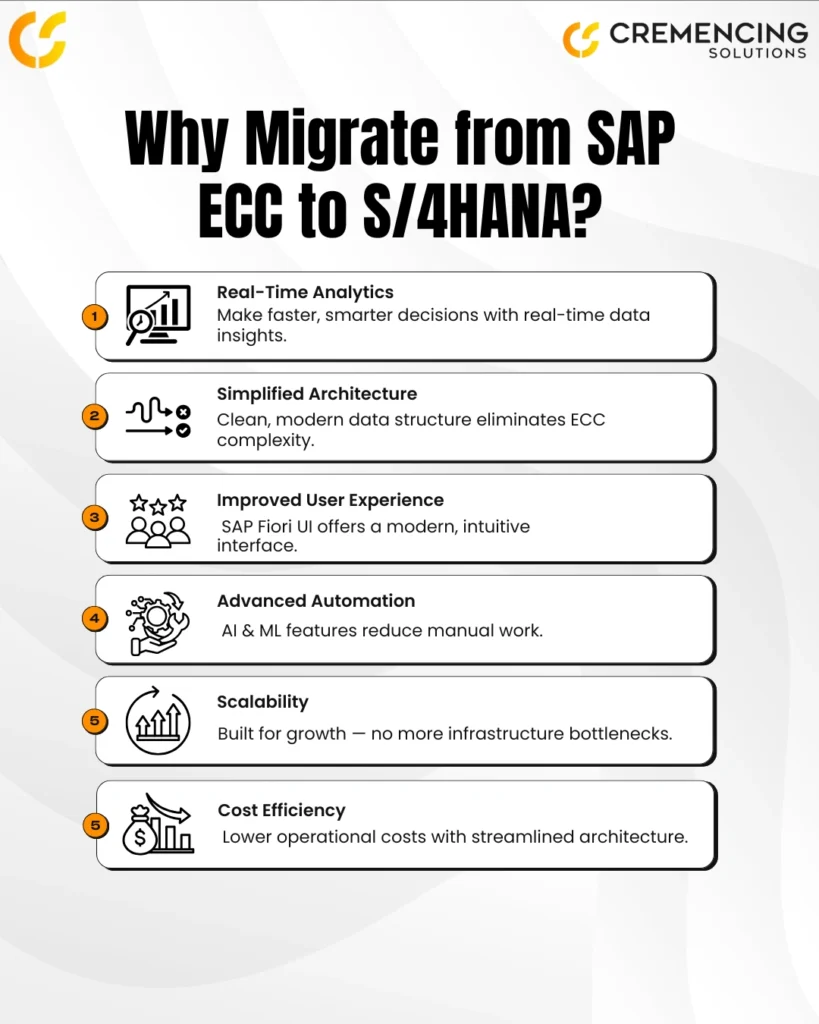
Real-Time Analytics: S/4HANA – With S/4HANA, the real-time processing world is changed by real-time analytics capabilities, allowing businesses to more quickly and confidently make decisions from their data.
Simplified Architecture: One of the major benefits of S/4HANA for partners and customers is a simplified data design that removes some of the “complexity” that typically riddles their ECC systems.
Improved User Experience: With the modern look & feel and enhanced user experience with SAP Fiori, the user interface across all devices has never looked this good before.
Advanced Automation: S/4HANA supports automation and intelligent business capabilities, with specific AI and machine-learning features depending on the S/4HANA release, deployment model, and enabled SAP services.”
Scalability: As an application running on the SAP HANA in-memory database, S/4HANA can handle the kind of massive processing load that growing businesses require without having to worry about infrastructure.
Cost Efficiency: Cost impact depends on the migration approach, system landscape, infrastructure model, custom-code footprint, data volume, and post-migration operating model.
7 Steps for SAP ECC to S/4HANA Migration
Migrating from SAP ECC to S/4HANA requires careful planning and execution. Below are the steps to ensure a successful migration:
1. Assess Your Current ECC Environment
- Before beginning the migration, do a comprehensive analysis of your SAP ECC environment so that you know your current environment, customizations, and configurations.
- This phase will help determine which components should be migrated, customized, or archived.
2. Choose the Right Migration Approach
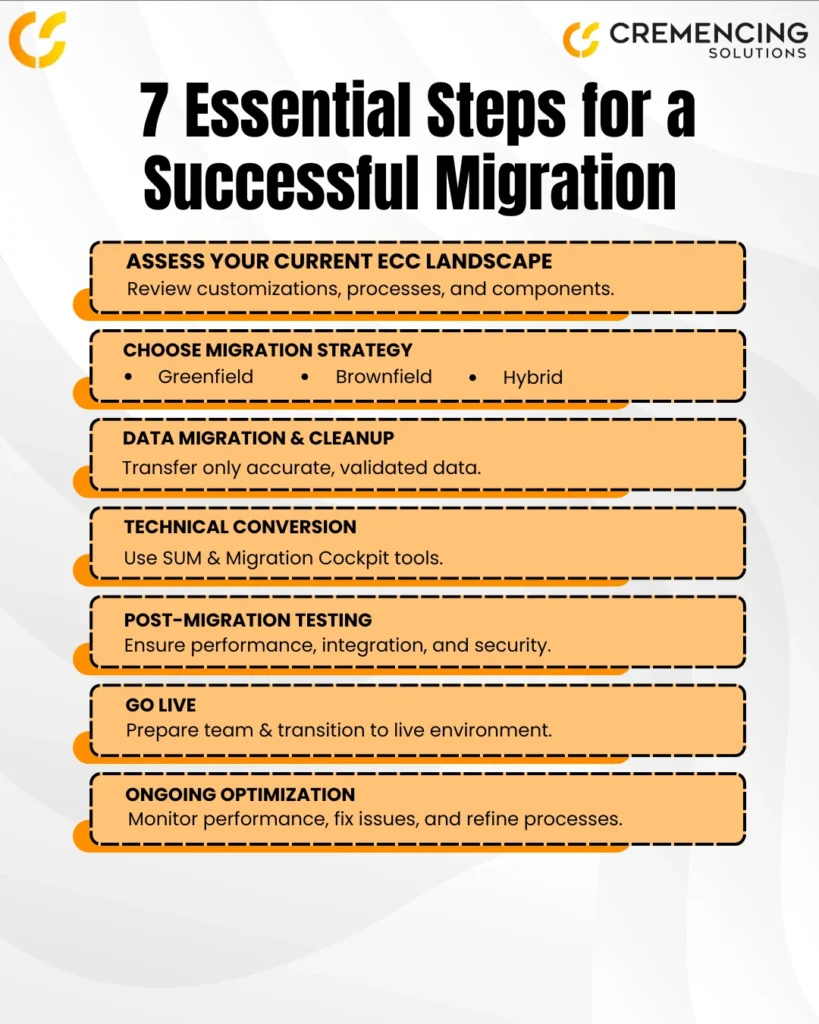
There are generally three main paths to move from SAP ECC to S/4HANA:
- Greenfield Migration: Begin from scratch with a new S/4HANA system. This is ideal for businesses that wish to re-engineer processes and have few legacy systems.
- Brownfield Migration: Move the current SAP ECC into an S/4HANA installation. It’s perfect for companies that wish to maintain their existing setup and company processes.
- Hybrid Migration: This combines both Greenfield and Brownfield approaches; moreover, it allows you to migrate your core business processes and data, but retain some of the existing legacy system.
SAP ECC to S/4HANA Migration Approaches Compared
| Migration approach | What changes | When it is relevant | Key technical consideration |
|---|---|---|---|
| New Implementation | New S/4HANA system and redesigned processes | Major business transformation or clean-core starting point | Data and integrations must be designed for the new system |
| System Conversion | Existing SAP ERP system is converted | Existing processes and historical data need substantial reuse | Simplification items, custom code, data model, add-ons, and conversion readiness must be addressed |
| Selective Data Transition | Selected configuration and business data are transferred or transformed | Organizations need a combination of reuse and redesign | Data scope, transformation rules, and migration tooling require detailed planning |
3. Data Migration from ECC to S/4HANA
- Data migration is one of the most important activities in the ECC to S/4HANA migration. This means moving data from SAP ECC to S/4HANA and ensuring the integrity and accuracy of that data.
- Data cleansing, transformation, mapping, validation, and reconciliation are important parts of the migration process.
4. Perform the Technical Conversion
- This step converts the existing SAP ERP system to SAP S/4HANA while addressing mandatory simplification items, data-model changes, custom-code dependencies, and required configuration adjustments.
- For a system conversion, Software Update Manager (SUM), including the appropriate Database Migration Option where applicable, supports the technical conversion. SAP S/4HANA Migration Cockpit is used for supported business-data migration scenarios, particularly new implementations and selected transition approaches
5. Test the System Post-Migration
- Following the move, do a thorough test to verify that the new S/4HANA system is working properly.
- Verify and check the migration for functions, integrations, security, performance, etc.
6. Go Live with S/4HANA
- Stand up – S/4HANA In a second phase, then go live finally with S/4HANA. Make sure your crew has the training and capability to work in the altered conditions.
7. Post-Migration Support and Optimization
Continue to support and optimize long after going live. Keep an eye on your system and make changes.
Benefits of Custom Development for S/4HANA Transition
At Cremencing Solutions, SAP Custom Development is our primary focus. You can be confident that using our bespoke tools and solutions will make for a seamless, swift ECC to S/4HANA migration focused entirely on your business.
- Customized Solutions: Our tailored features and processes are designed to suit your specific business model and are in line with your business goals for migration.
- Integration: We make sure S/4HANA integrates seamlessly with your current systems and third-party applications.
- User-friendly Custom UI: We design user-friendly interfaces that improve user adoption and productivity, using SAP Fiori.
- Performance Tuning: We optimise your S4HANA system to ensure that your business is able to take full advantage of real-time analytics and process flows.
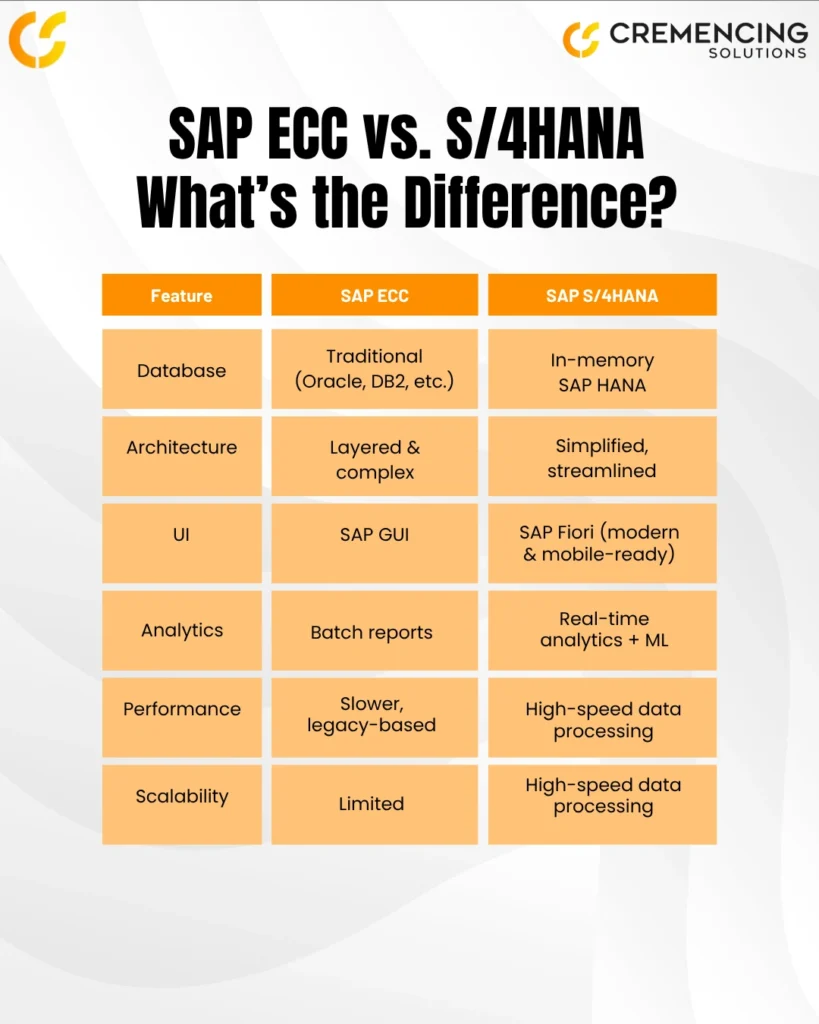
Key Features Comparison Table for SAP ECC and S/4HANA
| Feature | SAP ECC | SAP S/4HANA |
| Database | Runs on various traditional databases (e.g., Oracle, DB2) | Built on the SAP HANA in-memory database, enabling real-time processing |
| Architecture | Traditional architecture with multiple layers and complexity | Simplified architecture with fewer data models and tables |
| User Interface | SAP GUI interface with limited customization options | SAP Fiori UI offers a modern, intuitive, and role-based experience |
| Analytics | Limited to batch processing and standard reports | Advanced real-time analytics with embedded machine learning capabilities |
| Performance | Slower data processing due to a legacy database | Faster processing speed due to SAP HANA in-memory database |
| Scalability | Limited scalability and higher IT overhead | Highly scalable with the capability to support future business growth |
Conclusion:
An SAP ECC to S/4HANA migration should be treated as a structured transformation, not simply a technical database move. More importantly, the migration approach, target deployment model, custom-code footprint, simplification items, data scope, integrations, and testing strategy all affect the project. Therefore, for a system conversion, thorough preparation before SUM is particularly important because unresolved technical and functional dependencies can directly affect the conversion path.
At the same time, custom development has a specific role in this transition. Existing ABAP code may require adaptation, while interfaces may need redesign. However, business-specific processes may require extensions that align with the target S/4HANA architecture. As a result, a disciplined assessment before conversion gives the project team a clearer view of what should be retained, redesigned, retired, or rebuilt. With this approach, Cremencing Solutions can support the transition through SAP Custom Development focused on the technical requirements of the target S/4HANA landscape.If you’re ready to move from SAP ECC to S/4HANA and require custom work, CALL US at Cremencing Solutions. Our team will help you every step of the way when converting. Call us now to see how we can ensure you get maximum benefit from your investment in S/4 HANA for your firm.
FAQs
1. What is SAP ECC to S/4HANA migration?
SAP ECC to S/4HANA migration is the process of upgrading an organization’s SAP ECC system to the next-generation S/4HANA platform. The migration brings real-time processing, simplified architectures, and modern user interfaces to businesses, making operations more efficient.
2. What are the main benefits of migrating to S/4HANA?
Migrating to S/4HANA brings multiple benefits, including real-time data processing, simplified system architecture, advanced automation, enhanced user experience, and improved scalability.
3. How does Cremencing Solutions’ SAP Custom Development help in the migration?
We offer customized development for your S/4HANA system, ensuring it is tailored to your business needs. Our solutions help in smooth integration, optimize performance, and deliver a personalized user experience for better adoption.
4. What is the best approach for migrating from SAP ECC to S/4HANA?
The best approach depends on your business’s current state. You can choose a greenfield, brownfield, or hybrid migration approach based on your objectives and the level of change required.
5. How long does an ECC to S/4HANA migration take?
The duration of the migration process depends on the complexity of your current SAP ECC system and the chosen migration approach. A typical S/4HANA migration can take anywhere from several months to over a year for large enterprises.



One Response