
SAP FSCM helps finance teams improve cash collection visibility by connecting customer receivables with collection strategies, payment commitments, and dispute information.
However, collecting outstanding payments involves more than identifying overdue invoices and sending payment reminders.
Customers may dispute invoice amounts, request supporting documents, or make partial payments. Additionally, some customers may fail to meet previously agreed payment commitments.
Finance teams often struggle when information about these activities remains scattered across spreadsheets, emails, and financial applications.
For example, an aging report may identify an overdue balance without explaining why the customer has delayed payment.
Consequently, collection specialists may spend valuable time contacting customers without understanding their actual payment situations.
SAP Financial Supply Chain Management provides structured capabilities for managing receivables, prioritizing customers, tracking disputes, and monitoring credit exposure.
Furthermore, its integration with Financial Accounting helps collection teams connect operational activities with financial information.
This article explains why cash collection becomes complicated and how organizations can improve financial visibility through effective collections management.
Quick Answer: How Does SAP FSCM Improve Cash Collection Visibility?
SAP FSCM improves cash collection visibility through prioritized worklists, customer contact records, dispute cases, and promises to pay.
Collection specialists can identify customers who require attention and review the reasons behind outstanding payments.
Additionally, credit management information can support collection decisions where organizations configure the relevant integration.
These capabilities help finance teams distinguish ordinary overdue receivables from disputed invoices and broken payment commitments.
However, reliable collection visibility depends on accurate financial information, suitable collection strategies, and correct organizational assignments.
What Is SAP FSCM and How Does It Work?
SAP FSCM stands for SAP Financial Supply Chain Management. It comprises financial management solutions that help organizations manage receivables, liquidity, credit exposure, and financial risks.
The application supports several connected financial processes within relevant SAP environments.
For example, finance teams can use Collections Management to prioritize overdue customers. Meanwhile, Dispute Management helps them investigate objections that prevent customers from paying invoices.
Furthermore, Credit Management provides information about customer creditworthiness and financial exposure.
Together, these capabilities help organizations improve working capital management and financial decision-making.
Main Components of SAP FSCM
| SAP component | Technical component | Primary responsibility |
| SAP Collections Management | FIN-FSCM-COL | Prioritizes customers and manages collection activities |
| SAP Dispute Management | FIN-FSCM-DM | Tracks and manages customer invoice disputes |
| SAP Credit Management | FIN-FSCM-CR | Evaluates customer creditworthiness and credit exposure |
| SAP Cash and Liquidity Management | FIN-FSCM-CLM | Monitors cash positions and liquidity requirements |
| SAP Treasury and Risk Management | FIN-FSCM-TRM | Supports financial risk and treasury management |
| SAP Biller Direct | FIN-FSCM-BD | Supports electronic invoice access and payment-related activities |
| SAP In-House Cash | FIN-FSCM-IHC | Supports centralized cash management activities |
| SAP Bank Communication Management | FIN-FSCM-BCM | Supports bank communication management |
Each component addresses different financial requirements.
However, organizations should select the relevant capabilities according to their business processes and SAP deployment.
How SAP FSCM Connects With Accounts Receivable
Accounts Receivable Accounting, commonly known as FI-AR, maintains financial documents, customer open items, and payment clearing information.
In contrast, Collections Management organizes customer follow-up activities using relevant financial information.
A collection specialist may record a customer’s promise to pay without changing the underlying invoice balance.
Similarly, creating a dispute case does not automatically clear the corresponding financial document.
Therefore, organizations must maintain a clear distinction between collection activities and accounting transactions.
The official SAP Collections Management documentation explains how collection strategies and worklists support proactive receivables management.
Why Cash Collection Becomes Complicated in Large Organizations
Cash collection becomes difficult when finance teams cannot identify the reasons behind outstanding customer payments.
Although an overdue balance indicates a financial obligation, it does not necessarily explain the customer’s situation.
Several operational and financial factors can influence collection outcomes.
Overdue Invoices Do Not Explain Payment Delays
An aging report generally provides information about outstanding amounts and payment due dates.
However, collection specialists may require additional information before contacting customers.
Consider a customer with three overdue invoices.
One invoice has an active dispute. Another carries a payment commitment for the following week.
Meanwhile, the customer has not responded regarding the third invoice.
Each situation requires a different collection action.
Consequently, sending identical reminders for every outstanding invoice may create unnecessary communication without resolving the actual payment problems.
Fragmented Customer Information
Collection teams frequently exchange information through telephone conversations, emails, and spreadsheets.
Without centralized documentation, different employees may contact the same customer about identical outstanding balances.
Furthermore, a newly assigned specialist may repeat questions that another employee previously addressed.
These situations increase administrative work and complicate customer communication.
How SAP FSCM Addresses Fragmented Collection Information
SAP Collections Management allows specialists to document relevant customer interactions and review previous collection activities.
For example, a collector can examine open invoices, recent payments, existing disputes, and payment commitments before contacting a customer.
Additionally, recorded customer contact results provide context for subsequent follow-up.
Nevertheless, organizations must ensure that collection specialists maintain accurate and complete records.
How SAP FSCM Uses Collection Strategies to Prioritize Customers
Not every overdue customer requires immediate attention.
For instance, a customer with a history of timely payments may need a different collection approach from one who regularly misses payment commitments.
Collections Management uses configurable strategies to evaluate and prioritize customers.
Consequently, collection specialists can concentrate on accounts that require attention according to approved business rules.
Understanding Collection Strategies in SAP FSCM
A collection strategy consists of individual collection rules that determine how the system evaluates customers.
Organizations configure these rules according to their receivables management requirements.
For example, a strategy may consider overdue amounts, customer payment behavior, and existing promises to pay.
Furthermore, collection strategies can influence how the system presents financial information within a worklist.
The strategy can determine:
- Which customers require collection activities.
- Customer priorities within collection worklists.
- The currency for displaying receivable amounts.
- Time intervals for displaying overdue balances.
- Integration with relevant dunning processes.
- The influence of applicable payment conditions and discounts.
In supported SAP environments, transaction UDM_STRATEGY provides access to collection strategy maintenance.
However, organizations should validate their collection rules before using them in production.
The SAP Collection Strategy documentation provides further information about customer prioritization.
Prioritizing Customers According to Payment Behavior
A customer with substantial overdue receivables may require immediate attention.
However, payment history and previous customer commitments can also influence collection priorities.
For example, customers who consistently pay on time may only require follow-up when their payment behavior changes.
Meanwhile, customers who regularly miss payment deadlines may require closer monitoring.
The organization should therefore define collection strategies that reflect its actual business requirements.
Why SAP FSCM Collection Strategies Need Regular Review
Customer payment behavior can change over time.
Additionally, changing overdue balances may influence the workload of individual collection specialists.
A previously effective strategy may no longer reflect current collection requirements.
Consequently, collection managers should review worklist distribution, customer priorities, and actual payment outcomes.
Automatically increasing every customer’s priority can overwhelm specialists without improving their ability to focus on important accounts.
Visibility improvement: Collection strategies help finance teams prioritize customers using consistent rules rather than individual judgment alone.
Collection Segments, Groups and Profiles in SAP FSCM
Effective collection management requires appropriate organizational assignments.
Even when financial information remains accurate, incorrect master data can prevent customers from appearing in the intended worklists.
Therefore, organizations should understand how collection segments, groups, strategies, and profiles interact.
Collection Segments
A collection segment groups relevant company codes for collection activities.
For example, organizations may group company codes that share particular collection responsibilities.
Within the documented Collections Management organizational model, a company code cannot belong to two collection segments simultaneously.
Additionally, a worklist item represents a business partner within a collection segment.
These relationships influence how the system organizes receivables for collection purposes.
Collection Groups
Collection groups represent teams of collection specialists.
Each group uses one collection strategy. However, several groups can use the same strategy.
Furthermore, an individual collection specialist can belong to multiple collection groups.
Organizations can therefore establish collection responsibilities according to their operational requirements.
Collection Profiles in SAP FSCM
A collection profile can contain several collection segments.
Within the documented configuration model, each relevant business partner receives one collection profile.
The Business Partner role UDM000 supports Collections Management master data in applicable SAP environments.
Organizations can assign collection profiles manually or through the relevant assignment report.
Additionally, the system can derive standard collection groups from the profile configuration.
Teams can also maintain fixed collection specialists where business requirements justify such assignments.
SAP FSCM Organizational Structure and Responsibilities
| Organizational element | Purpose | Important relationship |
| Collection segment | Groups relevant company codes | Can contain several collection groups |
| Collection group | Organizes collection specialists | Uses one collection strategy |
| Collection strategy | Defines prioritization rules | Can serve several collection groups |
| Collection profile | Organizes customer collection assignments | Can contain several collection segments |
| Business partner | Represents the relevant customer | Receives one collection profile |
| Collection specialist | Performs customer follow-up | Can belong to multiple collection groups |
Incorrect organizational assignments can prevent relevant customers from reaching the appropriate collection specialist.
Consequently, finance and technical teams should validate master data and organizational relationships during implementation.
The SAP Collections Management organizational structure documentation explains these organizational concepts.
How SAP FSCM Collection Worklists Improve Daily Operations
Collection specialists often manage several customers with different payment requirements.
Without structured prioritization, deciding which customer to contact first can become difficult.
SAP Collections Management addresses this challenge through prioritized worklists.
Understanding the Collection Worklist
A collection worklist contains customer accounts that satisfy the relevant collection strategy rules.
The application evaluates available receivables information and assigns priorities according to the configured conditions.
For example, the worklist can provide information about open amounts, paid amounts, and arranged amounts.
Additionally, specialists can review customer priorities before starting collection activities.
In applicable SAP environments, transaction UDM_SPECIALIST provides access to My Worklist.
Process Receivables Screen in SAP FSCM
The Process Receivables screen provides additional information that helps specialists prepare for customer contact.
Relevant information may include:
- Current open invoices.
- Previous customer payments.
- Customer contact history.
- Open resubmissions.
- Existing dispute cases.
- Payment commitments.
Furthermore, collection specialists can document customer contact results and create relevant follow-up activities.
These capabilities help employees understand the customer’s financial situation before initiating another conversation.
Monitoring Collection Worklists
Collection supervisors can examine completed and outstanding worklist items.
For example, managers can identify workloads that require redistribution among collection specialists.
Additionally, they can review whether collection activities produced successful or unsuccessful outcomes.
Transaction UDM_SUPERVISOR provides access to All Worklists in the documented SAP configuration.
However, completing a worklist item does not automatically confirm that the customer has paid.
Finance teams must therefore connect operational collection activities with actual financial outcomes.
Visibility improvement: Prioritized worklists help collection specialists understand which customers require attention and provide supervisors with better oversight of collection activities.
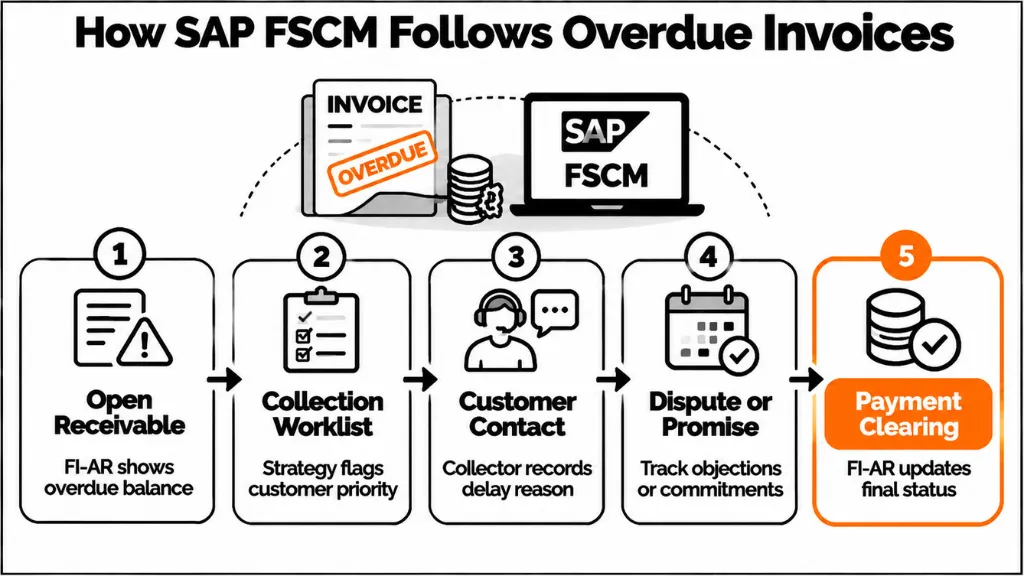
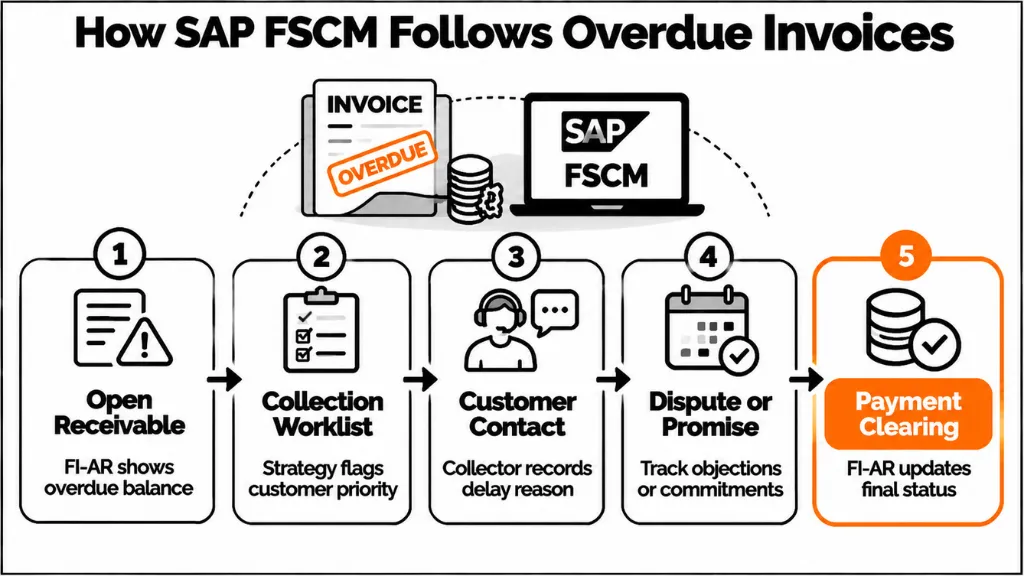
Following an Overdue Invoice Through SAP FSCM Collections Management
Understanding the complete collection process helps organizations identify where customer payments become delayed.
Consider a distributor that invoices a business customer for delivered goods.
The payment due date passes without the expected clearing transaction. Consequently, the customer receivable remains open in Financial Accounting.
Step 1: Identify the Overdue Receivable
FI-AR maintains the relevant invoice and outstanding customer balance.
Collections Management uses the available receivables information to evaluate the customer according to the applicable collection strategy.
However, the customer’s outstanding balance alone does not explain the reason for nonpayment.
Step 2: Generate a Prioritized Collection Worklist
The collection strategy evaluates relevant customer information.
If the customer satisfies the configured conditions, the application creates an appropriate worklist item.
Furthermore, the assigned collection specialist can review the customer’s priority and relevant financial information.
Step 3: Review Customer Information
Before contacting the customer, the specialist examines open invoices, recent payments, and previous collection activities.
Additionally, existing dispute cases can provide useful information about unresolved invoice objections.
This preparation helps the collector avoid repeating unnecessary questions.
Step 4: Record the Customer Contact
During the conversation, the customer explains that supporting delivery documents are missing.
The collection specialist records the relevant contact result and determines the next action.
Depending on the business process, the employee may arrange another contact or create a dispute case.
Consequently, other specialists can review the recorded information without restarting the investigation.
Step 5: Create a Resubmission
The customer may request another call after receiving the missing documents.
In this situation, the collection specialist can create a resubmission for the agreed date.
This helps coordinate subsequent collection activities.
However, inaccurate resubmission dates or incomplete customer notes can still create unnecessary follow-up.
Step 6: Monitor the Payment Outcome
Once the customer submits payment, Financial Accounting handles the relevant payment and clearing activities.
Collections Management then uses the applicable financial information to monitor outstanding receivables.
Furthermore, the specialist can investigate any remaining balance or unfulfilled payment commitment.
How SAP FSCM Dispute Management Explains Payment Delays
Customers do not always withhold payment because they lack sufficient funds.
For example, a customer may disagree with freight charges, invoice amounts, or transaction details.
Repeated payment reminders may not resolve these situations.
Instead, organizations need a structured process for investigating customer objections.
Creating Dispute Cases in SAP FSCM
SAP Dispute Management supports the creation and processing of relevant customer disputes.
A collection specialist can create a dispute case from an eligible receivable.
For instance, a customer may claim that an invoice contains an incorrect freight charge.
The dispute case records relevant information about the objection.
Additionally, users can attach SAP documents and external supporting information to the case.
These records help responsible employees investigate the customer’s concerns.
Assigning Responsibilities for Dispute Resolution
Different dispute cases may require different employees or departments to investigate the underlying issue.
For example, an invoice objection may require information from finance, sales, or logistics.
Dispute Management allows organizations to assign relevant roles and responsibilities within a case.
Furthermore, case notes can document questions, comments, and investigation results.
This information creates a case history that supports collaboration between departments.
Monitoring Dispute Status and Escalation
Dispute cases can have different processing statuses and reasons.
Consequently, finance teams can distinguish newly created objections from cases that require additional investigation or follow-up.
The application also supports relevant follow-up actions.
If responsible employees do not complete an action, the case may require escalation to another management level.
However, effective dispute resolution still depends on appropriate ownership and timely investigation.
Connecting Disputes With SAP FSCM Collection Strategies
Collections Management can consider dispute information when evaluating customers.
For example, organizations may configure collection strategies that treat disputed amounts differently from ordinary overdue receivables.
This helps specialists avoid pursuing payments without considering active customer objections.
Nevertheless, unresolved disputes require continued operational monitoring.
An organization should not allow disputed receivables to disappear permanently from collection oversight.
Resolving Financial Differences
Suppose an investigation confirms that the organization overcharged a customer.
Finance may need to process an appropriate credit adjustment.
After the relevant accounting procedures, the remaining receivable should reflect the correct financial position.
The collection specialist can then pursue any valid outstanding balance.
However, creating or resolving a dispute case does not independently replace the required accounting transactions.
Visibility improvement: Dispute Management helps collection teams understand why customers withhold payment, who owns the investigation, and which actions remain outstanding.
Promise to Pay in SAP FSCM: Tracking Customer Commitments
Customer payment promises provide valuable information about expected collections.
However, verbal commitments become difficult to monitor when finance teams rely exclusively on emails or personal notes.
SAP Collections Management supports structured recording and monitoring of promises to pay.
Recording Customer Payment Commitments
A promise to pay represents a customer’s commitment to settle relevant outstanding receivables.
For example, a customer may agree to pay two overdue invoices by a particular date.
The collection specialist records the commitment against the applicable invoices.
Additionally, supported scenarios may allow installment arrangements.
These records provide finance teams with information about expected customer payments.
Monitoring Broken Promises in SAP FSCM
Customers do not always meet their agreed payment commitments.
Collections Management can monitor whether customers fulfill their promises.
If a customer misses the agreed payment commitment, the configured collection strategy may return the customer to the worklist.
Consequently, the specialist can investigate the missed payment and determine an appropriate follow-up action.
This process helps organizations identify recurring problems with customer payment behavior.
Distinguishing Payment Promises From Actual Receipts
A recorded payment commitment does not represent completed financial settlement.
For instance, a customer may promise to pay an invoice without submitting the corresponding bank transfer.
Finance teams must therefore distinguish expected receipts from confirmed payments.
Furthermore, a partial payment may not fulfill the complete customer commitment.
Accurate financial information remains essential when evaluating the outcome of a promise to pay.
SAP FSCM Promise-to-Pay Information and Cash Planning
Payment commitments can help finance teams understand expected short-term collections.
However, customers may fail to meet those commitments.
Treasury and finance teams should therefore interpret promise-to-pay information using suitable assumptions.
A recorded commitment should not receive the same treatment as a confirmed bank receipt.
Visibility improvement: Finance teams can distinguish receivables with customer payment commitments from accounts that require further collection activities.
How SAP FSCM Connects Collection Activities With Actual Payments
Effective collection management requires reliable information about incoming customer payments.
Although a collection specialist may record a successful customer conversation, the corresponding financial settlement follows a separate accounting process.
Consequently, organizations need to connect collection activities with current FI-AR information.
Financial Accounting and Payment Clearing
Accounts Receivable Accounting maintains customer financial documents and relevant clearing information.
When a customer submits a payment, the financial process must identify and apply the payment appropriately.
Collections Management can then use the resulting financial information for ongoing receivables monitoring.
For example, a customer may transfer money after previously recording a promise to pay.
However, the collection record alone does not clear the invoice.
Finance must complete the applicable payment and accounting procedures.
Partial Payments in SAP FSCM Collection Processes
Customers may settle only part of an outstanding invoice.
These situations can create additional complexity for collection specialists.
For example, a customer may pay half of an agreed payment amount.
The remaining receivable may still require collection activities.
Furthermore, the original payment commitment may require reassessment.
Organizations should therefore establish how partial receipts influence collection follow-up and promise-to-pay monitoring.
Cash Application and Payment Matching
In relevant SAP S/4HANA receivables management scenarios, automated cash application can support the matching of incoming payments with open invoices.
This capability can help reduce repetitive manual payment matching.
However, collection teams must still understand whether the corresponding financial records reflect the actual payment outcome.
Accurate matching and clearing information helps specialists avoid contacting customers about balances that no longer require collection.
Separating Collections From Financial Settlement
Collection activities provide operational information about customer follow-up.
Financial Accounting maintains the actual receivables and payment records.
Although these activities complement each other, they have different responsibilities.
Therefore, organizations should avoid treating completed collection tasks as proof of financial settlement.
Visibility improvement: Collection specialists can make follow-up decisions using actual payment information instead of relying exclusively on previous customer conversations.
SAP FSCM Integration and Collection Worklist Data
Collection visibility depends on the accuracy and timing of financial information.
Different deployment architectures can influence how Collections Management receives and processes that information.
Consequently, organizations should understand the relationship between FI-AR data transfer and worklist generation.
Single-System and Multiple-System Scenarios
Organizations can use SAP Collections Management within a single-system or multiple-system architecture, depending on the applicable release.
In a single-system scenario, Collections Management and Accounts Receivable Accounting operate within the same system.
In contrast, a multiple-system scenario involves separate connected applications.
The documented multiple-system approach uses Application Link Enabling, commonly known as ALE, to support communication with the connected accounting system.
Furthermore, organizations connecting multiple accounting systems must maintain the relevant company-code assignments and applicable interface filters.
The correct architecture depends on the deployed SAP release and business requirements.
Transferring FI-AR Data to SAP FSCM
Within the documented Collections Management process, report FDM_COLL_SEND_ITEMS transfers relevant financial information from FI-AR to Collections Management.
Organizations use the initial data transfer option during the first execution.
Subsequent executions can use the periodic data transfer option.
Additionally, the documented process recommends scheduling regular background execution to update the information that supports worklist generation.
However, teams should confirm the appropriate processing schedule for their specific deployment.
Worklist Generation Using UDM_GENWL
After the relevant financial information transfer, transaction UDM_GENWL supports worklist generation in applicable SAP environments.
The application evaluates the transferred information according to the configured collection strategies.
Consequently, it creates relevant worklist items for collection specialists.
Organizations can also schedule regular worklist generation through background processing.
Where distribution rules leave worklist items without an assigned specialist, the collection supervisor can allocate those items to suitable employees.
Why Worklist Amounts May Differ From Current Receivables
A worklist may display information from the most recent financial data transfer and worklist generation.
Meanwhile, the Process Receivables screen can retrieve information directly from FI-AR in the documented configuration.
As a result, the two screens may display different amounts.
For example, Financial Accounting may record a new payment after the previous worklist generation.
The collection worklist may continue displaying earlier information until the relevant update processes complete.
Therefore, support teams should review data-transfer timing and worklist-generation status before treating these differences as accounting errors.
Visibility improvement: Understanding data-transfer and worklist-generation timing helps finance teams distinguish outdated collection information from actual financial discrepancies.
Important SAP FSCM Transaction Codes and Reports
Technical consultants require appropriate tools for maintaining collection configuration, reviewing worklists, and investigating customer assignments.
The following transaction codes and reports apply to the documented Collections Management environment. Availability may differ according to the SAP release and deployment.
| Transaction code or report | Description | Primary purpose |
| UDM_SPECIALIST | My Worklist | Review assigned collection activities |
| UDM_SUPERVISOR | All Worklists | Monitor and distribute collection workloads |
| UDM_BP | Business Partner Master Data | Maintain collection-related business partner information |
| UDM_STRATEGY | Collection Strategies | Maintain collection rules |
| UDM_GROUP | Collection Groups | Manage collection groups |
| UDM_GROUP2SGMT | Assign Groups to Segments | Maintain organizational assignments |
| UDM_GENWL | Creation of Worklists | Generate collection worklists |
| FDM_COLL_SEND_ITEMS | FI-AR data transfer report | Transfer relevant receivables information |
Additional documented transaction codes include UDM_BP_PROF for profile assignments, UDM_BP_GRP for segment data changes, and UDM_BP_SPEC for collection specialist assignments.
Furthermore, FDM_JUDGE supports promise-to-pay evaluation, while FDM_P2P_CONFIRM supports promise-to-pay confirmation.
Consultants should use the relevant transaction or report according to the actual processing requirement.
How SAP FSCM Credit Management Supports Cash Collection
Credit management and collections management address different aspects of customer financial relationships.
Credit Management focuses on creditworthiness, credit limits, and exposure.
Meanwhile, Collections Management focuses on outstanding receivables and customer follow-up.
Together, these capabilities can provide additional information for financial decision-making.
Understanding Customer Creditworthiness
SAP Credit Management can use internal and external information to evaluate customer creditworthiness.
Relevant information may include customer credit scores, credit limits, risk classifications, and payment behavior.
Additionally, organizations can maintain supporting documents such as credit reports and bank records.
These capabilities help credit teams understand the financial risks associated with customer accounts.
Credit Rules and Automated Decisions
The Credit Rules Engine supports automated scoring, credit decisions, and credit limit calculations in the documented SAP FSCM environment.
Organizations can configure relevant procedures according to their credit management policies.
Furthermore, credit teams can update customer scores manually or through supported automated processing.
This approach allows employees to concentrate on exceptions that require additional investigation.
Connecting Credit Information With Collection Strategies
Credit-related information can contribute to collection prioritization where organizations configure the relevant integration.
For example, risk classifications and credit limit utilization may provide additional context for customer collection activities.
However, a customer with high credit risk does not necessarily have the largest overdue balance.
Similarly, an account with a substantial outstanding amount may not represent the highest credit risk.
Organizations should therefore distinguish credit-related decisions from collection priorities.
Avoiding Static Credit Management Policies
Customer financial circumstances and payment behavior can change over time.
Consequently, organizations should review credit limits and risk-related information regularly.
Maintaining outdated credit information can weaken the value of financial visibility.
Finance and credit teams should use current customer information when reviewing relevant credit decisions.
Visibility improvement: Credit Management helps organizations understand customer financial risk alongside existing collection requirements.
SAP FSCM Cash and Liquidity Management
Cash collection directly influences an organization’s ability to manage working capital and meet financial obligations.
However, outstanding receivables and expected customer payments do not necessarily represent available cash.
Cash and Liquidity Management provides additional capabilities for monitoring financial positions and planning liquidity requirements.
Monitoring Cash Positions
Organizations can use relevant cash management capabilities to monitor cash positions across accounts.
Furthermore, financial information helps treasury teams understand expected inflows and outflows.
This visibility supports decisions about cash reserves and future payment obligations.
Nevertheless, the reliability of these decisions depends on accurate financial information.
Connecting Cash Collection With Liquidity Planning
Collection specialists may maintain information about upcoming customer payment commitments.
Meanwhile, treasury teams need to understand expected cash availability.
Reliable collection information can therefore contribute to short-term financial planning.
However, treasury teams must distinguish customer promises from confirmed financial receipts.
Treasury and Risk Management in SAP FSCM
SAP Treasury and Risk Management supports financial activities involving liquidity, investments, and financial risks.
Its relevant capabilities include transaction management, market risk analysis, and credit risk analysis.
For example, the Transaction Manager supports financial transactions from deal capture through the relevant accounting information transfer.
Additionally, the Credit Risk Analyzer helps organizations evaluate counterparty default risk.
These capabilities address broader financial management requirements beyond operational customer collections.
How SAP FSCM Biller Direct Supports Invoice Visibility
Customers may delay payments when they cannot access invoice information or resolve billing questions.
Consequently, improving access to relevant financial documents can support collection activities.
SAP Biller Direct provides web-based invoicing capabilities within applicable SAP FSCM environments.
Customer Access to Invoice Information
Biller Direct can allow customers to review relevant invoices through a portal.
For example, customers may access invoice details and available payment information without contacting finance employees.
Additionally, supported configurations can provide access to invoice images.
However, generating and storing PDF invoice images may require additional development in the documented environment.
Electronic Payment Capabilities
The documented Biller Direct solution supports relevant payment scenarios involving direct debit and credit cards.
Nevertheless, these capabilities require appropriate configuration.
Organizations should therefore assess their payment requirements and supported functionality before implementation.
Customer-Initiated Disputes
In supported configurations, customers can create dispute cases relating to their invoices.
This capability provides another way to document objections that prevent timely payment.
Furthermore, finance teams can investigate the relevant issues using structured dispute information.
SAP FSCM vs. Traditional Cash Collection Methods
Traditional collections processes often rely on aging reports, spreadsheets, emails, and individual customer follow-up activities.
Although these tools can support basic collection requirements, they may become difficult to coordinate as customer volumes increase.
SAP Collections Management provides a more structured approach to customer prioritization and operational monitoring.
| Comparison point | Traditional collection methods | SAP FSCM |
| Customer prioritization | Manual review of overdue balances | Configurable collection strategies |
| Customer contact history | Emails and individual notes | Recorded customer contact activities |
| Work distribution | Manual allocation of customer accounts | Structured collection worklists |
| Payment commitments | Verbal agreements or spreadsheet records | Promise-to-pay recording and monitoring |
| Dispute handling | Separate communication and documentation | Structured dispute cases |
| Customer follow-up | Individually maintained reminders | Resubmission and worklist activities |
| Credit risk information | Separate reports and assessments | Relevant Credit Management integration |
| Performance monitoring | Manual collection reports | Worklist statistics and collection indicators |
Traditional collection methods may remain appropriate for particular business requirements.
However, organizations with complex customer relationships and substantial receivables may benefit from structured collection strategies.
The appropriate approach depends on business needs, financial information quality, and available system capabilities.
How SAP FSCM Supports Advanced Receivables Management in SAP S/4HANA
Organizations using SAP S/4HANA can evaluate relevant Advanced Receivables Management capabilities according to their deployment requirements.
These capabilities connect several aspects of customer financial management.
Furthermore, they support a broader understanding of customer payment behavior and collection risks.
Credit Management and Customer Exposure
Credit Management helps organizations evaluate customer exposure and relevant credit limits.
This information can support decisions about customer financial risk.
Additionally, appropriate integration can make credit-related indicators available within collection activities.
Prioritized Collections Management
Collection strategies help specialists determine which customers require attention.
For example, worklists can reflect relevant overdue balances, previous payment commitments, and configured customer priorities.
Consequently, collection teams can focus on accounts according to established business rules.
Structured Dispute Resolution
Dispute Management helps organizations track invoice objections and their resolution.
Furthermore, responsible departments can maintain relevant information within dispute cases.
This approach can improve collaboration between finance, sales, and other operational teams.
Automated Cash Application
Relevant automated cash application capabilities support the matching of incoming payments with outstanding invoices.
Organizations can monitor automatic matching outcomes alongside manual processing requirements.
However, available functionality and licensing depend on the applicable SAP edition and implementation scope.
How to Implement SAP FSCM for Better Cash Collection Visibility
Implementing Collections Management requires more than activating technical functionality.
Organizations must establish collection policies, financial information requirements, and appropriate operational responsibilities.
Furthermore, implementation should address the existing reasons behind collection delays.
Step 1: Define Business Collection Requirements
Finance teams should examine their current collection processes.
For example, they may identify problems involving overdue receivables, unresolved disputes, or incomplete customer contact information.
Additionally, stakeholders should establish clear objectives for improving collection visibility.
These requirements provide the foundation for subsequent configuration.
Step 2: Prepare Customer Master Data
Organizations must map relevant customers to business partners for Collections Management.
The applicable business partner master data should support appropriate collection assignments.
Furthermore, teams should validate existing customer information and relevant payment history.
Incomplete or inaccurate records can affect subsequent collection decisions.
Step 3: Configure the SAP FSCM Organizational Structure
Consultants should establish relevant collection segments, groups, and profiles.
These assignments determine how the application organizes customers and distributes collection responsibilities.
Additionally, organizations should identify the specialists responsible for particular customer accounts.
Clear organizational design helps prevent missing or incorrectly assigned worklist items.
Step 4: Define Collection Strategies
Finance stakeholders should establish the rules that determine customer priorities.
For example, organizations may consider overdue balances, payment behavior, and existing customer commitments.
Technical consultants can then configure the relevant collection strategies.
However, business teams must validate whether the resulting priorities reflect actual collection requirements.
Step 5: Configure Financial Data Transfer
Organizations should establish the required integration between FI-AR and Collections Management.
In the documented processing scenario, the relevant data-transfer report provides financial information for worklist generation.
Furthermore, teams can schedule periodic processing to maintain current collection information.
Integration testing should confirm that the required customer and receivables information reaches Collections Management.
Step 6: Test SAP FSCM Collection Scenarios
Testing should include representative collection situations.
For example, organizations should examine overdue invoices, disputed amounts, partial payments, and broken payment commitments.
Additionally, teams should validate collection specialist assignments and worklist priorities.
These checks help identify configuration or information-quality problems before deployment.
Step 7: Train Collection Specialists
Employees should understand how to use collection worklists, record customer conversations, and maintain payment commitments.
Furthermore, training should explain the relationship between collection activities and financial accounting.
This helps specialists distinguish operational follow-up from actual financial settlement.
Step 8: Monitor and Improve Collection Processes
Organizations should regularly review collection performance after deployment.
For instance, supervisors can evaluate outstanding worklist items, dispute resolution times, and customer payment outcomes.
Additionally, finance and technical teams should investigate recurring processing problems.
Continuous improvement helps collection strategies remain aligned with changing business requirements.
Common SAP FSCM Configuration Problems That Reduce Visibility
Although Collections Management provides structured collection capabilities, configuration problems can limit their effectiveness.
Consequently, organizations should monitor master data, organizational assignments, and financial integration.
Missing Business Partner Assignments
Customers may not appear in the intended collection worklist when required business partner assignments remain incomplete.
For example, an incorrect collection profile can affect the customer’s organizational assignment.
Finance teams should therefore compare relevant open receivables with expected worklist populations.
Incorrect Collection Group Assignments
Collection groups influence which specialists receive particular customer accounts.
However, unsuitable assignments can distribute collection activities to the wrong employees.
Organizations should review collection group configuration and fixed processor assignments.
Furthermore, supervisors can investigate worklist entries that lack an assigned specialist.
Inappropriate Collection Strategies
Collection strategies must reflect actual business requirements.
For example, unsuitable rules may exclude customers who require immediate attention.
Alternatively, excessive prioritization can create unnecessary collection workloads.
Finance managers should therefore review strategy results and adjust relevant business rules when necessary.
Outdated Financial Information in SAP FSCM
Collection worklists may contain earlier financial information if the relevant transfer or generation processes have not completed.
Consequently, specialists may see outstanding amounts that differ from current accounting information.
Support teams should examine data-transfer and worklist-generation timing.
Additionally, they should reconcile collection information against the authoritative FI-AR records.
Incomplete Customer Contact Records
Customer conversations provide important information for subsequent collection activities.
However, incomplete notes can prevent other specialists from understanding previous discussions.
Organizations should establish consistent procedures for documenting customer contacts, payment promises, and follow-up requirements.
Unresolved Disputes
Dispute Management can provide information about customer invoice objections.
Nevertheless, recording a dispute does not automatically resolve the underlying problem.
Responsible departments must investigate the objection and complete the relevant actions.
Furthermore, supervisors should monitor outstanding cases and follow-up requirements.
Confusing Collection Activity With Payment Completion
A specialist may complete a customer contact without receiving payment.
Similarly, a recorded promise does not confirm financial settlement.
Finance teams should therefore evaluate collection activities alongside actual payment and clearing information.
SAP FSCM Collection Management Control Checklist
A structured control process helps organizations identify gaps in collection visibility.
Furthermore, it allows finance and technical teams to establish clear responsibilities for investigating problems.
| Control area | Required verification | Potential problem | Suggested responsibility |
| Business partner master data | Confirm relevant customer assignments | Missing collection customers | Master data team |
| Collection profiles | Validate applicable organizational assignments | Incorrect customer distribution | FSCM consultant |
| Collection strategies | Review customer prioritization rules | Unsuitable worklist priorities | Collection manager |
| Financial data transfer | Confirm relevant processing completion | Outdated financial information | SAP support team |
| Worklist generation | Verify expected worklist populations | Missing or unassigned worklist items | Collection supervisor |
| Customer contacts | Review recorded results and follow-up dates | Duplicate customer communication | Collection specialist |
| Payment commitments | Monitor fulfilled and broken promises | Missed collection opportunities | Accounts receivable team |
| Disputes and clearing | Review case status and financial records | Unresolved objections or balance differences | Finance and relevant departments |
Organizations should use these controls to investigate the reasons behind collection discrepancies.
However, successful technical processing does not independently establish that the organization collects payments effectively.
Key Performance Indicators for SAP FSCM Collections Management
Collection performance requires more than monitoring total overdue balances.
Organizations should examine operational activities alongside actual financial outcomes.
Additionally, several indicators can help managers identify recurring collection problems.
Days Sales Outstanding
Days Sales Outstanding, commonly known as DSO, helps organizations evaluate receivables collection performance.
However, sales patterns and accounting conditions can influence this measure.
Finance teams should therefore review additional indicators before attributing every DSO change to collection activities.
Overdue Receivables
Outstanding overdue amounts provide visibility into past-due customer obligations.
Nevertheless, the total overdue balance does not explain why customers have delayed payment.
Collection specialists should review relevant disputes, commitments, and contact information.
Collection Worklist Volume in SAP FSCM
Worklist volume identifies customers who satisfy configured collection rules.
Furthermore, supervisors can examine completed and outstanding collection activities.
However, declining worklist volume may indicate successful collection or incorrect customer exclusions.
Managers should therefore verify the underlying financial information.
Broken Payment Promises
Broken promises identify customers who fail to meet agreed payment commitments.
Monitoring these outcomes can help collection teams identify recurring payment problems.
Additionally, specialists can review previous commitments before arranging further customer contact.
Dispute Resolution Time
Dispute resolution time helps organizations understand how long customer objections remain outstanding.
Extended resolution periods may indicate that responsible departments require additional coordination.
Consequently, finance teams should monitor unresolved cases and relevant follow-up activities.
Automatic Payment Matching Rate
In relevant automated cash application scenarios, organizations can monitor the proportion of incoming payments that match open invoices without manual intervention.
This indicator helps identify the effectiveness of payment matching activities.
However, organizations must still validate the accuracy of financial processing.
Collector Productivity
Collection supervisors can monitor completed customer activities and remaining workloads.
Furthermore, they can evaluate payment-promise conversion and actual collection outcomes.
These measures help organizations assess whether collection activities contribute to financial results.
Bad Debt Write-Off Rate
Monitoring bad debt write-offs provides additional information about receivables collection performance.
Credit-related risks, customer payment behavior, and unresolved collection problems can influence financial outcomes.
Therefore, organizations should examine this indicator alongside other collection measures.
Best Practices for Improving SAP FSCM Cash Collection Visibility
Organizations should establish clear financial processes before implementing collection management functionality.
Furthermore, continuous monitoring helps identify problems that may develop after deployment.
Define Collection Policies Before Configuration
Finance stakeholders should establish the business rules that determine customer prioritization.
For example, collection policies may distinguish ordinary overdue customers from those with active disputes or broken promises.
Technical configuration should reflect these approved business requirements.
Maintain Accurate Customer Information
Reliable collections depend on accurate customer and business partner records.
Organizations should regularly validate collection profiles, customer assignments, and relevant financial information.
Additionally, teams should maintain appropriate contact records to support customer communication.
Review SAP FSCM Collection Strategies Regularly
Customer payment behavior and business requirements can change.
Consequently, collection managers should evaluate whether existing strategies remain appropriate.
Reviewing worklist populations and collection outcomes can help identify outdated prioritization rules.
Connect Dispute Resolution With Departmental Responsibilities
Customer objections may require investigation by several departments.
Therefore, organizations should establish clear responsibilities for dispute-related activities.
Furthermore, finance managers should monitor cases that remain unresolved beyond expected processing periods.
Maintain Reliable Financial Integration
Collections Management depends on relevant financial information from Accounts Receivable Accounting.
Organizations should monitor data-transfer activities, worklist generation, and integration exceptions.
Additionally, support teams should investigate differences between current receivables and collection information.
Provide Regular User Training
Collection specialists should understand the available system capabilities and their operational responsibilities.
For example, employees need to record customer contact results, payment commitments, and follow-up activities accurately.
Regular training can help users maintain consistent collection procedures.
Avoid Unnecessary SAP FSCM Customization
Organizations should prioritize the configuration required to support their collection processes.
However, excessive customization can introduce additional implementation and maintenance requirements.
Teams should assess business needs carefully and test relevant configuration before deployment.
Conduct Regular System and Process Reviews
Routine reviews help finance and technical teams identify collection problems and opportunities for improvement.
Furthermore, monitoring tools and relevant notifications can support earlier investigation of processing issues.
Organizations should encourage collaboration between finance, IT, and other departments involved in customer collections.
Frequently Asked Questions About SAP FSCM
1. What is SAP FSCM used for?
SAP FSCM stands for SAP Financial Supply Chain Management. It supports financial processes involving customer receivables, credit management, cash management, and dispute resolution. For example, Collections Management helps specialists prioritize customers and document collection activities. Additionally, Credit Management provides information about customer creditworthiness and exposure. These capabilities support financial visibility and working capital management. However, available functionality depends on the organization’s SAP release, deployment architecture, and configured business processes.
2. How does SAP FSCM improve cash collection?
SAP FSCM improves cash collection visibility through prioritized worklists, customer contact records, payment commitments, and dispute information. Collection specialists can identify customers who require attention and review relevant financial information before initiating contact. Furthermore, the application supports monitoring broken payment promises and arranging subsequent follow-up activities. However, improved collection outcomes depend on accurate financial records, suitable collection strategies, and effective customer communication. Organizations should also reconcile collection activities with actual payment information.
3. What is the difference between SAP FSCM and SAP FI-AR?
SAP FI-AR manages customer financial documents, open receivables, and relevant payment clearing activities. In contrast, SAP FSCM Collections Management uses receivables information to organize customer follow-up and collection priorities. For example, a specialist can record a payment commitment without changing the original invoice balance. Additionally, Dispute Management can provide information about customer objections. These capabilities complement Financial Accounting. However, collection records do not independently replace financial transactions or establish successful payment clearing.
4. What is a collection strategy in SAP FSCM?
A collection strategy defines the rules that determine which customers require collection activities and how the application prioritizes them. Organizations assign relevant strategies to collection groups. For example, configured conditions may consider overdue balances and customer payment commitments. Furthermore, strategies can influence the currency and overdue intervals displayed within worklists. Finance managers should regularly review prioritization results. Appropriate strategies help collection specialists focus on customer accounts that require attention according to established business policies.
5. What is a promise to pay in SAP FSCM?
A promise to pay records a customer’s commitment to settle relevant outstanding receivables by an agreed date. Collection specialists can maintain these commitments and monitor subsequent payment outcomes. Additionally, supported collection scenarios may allow installment arrangements. If a customer misses a commitment, the relevant collection strategy may return the customer to the worklist. However, a payment promise does not represent an actual cash receipt. Finance teams must verify the corresponding payment and clearing information.
6. How does SAP Dispute Management improve cash collection?
SAP Dispute Management helps organizations document and investigate customer objections that prevent invoice settlement. For example, a customer may dispute an incorrect freight charge or invoice amount. Responsible departments can review case information, supporting documents, and relevant processing actions. Furthermore, collection strategies may consider dispute information when determining customer priorities. However, organizations must still complete appropriate financial procedures when an investigation requires an accounting correction. Effective dispute resolution depends on clear responsibilities and timely follow-up.
7. What are collection segments and groups in SAP FSCM?
Collection segments organize relevant company codes for collection activities. Meanwhile, collection groups represent teams of collection specialists. Each group uses one collection strategy, although several groups can share the same strategy. Furthermore, a collection profile can contain multiple collection segments and support customer organizational assignments. These relationships influence how Collections Management distributes worklist items. Organizations should therefore validate business partner profiles and group assignments to ensure that the correct specialists receive relevant customers.
8. Why do SAP FSCM worklist amounts differ from FI-AR balances?
In the documented Collections Management configuration, worklist information reflects the most recent financial data transfer and worklist generation. Meanwhile, the Process Receivables screen can retrieve current financial information directly from FI-AR. Consequently, recent payments may appear in accounting before the collection worklist reflects them. Support teams should investigate the timing of relevant processing activities before identifying a financial discrepancy. Regular data-transfer and worklist-generation processes help maintain current information for collection specialists.
9. Can SAP FSCM help reduce Days Sales Outstanding?
SAP FSCM supports activities that can contribute to improved receivables collection performance and lower Days Sales Outstanding. For example, collection strategies help specialists prioritize customers, while Dispute Management supports the investigation of payment objections. Additionally, promise-to-pay monitoring helps identify missed customer commitments. However, DSO also depends on customer payment behavior, sales patterns, and financial conditions. Organizations should therefore review dispute resolution, payment outcomes, and collector productivity alongside DSO when evaluating collection improvements.
10. What is the role of SAP Credit Management in cash collection?
SAP Credit Management helps organizations evaluate customer creditworthiness, credit limits, and financial exposure. It can use relevant internal and external credit information to support credit-related decisions. Furthermore, collection strategies may consider credit indicators where organizations configure the appropriate integration. However, credit risk and collection priority represent different financial concerns. A high-risk customer does not necessarily have the largest overdue balance. Finance teams should therefore evaluate both credit-related information and actual receivables collection requirements.
Conclusion
Cash collection becomes complicated when finance teams lack visibility into customer payment behavior, outstanding disputes, and previous collection activities.
Additionally, incorrect organizational assignments and outdated financial information can prevent collection specialists from identifying customers who require attention.
SAP FSCM connects accounts receivable information with prioritized collection worklists, customer contact records, payment commitments, and dispute management.
These capabilities help organizations understand why customers delay payments rather than focus exclusively on overdue balances.
Furthermore, relevant Credit Management integration provides additional information about customer financial risks.
Financial Accounting remains responsible for authoritative receivables and payment clearing information.
However, successful collection management requires more than technical configuration.
Organizations must establish appropriate collection strategies, maintain accurate customer records, monitor financial integration, and assign clear operational responsibilities.
Consequently, finance teams should evaluate the complete collection process from outstanding invoices through customer contact, dispute resolution, and payment settlement.
By connecting these activities, businesses can improve cash collection visibility, reduce unnecessary manual follow-up, and support more effective working capital management.
References
- SAP Help Portal. FSCM General Overview.
- SAP Help Portal. General Documentation — FSCM Collections Management.
- SAP Help Portal. SAP Collections Management (FIN-FSCM-COL).
- SAP Help Portal. Collection Strategy.
- SAP Help Portal. Organizational Structure in SAP Collections Management.
- SAP Help Portal. Collecting Receivables.
- SAP Help Portal. SAP Collections Management Configuration Guide.
- Arthur Lawrence. SAP Financial Supply Chain Management Guide.
- CloudFoundation. SAP FSCM Training & Its Importance.
- Gemini Consulting & Services. Improve Cash Flow & Financial Health With SAP FSCM. June 13, 2023.
- SAPinsider. How Implementing SAP Cash Management Helps in Monitoring Your Working Capital.
- 2iSolutions. SAP FSCM in S/4HANA: Advanced Receivables Management for Faster Cash Collection & Lower DSO.
- Original technical research draft. Why Cash Collection Gets Complicated and How SAP FSCM Can Improve Visibility. October 27, 2026.