

“Month-end close is late again.” There are 43 invoices that are blocked, duplicate customer records on the ticket, and a failed nightly interface. Both teams are talking about ECC 6.0 and SAP S/4HANA 2025, but each one offers another standalone solution. The actual SAP tech challenge is not the absence of product; it’s picking the right capability that will be the bottleneck without introducing a ton of custom code, duplicated data, or support burden.
In this guide, they correlate the seven SAP tech trends with operational problems, provide technical detail about how each of these works, and provide a practical example of how to check if the investment is eliminating cost or shifting it to another location.
Why SAP Tech Investments Still Miss the Real Bottleneck
Most costly SAP problems are not single-system defects. A delayed order may involve poor master data, a custom approval, a batch interface, an unclear process owner, and an obsolete satellite application. Buying an AI assistant for that chain can make the first screen look better while the underlying wait states remain unchanged.
The second problem is product-first planning. Teams select SAP tech because it appears on a roadmap and then search for a use case. That reverses the correct sequence.
Start with a measurable constraint such as invoice-blockage, order-change frequency, interface recovery time, duplicate-application cost, upgrade regression effort, or developer backlog. These figures give the technical team a baseline against which it can test the proposed solution.
Release context also matters. SAP documents SAP S/4HANA and SAP S/4HANA Cloud Private Edition 2025 FPS01 for February 2026. ECC 6.0 customers cannot assume that every ABAP Cloud, Joule, semantic-data, or embedded-process capability exists in their current stack.
A sound SAP tech decision follows four checks:
- Identify the operational bottleneck.
- Confirm the supported deployment model.
- Test data, interface, and authorization readiness.
- Define the metric that must improve.
Without those checks, an organization can replace one bottleneck with higher license costs, additional integration work, or another platform that nobody governs.
Seven SAP Tech Trends to the Bottleneck
Step 1: Use Joule Agents for Repetitive Cross-Functional Decisions
Choose SAP Business AI when employees repeatedly collect information from several SAP applications, apply known rules, request approval, and update the process. Examples include investigating supply shortages, preparing a project, releasing a blocked order, or answering service questions with business context.
The technical shift is from a chatbot that returns text to assistants and agents that can work with enterprise data, identities, process context, and governed actions. SAP describes Joule Assistants as collaborating with users, while Joule Agents can execute business workflows. The SAP Business AI Platform also brings SAP BTP, SAP Business Data Cloud, and AI Foundation into a unified architecture.
| SAP environment | Primary technical consideration | What to validate first |
|---|---|---|
| S/4HANA Cloud Public Edition | Restricted extensibility and released interfaces | APIs, events, developer extensibility and supported services |
| S/4HANA Cloud Private Edition | Broader ABAP flexibility with clean-core requirements | ABAP Cloud, released APIs, ATC and extension location |
| S/4HANA on-premise | Maximum technical flexibility but greater governance responsibility | Custom code, modifications, API usage, performance and upgrade impact |
| SAP BTP | Side-by-side extensions and cross-system capabilities | API/event availability, identity, connectivity, lifecycle and monitoring |
| ECC 6.0 | Legacy architecture and different product capabilities | Existing interfaces, custom code, migration constraints and replacement strategy |
Use this SAP tech trend when the decision path is repeatable, and the required data is reliable. Do not deploy an agent to hide unclear ownership or poor master data. Keep a named approver for high-value postings, supplier changes, payment releases, and policy exceptions. Measure reduced handling time, fewer hand-offs, and lower rework rather than the number of AI conversations.
Step 2: Use SAP Business Data Cloud When Metrics Conflict
Choose SAP Business Data Cloud when finance, sales, procurement, and operations report different answers for the same KPI. The bottleneck usually comes from duplicated extraction pipelines, inconsistent transformations, missing lineage, or SAP and non-SAP data that has lost its business meaning.
SAP positions Business Data Cloud as the data foundation of the SAP Business AI Platform. Its business-data-fabric approach aims to preserve semantic context while making governed SAP and non-SAP data available to analytics, applications, and AI agents.
SAP’s 2026 direction also includes data products, semantic search, knowledge-graph relationships, and zero-copy connections with external data platforms. These capabilities can reduce repeated replication and give analytics or AI agents a governed view of customers, suppliers, products, and transactions.
This SAP tech trend will not settle uncontrolled business definitions. Assign an owner for every critical measure, document its calculation logic, and reconcile source-system totals before exposing the data to AI.
Verify success through:
- Fewer duplicated pipelines
- Faster lineage analysis
- Less manual reconciliation
- Consistent KPI totals
- Better data freshness
- Fewer conflicting executive reports
Step 3: Use Clean-Core Extensibility to Reduce Upgrade Drag
Select SAP Clean Core when upgrades have stalled due to custom objects affecting the standard behaviour, use of interfaces not yet released, or reliance on database structures that have been modified. The goal is not to have any custom code. The goal is to upgrade stable custom values that are created by the use of released APIs, events, approved extension points, ABAP Cloud, and side-by-side applications on SAP BTP.
SAP BTP supports loose coupling of extensions with workflows, applications, and interfaces that are added without the main logic being included in the ERP core. Released APIs and a limited, cloud-ready language model are used for upgrade-stable development in ABAP Cloud.
Since release 2022, ABAP documents are available on-stack for SAP Cloud for SAP S/4HANA and SAP S/4HANA Cloud Private Edition. Classic ABAP is still available on private-cloud and on-premise systems, but the use of classic ABAP does not mean that the systems are clean-core.
Use the ABAP Test Cockpit, commonly called ATC, to identify unreleased API usage and prioritize code that blocks upgrades or affects high-change business areas. SAP also provides central ATC-based clean-core governance options through SAP BTP.
This SAP tech approach succeeds when custom-code findings, regression effort, and upgrade remediation decline. It fails when teams move a poor, tightly coupled design to SAP BTP without changing its dependencies.
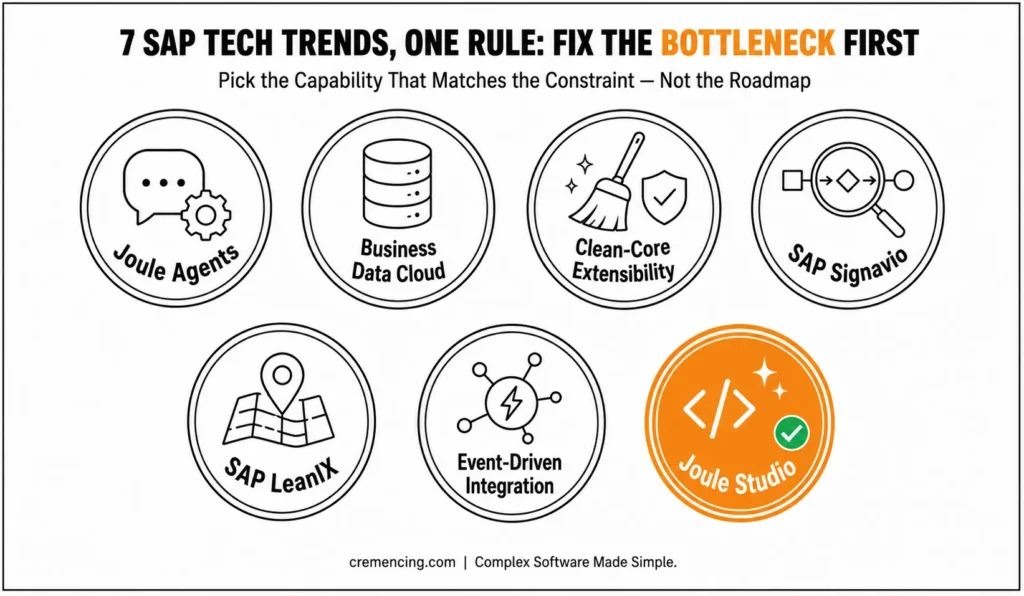
Step 4: Use SAP Signavio Before Automating a Broken Process
Choose SAP Signavio when the organization knows a process is slow but cannot agree on where time is lost. Process mining compares designed workflows with actual event data, revealing variants, loops, waiting time, rework, and paths that bypass the intended model.
A purchase-to-pay analysis may show that invoice blocks originate from incomplete purchase orders rather than accounts-payable processing. An order-to-cash analysis may expose repeated order changes or approval queues that no high-level dashboard highlighted.
SAP Signavio Process Intelligence provides evidence for deciding whether to remove a step, correct master data, change ownership, or automate a stable path. Joule became generally available with SAP Signavio solutions in February 2026, providing natural-language access to process information across compatible SAP applications. Blocked invoices and late closes often trace back to how manual vs automated change processes handle risk.
Use this SAP tech trend before workflow automation when the real process remains unclear. Do not classify every uncommon path as waste because legal, customer, or country requirements can create valid variants.
Track:
- End-to-end cycle time
- First-pass success
- Rework frequency
- Invoice-block reasons
- Approval waiting time
- Process conformance
- Manual journal corrections
Step 5: Use SAP LeanIX to Remove Application Duplication
Choose SAP LeanIX when transformation teams cannot answer which applications support a business capability, which interfaces depend on those applications, or which technologies are approaching end of support. This bottleneck creates duplicate license costs, delayed migrations, unplanned outages, and projects that discover dependencies too late.
SAP LeanIX Application Portfolio Assessment establishes a central architecture inventory. Its application rationalization and obsolescence capabilities help teams evaluate functional fit, technical fit, redundancy, lifecycle risk, and business impact.
This differs from SAP Signavio:
- SAP Signavio shows how business work moves through a process.
- SAP LeanIX shows which applications and technologies support that process.
SAP LeanIX can aggregate technology obsolescence risk at the application level, helping architecture teams connect outdated components with affected business capabilities.
Use this SAP tech capability when teams can maintain application ownership and dependency data. Avoid creating a one-time inventory that becomes outdated after the transformation project.
Measure retired applications, removed interfaces, eliminated licence duplication, reduced technology risk, and fewer unknown dependencies during future projects.
Step 6: Use Event-Driven Integration to Replace Slow Batch Chains
Choose SAP Integration Suite and event-driven architecture when business actions wait for nightly jobs or when one failed point-to-point interface blocks several downstream systems. In an event-driven model, a producer publishes an event such as “sales order created,” “stock changed,” or “payment received,” and authorised consumers react asynchronously.
This reduces direct dependency because the source system does not wait for every target application to complete its processing. SAP’s architecture guidance links event-driven design with asynchronous communication, loose coupling, real-time processing, responsive systems, and clean-core extensions.
SAP Integration Suite supports cloud and on-premises application integration, APIs, business-to-business scenarios, electronic data interchange, data pipelines, and event-driven integration. Advanced Event Mesh provides event-streaming, event-management, and monitoring capabilities for larger event-driven landscapes.
Use this SAP tech trend when consumers can tolerate asynchronous processing and the event contract is stable. Do not convert a required synchronous validation into an event simply because event-driven architecture is on the roadmap.
Define:
- Event ownership
- Message ordering
- Idempotent processing
- Retry behaviour
- Dead-letter handling
- Retention periods
- Monitoring responsibility
- Recovery procedures
Measure end-to-end latency, failed-message recovery, interface dependencies, duplicated mappings, and the time required to restore processing after an outage.
Step 7: Use Joule Studio to Reduce the Development Backlog
Choose Joule Studio when developers lose time translating business requests into specifications, scaffolding, workflows, test artifacts, and prototypes. SAP announced a new Joule Studio offering in May 2026 for building agents, applications, and workflows grounded in SAP business data and process semantics.
SAP also describes controlled deployments, schema validation, and connections with SAP Signavio, SAP LeanIX, and application-lifecycle capabilities for monitoring agent usage, cost, and business impact.
This SAP tech trend can shorten the distance between a business intent and a reviewable solution. It does not remove architecture, security, data-access, performance, clean-core, testing, or transport responsibilities.
Treat generated code and workflows as proposed implementation assets, not approved production changes. Start with bounded internal use cases, approved APIs, protected test data, and mandatory peer review.
Measure:
- Requirement-to-prototype time
- Requirement-to-tested-increment time
- Developer hours spent on scaffolding
- Rework after code review
- Escaped defects
- Unsupported dependencies
- Generated artefacts rejected during review
Stop the pilot if the generated output increases remediation effort or creates dependencies that the target SAP release does not support.
Choose the First Investment with a Bottleneck Matrix
Do not launch all seven programs together. Rank each bottleneck by annual cost, customer impact, compliance exposure, frequency, and dependency on other work.
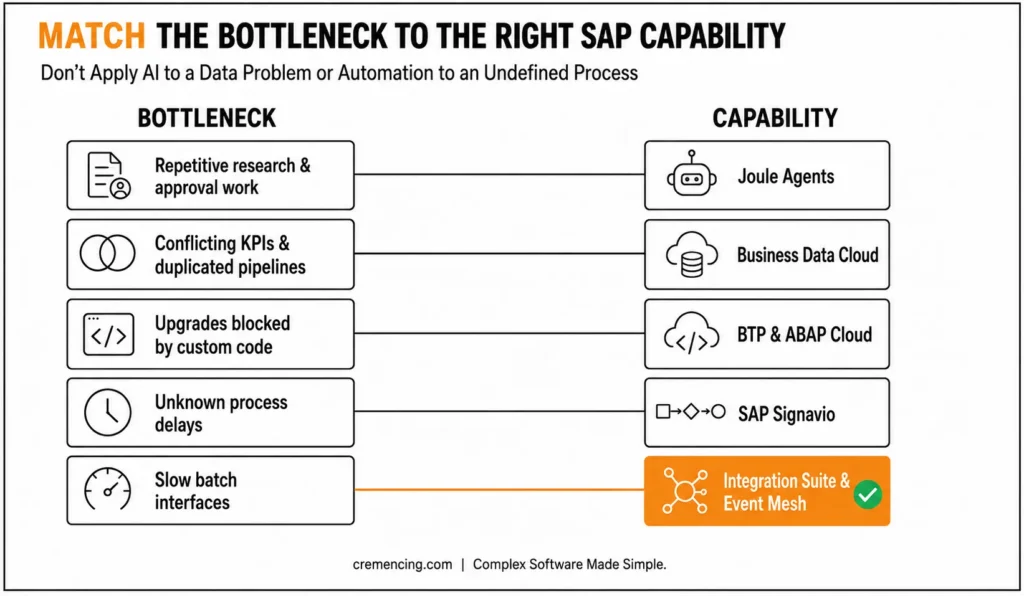
Then select the smallest SAP tech intervention that can change the target metric within one release cycle.
| Costly bottleneck | First SAP capability to assess | Readiness test | Evidence of improvement |
| Repetitive research and approval work | Joule Agents | Stable rules, trusted data, controlled actions | Lower handling time and fewer hand-offs |
| Conflicting KPIs and duplicated pipelines | SAP Business Data Cloud | Agreed definitions, ownership, and lineage | Less reconciliation and consistent totals |
| Upgrades blocked by custom code | SAP BTP and ABAP Cloud | Released APIs, ATC governance, extension strategy | Fewer findings and shorter regression cycles |
| Unknown process delays | SAP Signavio | Usable event data and process ownership | Lower cycle time and rework |
| Duplicate or obsolete applications | SAP LeanIX | Maintained inventory and named owners | Retired systems and lower technology risk |
| Slow batch interfaces | SAP Integration Suite and Event Mesh | Stable event contracts and monitoring | Lower latency and faster recovery |
| Development backlog | Joule Studio | Review standards, approved APIs, and test controls | Shorter lead time without more escaped defects |
This matrix prevents a common SAP tech mistake: applying AI to a data problem or automation to an undefined process. Where dependencies exist, sequence the work.
SAP Business Data Cloud may need to precede an agent. For SAP Signavio, analysis may need to precede workflow. SAP LeanIX rationalization may need to precede an S/4HANA transformation program.
How to Verify the SAP Tech Fix
Do not verify an SAP tech program with license adoption, login counts, or demonstration quality. Verify the bottleneck that justified the investment.
Create a baseline before implementation. For AI, record handling time, approval waiting time, manual touches, exception rates, and incorrect actions.
Moreover, for SAP Business Data Cloud, record reconciliation hours, duplicated pipelines, data freshness, lineage-analysis time, and KPI disagreement. However, for clean the core, record ATC findings, standard modifications, unreleased API use, upgrade remediation, and regression duration.
For SAP Signavio, measure cleaning process cycle time, conformance, rework, and block reasons. SAP LeanIX, measure duplicate applications, unsupported components, unknown ownership, and retirement savings.
For SAP Integration Suite, use message monitoring to track latency, retry volume, failed events, recovery time, and downstream availability.
In ABAP landscapes, run the ABAP Test Cockpit rather than relying only on successful activation. A clean activation confirms syntax and dependency resolution; it does not confirm clean-core compliance, acceptable performance, or correct business behavior.
Use ST05, the SQL Trace transaction, when a custom extension creates unexpected database load. Define a repeatable test case and compare execution time, database accesses, and access paths before and after the change.
Use SM37, the background-job monitoring transaction, to confirm that retired batch interfaces no longer run and that replacement jobs complete within their required processing window.
For production validation, assign one owner, one threshold, and one rollback decision to every critical metric. An SAP tech change has worked only when the business constraint improves without creating a larger support, security, performance, or data-quality problem elsewhere.
Mistakes That Bring Costly Bottlenecks Back
- Buying the Trend Before Measuring the Constraint
- Treating ECC and S/4HANA as One Release Scope
- Moving Technical Debt Instead of Removing It
- Automating Exceptions Without Controls
- Running Disconnected Transformation Tools
Conclusion
The strongest SAP tech trend is not the newest product; it is the capability that removes a measured constraint without increasing technical debt. Use Joule for governed decisions, Business Data Cloud for trusted context, BTP and ABAP Cloud for upgrade-stable extensions, Signavio for process evidence, LeanIX for architecture control, Integration Suite for responsive integration, and Joule Studio for reviewed development acceleration.
Prioritise one bottleneck, prove the result, and then scale the SAP tech pattern. Duplicate records are frequently a symptom of disconnected systems integrating ServiceNow with SAP is one common fix.
Frequently Asked Questions
1. Does SAP Clean Core Mean Zero Custom Code?
No. A clean core means controlling customization so updates remain manageable, not deleting every extension. Use released APIs, approved extension points, ABAP Cloud, or side-by-side SAP BTP applications. Classic ABAP can remain in on-premises or Private Edition, but teams should classify and govern it according to upgrade risk.
2. Can Clean Core Be Achieved Without a BTP-First Strategy?
Not always, but SAP BTP becomes important when an extension needs loose coupling, independent scaling, cloud services, or cross-system reach. On-stack ABAP Cloud can suit tightly coupled S/4HANA logic. Choose the location based on data proximity, latency, lifecycle, security, and released-interface requirements rather than a platform slogan.
3. What Exactly Does SAP Joule Do?
SAP Joule is SAP’s AI user experience for finding information, explaining business context, and supporting actions inside compatible SAP solutions. In the newer SAP Business AI model, Joule Assistants collaborate with users while Joule Agents execute governed workflow steps. Availability depends on the product, license, region, and release.
4. What Are the Benefits of Side-by-Side Extensibility?
Side-by-side extensibility keeps the extension outside the ERP core and connects through published APIs or events. This can reduce direct modifications, separate lifecycle management, and support cloud services. The trade-off is additional integration, identity, monitoring, and data-consistency design, so SAP BTP is not automatically simpler for every requirement.
5. What Is SAP Tech?
SAP tech is an informal umbrella term for SAP products, platforms, development models, integration services, data capabilities, and technical roles. Here, it means enterprise technologies such as SAP BTP, Business AI, Business Data Cloud, Signavio, LeanIX, Integration Suite, ABAP Cloud, and the SAP S/4HANA platform.




One Response