
Introduction
Companies in all industries are scrambling to adopt AI, but so many continue to use the traditional tools of AI, which only assist in performing tasks, as opposed to actually shaping outcomes. Enter Agentic AI in SAP S/4HANA, a system that not only suggests but actually implements decisions and optimizes processes.
Only 3% of SAP customers are actually running SAP Business AI in production, according to the DSAG Investment Survey 2026, and among the companies that are using AI agents somewhere in their SAP landscape, 77% are doing it with Microsoft Copilot, not SAP’s own tools. That gap is the real story behind agentic AI in SAP S/4HANA. The technology exists.
SAP has been shipping it under the Joule and Joule Agents brand since 2024, but most organizations haven’t moved past evaluation, often because they don’t know which processes actually qualify, what it requires on the SAP side (a cloud contract, a clean core, connected data), or how to measure the return once it’s live. This piece breaks down seven concrete ways agentic AI is already changing S/4HANA workflows, from invoice approvals to supply chain forecasting, along with the adoption mistakes keeping most companies in that 97%, and what the early movers are doing differently.
What Is Agentic AI in SAP S/4HANA?
Agentic AI can be defined as autonomous software agents incorporated into SAP S/4HANA that can act on their own. In contrast to the regular AI, which needs to be taught by humans, Agentic AI can:
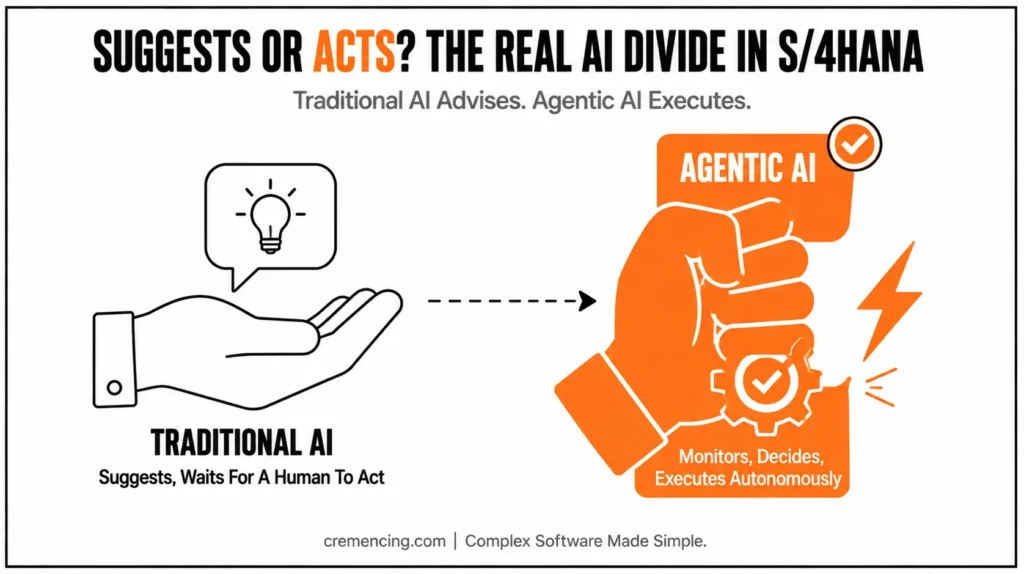
- View processes in real-time.
- Make contextual and informed decisions.
- Start work, e.g., reordering of inventories or modification of production schedules.
- Provide practical suggestions and have minimal human guidance.
In practice, this capability runs under SAP’s Joule brand, specifically Joule Agents, pre-built and customizable AI agents that act inside core S/4HANA processes, and Joule Studio, where teams can build custom agents on top of SAP’s Knowledge Graph and business process data. Availability currently centres on SAP’s cloud editions (S/4HANA Cloud, RISE with SAP, GROW with SAP); on-premises customers should treat this as a migration-linked roadmap item rather than something to switch on today.
Key Components
| Component | Role |
| Smart Robotic Process Automation (iRPA). | Performs routine routines automatically. |
| Machine Learning Models | Examine past information to forecast trends. |
| Decision Intelligence | Recommends or performs an action via rules and forecasts. |
| Predictive Analytics | Foresees possible process interruptions or inefficiencies. |
With these elements combined, companies will be able to minimize mistakes, automate processes, and allow their workforce to concentrate on more important matters instead of manual labor.
The Process of Agentic AI in SAP S/4HANA.
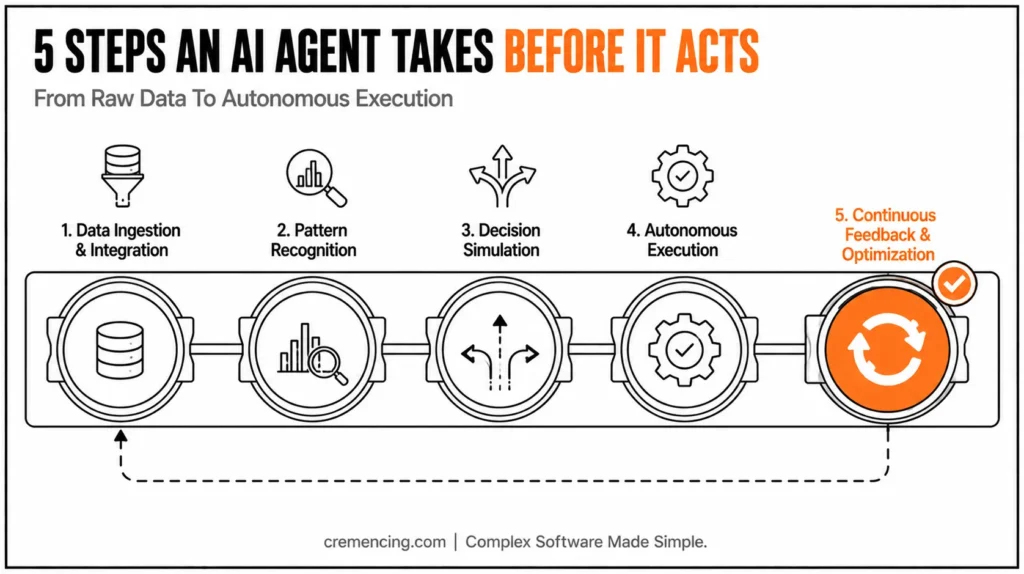
The power of the Agentic AI in agentic is that it can independently govern the workflows. The following is a breakdown in detail:
Step 1: Data Ingestion and Integration.
The agentic AI takes in finance, procurement, manufacturing, and supply chain modules’ data. It is accurate and consistent and brings together the structured and unstructured data to be used in actionable insights.
Step 2: Pattern Recognition.
With machine learning, the system detects trends in historical data. As an example, it may be used to determine trends in the use of inventory, detect delays in the work of suppliers, or predict gaps in cash flows
Step 3: Decision Simulation.
The AI can simulate various scenarios prior to making actions to determine the best course of action. This reduces risks and assists in avoiding expensive mistakes.
Step 4: Autonomous Execution.
After identifying the best scenario, Agentic AI takes action, e.g., automatically approving invoices, changing the production schedule, reallocating resources, or informing stakeholders.
Step 5: Constant Feedback and Optimization.
After execution, AI tracks the results and makes decisions based on the results, thus improving its capacity to make decisions over time.
Use of Agentic AI in SAP S/4HANA has benefits and ROI.
Organization using agentic AI experience real changes in the most significant areas of performance:
- Operational Efficiency: Reduces the time of manual processes by 30-40%.
- Forecast Accuracy: Enhances the accuracy of inventory and demand forecasting by up to 20%.
- Cost Savings: Reduces operational costs by 25% on average
- Employee Productivity: Employees work on high-value strategic work.
- Speed of decisions: Speeds up important decisions by up to 50%.
| Metric | Traditional ERP | SAP S/4HANA + Agentic AI. | Improvement |
| Invoice Processing Time | 3–5 days | <1 day | 60–70% faster |
| Forecast Accuracy | 75% | 90% | +15% |
| Operational Costs | Baseline | 25% lower | – |
| Employee Productivity | Moderate | High | +30% |
Through the combination of Agentic AI, businesses will be able to make quicker, smarter decisions that will eventually lead to revenue and ROI.
Most of the mistakes and best practices.
Despite high-level AI, the implementation errors can decrease ROI.
Common Mistakes:
- Using AI as a set-and-forget application.
- Overlooking the requirements of data quality and integration.
- Hyperautomation and lack of human supervision.
- Not training employees regarding AI processes.
Best Practices:
- Give explicit process ownership to AI workflows.
- Keep data clean, well organized and up-to-date.
- Integrate human judgment and AI insights to make important decisions.
- Periodically oversee, review, and streamline AI activities.
Neglected Opportunities Competitors Miss.
There are so many businesses that merely touch the tip of the iceberg that Agentic AI can achieve:
- Cross-Module Automation: Automate end-to-end finance, supply chain, and production.
- Predictive Maintenance: Reduce downtime through predicting equipment problems.
- Scenario Planning: Proactively test procurement plans to a range of disruptions in the supply chain.
Through the exploitation of these areas, companies can glean the maximum value and have a competitive advantage.
Conclusion
The gap between what agentic AI can do in SAP S/4HANA and what most companies are actually running isn’t a technology problem.
It’s an adoption one. SAP has shipped Joule and Joule Agents since 2024, but the DSAG data above shows most SAP customers are still watching from the sidelines or routing around SAP entirely with tools like Microsoft Copilot.
The seven use cases in this piece—invoice approval, inventory reordering, production scheduling, supply chain forecasting, predictive maintenance, cross-module automation, and scenario planning—aren’t hypothetical; they’re live capabilities tied to specific SAP contracts and a specific data-readiness bar. Closing that gap starts with picking one process, cleaning the data behind it, and giving a Joule agent explicit, bounded ownership of the decision not switching everything on at once and hoping governance catches up later.
Frequently Asked Questions.
Q1: How is Agentic AI different from traditional AI in SAP?
Compared to traditional AI, which merely gives recommendations, agentic AI acts and makes decisions on its own.
Q2: What are some of the tasks that can be automated by Agentic AI?
Invoice approval, scheduling procurements, inventory management, predictive maintenance warnings, and reporting.
Q3: Does it need human control?
Yes, to be compliant, to validate decisions, and to monitor AI-inspired activities.
Q4: What is the average ROI time frame?
The payback period gains are typically realised after 3-6 months; the payback period is typically realized in 12-18 months.
Q5: Is it possible to benefit small businesses?
Yes, smaller companies benefit from quicker decision-making, reduced mistakes and efficiency in automation without the massive cost of implementation.
6.Does Agentic AI in SAP S/4HANA work on-premise, or only in the cloud?
Currently, it’s largely a cloud capability, delivered through Joule under RISE with SAP or GROW with SAP contracts; on-premise systems should plan for it as part of a future cloud migration rather than expect it today.
7. What is SAP Joule, and how does it relate to Agentic AI?
Joule is SAP’s AI copilot and agent framework Joule Agents are the specific pre-built and customizable agents that carry out the autonomous actions described in this post.
8. How is Agentic AI different from SAP’s older RPA tools?
Traditional RPA (formerly SAP Intelligent RPA, now part of SAP Build Process Automation) follows fixed, scripted steps; agentic AI can interpret context, decide among options, and adapt its actions based on outcomes.
Resources
SAP S/4HANA Overview
Learning about Agentic AI in Business.
AI & Intelligent Technologies


One Response