By December 31, 2027, SAP Solution Manager 7.2 reaches the end of mainstream maintenance — and every team still running transformation governance through it will need a documented plan to move to SAP Cloud ALM before that date. This is exactly the gap SAP CALM Certification exists to close: waiting until 2027 to figure out that migration isn’t a technical risk anymore, it’s a staffing risk, because the consultants who can lead that conversation are the ones who understand the full toolchain, not just the screens.
That’s the gap SAP CALM certification is built to close — and it’s not the credential many consultants remember. The 2026 assessment tests whether you can guide an SAP solution transformation using SAP Cloud ALM, from initial planning through implementation, testing, deployment, operations, and the Solution Manager transition itself. Here’s what the credential actually validates, how the new format works, and whether it’s worth your time in 2026.
What Is SAP CALM Certification in 2026?
The SAP CALM certification is a role-based credential for professionals who need to guide an SAP solution transformation using SAP Cloud ALM. SAP’s official training page describes the target profile as a consultant who understands the transformation journey from initial planning through implementation, testing, deployment, operations, and the transition away from SAP Solution Manager.
SAP CALM certification is not a narrow administration badge.It includes SAP Activate, project planning, requirements, process documentation, testing, deployment, analytics, operations, RISE with SAP, Clean Core and the broader transformation tool chain.
Distinguish between course competence and the formal qualification. SAP’s learning courses (introduction, implementation, operations, and administration) can be used to achieve learning outcomes, and SAP CALM certification involves taking and passing the certification assessment, which leads to an SAP Certification digital badge.
That makes SAP CALM certification relevant to people who must explain why a team should use a capability, how it fits the delivery method, and which outcome it supports.
How the 2026 C_STC Assessment Works
The 2026 C_STC model is different from the older exam many consultants remember. SAP moved the credential to a scenario-based assessment using AI roleplay, with a recorded-video route available for candidates who do not want the AI interaction. SAP describes the assessment as open-book and timeboxed, to test how candidates apply knowledge during realistic stakeholder conversations.
For this certification, SAP’s Solution Transformation Consultant training page currently lists one assessment activity, up to 24 hours to complete it, and a 50% cut score. It recommends completing the roughly 35-hour Transforming for Success with SAP Cloud ALM learning journey before attempting the assessment.
This changes how you should prepare for SAP CALM certification. You must explain choices, connect business goals to Cloud ALM capabilities, structure recommendations, and respond to objections—not just memorize the product menu.
The broader SAP practical-exam guidelines also permit 4 attempts for the identical certification instead of 12 months, allowing for a 24-hour wait between tries. It is important to always check the live certification page before beginning, as SAP may change exam information, access rules and the assessment interface.
| Aspect | Previous C_STC Format | 2026 C_STC Format |
|---|---|---|
| Question type | Multiple choice | Scenario-based, AI roleplay (or recorded-video route) |
| Focus | Product knowledge recall | Applied judgment, stakeholder communication |
| Time limit | Fixed exam window | Up to 24 hours (open-book, timeboxed) |
Reason 1: Validate Applied Transformation Skills
The best justification for taking the SAP CALM in 2026 is the change to focus on applied judgement in the assessment. No one ever calls on you to (dare them) state the definition of application lifecycle management in a project meeting. They want to know how to manage scope, link requirements to delivery, plan testing, prepare for deployment, and monitor operations post-go-live.
The scenario-based C_STC assessment is designed around that type of work. You may need to explain how SAP Cloud ALM supports an implementation, position its role within a transformation, or recommend a path for a customer moving from an existing ALM setup. The exam therefore tests communication and decision structure alongside product knowledge.
That is useful for functional consultants and developers who want to move beyond isolated work packages. An ABAP developer may already understand transports, defects, test evidence, and production risk. SAP CALM certification helps connect those technical activities to program governance, SAP Activate deliverables, release planning, and business outcomes.
SAP CALM certification does not replace project experience. It shows that you understand the role, tools, and decision points expected from a solution transformation consultant.
Reason 2: Prepare for the SAP Solution Manager Transition
The second one is time. According to SAP, SAP Solution Manager 7.2 will reach the end of mainstream maintenance on 31 December 2027 and recommends completing the migration to SAP Cloud ALM before the end of the mainstream maintenance period. Some of the functions may still be available for limited extended maintenance and for some customers, but the direction of travel is obvious.
This brings some work for customers and partners in 2026 and 2027. Teams need to evaluate existing Solution Manager usage, analyze the available capabilities, determine what can be moved, identify any gaps, perform the SAP Readiness Check for SAP Cloud ALM and plan any selective data transfer. The switchover is not a one day technical switchover.
SAP CALM certification gives you a structured foundation for those discussions. The certification learning path includes the transition strategy, implementation capabilities, operations, onboarding, and the role of SAP Cloud ALM in the broader transformation approach. It helps you ask better questions before recommending a target model.
This is especially valuable for Basis teams, Solution Manager specialists, test managers, ChaRM stakeholders, and consultants who support hybrid landscapes. Even when a customer retains parts of Solution Manager for a period, they still need people who can explain the future-state ALM model.
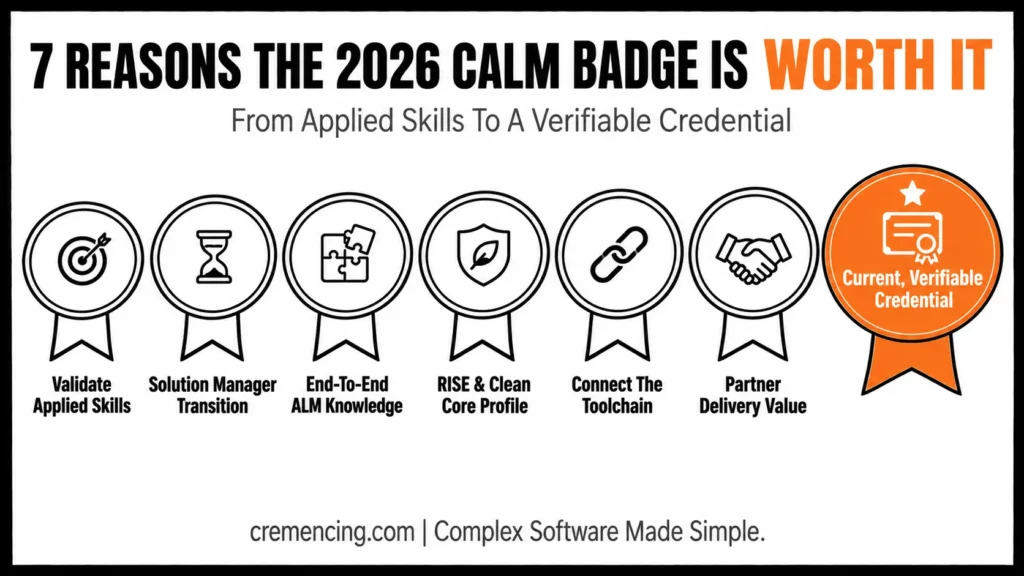
Reason 3: Build End-to-End SAP Cloud ALM Knowledge
Many professionals know one SAP Cloud ALM area well. A project manager may understand tasks and milestones. A test lead may know test preparation and defect handling. An operations specialist may focus on monitoring, events, integrations, jobs, or health data.
SAP CALM certification pushes you to understand the complete lifecycle. SAP’s official learning content covers implementation, operations, service, onboarding, integration options, reporting, deployment, testing, and the transition from SAP Solution Manager. That breadth helps prevent local optimisation, where one team configures its area without understanding the downstream effect.
For example, a requirement may need links to process scope, features, user stories, tests, deployment activity, and reporting. Operations discussions should connect technical monitoring to business service impact rather than stop at alert counts.
This end-to-end view makes SAP Cloud ALM training useful for architects and senior consultants. It gives you a shared model for discussing implementation and run phases with different teams. The SAP CALM certification then validates that you can use that model in a transformation conversation.
Reason 4: Strengthen Your RISE and Clean Core Profile
SAP Cloud ALM now sits inside SAP’s transformation guidance for RISE with SAP and Clean Core. The official Solution Transformation Consultant training includes how SAP Cloud ALM supports the RISE methodology, how it contributes to transformation execution, and how teams can use methodology dashboards and project information to manage progress.
That gives SAP CALM certification value beyond an ALM job title. S/4HANA program managers, enterprise architects, technical architects, workstream leads, and quality managers increasingly need to explain how governance tools support the transformation method. They also need to connect design decisions, extensions, testing, release controls, and operations to a Clean Core approach.
SAP CALM certification does not replace deep expertise in S/4HANA, BTP, Signavio, LeanIX, testing, or architecture. It strengthens the connective layer between them and shows where Cloud ALM supports execution from Explore through Run.
For a consultant building a broader transformation profile, that connective knowledge can be more valuable than collecting another product-only badge. It shows that you can discuss the customer journey, not just a single configuration task. Before certifying, it’s worth reviewing how SAP CALM transport management reduces release risk, since that’s a core exam topic.”
Reason 5: Prove You Can Connect the Integrated Toolchain
Modern SAP transformations rarely run in one product. Architecture, process design, implementation execution, testing, adoption, and operations often involve several SAP and third-party tools. SAP’s current learning journey explicitly covers an integrated toolchain that includes SAP Cloud ALM, SAP LeanIX, and SAP Signavio, with other tools appearing where they fit the use case.
SAP CALM certification helps you understand SAP Cloud ALM’s role in that chain. It is commonly positioned as the execution and application-lifecycle layer: project tasks, process scope, requirements, testing, deployment, reporting, and operational transparency. Architecture and process-management tools provide different views and should not be treated as duplicates.
This matters when a customer also uses Jira, ServiceNow, Tricentis, or other delivery platforms. The right question is not whether SAP Cloud ALM can replace every tool. The better question is which system owns each object, which status should synchronise, and where governance should sit.
A certified consultant should be able to explain those boundaries. That reduces duplicate records, conflicting reports, and unclear ownership. It also helps technical teams design integrations around a defined operating model instead of connecting systems first and deciding responsibility later.
Reason 6: Improve Your Value in SAP Partner Delivery
SAP partners need consultants who can position, configure, and use SAP Cloud ALM during customer transformation work. SAP’s 2026 Partner Readiness Series describes SAP Cloud ALM as a central element of the transformation toolchain and uses its learning content as preparation for the Solution Transformation Consultant assessment and certification path.
The credential also has specific value in SAP’s Solution Manager Transition Service partner ecosystem. SAP lists possession of the SAP Cloud ALM certification badge and completion of transition training among the admission criteria for partners participating in that service community.
This does not mean SAP CALM certification guarantees a role, promotion, or project allocation. Hiring and staffing decisions still depend on delivery experience, industry knowledge, communication, and the rest of your SAP profile. The certification works best when paired with evidence that you have created projects, structured scope, managed requirements, prepared tests, analysed monitoring use cases, or supported an ALM transition.
For independent consultants, the badge can also make your profile easier to verify. Instead of writing “familiar with Cloud ALM,” you can show a current SAP credential and then support it with project examples.
Reason 7: Earn a Current, Verifiable SAP Credential
The final reason is credibility, but only when you keep the badge current. SAP certifications now have a 12-month validity cycle. Candidates with an active SAP Learning Hub subscription can complete the required annual stay-certified assessment to extend validity; professionals without that subscription may need to retake the full certification exam.
That annual cycle matters for SAP CALM certification because SAP Cloud ALM changes frequently. New functions, revised integration options, AI-assisted capabilities, transition content, and methodology updates can make old preparation notes unreliable. The stay-certified model pushes credential holders to review delta content instead of treating one passed exam as permanent proof.
SAP issues a digital badge after certification, giving employers, partners, and clients a way to check the credential. The badge is most useful when your public profile also states what you can do: guide an SAP Cloud ALM implementation, support a Solution Manager transition, structure test and deployment governance, or explain the integrated transformation toolchain.
In other words, the value comes from the combination of verified knowledge, current learning, and visible project evidence. SAP CALM certification supplies the formal validation; your delivery record gives it weight.
Who Should Pursue SAP CALM Certification?
SAP CALM certification is a strong fit for SAP implementation consultants, Solution Manager specialists, ALM architects, Basis professionals, test managers, project managers, and senior developers moving toward design or delivery leadership. It is also relevant for partner consultants involved in RISE with SAP, GROW with SAP, S/4HANA transformation, hybrid operations, or SAP Solution Manager transition planning.
You do not need to be an ABAP developer, and the credential is not tied to a specific ECC or S/4HANA code release. Basic understanding of project management, agile delivery, enterprise software, SAP systems, and business processes is more important. SAP lists those areas as preparation prerequisites for the Solution Transformation Consultant training.
Delay the exam if you have never explored the product, cannot explain SAP Activate phases, or have only watched overview videos. Course completion without practice can leave you unprepared for a scenario-based conversation. Use a demo environment or project tenant to create scope, tasks, requirements, test artefacts, features, and reports before attempting the assessment. A SAP Community learner who passed C_STC specifically reported that hands-on work in the demo tenant helped with project, scope, task, test case, and defect concepts.
SAP CALM certification may be lower priority when your role has no connection to implementation governance, operations, service delivery, or transformation tooling. A credential focused on your core SAP solution may provide a clearer return first.
A Practical SAP CALM Certification Preparation Plan
Start with the official Transforming for Success with SAP Cloud ALM learning journey. SAP recommends this route for C_STC preparation and estimates about 35 hours of learning. Do not rush through it only to mark units complete.
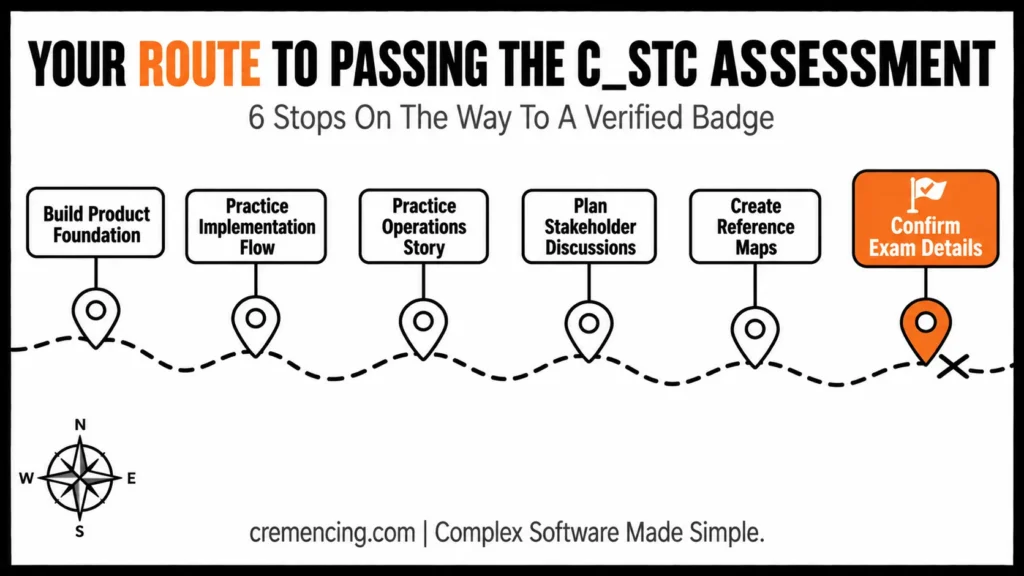
First, build the product foundation. Cloud ALM covers Implementation for setup, Operations for monitoring, and Service for handling issues. You should also understand onboarding, role assignment, integrations, and the transition from SAP Solution Manager.
Second, practise the implementation flow. Work with projects, roadmaps, scope, teams, tasks, requirements, features, tests, defects, releases, and reporting. Explain how traceability works across the lifecycle.
Third, practice the operations story. Explain business process, integration, health and job monitoring, event handling, and business service impact. You need to know why a customer would select each use case.
Fourth, plan for stakeholder discussions. Practice short answers to these questions: “Why move from Solution Manager?”, “Where does SAP Cloud ALM sit versus Jira?”, “How does it support Clean Core?”, and “What should we implement first?”. For each answer, use this format: context, recommendation, reason, risk, next action.
Fifth, create reference maps for SAP Learning, SAP Help Portal, SAP Support Portal, SAP Community, and Cloud ALM expert portals. Assessment is open-book, but fast recall beats searching the text from scratch.
Finally, confirm your SAP Universal ID, exam entitlement, remaining attempts, assessment format, and current certification instructions. SAP’s practical-exam guidance recommends linking at least two email accounts with different domains to the Universal ID. Check these details before exam day, not after the activity has started.
SAP CALM (C_STC) Prep Checklist
- Complete the ~35-hour Transforming for Success with SAP Cloud ALM learning journey
- Build product foundation: Implementation vs. Operations vs. Service, onboarding, transition from Solution Manager
- Practice implementation flow: projects, scope, requirements, tests, defects, releases, reporting
- Practice operations story: monitoring, integrations, jobs, business service impact
- Rehearse stakeholder answers using Context → Recommendation → Reason → Risk → Next Action
- Build reference maps (SAP Learning, Help Portal, Support Portal, Community) for fast open-book lookup
- Confirm Universal ID, exam entitlement, remaining attempts before exam day.
Conclusion
SAP CALM certification isn’t valuable because it proves you memorized SAP Cloud ALM’s screens — it’s valuable because the 2026 scenario-based format forces you to demonstrate the exact skill Solution Manager’s 2027 shutdown will demand: explaining a transformation model to stakeholders who don’t care about the tool, only the outcome. That’s a narrower, harder bar than the old multiple-choice exam, and it’s why the credential carries more weight for consultants building a RISE, Clean Core, or transition-leadership profile.
If your role touches implementation governance, operations, or Solution Manager transition planning in the next two years, the practical move isn’t waiting for the 2027 deadline to force the conversation — it’s building the demo-tenant experience and stakeholder-answer structure this guide outlines now, while you still have runway to prepare properly instead of scrambling.
Frequently Asked Questions
1. Is SAP CALM certification the official name of the credential?
The common search term is SAP CALM certification, but the official title is SAP Certified – Solution Transformation Consultant with SAP Cloud ALM. “CALM” is an informal abbreviation for Cloud ALM. Use the formal title on your CV and LinkedIn profile so recruiters can verify the correct C_STC credential.
2. Is the C_STC assessment still multiple choice?
No. In 2026, the C_STC certification uses a scenario-based assessment rather than the previous multiple-choice model. Candidates interact with an AI roleplay or can use the available recorded-video review route. Preparation should focus on recommendations, stakeholder communication, and applied SAP Cloud ALM knowledge.
3. Is the SAP Cloud ALM certification exam open-book?
Yes. SAP describes its practical scenario-based certification exams as open-book. You can use relevant resources, but the assessment remains timeboxed. Organize official SAP Cloud ALM training and Help Portal references before starting so research supports your answer instead of consuming most of your available time.
4. How long does SAP CALM certification preparation take?
SAP recommends completing the approximately 35-hour Transforming for Success with SAP Cloud ALM learning journey. Actual preparation time depends on your project experience. A newcomer should add hands-on practice for implementation, testing, deployment, operations, and stakeholder scenarios before taking the C_STC certification assessment.
5. Can an individual purchase SAP Learning Hub?
Yes. SAP Learning Hub subscriptions are available to individual learners as well as organizations, subject to the editions and purchasing options available in your market. An active subscription provides learning resources, exam attempts under the relevant plan, and access to annual stay-certified assessments. Verify current pricing directly with SAP.
6. How many attempts do I get for SAP certification?
SAP’s practical-exam guidance allows up to four attempts for the same certification within a 12-month period, with a 24-hour waiting period between attempts. Your usable attempts also depend on your subscription or exam purchase. Check the assessment page before starting to see the exact remaining balance.
7.Does SAP CALM certification expire if I don’t complete the stay-certified assessment?
Yes — SAP certifications run on a 12-month validity cycle. Without an active SAP Learning Hub subscription to complete the annual stay-certified assessment, you’d need to retake the full C_STC exam to keep the credential current.
8.Is SAP CALM certification required to use SAP Cloud ALM day-to-day?
No. The certification validates that you can guide a transformation using SAP Cloud ALM as a consultant — it isn’t a prerequisite for operational users who simply work within the tool for their own project tasks.
9.How is SAP CALM certification different from other SAP Activate-related credentials?
SAP Activate is a methodology referenced throughout the C_STC content, but the certification specifically validates SAP Cloud ALM as the execution layer supporting that methodology — not SAP Activate knowledge in isolation.
10.Can I take the SAP CALM certification without prior SAP Solution Manager experience?
Yes. The prerequisites focus on project management, agile delivery, and general SAP systems understanding — not specifically on prior Solution Manager experience, though that background helps with the transition-focused content.