

What SAP Agile Methodology Stands For
SAP Agile Methodology is a methodology that helps in the designing, implementation, and improvement of processes among the SAP systems. This contemporary method replaces traditional waterfall methods with collaborative, sprint-oriented cycles that prioritize flexibility, velocity, and demonstrable value.
Introduction:
An SAP project can have a detailed requirements document and a committed timeline and still discover late in the project that the delivered process does not work for the people who use it. In many cases, the problem is not the SAP platform itself. Instead, it is the distance between requirements, development, testing, and business feedback.
To reduce this gap, Agile delivery organizes SAP work into prioritized increments, regular reviews, and continuous testing. For example, in S/4HANA implementations, SAP Activate provides the broader implementation framework and incorporates agile project delivery, particularly during the Realize phase.
In this article, you’ll learn how Agile works in SAP projects, where Scrum and Kanban fit, how SAP Activate structures implementation work, and which ALM and testing practices can support iterative delivery.
What Is SAP Agile Methodology?
Agile in SAP is best understood as a delivery approach rather than a single SAP product or methodology. In practice, teams organize requirements into a prioritized backlog, break selected work into manageable increments, develop or configure the required functionality, test it, and obtain feedback before continuing with the next iteration.
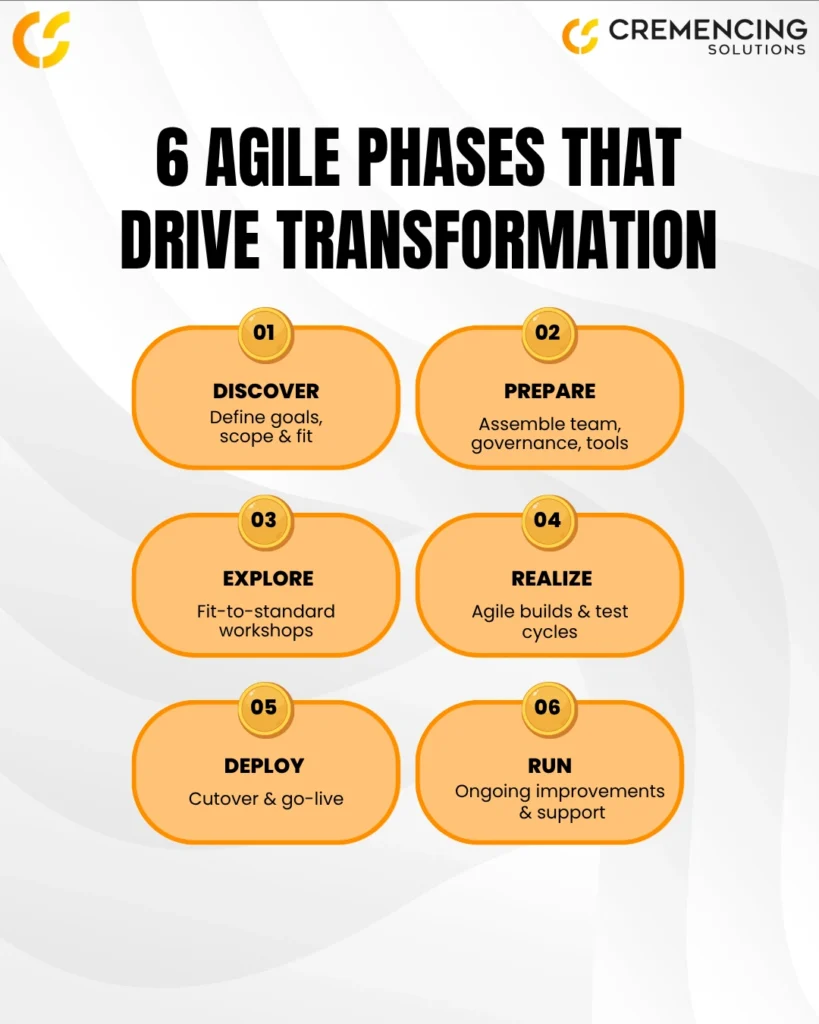
Meanwhile, SAP Activate provides the broader implementation framework. SAP currently describes it as combining SAP best practices, guided implementation content, and agile project delivery. As part of this framework, its six phases are Discover, Prepare, Explore, Realize, Deploy, and Run.
However, the distinction matters because an SAP project can use Agile practices without treating every activity as a Scrum sprint. For example, governance, architecture, security, data migration, integration, testing, and production deployment still require appropriate controls.
The strongest Agile fit usually appears where requirements can be prioritized and delivered incrementally. For example, a custom SAP extension might move through the following cycle:
- A business requirement enters the backlog.
- The team defines acceptance criteria and dependencies.
- The product owner prioritizes the requirement.
- Developers and functional consultants configure or build the solution.
- The team performs appropriate unit, integration, or other testing.
- Stakeholders review the working increment.
- Feedback becomes new or revised backlog items.
- Approved functionality moves through the project’s release and transport governance.
SAP’s Activate guidance explicitly describes the Realize phase as an iterative and incremental build process. It also states that configuration, development, testing, and integration activities occur during this phase, with business users continuing to participate.
Benefits of Using SAP Agile Methodology
| Traditional (ASAP/Waterfall) | SAP Agile Methodology |
| Long release cycles | Frequent, faster releases |
| Fixed scope and timeline | Adaptive to change |
| Late stakeholder involvement | Continuous collaboration |
| High risk toward the end | Risk reduced early and often |
Additional Benefits:
- Shorter development cycles
- Continuous stakeholder feedback
- Faster ROI from incremental delivery
- Smooth interoperability with other SAP systems
- Improved issue tracking and risk mitigation
Aligning Teams for SAP Success
Agile methods also help stakeholders collaborate more effectively on SAP projects, which is particularly important in complex bespoke development environments. Moreover, Agile emphasizes business-driven development rather than focusing only on technical delivery. It brings end users, developers, functional teams, and SAP consultants into the process early and keeps them involved throughout the development lifecycle.
As a result, teams can continuously validate whether the solution meets real business needs rather than relying only on requirements defined at the beginning of the project. For example, we use sprint reviews and backlog refinement sessions at Cremencing to validate each delivered increment against both strategic and operational goals.
Optimizing SAP Delivery with Agile and DevOps
Another significant benefit of SAP Agile Methodology is that it works well with DevOps and continuous integration. Moreover, development teams can release high-quality transfers faster and with fewer problems by using tools like SAP Solution Manager, ActiveControl, and automated QA pipelines. As a result, this approach lowers the risk of going live, makes upgrades go more smoothly, and helps reduce downtime.
As more businesses move to cloud-native or hybrid SAP landscapes, Agile techniques help close the gap between business agility and IT governance. This lets companies grow more quickly and come up with new ideas more quickly. Add it to the title of this blog to make it more interesting..
Agile Methodologies Used in SAP Projects
Scrum
Scrum is a widely used Agile framework for SAP projects, particularly when teams need structured iterations and regular business feedback. Typically, work is organized into 2–4 week sprints, with each sprint focused on a defined set of backlog items. During the sprint, developers, functional consultants, testers, and business stakeholders collaborate to deliver and validate working functionality. Daily stand-ups help teams track progress, identify blockers, and keep work aligned with sprint goals.
Kanban
Kanban is a visual framework for managing and tracking work items continuously. Unlike Scrum, it does not require fixed-length sprints, making it well suited to SAP maintenance, support, incident resolution, and smaller enhancements. As a result, teams can prioritize incoming requests, monitor work in progress, and move items through stages such as development, testing, and deployment.
SAP Activate
SAP Activate is SAP’s implementation framework for deploying and adopting SAP solutions, particularly S/4HANA. Rather than relying on Agile practices alone, it combines SAP best practices, guided implementation content, and agile project delivery. In addition, its six phases Discover, Prepare, Explore, Realize, Deploy, and Run provide a structured path from initial planning through implementation and ongoing operations. During the Realize phase, teams can use iterative delivery, testing, and feedback to refine the solution before deployment.
Phases of SAP Activate Methodology
| Phase | Description |
| Discover | Identify business needs and define scope |
| Prepare | Set up systems, teams, and project governance |
| Explore | Conduct fit-to-standard workshops. |
| Realize | Develop based on prioritized user stories. |
| Deploy | Conduct final testing and move to production |
| Run | Support, monitor, and continuously improve |
Why Agile Beats Traditional SAP Implementation Models
Traditional SAP methodologies like ASAP were based on rigid timelines and documentation-heavy processes. Agile models like SAP Activate provide the flexibility to:
- Adjust project scope in real time
- Improve user adoption through early feedback
- Deliver visible business value faster
- Avoid the pitfalls of large, end-loaded go-lives
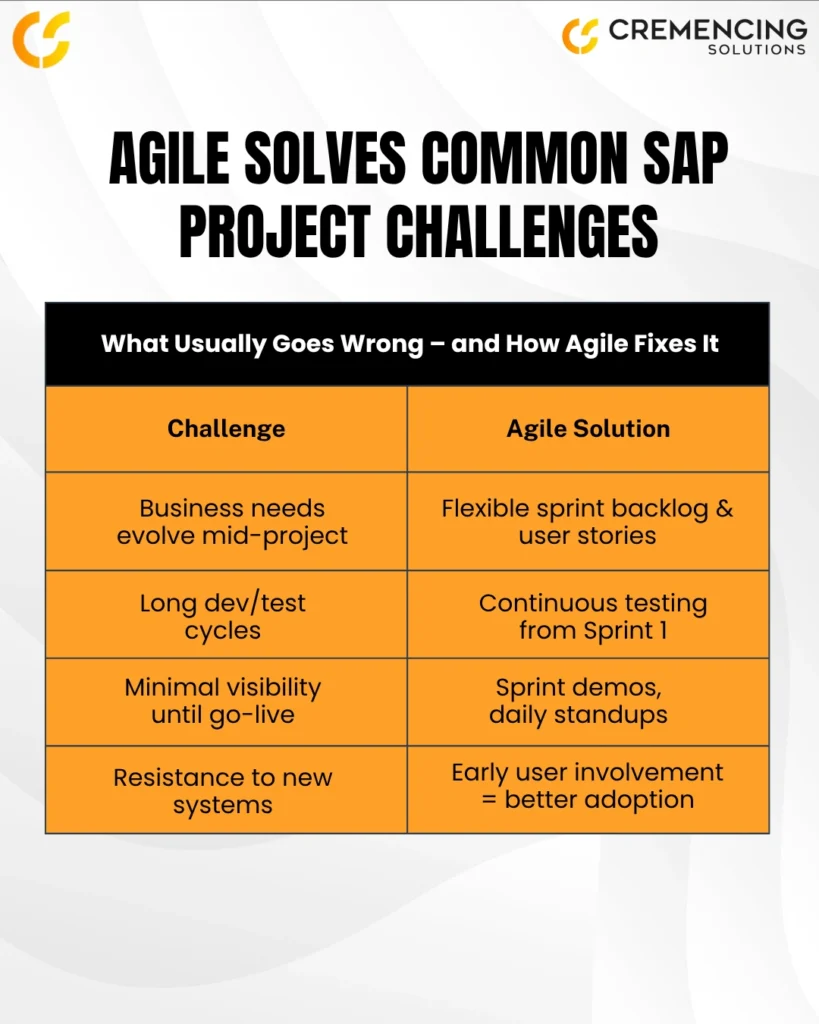
Addressing Common SAP Implementation Challenges with Agile
- Challenge: Misaligned business needs
Agile Solution: Constant stakeholder involvement - Challenge: Long development cycles
Agile Solution: Short, iterative sprints - Challenge: Limited visibility
Agile Response: Sprint reviews and daily standups - Challenge: Testing delays
Agile Solution: Test as you go from sprint one.
Agile Tools and Technologies
Agile development for SAP can be promoted through tools such as:
- SAP Solution Manager / Focused Build for SAP Solution Manager
- SAP Cloud ALM
- Jira or Azure DevOps (using connectors)
- Active Control for automated transport management
- SAP Test Cockpit & ABAP Unit for early Quality Assurance checks.
Why Choose Cremencing for Agile SAP Projects?
At Cremencing.com, we deliver SAP Custom Development in an agile way of working. We work with businesses to provide SAP modules and tools, which would be :
- Aligned to your business strategy
- Delivered incrementally and transparently
- Scalable across your SAP landscape
- Tested and refined continuously
We make sure your SAP system grows with your business through an agile-first philosophy.
Conclusion
Agile is no longer limited to software development. For SAP, it provides a structured way to manage complex transformation projects while adapting quickly to changing business needs. Whether you are implementing S/4HANA or improving an existing SAP solution, Agile can support faster delivery, stronger collaboration, and measurable business value.
With the right SAP partner, Agile can turn this approach into practical results. At Cremencing Solutions, we combine SAP Custom Development expertise with agile delivery to help businesses build, improve, and scale SAP solutions effectively.
Ready to move forward with Agile in SAP? Get in touch with Cremencing Solutions and start building a more flexible, efficient SAP environment.
Frequently Asked Questions (FAQs)
What Is The Agile Methodology Of SAP Implementation?
Agile Process in SAP is incremental development and continuous delivery. It enables teams to deploy SAP modules in short, iterative sprints that meet changing business requirements.
How is Agile better than other methodologies?
Instead of Waterfall-like models, you get continuous collaboration, faster time-to-value, early testing, and flexibility to change—things that are essential for a complex SAP environment.
Methodology to be used for SAP Implementation?
The most popular echelle methodologies today is SAP Activate. It combines agile methodology with the best practices of SAP, replacing the legacy ASAP waterfall model.
For what is agile methodology best suited?
We recommended Agile methodology for custom SAP development, modular S/4HANA implementations, integrations, and incremental system enhancements projects when flexibility and speed matter most.