
Introduction
The job market for SAP around the world is changing quickly. The need for competent SAP specialists has skyrocketed as businesses move to the cloud, become digital, and use smart automation. But because there is more competition, you need a strategic plan to stand out.
If you want to find your next SAP job, you need to do more than just upload your resume. This is true whether you’re finishing up a project or looking to change jobs. You need to know where to look, how to promote oneself, and how to stay ahead of the curve in your field. SAP Jobs stand for employment opportunities related to SAP (Systems, Applications & Products in Data Processing) a leading enterprise software used worldwide for business operations and customer relations. Read more on Wikipedia
We at Cremencing.com are experts in SAP custom development, which helps businesses get the most out of their SAP systems. We also help the SAP professional community by giving them advice and tips on how to build their careers.
This blog post goes over the top five strategies to get your next SAP job. It also gives you useful ideas, up-to-date trends, and useful resources to help you find a SAP career in 2025.
How to Evaluate an SAP Job Opportunity Before Applying
Not every SAP job opening is suitable for every consultant. Before applying, professionals should evaluate whether the position aligns with their technical background, project experience, and career objectives.
Consider these factors:
SAP System Environment: Check whether the employer uses SAP ECC, S/4HANA, or a combination of SAP and third-party platforms.
Project Responsibilities: Understand whether the role involves implementation, development, migration, integration, maintenance, or production support.
Required Technical Skills: Compare the listed requirements with your actual experience in relevant SAP modules and technologies.
Industry Experience: Some positions require knowledge of specific business processes, particularly in manufacturing, retail, energy, and finance.
Employment Arrangement: Determine whether the opportunity is permanent, contract-based, remote, hybrid, or onsite.
Career Development: Consider whether the role provides opportunities to work with newer SAP technologies and develop deeper expertise.
Evaluating these factors before applying helps professionals focus on opportunities that match their experience and long-term career plans.
Top 5 Ways to Find Your Next SAP Job
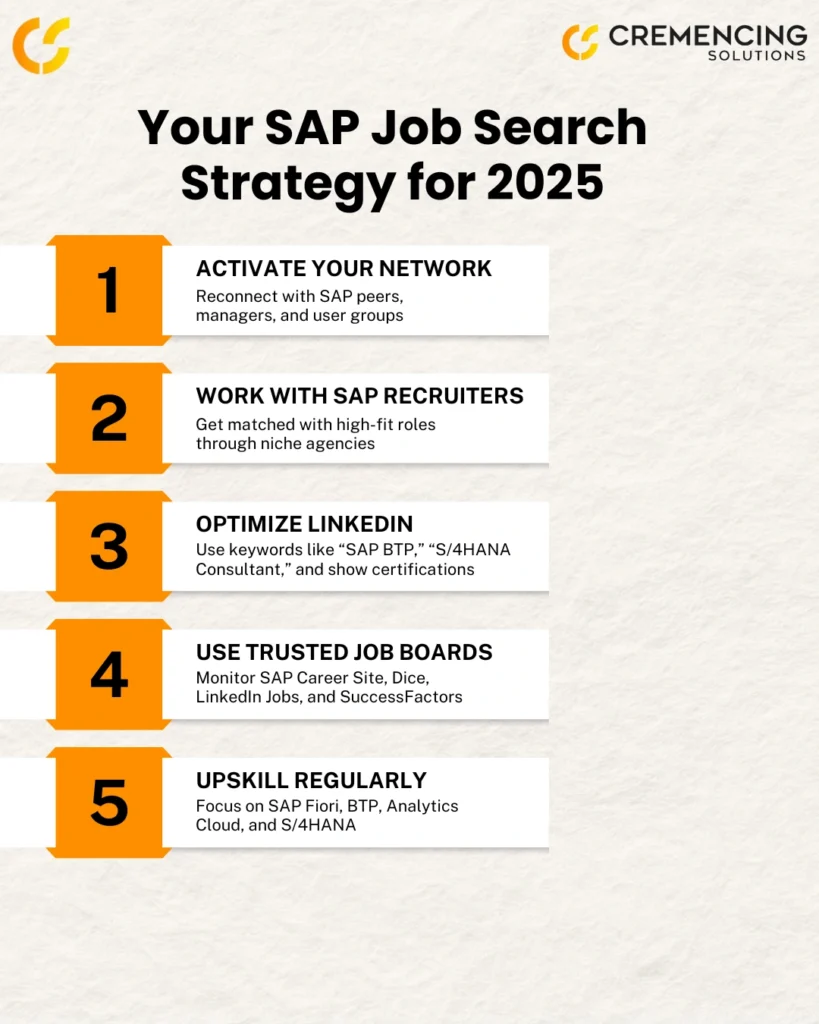
1. Tap Into Your SAP Network
Your network is one of your finest tools in the SAP job search. A lot of SAP jobs are never made public. Instead, they are shared within the company or given to others through referrals.
How to leverage your network:
- Get in touch with old coworkers, project managers, and clients again.
- Become a member of local SAP user groups, such as ASUG.
- Go to SAP webinars and conferences
- Join and participate in LinkedIn groups and SAP Community forums.
Making real connections with others makes you more visible and trustworthy. If you have a big and active network, you’re more likely to be thought of when a chance comes up.
2. Partner with SAP Job Agencies and Recruitment Firms
If you work with a specialized SAP recruitment agency, your chances of getting jobs that fit your skills will go up a lot.
Benefits of SAP-focused recruitment agencies:
- Access to job posts for SAP that only you can see
- Getting ready for interviews and resumes
- Guidance on market rates and contract negotiation
- Understanding the company’s culture and hiring needs
Pick agencies that really know SAP and work directly with businesses that are setting up or updating SAP systems. This makes sure that you are being offered jobs that meet your skills.
Well-known SAP recruitment firms
- Whitehall Resources
- Eursap
- Get SAP going
- RED Global
3. Optimize Your LinkedIn Profile
LinkedIn is more than just a way to meet people; it’s also a way to create your brand and find jobs. Every day, recruiters use keywords and filters on LinkedIn to look for SAP talent.
To make your profile SAP job-ready:
- Use phrases like “SAP S/4HANA Consultant,” “SAP SuccessFactors Specialist,” or “SAP FICO Analyst.”
- Add certificates and training courses
- Write a clear headline and summary about what you know about SAP.
- Post or comment on industry discussions that are important to you.
Also, turn on the “Open to Work” setting and tell others what kinds of SAP jobs you’re looking for.
4. Explore the SAP Career Site and Job Boards
Job boards and official SAP channels are also quite helpful, even though networking and agencies are wonderful.
Top places to find SAP job postings:
- SAP Career Site
- LinkedIn Jobs
- Dice.com
- Indeed
- Monster
- Career SuccessFactors-integrated job portals
How to apply using job boards:
- Add keywords that are particular to the job to your CV.
- Add results from past initiatives that can be measured
- Apply early and, if you can, get in touch with someone within the company
5. Improve Your SAP Skills and Certifications
SAP technologies change frequently. Being up to date provides you an edge over your competitors. Cloud, AI, and S/4HANA migration capabilities are now at the top of employers’ lists.
In-demand SAP skills in 2025:
- SAP S/4HANA, especially for Finance, Logistics, and Green Ledger
- SAP BTP, or Business Technology Platform
- SAP Cloud for Analytics
- SAP Fiori and UI5
- SAP SuccessFactors for hiring, onboarding, and learning management
How to improve your skills:
- Take free or low-cost courses via openSAP
- Join blogs and conversation threads in the SAP Community
- Join webinars and read whitepapers
- Practice in a sandbox setting
We help SAP specialists at Cremencing by sharing our technical knowledge and offering custom development services.
SAP Job Market Trends and Insights (2025)
| Trend | Insight |
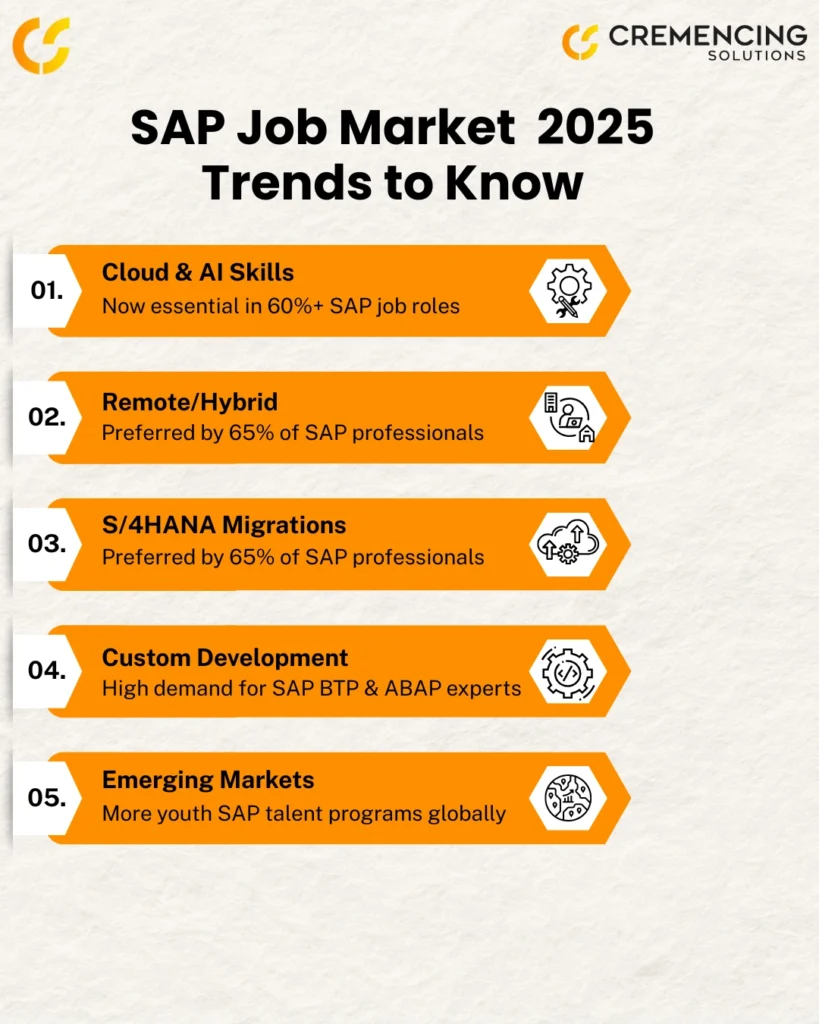
| Cloud & AI Skills | Over 60% of SAP jobs now require experience with AI or cloud deployment |
| Remote Work | 65% of SAP professionals seek hybrid or remote roles |
| Young Talent | SAP is investing in youth training programs in emerging markets |
| S/4HANA Demand | Migration demand continues to grow due to ECC support ending in 2027 |
| Customization | More companies are seeking tailored SAP solutions, driving demand for developers |
Notable Update: Telefónica is launching a SAP Talent Center in Spain to support digital transformation projects nationwide.
Conclusion
Finding the right SAP job requires more than searching job boards and submitting applications. Professionals need to build relevant technical skills, demonstrate practical project experience, maintain professional networks, and understand the changing requirements of the SAP job market.
Whether you specialize in ABAP development, S/4HANA implementation, SAP BTP, or functional consulting, a focused career strategy can help you identify opportunities that match your expertise and professional goals.
At Cremencing Solutions, we work across SAP Custom Development, integrations, and technical consulting. Through our industry experience, we understand the skills and technical capabilities required to support modern SAP environments.
Explore our SAP Custom Development Services or contact our team to learn more about our SAP expertise.
Get in Touch
Cremencing Solution can assist you in improving your SAP systems or customizing your business processes.
We are experts in:
- SAP Custom Development
- Custom integrations
- Improving performance
- Improvements to the user experience
Let’s talk about how we can support your SAP journey. Get in touch today
Frequently Asked Questions
1. How can I find SAP jobs with no experience?
Start by learning the fundamentals of a specific SAP module or technology. Explore SAP Learning resources, practice with available learning environments, complete relevant training, and apply for entry-level positions, internships, and junior consultant opportunities.
2. Which SAP skills are most in demand?
Demand varies by industry and project requirements. SAP S/4HANA, ABAP, SAP BTP, Fiori, SAP Integration Suite, FICO, and SuccessFactors are relevant skill areas across different SAP career paths.
3. How can I get an SAP job as an experienced consultant?
Highlight your implementation experience, technical expertise, project responsibilities, and measurable achievements. Build relationships with SAP recruiters, use professional networks, and target opportunities that match your project background.
4. Are SAP jobs available for remote workers?
Yes. Some organizations offer remote and hybrid SAP positions, particularly for development, integration, consulting, and support roles. However, working arrangements depend on the employer, project requirements, and client location.
5. Is SAP certification necessary to get a job?
SAP certification can demonstrate structured knowledge of a particular technology or module, but it is not mandatory for every position. Employers also consider practical experience, project contributions, technical problem-solving, and business knowledge.
6. How can I move from SAP ECC to S/4HANA roles?
Start by understanding the S/4HANA architecture and the changes relevant to your existing specialization. Developers can explore ABAP for cloud development, CDS Views, RAP, and Clean Core principles, while functional consultants can focus on changes to their respective business processes.
External Resource:
Telefónica SAP News