

Introduction
When it comes to SAP Basis, many IT pros are reluctant to adopt it because they are not sure if their old administration techniques will still be applicable in the current SAP landscape or not. With the evolution of SAP S/4HANA, cloud platforms, and RISE with SAP, enterprises are reimagining ways to operate their enterprise systems, raising the question: What role will technical roles play in the future? If you’re considering if SAP Basis is a good career, you need to know how the job is changing.
Beyond simple system administration, SAP Basis is transitioning to technical architecture, operations in the cloud, automation, and life cycle management. The article explains the relevance of SAP Basis, how skills are becoming relevant, and how professionals can create long-term careers in this area.
Why Professionals Question the Future of SAP Basis Careers
The technology landscape of the SAP business world has undergone a dramatic transformation over the last few years. The preceding SAP Basis positions had strong ties to managing on-premise infrastructure, system installations, database management, transport management, and technical monitoring. These organizations typically had full control over servers, operating systems, and databases, as well as the SAP application layers in SAP ECC environments.
This operating model has been transformed by the adoption of the cloud. There is a growing trend towards SAP S/4HANA Cloud, RISE with SAP, managed services, and hybrid landscapes. Previously, internal responsibilities for infrastructure have been delegated to SAP, cloud service providers, or service partners.
This transformation has led to doubts about SAP Basis as a career choice for professionals. Many feel that with the decline of direct physical infrastructure management, there will be less demand for Basis professionals.
This is, however, ignoring the enterprise-wide responsibilities of SAP Basis. SAP systems are still complex environments which demand technical expertise for upgrades, monitoring, integrations, performance management, security coordination, and lifecycle activities.
The question is, is SAP Basis going away? The interesting question is how the responsibilities are shifting and how the skills required are to be of value.
What Makes SAP Basis a Valuable Technical Role?
SAP Basis provides the technical foundation required for SAP systems to operate reliably. While business users interact with SAP applications, Basis professionals ensure that the underlying technical environment supports those processes.
The role covers several important areas, including:
- SAP system installation and configuration
- System monitoring and troubleshooting
- Transport management
- SAP upgrades and maintenance
- Database coordination
- Performance analysis
- Technical system operations
In enterprise environments, SAP systems can be used to support critical business functions like finance, supply chain, manufacturing, procurement, and human resources. SAP Basis skills can be crucial to keeping systems available and can directly impact business processes in the event of technical failures.
In fact, Basis professionals are engaged in the technical life cycle of an SAP S/4HANA implementation. They enable the preparation of the system, set up the landscape, conduct migration, create test systems and prepare production systems.
The significance of SAP Basis is the knowledge of how the SAP components are interrelated. A Basis professional is not just a person who performs single transactions or technical tasks, but he/she has a grasp of how application servers, databases, integrations, operating environments, and business needs are all interconnected.
How SAP S/4HANA Is Changing SAP Basis Careers
SAP S/4HANA has significantly changed the responsibilities of SAP Basis professionals. The move from traditional SAP ECC environments to S/4HANA introduces new technical requirements related to SAP HANA, system architecture, cloud connectivity, and modern application design.
In SAP ECC environments, Basis administrators often focused on ABAP application servers, database administration, system copies, patches, and technical monitoring. These responsibilities remain important, but S/4HANA requires additional knowledge.
Modern SAP Basis professionals need to understand areas such as:
- SAP HANA database administration
- S/4HANA system conversion
- Technical migration processes
- SAP Fiori architecture
- Integration technologies
- Cloud connectivity
For example, an organization migrating from SAP ECC to SAP S/4HANA requires technical experts who can analyze the existing landscape, prepare systems for conversion, support migration activities, and validate the new environment after implementation.
The role also becomes more collaborative. SAP Basis professionals work closely with functional consultants, developers, security specialists, and enterprise architects because modern SAP projects involve multiple technical layers.
The Role of SAP HANA Knowledge in SAP Basis Careers
SAP S/4HANA does not reduce the importance of Basis skills. Instead, it requires professionals to move from traditional administration toward broader technical expertise.
One of the biggest changes in modern SAP Basis careers is the importance of SAP HANA knowledge. Since SAP S/4HANA runs on the SAP HANA database, understanding database behaviour has become an important technical requirement.
Traditional SAP Basis administrators often worked alongside separate database administrators. In many S/4HANA environments, Basis professionals need a stronger understanding of database monitoring, performance analysis, and system optimization.
Important SAP HANA areas include:
- Database monitoring
- Backup and recovery concepts
- Memory management
- SQL performance analysis
- High availability concepts
- System replication
For example, when an SAP S/4HANA system experiences performance issues, the problem may involve application processes, database queries, memory allocation, or system configuration. A modern Basis professional needs the ability to analyze these connected areas.
This does not mean every SAP Basis professional must become a database expert. However, understanding SAP HANA architecture improves troubleshooting ability and makes professionals more valuable in modern SAP environments.
SAP HANA knowledge is therefore one of the key skills separating traditional Basis administrators from future-ready SAP technical specialists.
Impact of RISE with SAP and Cloud Adoption on SAP Basis Careers
The adoption of RISE with SAP has changed how organizations manage SAP landscapes and has influenced the responsibilities of SAP Basis professionals. RISE with SAP provides a managed transformation approach that helps organizations move SAP ERP environments toward cloud-based operations, including SAP S/4HANA Cloud Private Edition deployments.
This shift does not remove the need for SAP Basis expertise. Instead, it changes the focus from direct infrastructure administration toward technical coordination, system governance, monitoring, lifecycle management, and collaboration with cloud providers.
In traditional SAP environments, Basis teams often controlled the complete technical stack, including operating systems, databases, servers, and SAP application layers. In cloud-based models, some infrastructure responsibilities may move to SAP or managed service providers, but organizations still require professionals who understand how SAP systems operate and how technical decisions affect business processes.
A modern SAP Basis professional may be involved in activities such as:
- SAP system lifecycle planning
- Cloud environment coordination
- Technical monitoring
- Incident management
- Release planning
- Integration support
- System performance analysis
For example, during a RISE with SAP migration, Basis professionals help ensure that system readiness, technical dependencies, interfaces, and operational processes are properly managed before and after the transition.
The role is moving from infrastructure ownership toward SAP platform management, where technical knowledge remains important but is applied in a different way.
SAP BTP Knowledge Is Becoming Important for SAP Basis Professionals
SAP Business Technology Platform (SAP BTP) has introduced another layer into modern SAP landscapes. Organizations increasingly use SAP BTP for extensions, integrations, application development, and data services alongside SAP S/4HANA.
This creates new responsibilities for SAP Basis professionals because enterprise systems are no longer isolated SAP installations. They are connected ecosystems involving cloud services, APIs, identity platforms, and external applications.
A basic professional working in a modern SAP environment may need to understand:
- SAP Cloud Connector configuration
- Connectivity between SAP S/4HANA and SAP BTP
- Technical service configuration
- Cloud monitoring concepts
- Authentication and communication methods
- Hybrid landscape operations
For example, a company may develop a custom application on SAP BTP that communicates with SAP S/4HANA through APIs. While developers build the application logic, Basis specialists may support connectivity, environment setup, monitoring, and technical troubleshooting.
This broader understanding helps SAP Basis professionals participate in architecture discussions instead of only handling operational tasks. The future of SAP Basis is increasingly connected with understanding how SAP platforms work together.
Automation Is Changing Traditional SAP Basis Activities
Automation is one of the biggest factors influencing the future of SAP Basis. Many repetitive administration tasks that previously required manual execution are now being automated through monitoring platforms, scripts, cloud tools, and operational frameworks.
Activities such as system monitoring, alerts, job checks, and certain maintenance procedures can increasingly be supported through automation.
This does not reduce the importance of Basis professionals. Instead, it changes the type of work they perform. Professionals who understand automation can spend more time solving complex technical problems rather than repeating manual operational tasks.
Modern SAP Basis professionals should develop skills in areas such as:
- Scripting concepts
- Automation frameworks
- Monitoring solutions
- DevOps practices
- Cloud operations
For example, instead of manually checking multiple SAP systems every day, teams can create automated monitoring processes that identify abnormal conditions and notify responsible teams.
The ability to design, maintain, and improve automated operations will become an important advantage for SAP Basis careers.
The Future SAP Basis Skill Profile
The future SAP Basis professional will need a broader technical skill set than traditional administrators. The foundation of SAP administration remains important, but additional capabilities are required to support modern SAP landscapes.
A future-ready SAP Basis skill profile includes:
SAP S/4HANA Administration
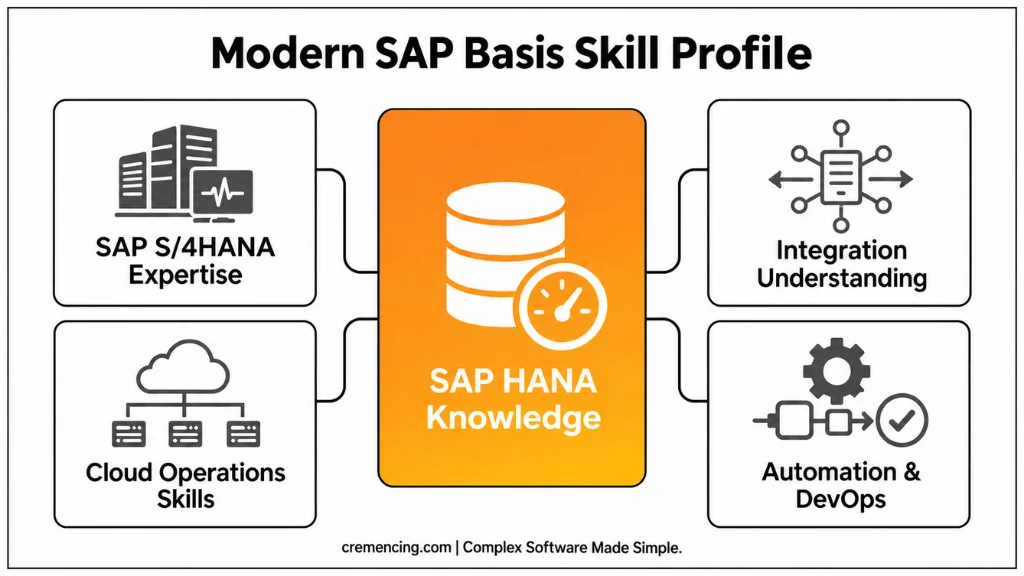
SAP S/4HANA knowledge is essential because many organizations are transitioning from SAP ECC environments. Professionals need to understand technical migration activities, upgrades, system operations, and S/4HANA architecture.
SAP HANA Expertise
SAP HANA knowledge has become a core requirement because S/4HANA depends on the HANA database platform. Understanding database monitoring, performance analysis, backup strategies, and system replication improves troubleshooting capabilities.
Cloud Knowledge
Cloud understanding is becoming increasingly important. SAP Basis professionals should understand how SAP systems operate on hyperscaler platforms and within managed service environments.
Integration Knowledge
Modern SAP landscapes depend heavily on integrations. Understanding SAP Integration Suite, APIs, connectivity concepts, and interface monitoring helps Basis professionals support connected enterprise environments.
Security Awareness
Although SAP Security is a specialized discipline, Basis professionals need awareness of authentication, certificates, communication security, and system protection concepts.
Professionals who combine these skills can move beyond traditional administration roles into SAP technical consulting and architecture positions.
SAP Basis vs Traditional IT Administration Career Path
SAP Basis is sometimes compared with general system administration roles because both involve technical operations. However, SAP Basis requires specialized knowledge of enterprise applications and business-critical processes.
| Area | Traditional IT Administration | Modern SAP Basis |
| Main Focus | Infrastructure and systems | SAP enterprise application platforms |
| Core Knowledge | Servers, networks, operating systems | SAP architecture, HANA, S/4HANA, cloud operations |
| Business Impact | General technology support | Direct support for business processes |
| Future Direction | Cloud and automation | SAP cloud platforms, architecture, automation |
The difference is that SAP Basis professionals work directly with systems that support financial operations, supply chains, manufacturing processes, and other critical business functions.
This business connection makes SAP Basis a specialized technical career path.
Common Mistakes When Choosing SAP Basis as a Career
Many professionals make career decisions about SAP Basis based only on current market discussions instead of understanding how the role is changing. A common mistake is assuming that cloud adoption means SAP Basis skills are no longer required. While cloud platforms and managed services have changed the responsibilities of Basis teams, enterprises still need professionals who understand SAP technical operations, system architecture, integrations, and lifecycle management. SAP’s movement toward cloud-based ERP models such as RISE with SAP has shifted the focus of technical roles rather than removed them.
Another mistake is learning only traditional SAP Basis administration without expanding into modern technologies. Knowledge of system monitoring, transports, and installations remains useful, but future opportunities require additional expertise in SAP HANA, S/4HANA operations, cloud platforms, automation, and technical architecture.
Professionals who treat SAP Basis as only a support role may limit their career growth. Modern SAP Basis specialists need to understand how technical decisions influence business processes, system availability, compliance requirements, and transformation projects.
A strong career approach is to build a foundation in classic SAP administration and gradually move toward broader technical consulting responsibilities.
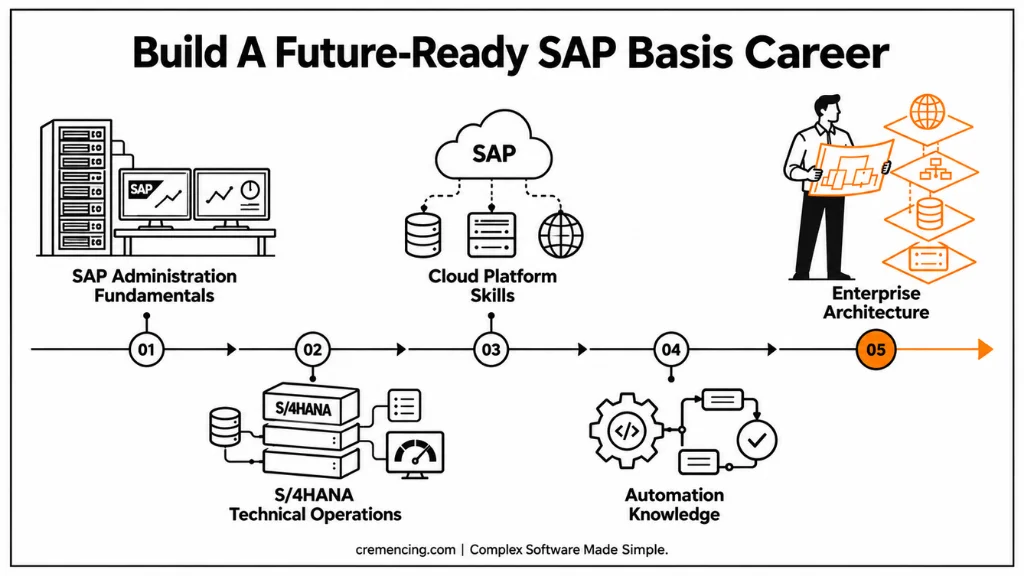
How to Build a Future-Ready SAP Basis Career
Professionals asking is SAP Basis a good career should evaluate the role based on long-term skill development rather than only current job descriptions. The strongest SAP Basis careers will belong to professionals who combine operational knowledge with modern SAP technologies.
A practical development path includes several important stages.
Build Strong SAP Administration Fundamentals
The first step is understanding the core responsibilities of SAP Basis. Professionals should develop knowledge of SAP landscapes, clients, transports, system monitoring, background jobs, user administration coordination, and technical troubleshooting.
These fundamentals remain important because every SAP environment requires operational management, whether the system runs on-premise, in a private cloud, or through managed services.
Learn SAP S/4HANA Technical Operations
SAP S/4HANA knowledge has become essential because many organizations are moving away from SAP ECC environments. SAP Basis professionals involved in transformation projects need to understand system conversions, upgrades, technical migrations, and post-implementation support.
Understanding S/4HANA architecture allows Basis professionals to participate in larger transformation discussions instead of focusing only on operational activities.
Develop Cloud and Platform Skills
Cloud knowledge is becoming a major differentiator. Professionals should understand how SAP systems operate within cloud environments and how responsibilities are divided between customers, SAP, and cloud providers.
Important areas include:
- SAP BTP fundamentals
- Cloud connectivity
- Hybrid SAP landscapes
- Cloud monitoring
- Managed SAP operations
These skills help Basis professionals support modern enterprise architectures.
Improve Automation Knowledge
Automation is becoming increasingly important in SAP operations. Professionals who understand automation can improve system monitoring, reduce repetitive tasks, and support more efficient operational processes.
Learning scripting concepts, monitoring automation, and DevOps principles can help SAP Basis professionals move toward advanced technical roles.
Future Career Paths for SAP Basis Professionals
The future of SAP Basis is not limited to the traditional Basis administrator role. As SAP landscapes become more complex, professionals can move into several specialized career paths.
Possible career directions include:
| Career Path | Main Focus |
| SAP S/4HANA Technical Consultant | S/4HANA operations, upgrades, migrations |
| SAP Cloud Operations Specialist | Cloud-based SAP landscape management |
| SAP Technical Architect | Enterprise SAP landscape design |
| SAP HANA Administrator | Database operations and performance |
| SAP Platform Engineer | Automation and technical platforms |
These opportunities show that SAP Basis knowledge can become the foundation for broader technical careers.
For example, an experienced Basis administrator who develops knowledge of SAP architecture and cloud platforms can move into a technical architect role. Instead of managing individual systems, the professional helps design how SAP solutions operate across an enterprise.
The transition requires continuous learning, but the underlying SAP technical experience remains valuable.
SAP Basis Career Compared With SAP Functional Careers
Professionals choosing an SAP career often compare technical roles with functional consulting paths. Both areas have different responsibilities and career opportunities.
SAP Basis is focused on technical operations, while functional consultants focus on business processes such as finance, sales, procurement, or manufacturing.
| Area | SAP Basis Career | SAP Functional Career |
| Main Focus | Technical SAP platform management | Business process configuration |
| Core Skills | Systems, databases, cloud, architecture | Business processes and SAP modules |
| Main Users | Technical teams and IT operations | Business departments |
| Future Direction | Cloud operations, automation, architecture | S/4HANA transformation and process optimization |
The right choice depends on individual interests. Professionals who enjoy infrastructure, troubleshooting, technology, and architecture may prefer SAP Basis. Those interested in business processes and organizational workflows may prefer functional consulting.
Both paths remain important because successful SAP implementations require both technical and functional expertise.
The Importance of Continuous Learning in SAP Basis
Technology changes quickly, and SAP professionals need to maintain updated skills. The future of SAP Basis depends heavily on continuous learning because enterprise landscapes continue evolving.
SAP professionals should regularly update their knowledge in areas such as:
- SAP S/4HANA releases
- SAP HANA administration
- SAP BTP services
- Cloud architecture
- Security concepts
- Automation methods
SAP itself continues expanding learning resources around cloud and S/4HANA technologies as the ecosystem moves toward modern enterprise platforms. Certifications and practical project experience can also improve career opportunities. However, certifications should support real technical understanding rather than replace hands-on experience.
The most valuable professionals are those who can apply knowledge to real SAP environments, troubleshoot complex problems, and support business-critical systems.
Conclusion
The answer to is SAP Basis a good career depends on how professionals approach the changing SAP landscape. Traditional SAP administration tasks are evolving because organizations are adopting SAP S/4HANA, RISE with SAP, cloud platforms, and automation. However, the need for professionals who understand SAP technical operations, system architecture, and enterprise reliability remains important.
SAP Basis is becoming a broader technical discipline that combines administration knowledge with cloud operations, SAP HANA, automation, and architecture skills. Professionals who continue learning and adapt to modern SAP technologies can build strong career paths in technical consulting, platform management, and enterprise architecture. The future belongs to SAP Basis professionals who evolve with the technology.
Frequently Asked Questions
Is SAP Basis a good career choice in 2026?
Yes, SAP Basis remains a good career choice for professionals who adapt to modern SAP technologies. The role is changing because of S/4HANA, cloud adoption, and automation, but companies still need experts who understand SAP operations, architecture, and technical lifecycle management.
Will SAP Basis disappear because of RISE with SAP?
No, SAP Basis will not disappear because of RISE with SAP. Some infrastructure responsibilities may move to SAP or cloud providers, but organizations still require technical specialists for monitoring, integrations, system management, and operational coordination.
What skills should I learn for a future SAP Basis career?
Future SAP Basis professionals should learn SAP S/4HANA administration, SAP HANA, SAP BTP basics, cloud platforms, automation, monitoring tools, and security concepts. These skills help professionals move from traditional administration toward modern SAP technical roles.
Is SAP Basis difficult to learn for beginners?
SAP Basis requires understanding of SAP systems, databases, operating systems, and enterprise technology concepts. Beginners can learn it gradually by building fundamentals first and then expanding into S/4HANA, HANA, and cloud technologies.
Does SAP Basis have better opportunities after learning SAP HANA?
Yes, SAP HANA knowledge improves SAP Basis career opportunities because modern SAP landscapes depend heavily on HANA databases. Professionals who understand database operations, performance analysis, and troubleshooting can support more advanced SAP environments.
What is the future role of SAP Basis administrators?
Future SAP Basis administrators will increasingly work as SAP technical platform specialists. Their responsibilities will include cloud operations, system lifecycle management, automation, architecture support, and technical coordination.
Should I choose SAP Basis or SAP Security as a career?
Both SAP Basis and SAP Security have strong opportunities. SAP Basis focuses on technical operations and platforms, while SAP Security focuses on authorization, compliance, and access management. The better choice depends on personal interests and career goals.
Can SAP Basis professionals become SAP architects?
Yes, SAP Basis professionals can transition into SAP architecture roles by developing skills in enterprise architecture, cloud platforms, integrations, security, and solution design. Technical operations experience provides a strong foundation for architecture responsibilities.