
Traditional tutorials are either only ECC-based or lack hands-on examples, making it difficult for many beginners to get started with ABAP. This free SAP ABAP course solves that problem with a step-by-step roadmapcovering real ECC/S/4HANA examples, CDS views, RAP services, ABAP Cloud integration, and guidance for hybrid Python/Java orchestration.
Notably, Employers value validated skill acquisition demonstrated by completing a free course with a certificate. Additionally, Modern SAP projects increasingly require integration with cloud services and hybrid architectures. As a result, It will be easier for beginners to develop Fiori apps, API services, and side-by-side extensions that are ready for production if they combine cloud-aware concepts with fundamental ABAP skills.
This blog ensures a structured and practical learning experience by guiding students through certified ABAP examples, course duration, and key learning milestones. Unfortunately, The ECC exercises on many platforms are either out of date or not certified.
Why This Free SAP ABAP Course Fixes That
Due to a lack of release context and hands-on examples, beginners frequently fail.
Specifically, ECC-only tutorials do not teach CDS views, RAP services, or ABAP Cloud extensions, leaving learners unprepared for S/4HANA projects. Additionally, ABAP necessitates proper internal table manipulation, authorization checks, and handling of LUW.
Consequently, Early code may fail in hybrid or production environments without guidance. Furthermore, S/4HANA includes CDS annotations, semantic layers, RAP objects, and side-by-side extensions. For runtime errors to be avoided and performance to be improved, beginners must comprehend these concepts. Moreover, Lack of modularization, debugging experience, and cloud integration exposure also contributes to slow learning and poor adoption of best practices.
Learning Core ABAP, Internal Tables, Modularization, CDS, RAP, and Cloud Integration in the correct order is ensured by a structured, release-aware tutorial, giving students confidence and competence while avoiding common rookie mistakes. Before working on complex SAP projects, learn the essential ABAP concepts and practical coding approaches every beginner developer should know. ABAP Tutorial for Beginners
Free SAP ABAP Course: The Learning Path in Steps
Step 1: Learn the Fundamentals
DATA TYPE mara-matnr lv_matnr Number of the material
DATA lv_desc TYPE makt-maktx. “Description of the material
SELECT SINGLE matnr maktx
INTO (lv_matnr, lv_desc)
FROM mara
JOIN makt ON makt~matnr = mara~matnr
WHERE mara~matnr = ‘10000001’.
PEN: / lv_matnr, lv_desc
- First, learnLearn to SELECT, JOIN, and WRITE using DATA declarations.
- Next, understand field types and ECC transactional tables
- Then, Run code in SE38 or Eclipse ADT
- Tip: Always check sy-subrc after SELECT for error handling.
Step 2: Internal Tables and Loops (Free SAP ABAP Course)
DATA: it_mara TYPE TABLE OF mara,
TYPE wa_mara mara.
SELECT * FROM mara INTO TABLE it_mara UP TO 5 ROWS.
LOOP AT it_mara INTO wa_mara.
WRITTEN: wa_mara-matnr, wa_mara-maktx
ENDLOOP.
- Specifically, Practice filtering, sorting, aggregationInternal tables allow bulk data processing
- Next, Practice filtering, sorting, aggregation
- Additionally, S/4HANA 2022+ supports CDS-enhanced queries
- Tip: Avoid SELECT * in production; always specify fields for performance.
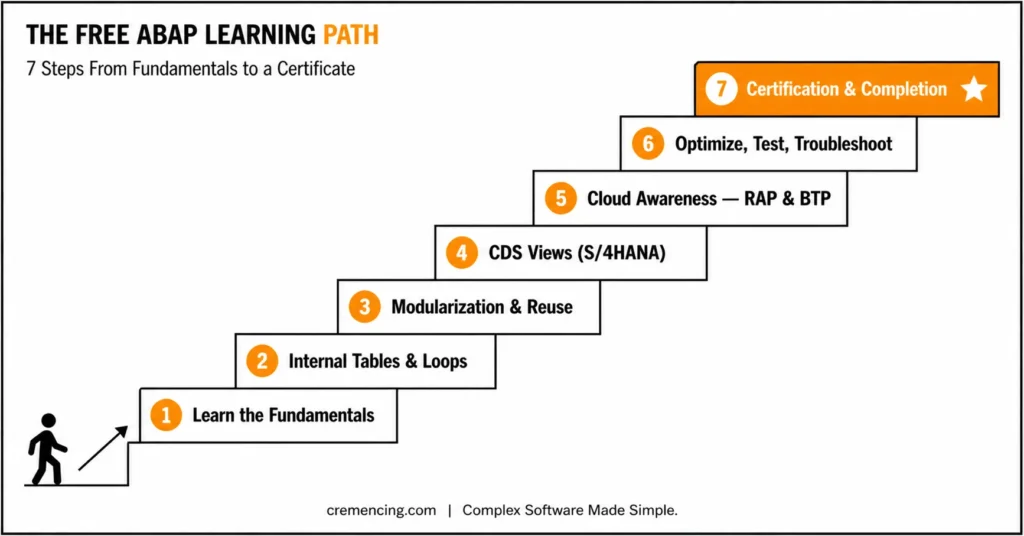
Step 3 — Modularization and Reuse
FORM display_material USING p_matnr TYPE mara-matnr.
DATA lv_desc TYPE makt-maktx.
SELECT A SINGLE maktx FROM makt INTO lv_desc WHERE matnr = p_matnr.
WRITE: / ‘Material:’, p_matnr, ‘Description:’, lv_desc.
ENDFORM.
CALL FUNCTION ‘Z_DISPLAY_MATERIAL’.
- First, Use FORM, FUNCTION MODULES, and INCLUDE programs
- Additionally, Encourages reusable, maintainable code
- Consequently, Simplifies debugging and reduces code duplication
Step 4 of the Free SAP ABAP Course: CDS Views
@AbapCatalog.sqlViewName: ‘ZCDS_MATERIAL’
#CHECK: @AccessControl.authorizationCheck
define view Z_CDS_MATERIAL as select from mara
{
key number,
maktx
}
- Specifically, Provides semantic layers, access control, and analytics readiness
- Next, Learn annotations, SQL view names, and authorization checks
- Notably, Required for S/4HANA 2022+ projects
- For analytics, use CDS views instead of many older SELECT statements.
Cloud Awareness with RAP and ABAP (Step 5)
- First, Learn RAP behavior definitions and service bindings
- Additionally, BTP lets you create Fiori apps side-by-side.
- Furthermore, Integrate ABAP with Python/Java microservices for cloud orchestration
- Ultimately, teaches novices how to use modern enterprise-scale SAP applications
Optimizing, Testing, and Troubleshooting (Step 6)
- SE16/SE16N: Validate SELECT results
- SM37: Keep an eye on batch jobs
- ST05/ST22: Trace SQL and analyze dumps
- Using ABAP Trace and SE24/SE30 to debug
- Finally, Optimize loops and SELECT statements for performance efficiency
- Tip: Test code in both ECC and S/4HANA to ensure compatibility.
Certification & Course Completion (Step 7)
- Notably, Digital certificates are available through free courses like openSAP ABAP Programming for SAP S/4HANA.
- Duration: 4–8 weeks, ~3–5 hours/week
- No fees for basic certification; optional paid certificates for enhanced recognition
- Therefore, Completing the course shows commitment to learning and practical ABAP skills
Before investing in SAP certification, learn what certifications, preparation paths, and practical ABAP skills can make a real difference in your career. ABAP Certification Course Guide 2026
How to Verify Your Skills
- Test queries using SE16/SE16N
- Validate modularization and syntax in SE80 or Eclipse ADT
- Monitor jobs via SM37
- Use ABAP Trace or SE24/SE30 to step through code
- Compare ECC vs S/4HANA execution for version-specific issues
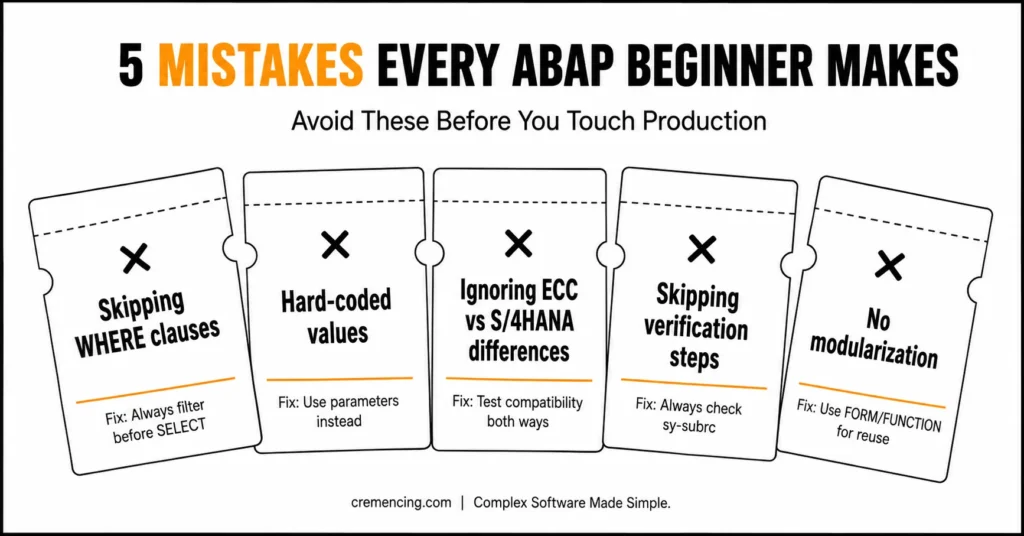
Mistakes Made by Beginners
- retrieving unnecessary rows by skipping the WHERE clauses
- Using hard-coded values instead of parameters
- ignoring differences between ECC/S/4HANA
- omitting steps for verification and debugging
- Not using modularization, which makes code difficult to maintain
Conclusion
Learn the intricacies of ECC and S/4HANA in addition to writing tested, production-ready ABAP code in this free online SAP ABAP course. Modern, marketable skills are guaranteed by mastering DATA declarations, SELECTs, loops, internal tables, modularization, CDS views, RAP, and ABAP Cloud integration.
Learning is accelerated, beginner mistakes are avoided, and learners are prepared for hybrid SAP projects when hands-on practice, digital certification, and community resources are combined. Learners are placed for long-term advancement in SAP modernization initiatives, gain access to cloud and Fiori development opportunities, and improve their career credibility by following this roadmap. Explore this free SAP ABAP course to learn practical development skills, build real experience, and understand concepts employers value. Free SAP ABAP Course Online With Certificate: Build Real Skills That Employers
Frequently Asked Questions
Free online SAP ABAP course?
Free courses like openSAP provide hands-on ABAP training with certificates recognized by employers.
ABAP online training certificate?
Certificates are issued digitally after course completion and demonstrate verified skills.
SAP ABAP training online free?
Covers ABAP basics, ECC/S/4HANA differences, CDS views, and RAP services without cost.
SAP ABAP course duration and fees?
Most free courses run 4–8 weeks with 3–5 hours/week, fully free for beginners.
How to start ABAP online?
Start with SELECTs, loops, WRITE statements, and modularization, then progress to CDS views and RAP.