Why Hidden Data Issues Can Slow Down Your SAP System
In most organizations, SAP performance problems don’t arise from slow hardware or bad infrastructure choices.
They start quietly—inside memory.
As it matures, SAP systems tend to stockpile gigantic quantities of historical data: closed transactions, aged financial documents, completed logistics records, and old operational data often not accessed but still taking up expensive HANA memory.
Leaders green-light S/4HANA investments for speed, agility, and reduced cost of ownership. Instead, lots of businesses see their infrastructure costs going up and their performance going down while facing a reportedly ever-increasing “Data Inconsistency”.
The real issue, of course, is not generally considered: Unmanaged historical data.
And right here is where SAP data aging can become a strategic lever — not merely a technical task. As part of our progressive suite of Data Management and Archiving Solutions, when the solution is implemented in the right way, SAP System Data Aging can provide you with up to 40% reduction on memory costs, boost system performance, plug critical visibility gaps within data, and without sacrificing access to your business-critical history.
What Is SAP Data Aging?
SAP Data Aging is inherent to S/4HANA, and enables the system’s ability to neatly divide and temporarily migrate frequently accessed (“hot”) data from infrequently accessed historical data (“cold”), while maintaining access to both separately.
SAP data aging, rather than deleting or archiving the business-relevant information, SAP processing is used:
- Transitions older transactional data to lower-cost storage layers
- Frees up expensive in-memory space
- Ensures that users have continued access for reporting, audit, and compliance purposes
- Maintains the integrity of information across your enterprise
In brief, SAP data archiving enables companies to maximize memory storage capacity without sacrificing business knowledge.
Why Leaders Should Pay Attention to Historical Data Management
SAP Data Cleanup is generally seen as a technical optimisation activity. That’s a mistake.
For IT leaders and CIOs, this means:
- HANA infrastructure costs
- System performance and user experience
- Scalability of S/4HANA
- Audit readiness and compliance
- Data-driven decision-making
Without a data aging strategy, companies are paying premium rates to store data that they never access and grapple with less than satisfactory performance and incomplete analytical pictures.
SAP Data Aging: Reducing Memory Costs up to 40%
The cost of being “always-hot” data explained
S/4HANA is an in-memory database. Memory is fast—but expensive.
How about when historic data will never age out of hot memory?
- Costs are rising for infrastructure every year
- Scaling requires additional HANA memory
- Performance degrades as datasets grow
- Maintenance is eating into IT budgets instead of advancement
SAP S4 HANA Data Aging Can Resolve This By Correlating The Temperature Of Data To Business Volume.
How SAP Handles Hot and Cold Data in Practice
SAP System Data Aging categorizes database content in logical layers:
- Hot data – In-memory state of actively used operational data
- Hot data – Data that is sometimes accessed but not queryable anymore ( performs with reasonable speed )
- Cold data – This cold the historical data is kept on cheaper disk storage.
End users will not even know a change is occuring. Reports,queries and audits keep on running – without making organizations have everything in memory.
This alone can lead to a 30-40% drop in HANA-memory requirement (depending on the data volume and business process).
Data Aging vs Archiving: What Executives Need to Know
Here is an article to help you understand the difference between data aging and data archiving There commonly seems to be a misunderstanding about what is data aging and what his data archive. They are not.
Traditional Archiving
- Takes data off the current system
- Requires separate access tools
- Often limits reporting and analysis
- Introduces audit and compliance complexity
SAP Data Aging
- Keeps data online and accessible
- Preserves reporting continuity
- Supports compliance and audits
- Optimises cost without sacrificing insight
SAP System Data Aging is the happy medium for companies who seek performance and transparency.
Filling in Missing Information with SAP Data Aging
The risk of a broken data chain
When institutions are heavily dependent on archiving or external data stores, they build a big gap in their data:
- Incomplete historical reporting
- Inconsistent financial views
- Reduced confidence in analytics
- Manual reconciliation during audits
A concept like the SAP® specific data aging prevents precisely this kind of unwanted situation by maintaining the historical data logicallyembellish to operational datasets.
Executives gain:
- End-to-end visibility across time periods
- Consistent financial and operational reporting
- quicker retrievals during audits and inquiries
- Higher confidence in enterprise analytics
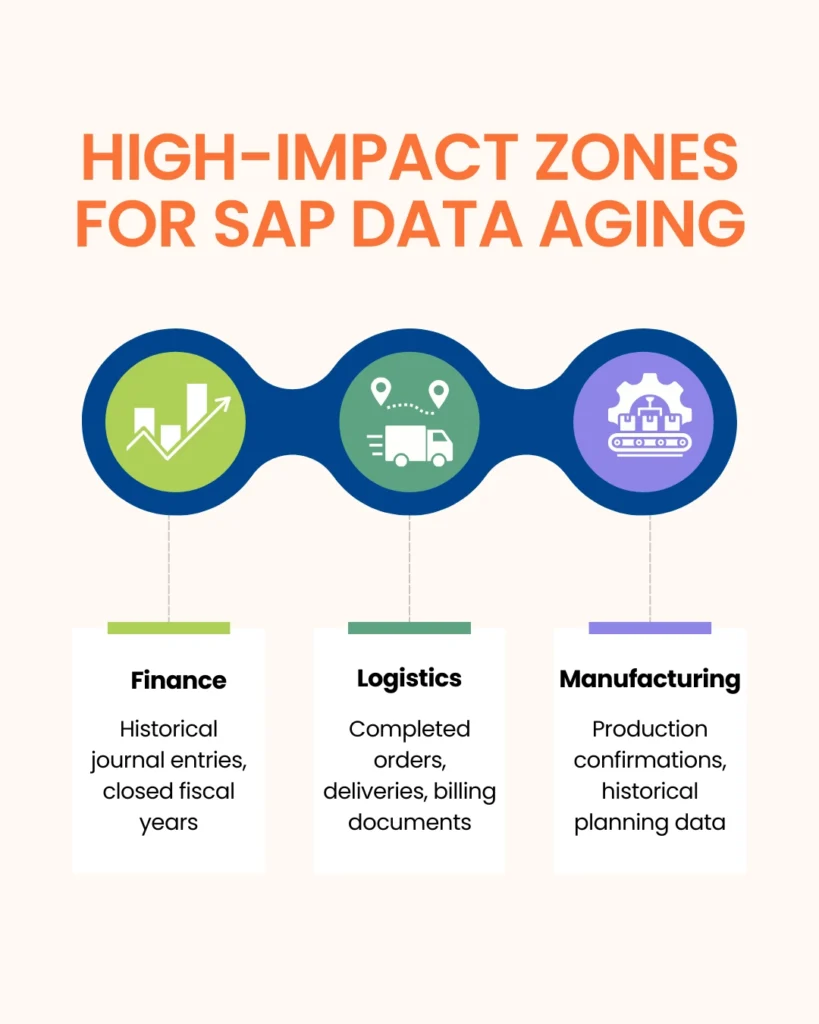
Where Data Aging with SAP Brings the Most Benefits
SAP Data Lifecycle Management is especially effective in high volume zones like:
Finance (FI/CO)
- Closed fiscal years
- Historical journal entries
- Cleared documents
Logistics (MM/SD)
- Completed purchase orders
- Historical deliveries
- Billing documents
Manufacturing
- Production confirmations
- Historical planning data
In both scenarios essential history is on deck – without clogging up premium memory.
Why SAP Data Cleanup Should Matter to You After Your S/4HANA Migration
Most organizations defer data aging decisions until post-golive. That delay is costly.
Post-migration realities include:
- Rapid data growth
- Increased reporting demands
- Rising infrastructure costs
- Performance degradation over time
Without SAP Data Lifecycle Management:
- Price per Year more than the last one
- Scaling S/4HANA requires disproportionate investment
- Performance issues across several business units are on the rise
Data aging turns S/4HANA from a cost driver into a digital and scalable core.
Typical Errors Businesses Make with SAP Data Aging
Considering It a One-Time Cleanup
SAP Data Lifecycle Management is not a one-time operation. It needs to be part of data lifecycle governance.
Ignoring Business Ownership
Ageing data decisions can have impacts on both reporting, compliance and analytics.
Business stakeholders have to be brought in — not just IT.
Aging Data Without Strategy
Aging data blindly can lead to confusion.
Healthy organizations establish clear rules based upon value to the business and regulation.
SAP Data Cleanup Strategic - The CIO way to do it!
Step 1: Get to Know Your Data Growth Characteristic
Identify:
- High-volume tables
- Rarely accessed historical data
- Memory consumption drivers
Step 2: Establish Business-Driven Ageing Policies
Align data aging rules with:
- Reporting needs
- Audit requirements
- Regulatory retention policies
Step 3: Merge Data Aging with SAP Governance
Data aging should be part of:
- SAP lifecycle management
- Performance optimisation strategy
- Cost governance frameworks
Step 4: Measure Impact Continuously
Track:
- Memory reduction
- Performance improvement
- Cost savings
- Reporting effectiveness
The ROI and strategic impact of SAP Data Lifecycle Management
Successful SAP Data Lifecycle Management drives measurable results – when done right:
- HANA Memory Costs reduced by 40% PORTFOLIO/PRICING HIGHLIGHTS Save up to 40% on HANA memory costs
- Faster system response times
- Lower infrastructure scaling requirements
- Improved reporting confidence
- Reduced audit preparation effort
For leaders, this is about taking money out of maintenance and putting it back into innovation.”
SAP Data Aging – A Business Decision in a Technical Suit?
SAP Data Archiving is not about housekeeping.
It’s really about cost discipline, performance and trust of data.
In today’s world of continual SAP cost scrutiny, the companies that ignore data aging overpay in silence — those who take it on strategically extract tangible value.
S/4HANA was intended to go fast. That’s the beauty of SAP data aging it stays fast and cost-efficient as time goes on
Resources
SAP official guide on data aging in S/4HANA