Companies are spending billions on SAP every year, yet success seems to be out of reach.
Projects are stalled, cost overruns escalate, and the business value often fails to materialize for years. The culprit is rarely technology. It is not clear on readiness for digital and sequencing a road map.
Here is how SAP Digitalization combines with the FLASH Framework. Through a deliberate strategy for SAP Digital Transformation, in collaboration with a rapid, structured assessment process, organizations can develop an implementation plan that produces quantifiable results and avoids any shooting in the dark.
SAP Digitalization is transforming how enterprises manage processes, optimize resources, and accelerate innovation. In this post, we will learn how the FLASH Framework can be used to lead your SAP Digitalization journey, align leadership, and deliver business value sooner.
Why Your SAP Digital Transformation Requires More Than Just Projects
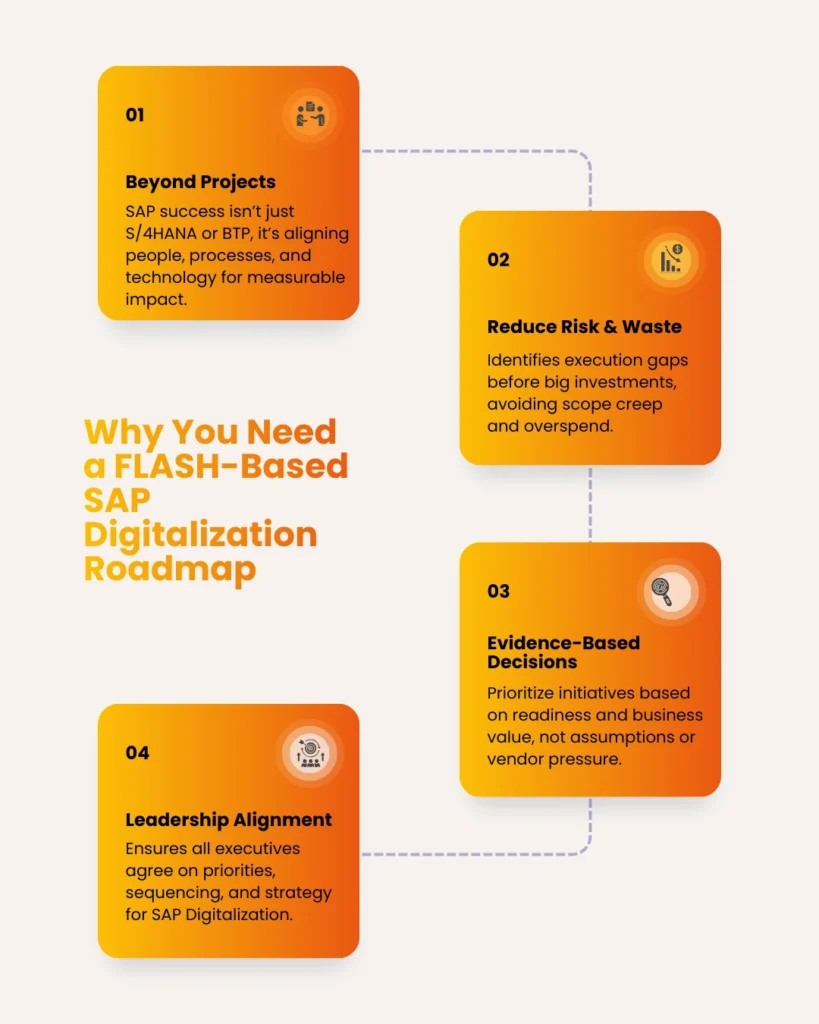
SAP Digitalization is not just about migrating to S/4HANA, subscribing to BTP extensions, or implementing analytics tools. It is the alignment of people, processes, and technology standards to achieve predictably effective business results.
Without a roadmap:
- Initiatives jostle for attention and cash
- Teams are focused on activity, not impact.
- Strategic aims either get postponed or are watered down
A well-planned roadmap that is built on the FLASH Framework will guide your SAP digital transformation initiatives with a sense of purpose, instead of sequencing and risk consciousness.
What Is the FLASH Framework?
The FLASH framework for the experienced SAP consultant is a best practice approach to evaluating digital readiness across eight key aspects. It gives decision makers a fast, data-driven look at where the organization is and what must change before they write that check.
The FLASH framework is intended to be
- Rapid – Rapidly deliver actionable insights
- Focused – Focus on the dimensions of success
- Real-world—Make results easily digestible by those in the C-Suite
FLASH is designed to assist your organization focus on specific points that will enable the adoption of SAP Digitalization initiatives.
How Does FLASH Support SAP Digitalization?
Digitalizing is about enabling technology and changing the way of working. Although, FLASH addresses both by assessing preparedness on multiple dimensions that will influence execution.
Benefits include:
- Early identification of potential pitfalls disrupting the execution of SAP Digitalization
- IT and business priorities in sync
- Evidence-based sequencing of investments
- Lower risk of scope creep and spend squandering
As a result With FLASH, SAP Digitalization goes from a bunch of disjointed projects to a strategic and measurable transformation.
The 8 Dimensions of SAP Digital Transformation in the FLASH Technique
Now let’s deconstruct the 8 dimensions of the FLASH Framework in relation to SAP Digitalization.
Strategy and Business Alignment
The work of digitalization begins with a clear intent.
- Is there a direct connection between SAP projects and your strategic business goals?
- Is the senior management sponsor engaged and sustained?
- Is there a joint vision across all business units with regard to SAP Digitalization?
First Measure: Volume of initiatives with specific business implications, level of ownership across the organization, how well projects align with corporate KPIs.
Process Maturity and Standardization
SAP Digitalization doesn’t work without process preparedness.
- Is the core process standardized or decentralized?
- How disciplined is process governance?
- Is that something we should customize or is it designed to be that way?
Second Measure: Hence numberof process variants, adherence to standard prprocesses, andmount of exceptions.
Clean Core and Extension Strategy
Custom development is supposed to make the SAP kernel better, not worse.
- How well are the boundaries of core vs extension managed?
- Are BTP and side-by-side extensions being used strategically?
- Is upgrade readiness maintained?
Third Measure: % of critical extensions outside the core, documented patterns, and technical debt warnings.
Architecture and Integration Readiness
SAP Digitalization relies on a well-working integration backbone.
- Are integrations standardized and reliable?
- Are APIs leveraged consistently?
- Is system dependency visibility maintained?
Fourth Measure: API usage numbers, integration stability, and ratio of manual vs automated processes.
Data, Analytics, and Insight Enablement
- Is data ownership and governance well-defined?
- Do analytics support decisions at the executive level?
- Is master data quality sufficient?
Fifth Measure: Data quality KPIs, executive satisfaction with reporting, and analytics adoption rates.
Operating Model and Capability Readiness
Technology is only successful when the organization is prepared.
- Are SAP roles clearly defined?
- Are internal resources adequate, or are you depending too heavily on third-party vendors?
- Do you have any change management and adoption plans in place?
What to measure today: Skills gap assessment, role clarity score, training coverage metrics.
Governance and Portfolio Management
Well-governed is good decision-making.
- Is the question of who does what clear in SAP projects?
- Is portfolio prioritization disciplined?
- Are escalation paths defined?
Measure of today: Time to key decision, alignment of the portfolio with strategy, and number of governance overlaps.
Commercial and Licensing Awareness
The financial and contractual complexity of SAP Digitalization.
- Is there awareness of its licensing and commercial implications?
- Do technical choices line up with contracts and expenses?
- Are newly discovered commercial exposures being monitored?
What to measure today: Licensing compliance, the degree of technical and budget alignment, and the frequency of unplanned costs.
Create your roadmap to SAP Digitalization with FLASH
When you have rated your level of readiness for the eight dimensions, the pathway will be clear:
- Find the Holes: Dim scores to indicate where key weaknesses are.
- Rank Initiatives: Order initiatives based upon readiness and business impact.
- Risk Reduction: Target high-risk areas before large investments are made.
- Align Leadership: Achieve company-wide executive agreement using insights from FLASH.
- Monitor Progress: Review periodically to make sure that your roadmap is realistic and working.
Meanwhile, this methodology shifts SAP Technology Modernization from a project list to a strategic, risk-managed program.
Common Mistakes FLASH Prevents
Yet the over-reliance on digital as a technical project is very often where executives trip up. FLASH prevents common pitfalls:
- crowded SAP roadmaps without capability readiness
- Disregarding risks of process, governance, or adoption
- Making strategic assumptions without evidence
- Misaligning IT and business priorities
By offering a prescriptive, quantifiable assessment framework, FLASH makes certain that SAP Digitalization is strategic, actionable, and value-based.
For more insights, read our blog Why your SAP Upgrade is Green
Why SAP Digitalization With FLASH Is Important Today
Business churn has intensified. Cloud migration, AI, and integration complexity mean digital readiness has never been more important.
FLASH allows enterprises to:
- Make faster, evidence-based decisions
- Minimize disruption during transformation
- Get leadership on the same page about priorities and sequencing
- Safeguard SAP investments against risk and waste
This turns SAP Digitalization from an aspirational goal to tangible business value.
Final Reflections: On Evaluation and Intervention
To sum up, SAP Digitalization is a voyage, not an assignment. Furthermore, the success of that ride is called realistic evaluation, so that planned organisation and measurable performance.
Furthermore, the FLASH Framework offers the transparency leaders require to prioritize, sequence, and govern investment initiatives that mitigate risk while maximizing value.
Overall, by utilizing FLASH today, your SAP Digitalization roadmap is transformed into a predictive, actionable path that is tied to business strategy, not a list of projects. If you’re ready to take the next step in your digital transformation journey, connect with Cremencing today. Together, we’ll explore tailored solutions that drive efficiency, innovation, and growth.