Companies don’t fail their enterprise SAP deployments due to technology. They failed because leadership thought they were ready when they weren’t. Not a great thing to do in some cases, but lots of CIOs have signed off on multi-million-dollar SAP programs composed purely of system inventories, project plans, and vendor promises. But months later, the organisation is mired in delays, overruns and slow adoptionas well as several new risks.
Running a SAP Digital Maturity Assessment, also called a SAP Maturity Model Assessment, helps organisations benchmark readiness, optimise processes, and predict transformation success. The missing piece? An SAP Digital Maturity Assessment that extends far beyond checklists and actually forecasts results.
The most successful SAP Digital Maturity Assessments are a leveraging point, not an autopsy report. It informs executives on whether their company is actually prepared for modernisation, where risks lie hidden and which investments will realise tangible business value.
This blog explains how C-level executives can trust a SAP Maturity Model Assessment that guides strategy, safeguards investment and raises the odds of successful transformation.
Why the Vast Majority of SAP Digital Maturity Assessments Fail
On paper, the idea of digital maturity is simple: Do an inventory and assessment of systems, processes and capabilities, then give yourself a score. In reality, many evaluations end in failure because what is being evaluated is technical readiness rather than organisational reality.
Common issues include:
- Too much focus on the OS version and the module list
- One-size-fits-all scoring models not tied to business objectives
- No relationship between maturity discoveries and execution risk
- Tests designed for architects, not executives
And therefore, leaders are served a polished document but have little idea whether their SAP agenda will actually work.
Building a Relevant SAP Digital Maturity Assessment
The type of relevant questions an assessment provides context for:
1) Executive-Level Questions
Any reusable set of line-of-business-oriented process-based content should answer for the very top level in your customer or prospect organisation.
- Are We Spending on the Correct SAP Projects When Timing Is Critical?
- What are the hazards that could upend our roadmap before we’ve even begun?
- What will be our competitive distinguishing capabilities?
- Where should we modernise now, and where should we wait?
If your evaluation doesn’t address these questions, it’s not going to predict success.
The Relevance of SAP Digital Maturity at the C-Level
Digital maturity is not an IT matter anymore. It is a business function that has immediate/direct hits on cost structure, agility, resilience and growth.
The SAP Digital Maturity Assessment drives value for CIOs and owners of SAP transformation by:
Strategic Investment Decisions
SAP projects vie for capital alongside M&A, market penetration and product development. 2020 will be a time for leaders to determine exactly what SAP investments offer strategic leverage not just technical compliance.
Risk Management
Whether for S/4HANA migrations, BTP extensions, and more, the lack of maturity consistency amplifies the risk of operational disruption, security exposure, and upgrade exposure.
Time-to-Value
Digital maturity is what makes the difference between value from SAP programs in months, or having them run into the sand for a few years because they are all about rework and change management.
Organisational Confidence
Executives and boards are also becoming skeptical of large ERP programs. A trustworthy maturity assessment breeds confidence and governance alignment.
Simply put, SAP digital maturity is how well your business leverages your SAP spend for business success.
What “Good” is: A redefinition of SAP Digital Maturity
Before you start a SAP Digital Maturity Assessment, it’s very important to change what maturity really means.
Digital maturity is not:
- Being fully migrated to S/4HANA
- Using the latest SAP modules
- Eliminating all custom code
- Moving everything to the cloud
Real digital maturity of an SAP organisation is determined by its capability to:
- Tailor SAP to industry-specific business models
- Innovate without destabilising the core
- Scale capabilities efficiently
- Reasonable trade-offs between standardisation and variation
A mature SAP organisation does not look modern on paper; it’s the most deliberate in utilising technology to drive strategy. For more insights, read our blog on SAP Flash Assessment
Key Aspects of a Prospective SAP Digital Maturity Assessment
A future-proof SAP Digital Maturity Assessment would then need to assess maturity from numerous interconnected angles if it is to predict success. Each of them, ignored on its own, produces a blind spot.
Business Alignment and Strategic Intent
The first question isn’t technical; it’s strategic.
- Is SAP-related work well aligned to the business?
- Isthe corporate planning strategy consistent with the operating model and the SAP roadmap?
- Is there a common understanding of success between the executives?
Low maturity often manifests itself in broken priorities, conflicting KPIs and SAP programs driven by urgency rather than value.
A robust assessment will determine whether SAP is a strategic platform or simply a transactional system.
Process Standardisation vs. Differentiation
SAP Process Decisions – The Magic Ingredient that Execs Forget That often gets lost on the top guys and gals.
Key maturity signals include:
- When to standardise vs. customise guidelines? Limited guidance on this.
- Consistent global process ownership
- Willingness to challenge historical practices
Low-maturity organisations customise without thinking. The most mature organisations customise with purpose, where variation creates a business outcome that can be measured.
A valid SAP Digital Maturity Assessment reveals how “process debt” will hinder scale, and what “differentiation” is worth defending.
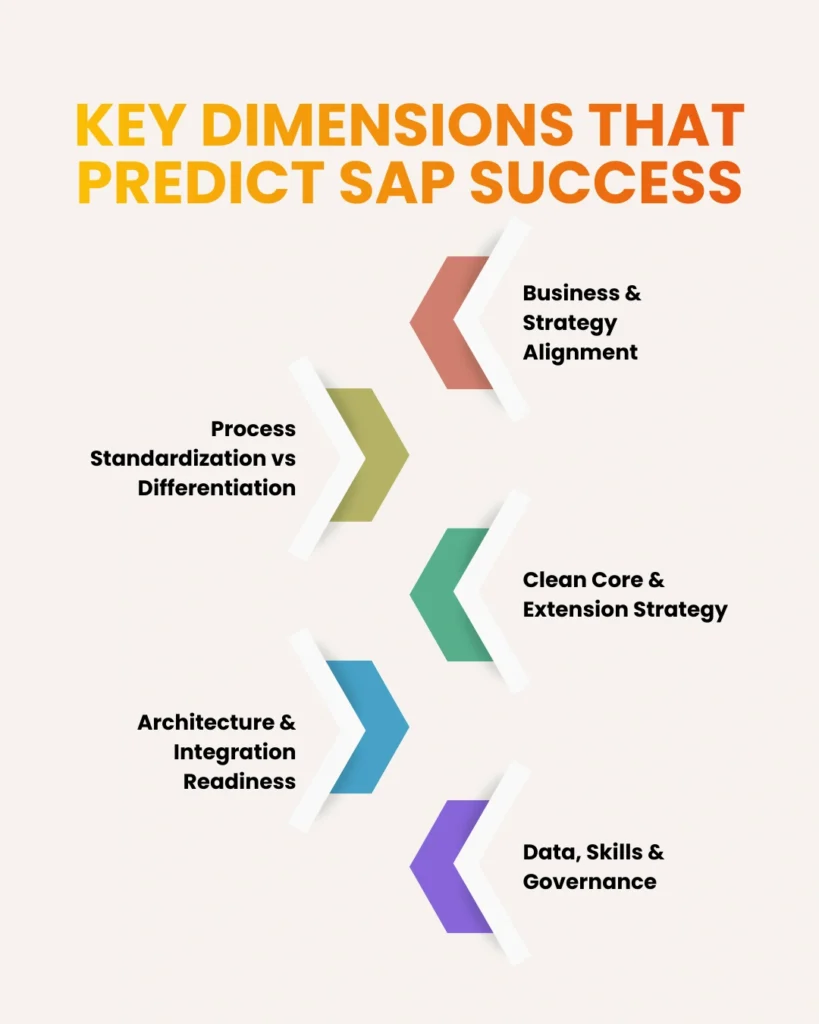
Clean Core and Extension Strategy
Clean Core is a concept that many people don’t understand, one of the SAP mysteries!
Maturity isn’t the elimination of custom development, per se – it’s about managing edges.
Your assessment should evaluate:
- How extensions get built and governed
- When and how BTP is used strategically or tactually
- Readiness for Modernisation and Technical Debt Exposure
Without this clarity, companies either overspecialise and wreak havoc or overgeneralise and lose competitive flexibility. You take the predictive SAP Digital Maturity Assessment to see if your clean core strategy can enable long-term agility.
Architecture and Integration Readiness
SAP Landscapes these days are not monoliths; they are more or less ecosystems.
Maturity indicators include:
- API-first integration patterns
- Clear ownership of integration platforms
- Consistent data governance models
Low integration maturity results in fragile architectures, hard-coded dependencies, and slow innovation cycles.
Moreover, Executives must have a clear view of how today’s architecture decisions affect the future scalability, acquisitions and digital initiatives.
Data, Analytics, and Decision Enablement
Many overstate how mature their data is until leadership demands answers and can’t get them.
A strong assessment of SAP Digital Maturity looks at:
- Data ownership and accountability
- Master data governance effectiveness
- Analytics as part of executive decision-making requirements
Mature organisations are designing their SAP data models to accommodate decision velocity, not just reporting accuracy. In simple words, this is because the aspect has a direct impact on forecasting, risk management, and confidence among executives in the insights.
Operating Model and Skills Readiness
Technical Maturity w/o Organisational Maturity is a Mirage.
Key questions include:
- Do SAP roles map to the future way of working?
- Is the organisation too dependent on outsourced services?
- Do delivery plans incorporate change, training and adoption?
A forward-looking SAP Digital Maturity Assessment reveals capability gaps that lead to slow delivery long after go-live.
Governance, Portfolio, and Commercial Discipline
SAP investment collaboration or collision? Here are the questions to ask your C-suite. Governance maturity determines if SAP investments add – or detract
Assessment areas include:
- Portfolio prioritisation discipline
- Decision rights clarity
- Licensing and commercial awareness
Many organisations have found, too late for damage limitation, that ‘technical decisions’ had created commercial constraints in the long term.
G-Organisations (mature ones) have a clear idea about how their governance decisions affect their technical as well as financial results.
Transforming Feedback Into Predictive Alerts
The “value” of a SAP Digital Maturity Assessment is not in the score, but in the interpretation.
Executives don’t need another heatmap. They are seeking answers to questions such as:
- Which options are high risk in terms of current maturity?
- Where will its operation suddenly become inefficient?
- What competencies will create the foundation for future growth?
To be predictive, assessments must:
- Highlight dependency risks across dimensions
- Show trade-offs, not absolutes
- Tie the maturity gaps to their financial and operational consequences
Turning maturity insights into decision scenarios gives leaders confidence to act.
Common Executive Mistakes to Avoid
Even well-intentioned leaders screw up maturity assessments by:
- Treating them as one-time exercises
- Delegating ownership entirely to IT
- Ignoring uncomfortable findings
- Rushing to solutions before alignment
A SAP Digital Maturity Assessment should be used to guide the sequence in which you make changes, not explain why your pre-determined change plan is right.
How frequently to run a SAP digital maturity assessment?
Digital maturity is not static.
Moreover, organisations should reassess maturity:
- Before major SAP investments
- After a significant organisational change
- When business strategy shifts
- Before platform changes or cloud migrations
Best-in-class companies consider maturity assessment a continuous management discipline, not a milestone in a project.
Final Thoughts:
You can learn more about predicting your business success , starting with honest self-insight. A SAP Digital Maturity Assessment should not give you the answers you want to hear. It should give you what you need to know before cost, complexity and risk spiral out of control.
Maturity assessment is no longer a matter of choice for CIOs and SAP transformation owners. It provides the basis for responsible investments, credible roadmaps and sustainable value creation.
Overall, organisations that are successful with SAP aren’t those with the most money or the newest technology. They are the ones who really know when they’ve grown up and behave accordingly.
If you’re ready to take the next step in your digital transformation journey, connect with Cremencing today. Together, we’ll explore tailored solutions that drive efficiency, innovation, and growth.