Introduction:
Why Digital Maturity Matters
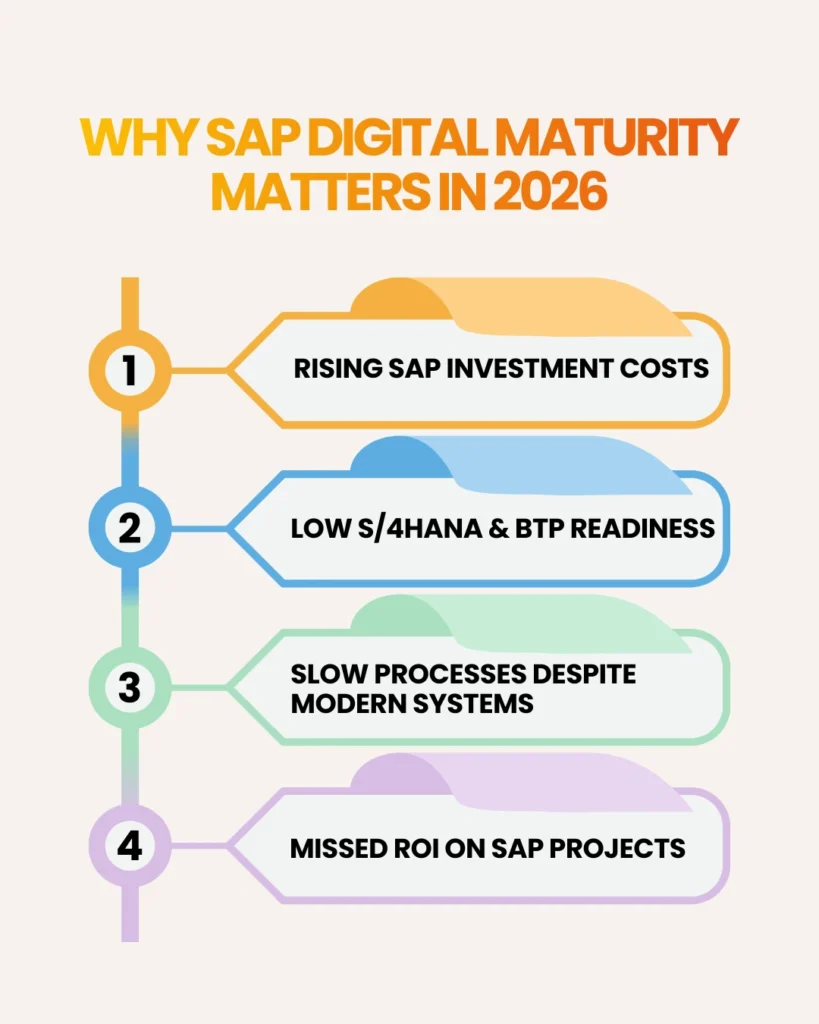
Are you getting the most out of your SAP investment? To begin with, S/4HANA, SAP BTP, and analytics are major beneficiaries of enterprise investments, but scores for readiness remain low. Furthermore, once you know where you are at a simple, sophisticated, or advanced level in terms of your SAP digital maturity. In addition to that, the last thing an organisation wants is to be wasting money and time in inappropriate areas.
Moreover, the SAP Digital Maturity Framework allows clients’ leadership teams to do a quick health check of their SAP landscape. Leverage a FLASH Assessment to reveal gaps or risk and focus on efforts that create real business value.
In 2026, digital fitness is not an elective; it’s essential to strategic differentiation. Organizations that don’t evaluate and optimize their SAP environment are subject to inefficiencies, higher costs, and a lost competitive edge. By applying the SAP Enterprise Maturity Model, companies can benchmark their processes and identify gaps in digital maturity.
This is the SAP Digital Where your people, processes, and technology are aligned and integrated. Furthermore, it paves the way for improved decision-making, more disciplined governance, and quantifiable ROI on your SAP investments.
What is meant by Digital SAP Maturity?
Therefore is also a lot more than adopting the latest technology. It’s the extent to which your company is mastering the use of SAP to achieve business goals.
An SAP landscape with decades of experience also has a lot going for it:
- Operational Efficiency: Streamline procedures to eliminate manual work and errors.
- Better Decisions: complete analytics at the right time – Act now on true insight.
- Business-IT Alignment: IT projects are aligned with business objectives.
- Risk Prevention: Governance and compliance gaps are proactively identified and remediated.
A FLASH Assessment is a quick, actionable look at your SAP landscape. Because of this, it gives a ‘snapshot’ of what’s good and not so good, at different levels, to inform leaders as they plan for change.
Therefore, SAP Enterprise Maturity Model also enables managers to focus effectively on different measures. For instance, a company could discover that even though it technically has an up-to-date S/4HANA system, as a result, slow procurement is preventing the shop from running at full speed. Moreover, A big picture vision also enables leadership to block out shiny objects and focus on high-impact projects first.
What is the SAP Digital Maturity Framework?
The SAP Digital Maturity Framework is a method to measure how ready an organization is for SAP usage. It’s designed to help organizations evaluate where they are today, identify gaps, and create a path toward improvement.
SAP Digital Maturity Framework at a Glance
What do you mean by SAP Digital Maturity Framework?
The SAP Digital Maturity (DDE) is a measure of an organization’s readiness for SAP. It allows organizations to understand where they are today, what the gaps are, and plan a road map for improvement.
The tool will evaluate your organization on many levels to provide you with a snapshot of SAP maturity.
Here are some of the key goals that we’re striving for with the framework:
- Pinpoint Shortfalls: Determine the gaps or deficiencies in strategy, governance, and technology.
- Prioritisation actions: Allocate resources to the project which of greatest business value.
- Align IT and Business: Ensure your SAP projects are aligned with your company’s goals.
The blueprint is particularly advantageous for organizations contemplating moving to S/4HANA, adopting SAP BTP, or executing enterprise-wide modernization projects.
Using the SAP Enterprise Maturity Model can help executives see what they need to tackle now and what they can iterate on over time. It delivers the “best of” value, speed, and priority alignment for investments in SAP.
Key Dimensions of the SAP Digital Maturity Framework
The SAP Digital Maturity Framework measures five fundamental dimensions that build the foundation to gain transparency across your SAP landscape.
Strategy & Vision
And a solid SAP strategy starts at the top. “Companies need to link SAP initiatives more closely with business goals, create tangible KPIs, and have the support of senior leadership.”
Key considerations include:
- Business Strategy Alignment: SAP projects shall be aligned with the corporate vision and growth plans.
- KPI definition: Define measurable targets for success.
- Leadership Commitment: Placing your bet on transformation starts with the executive team.
Semantic keywords: Readiness for SAP transformation, enterprise SAP strategy
Example: A manufacturing organization might define its SAP strategy to streamline supply chain operations, lower expenses, and speed time-to-delivery of products. SAP initiatives support these objectives and, in doing so, give management the guarantee that IT investments result in tangible business value.
Processes & Governance
Process and governance maturity lie at the core of SAP maturity. Companies need to assess end-to-end process effectiveness and enforce appropriate governance.
Key areas include:
- Process Efficiency: Recognize where there are bottlenecks, repetitiveness, or inefficiencies.
- Adherence: Confirmed that adherence to both external and internal requirements is maintained.
- Automation Avenues: Letting SAP tools work for you to automate common tasks.
Semantic Keywords: SAP Process Improvement, Governance, and Compliance in SAP
Example: A retail business might find that its order-to-cash process is time-consuming and that delayed billings result. Through process analysis and automation, it can help streamline operations, reduce errors, and improve cash flow.
Technology & Architecture
A well-timed technical and architectural foundation. The stable SAP environment is built on sound technology and good architecture. System performance, integration potentials, and modernization requirements that agencies must evaluate.
Key considerations:
- Review system: Assess S/4HANA, BTP, and cloud offerings.
- Consolidation: Systems integration, Be sure that all the systems are connected together seamlessly.
- Technical Debt & Modernization: The discovery of legacy systems and an upgrade plan.
Minimizing Impact: Planning for the Upgrade. The whole point of discussing a software implementation or any other kind of system changes is to make sure that everything continues to operate as it should.
Use case: In practice, A business discovers it has installed S/4HANA, but there are several legacy systems that are not well-connected. However, further integration moderation reduces redundant control data and minimizes redundancy between performed filtering operations.
People & Organization
People are vital to SAP maturity. Skills, roles, and training program evaluations need to be conducted by organizations to see that their resources are well-equipped to take advantage of SAP solutions.
Key considerations:
- EnTISE Skills Assessment: Assess the skills of IT and business teams.
- Training Needs: Establishes gaps and sources of further training.
- Job Alignment: Is there alignment between what needs to be done and the organizational goal?
Keywords: Semantic Spain and the Maei Technology Consulting Group 11-12 – words: Digital Adoption, Business-IT alignment
Example: A company can learn that its finance departments have not been fully trained with SAP Fiori apps. Focused instruction increases effectiveness, lowers errors, and improves utilization.
Data & Insights
To use it effectively, organizations must evaluate data governance, accessibility, and analytics capabilities.
These elements determine how reliably insights can be generated and acted upon.
Key considerations:
Data Quality: Keep data precise, reliable, and comprehensive.
Availability: Get the information into the hands of those making decisions on the ground when they need it.
Predictive Insights: Utilize analytics to anticipate and predict issues, and proactively act.
Example: A block of the logistics sector can predict demand and adjust inventory using predictive analytics. However, this should not only save money but also allow for better services.
Benefits of a FLASH Assessment
The FLASH Assessment is a quick, laser-focused evaluation of SAP digital readiness. Benefits include:
- Quickly Identify Gaps: Find strategy, governance, technology, and people gaps.
- Focus: Allocate resources to the most valuable projects.
- Benchmarking: Measure against norms or best practices.
- Fast-track decision-making: Improve the confidence to take faster decisions on SAP transformation.
Above all, this knowledge can also assist executives with prioritizing modernization initiatives, justifying monetary investments, and reducing operational risk.
How to do a FLASH Assessment
- Plan the Assessment – Engage the right audience members and determine primary drivers.
- Map Current Maturity – Comparison to the five dimensions of the success framework.
- Highlight Gaps – Note what is lacking or could be done better.
- Develop an Initial Plan of Action – Filter for the activities that give you clear results.
- Check Success – Gradually monitor progress to maintain success over the long term.
Conclusion
In conclusion, SAP digital maturity is something no company has the luxury of overlooking any longer. Ultimately, the SAP Digital Maturity Framework, coupled with a FLASH Assessment, provides executives with real-world, actionable insight into their capabilities and potential.
By reviewing your current SAP estate, you can:
- Minimize risks and prevent expensive pitfalls
- Match IT to business strategy
- Focus on high-value, high-impact projects
- Improve decision-making with real-time insights
Overall, do a FLASH Assessment, plot your digital maturity, and create an actionable transformation plan. It is about the future of your business: real and measurable results from your SAP investment.
If you’re ready to take the next step in your digital transformation journey, connect with Cremencing today. Together, we’ll explore tailored solutions that drive efficiency, innovation, and growth.