Poor SAP module scoping can add months of redesign and testing. Teams often select modules by department instead of mapping complete business processes first.
That approach creates gaps between finance, procurement, manufacturing, sales, and HR. Several modules may operate inside the same SAP environment while poor configuration still produces disconnected processes.
Learn about 10 critical SAP ERP modules such as SAP ERP MM, SAP ERP Financials, and SAP ERP HCM in this guide. The module map also explains how transactions move between modules and affect financial records. SAP architects, consultants, technical leads, and IT managers can use it to evaluate SAP ERP environments and plan their transition to SAP S/4HANA.
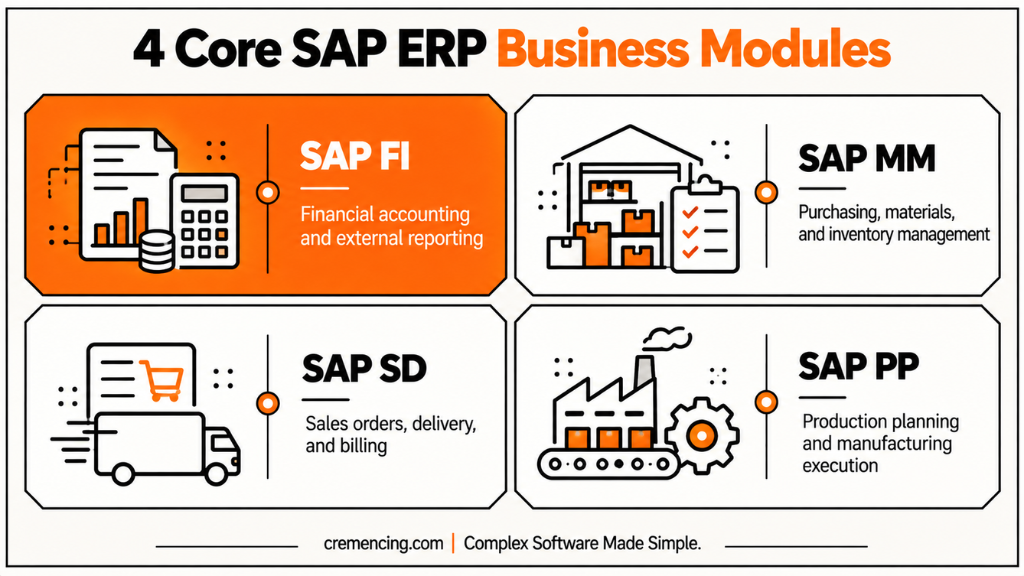
SAP ERP modules are business processes that comprise specific functions. FI is responsible for financial accounting, CO is responsible for internal costs, MM is responsible for procurement, and SD is responsible for sales. Extending SAP into production, quality, maintenance, projects, warehousing, and workforce management includes PP, QM, PM, PS, WM, and HCM.
What does SAP ERP module mean, and why is it important?
SAP ERP modules are functional components that are used for managing defined business processes in SAP ERP. The application logic, the organizational structures, master data, transactions, and reporting is included in each module.
The modules are not separate programs, though. They share master data, structure, and relationships between documents.
For example, a warehouse employee can enter a Goods receipt in the materials management module. This transaction affects the quantity of inventory and could create an automatic financial accounting document.
In Materials Management, an employee in a warehouse can post a goods receipt, for instance. That transaction will update the quantity of the inventory, and it can automatically generate a corresponding financial accounting document.
Master data forms a second layer of integration. You can have multiple views in a material master for the same material, such as purchasing, planning, sales, storage, and accounting views.
Then, operational activity is linked to general ledger accounts via automatic account determination. As a result, errors may occur in CO and FI if the valuation is wrong or the account is not set up correctly in MM.
What are the 10 modules of SAP ERP that Companies use?
The major SAP ERP modules are: FI, CO, MM, SD, PP, QM, PM, PS, WM and HCM. They work together to support finance and the primary operating processes across manufacturing, distribution, services, engineering and project-based businesses.
| # | Module | Full Name | Primary Function |
| 1 | FI | Financial Accounting | Ledger, payables, receivables, assets |
| 2 | CO | Controlling | Costs and profitability |
| 3 | MM | Materials Management | Procurement and inventory |
| 4 | SD | Sales and Distribution | Sales, delivery, and billing |
| 5 | PP | Production Planning | Manufacturing planning |
| 6 | QM | Quality Management | Inspection and quality |
| 7 | PM | Plant Maintenance | Equipment maintenance |
| 8 | PS | Project System | Project planning and costs |
| 9 | WM | Warehouse Management | Warehouse-bin processes |
| 10 | HCM | Human Capital Management | Personnel, time and payroll |
Companies rarely require every module. A distributor may depend mainly on FI, CO, MM, and SD. Manufacturers often add PP, QM, PM, and warehouse functionality.
The correct scope should therefore follow actual business processes rather than a standard module checklist.
SAP ERP Financials: How Do FI and CO Differ?
SAP ERP Financials uses FI for external accounting and CO for internal management accounting. Both receive data from operational processes, but they serve different reporting purposes.
1. SAP FI: Financial Accounting
SAP FI records transactions required for financial and statutory reporting. Its major components include general ledger accounting, accounts payable, accounts receivable, and asset accounting.
A vendor invoice can create a supplier liability and expense posting. Likewise, billing in SD can create revenue and customer receivables automatically.
SAP ERP 6.0 also supports parallel accounting through the New General Ledger. Organizations can configure different reporting requirements within their ledger structure.
Because logistics transactions frequently create accounting documents, FI sits at the financial end of many SAP processes.
2. SAP CO: Controlling
SAP CO supports internal cost and profitability analysis.
Cost Center Accounting tracks organizational costs. Internal Orders collect costs for specific activities. Product Costing calculates manufacturing costs, while Profitability Analysis evaluates contribution margins.
Operational modules feed CO automatically. Production orders collect manufacturing costs, maintenance orders receive repair costs, and project structures can collect project expenditure.
SAP S/4HANA changes this architecture through the Universal Journal, which brings financial and management accounting information into a more unified line-item model.
SAP ERP Logistics Modules
SAP ERP logistics modules control material and product flows. They link procurement, production, sales, quality, maintenance, projects, warehousing, and finance.
3. What is the use of SAP ERP MM?
SAP ERP MM is used for procurement, inventory management, valuation and invoice verification. A typical procure-to-pay process involves a purchase order, goods receipt and supplier invoice. Common transactions are ME21N, MIGO, and MIRO.
Goods receipt can be used to update physical stock and accounting values at the same time. Based on configuration, SAP can debit inventory and credit the goods receipt/invoice receipt clearing account.
Thus, the type of material, the valuation class, the type of movement, and the determination of the account go hand in hand with logistics and finance.
Clicking on this link will take you to the SAP MM procurement process: Purchase Requisition to Invoice Verification. Clicking on this link will take you to the next part of the SAP MM procurement process: Purchase Requisition to Invoice Verification.
4. SAP SD: Sales and Distribution
The order-to-cash process is controlled by SAP SD.
It performs operations such as sales orders, pricing, availability checking, deliveries, shipping, and billing. Values like base price, discount, freight, surcharge, and tax are based on the pricing conditions.
Delivery processing gets ready products for delivery. Post goods issue is used to decrease inventories, and billing is used to generate customer invoice.
Billing is integrated with FI. It can generate revenue, tax, and accounts receivable postings without any need for separate manual journals.
5. SAP PP – Plans and controls manufacturing.
Other key master data are bills of material, routings, work centers and production versions (if applicable). Material Requirements Planning translates the demand and available supply into proposals for procurement or production.
Production orders control execution. Component goods issues record consumption, while confirmations capture manufacturing activities.
Finished-goods receipts increase inventory. Costs accumulated on production orders also feed CO for product costing and variance analysis.
6. SAP QM: Quality Management
SAP QM controls quality processes across procurement and production.
Inspection plans define what must be checked, while inspection lots capture the inspection process. A supplier goods receipt can automatically trigger an inspection lot when quality inspection is configured.
Users record results and make a usage decision that determines whether stock can continue through the process.
Quality notifications can also record defects, causes, complaints, and corrective activities.
7. SAP PM: Plant Maintenance
SAP PM manages technical assets and maintenance activities.
Functional locations define where assets operate, while equipment records identify individual technical objects. Maintenance notifications document problems, and maintenance orders control planned repair work.
Preventive maintenance plans can create scheduled activities based on time or counter readings.
PM integrates with MM when technicians consume spare parts. It also connects with CO because labor, materials, and external service costs can collect against maintenance orders.
8. SAP WM: Warehouse Management
The classic SAP WM application provides stock management at the storage-bin level.
The physical warehouse is represented by warehouse numbers, storage types and storage bins. At a typical facility, orders are typically processed by transfer orders that manage putaway, picking and in-house motion.
There’s a need to distinguish between classic WM and Stock Room Management, as well as extended warehouse management, in the pathway towards SAP S/4HANA.
For lighter warehouse situations, Stock Room Management can be used, but for more complex situations, embedded EWM can be used. When migrating to SAP, it’s not a matter of simply replacing the existing warehouse functionality but of comparing its processes with the target functionality.
9. SAP PS: Project System
SAP PS uses work breakdown structure elements, networks, activities, budgets and schedules to manage complex projects.
Costs of procurement and other costs may go directly to project structures. For example, a WBS element could be used to support a capital project.
Costs are incurred in execution and are deposited to assets, cost centers, or other receivers. Thus, PS is especially critical for engineering, construction, infrastructure, and capital-investment firms.
What Is SAP ERP Human Capital Management?
SAP ERP HCM manages employee information, organizational structures, working time, and payroll.
Personnel Administration stores employee records through infotypes. Organizational Management defines organizational units, positions, jobs, and reporting structures.
Time Management processes attendance and absence information, while Payroll calculates employee remuneration according to configured country requirements.
Payroll also integrates with FI. Posting runs transfer relevant salary expenses and liabilities into financial accounting.
10. How Does HCM Fit Into SAP S/4HANA?
For organizations that are keeping on-premise supported HCM processes, SAP offers SAP Human Capital Management for SAP S/4HANA.
From the SAP documentation, the corresponding HCM business function is activated by default for the corresponding licensed environment for SAP S/4HANA 2025. SAP’s cloud HCM portfolio continues to be called SAP SuccessFactors.
Organizations should therefore decide on their desired architecture based on the nature of their payroll needs, localization requirements, integration requirements, licensing requirements and cloud strategy.
How do SAP ERP Modules work together in one process?
Business documents, requirements, quantities, values and account assignments are used to integrate SAP ERP modules.
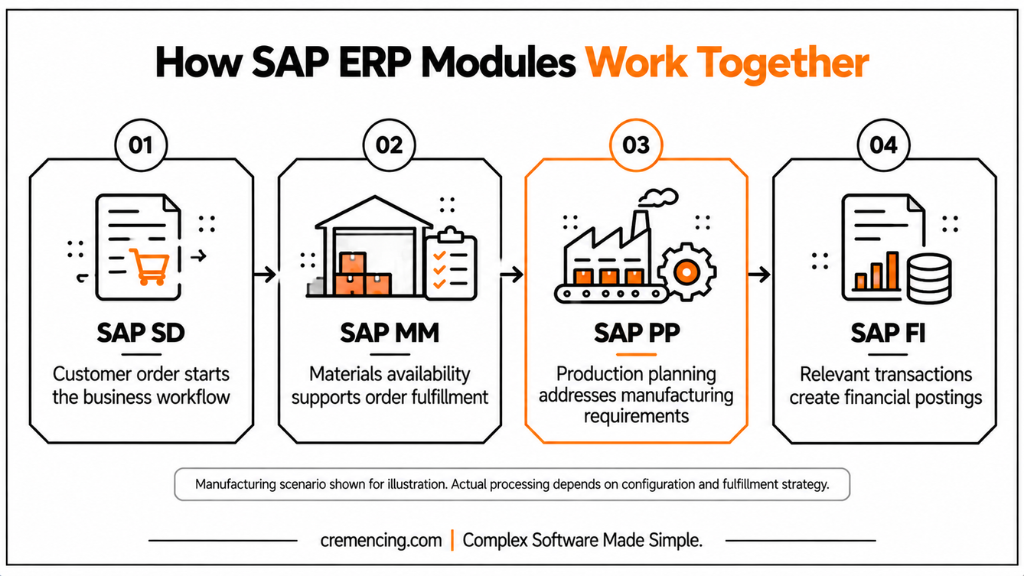
Consider a simplified make-to-order process.
SD creates the sales order. Customer demand can trigger planning in PP. PP creates production requirements, while MM provides the required materials.
When components enter production, MM records the goods issue. The production order receives material costs in CO. Production confirmation records manufacturing progress. A finished-goods receipt increases inventory. QM can create an inspection lot when the relevant inspection process applies.
SD then manages outbound delivery. Post goods issue reduces stock and can trigger cost-of-goods-sold postings. Billing creates the customer invoice.
FI receives revenue and receivables, while CO records relevant production costs and profitability data.
The flow can therefore look like this:
Sales order → production requirement → production order → material document → inspection → delivery → billing → accounting document
This chain explains why SAP testing should cover complete processes rather than individual modules.
An MM valuation problem can affect FI. Production configuration can affect CO. Incorrect SD account determination can send revenue to the wrong account.
How Do You Choose the Right SAP ERP Modules?
Choose SAP ERP modules by mapping processes before selecting components.
Identify where each transaction starts, which business object it creates, who owns the associated master data, and what accounting consequences follow.
Trading businesses commonly rely on FI, CO, MM, and SD. Manufacturers may add PP, QM, PM, and warehouse capabilities. Project-driven companies may require PS.
Before adding a module, confirm that the process requires it, licensing supports it, master data is ready, localization requirements are covered, and dependent interfaces are understood.
Module activation cannot replace process design.
What Changes in SAP S/4HANA?
SAP S/4HANA retains many familiar functional areas but changes important data models, master-data concepts, processing options, and application experiences.
| Area | SAP ERP 6.0 | SAP S/4HANA Direction |
| FI / CO | Separate accounting structures | Universal Journal |
| Customer / vendor | Traditional master records | Business Partner as leading object |
| MM | Classic procurement model | Simplified data structures and Fiori |
| PP | Classic MRP | MRP Live for supported scenarios |
| WM | Classic LE-WM | Stock Room Management or embedded EWM |
| HCM | SAP ERP HCM | SAP HCM for S/4HANA and/or SuccessFactors |
Why Does Business Partner Matter?
Business Partner is central to SAP S/4HANA customer and supplier master-data architecture.
For system conversion, SAP requires customer and supplier data to be converted into Business Partners through Customer/Supplier Integration. Business Partner becomes the leading object for this master data. This change can affect interfaces, custom code, partner relationships, duplicate-management rules, and external systems.
Migration teams should therefore address Business Partner conversion early.
What Does the SAP ERP Maintenance Timeline Mean?
SAP currently provides mainstream maintenance for relevant SAP Business Suite 7 core applications through the end of 2027. Optional extended maintenance follows through the end of 2030.
Organizations still running SAP ERP 6.0 should therefore map each active module, integration, and custom development to its SAP S/4HANA target.
Conclusion
The SAP ERP modules are integrated components of a single enterprise system. Financial values are controlled by FI and CO, and supported by MM, SD, PP, QM, PM, PS, WM and HCM. There is a need to cross-module configure shared master data, documents and automatic postings.
SAP S/4HANA carries over many of the same SAP ERP concepts but makes significant changes to the architecture. The following factors impact migration planning: The Universal Journal, Business Partner model, warehouse options, and HCM direction. Organizations should therefore first map all existing SAP ERP modules to their business process, interfaces, custom developments and target SAP S/4HANA design, and only then design the transition roadmap.
Frequently Asked Questions
Which are the key SAP ERP Modules?
The main modules of SAP ERP are those like FI, CO, MM, SD, PP, QM, PM, PS, WM and HCM. They include accounting, controlling, procurement, sales, manufacturing, quality, maintenance, projects, warehousing and human resources. Typically, companies select modules in accordance with their processes, and not all the modules are utilized.
What will SAP ERP MM be used for?
Procurement, Inventory Management, Material Valuation and Invoice Verification are all handled by SAP ERP MM. People buy things, it generates purchase orders, people move things into the warehouse, Accounts Payable checks supplier invoices. It connects to FI, and can automatically generate the financial postings for many inventory transactions.
What are the components of SAP ERP Financials?
The core components of SAP ERP Financials are mainly FI and CO. FI enables general ledger, payables, receivables and asset accounting. CO provides cost centres, internal orders, product costing, and profitability analysis. Financial and controlling information can be transferred automatically with operational transactions in the logistics modules.
What is SAP ERP HCM?
HRM benefits the administration of personnel records, organisational structure, working time, as well as payroll in SAP ERP HCM. It provides structured employee data and incorporates payroll outcomes with Financial Accounting. Any organization transitioning towards the SAP S/4HANA should consider SAP HCM for SAP S/4HANA in addition to SAP SuccessFactors.
What is the difference between SAP HCM and SAP SuccessFactors?
SAP HCM has traditionally been used to manage HR and payroll on-premise. SAP’s cloud-based HCM applications are offered with SAP SuccessFactors. SAP also offers SAP HCM for relevant on-premises scenarios, which would take into account payroll, localization, integration, and deployment needs.
How many modules are there in SAP ERP?
The ten described modules and components are only a part of the SAP ERP. Organizations do not implement anything more than what is needed in their processes. Additional scope depends on manufacturing, project, maintenance, warehouse and HR needs, and is widely used, including FI, CO, MM, and SD.
Which SAP ERP module is the best first?
If you have a background in a specific field, begin with the module that suits you. Others may consider FI or CO; MM is the common first choice for finance professionals, PP for manufacturing professionals. It is also important to the consultants to know about cross module integration as production SAP processes are seldom confined within one module only.
Are SAP ERP modules available as in SAP S/4HANA?
No. Important data models and application patterns have been altered with SAP S/4HANA, but there are still many functional concepts. The Universal Journal is used in Finance, the Business Partner is the key for customers and suppliers, and the warehouse and HCM architectures have to be handled in different ways for their migration.