
The Complete SAP Maturity Framework Guide for Measuring Digital Readiness in 8 Dimensions
Posted on February 9, 2026 by Laeeq Siddique
Why Assessing Digital Readiness Matters for SAP Transformations
Why the SAP Maturity Model is Vital for Business Transformation Success
Companies are getting on with the job of investing in SAP S/4HANA or they’re looking at a platform play through SAP BTP. Therefore, that’s only half the story; they need to have clarity about their digital fitness as well. Use the SAP Maturity Framework to evaluate systems, processes, and capabilities in a structured manner and expose gaps for businesses to fully leverage their SAP investment.
In organizations, too often we measure progress by milestones:
- Migration completion
- System uptime
- Feature deployment
But months later, executives see performance gaps, low adoption, and slow ROI or even missed opportunities. The missing piece is digital maturity.
The solution? A structured SAP maturity framework.
This model represents a measurable, actionable construct for understanding digital readiness in your organisation, also leading into and following the SAP transformation. It lets executives scan for gaps, mitigate risk, and speed business results.
What is the SAP Maturity Framework?
SAP Maturity Framework
The SAP maturity framework is a model that assesses how well an organization leverages SAP technologies across various dimensions.
Further, a strategic, measured system is quite different than a basic readiness checklist. It showcases where systems, processes, data, governance, and organizational capabilities fit – or don’t fit – with the goals of digital transformation.
In other words, it addresses the vital leadership question:
“If we want to be treated like adults, can’t we act on the value promised by investments in SAP?”
With the framework, CIOs, IT leaders, and enterprise architects are able to take more fact-based decisions, prioritize initiatives, and realize that SAP drives business value.
How Businesses Benefit from Assessing Readiness?
Digital transformation is not just about moving systems; it’s about changing the company. Enterprises run the risk of the following without a maturity model:
- Copying old ways of doing things to new systems
- Overinvesting in technology and underinvesting in capability
- Failed audits: Too many breakdowns in governance
- Low adoption and ROI opportunity
A structured approach to SAP maturity can help leaders identify gaps, establish a strategic roadmap, and align IT with business goals. It turns assumptions into insights.
8 Key Areas to Measure SAP Transformation Readiness
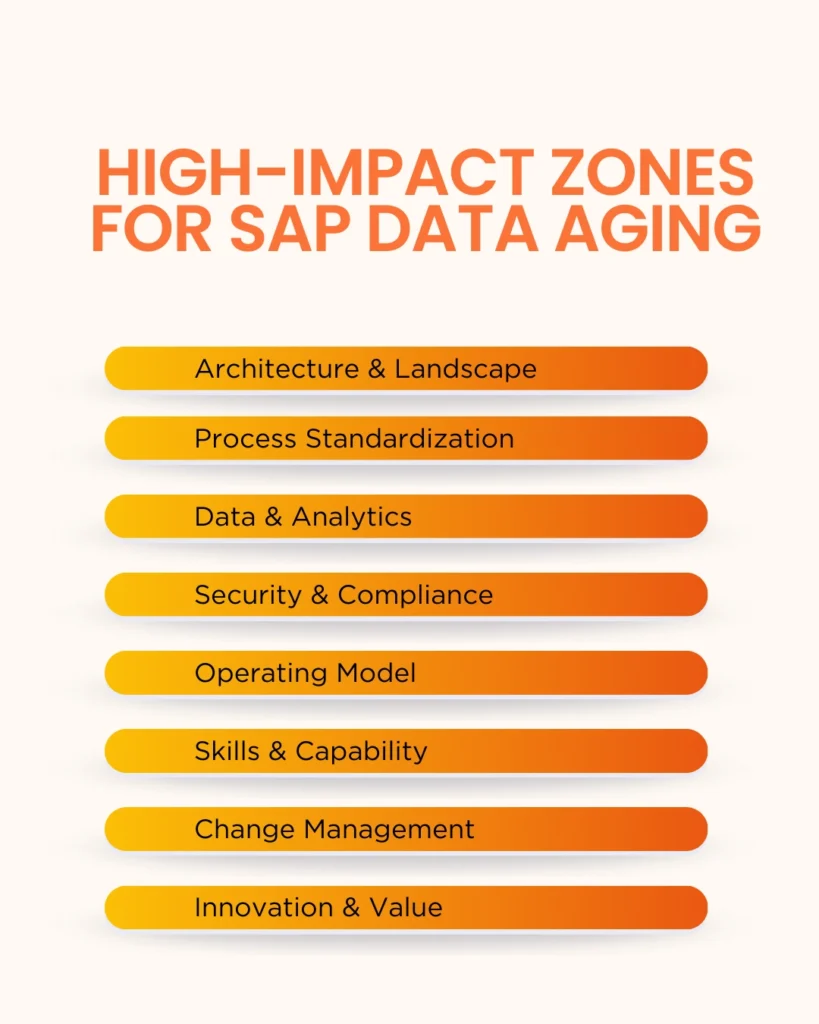
A solid SAP maturity model looks at readiness from eight key dimensions. A combined approach of those dimensions gives you a comprehensive image of what your SAP transformation asset is.
1. SAP Architecture & Landscape Maturity
- Low maturity: Heavy customisation, fragmented systems, and low cloud uptake
- Best practice: Modular architecture, lean core, extensibility; SAP BTP third-party tools aren’t integrated, and there are no common services
- High maturity: Modular clean core build for S/4HANA; SAP BTP-based extensibility
Executive summary: Architecture maturity dictates how much you can innovate without breaking the business.
2. Process Standardisation & Optimisation
- Low maturity: Manual operations, ad-hoc, inconsistent processes, duplicate legacy
- Mature: End-to-end responsibility, simple automation, constant improvement
Executive summary: Streamlined operations allow for quicker decision-making and less “grit” in the mechanisms.
3. Ensuring Data Quality and Analytics Readiness
- Low maturity: Disparate mastering of master data, non-standard reporting, low confidence in analytics
- Mature: Trusted single versions of the truth; real-time insights and analytics consolidated in one location
Executive summary: Data maturity guarantees that S/4HANA will provide the organization with insight and not simply raw data.
4. Security, Risk & Compliance Readiness
- Low maturity: Manual controls, compliance is scattered, unclear roles, manually defined responsibilities
- High maturity: Compliance automation, role simplification, continuous monitoring
Executive impact: Reduces operational and regulatory risk while accelerating digital uptake.
5. Operating Model & Delivery Maturity
- Immature: Project-based delivery model, fragmented IT teams, reactive support
- Mature: Platform assets, Agile ways of working, Business-IT partnership
Executive impact: Decides whether your company can drive continuous improvement and innovation, post go-live.
6. Skills & Capability Readiness
- Low maturity: Lots of consultants, not a lot of internal expertise, skill gaps
- High maturity: Internal capability, clear role evolution, continuous upskilling
Executive summary: Creates higher value SAP support and significantly reduces risk and reliance on outside resources.
7. Change Management & Adoption
- Low maturity: Ineffective communication, change weariness, low engagement
- High maturity: Definite transformation story, executive sponsor, change monitoring
Executive summary: Translating SAP investments to business value.
8. Innovation & Value Realisation
- Low maturity: Just stability, little innovation
- High maturity: Continuous innovation cycles, value-realisation metrics, and platform-based use cases
Executive impact: Turns SAP from cost center to strategic enabler.
How the SAP Maturity Framework Operates in Action
On each dimension, there is at least one maturity assessment (commonly referred to as a level) and often on a scale (e.g., Initiation → Exposure → Defined → Managed).
The outcome:
- A quantified maturity score
- Clear gaps by dimension
- Actionable roadmap for improvement
This practice relieves decision-making from ‘gut feel’ to informed direction, encouraging management to focus resources on the most significant initiatives.
Advantages of Using the SAP Maturity Framework
- Alignment: Guarantees that SAP initiatives are in line with business strategies
- Risk Reduction: Identify capability gaps before they become expensive problems
- ROI Optimised: Guides spend to the areas where value is unlocked
- Continuous Improvement: Enables maturing to be tracked on an ongoing basis
- Executive Visibility: Offers a board-level view of SAP readiness and transformation health
Typical Pitfalls While Assessing the Maturity of SAP
- Considering maturity assessment as an event, not a journey
- Tech for tech’s sake; not considering process, people, governance
- Making objective determinations based on assumptions rather than quantifiable standards
- Isolating IT from business stakeholders
High-performing companies sidestep these by building maturity measurement into SAP governance, planning, and continuous improvement.
SAP Maturity Measurement: Why You Shouldn’t HANA Without It
A majority of S/4HANA projects don’t fail because of technology; they fail because the organisation is not ready.
The SAP maturity model gives you a predictive view of what success will look like:
- Highlights discrepancies that may impede value realisation
- Prioritises improvements for fast wins
- Reduces post-go-live remediation costs
- Aligns IT and C-level around shared goals
Final Thoughts: Digital Readiness Is Not Just Migration
Deploying S/4HANA or SAP BTP is not the destination; rather, it’s a jumping-off point in the digital journey.
By following the SAP maturity framework, business leaders can:
- Understand readiness across eight dimensions
- Spot the hidden gaps before they derail transformation
- Choose where to invest based on measurable results
In today’s competitive environment, maturity isn’t just a measure of success it’s a metric that reflects how long your organisation will take to unlock value from SAP.
If you’re ready to take the next step in your digital transformation journey, connect with Cremencing today. Together, we’ll explore tailored solutions that drive efficiency, innovation, and growth.
Resources
📩 Subscribe to Our Newsletter
Get the latest updates, tips, and insights delivered straight to your inbox.