

Introduction
Most businesses relocate to RISE when SAP anticipates a consistent increase in the expenses of its subscription plans, only to discover that the expenses surpass projections months later. Understanding SAP RISE Pricing upfront is what separates a smooth transition from a budget surprise. What appears to be a package deal usually incorporates some extra costs in infrastructure, customization, and integration — surprises that can greatly affect budgets and postpone ROI.
This isn’t just a finance team problem. IT leaders, project sponsors, and even executive stakeholders often walk into RISE conversations expecting a fixed, all-inclusive number, only to realize later that the actual invoice tells a different story. The subscription model is genuinely flexible, and that flexibility is exactly what makes the pricing harder to predict without the right context.
Knowing RISE with SAP pricing is not merely going through a price list. It involves a further examination of cost drivers, which are not necessarily visible when first encountered during such discussions. The lack of this clarity means that businesses can underestimate total investment, sometimes by a significant margin.
Here, you will find out how the RISE with SAP pricing works, the five hidden cost factors companies usually do not pay much attention to, and some practical strategies on how to budget effectively before committing.
Navigating RISE Commercial Structures
RISE with SAP consolidates S/4HANA Cloud software, cloud infrastructure, and technical managed services under a single subscription contract based on Full User Equivalents (FUEs). While this unified pricing model lowers initial capital expenditure compared to traditional licensing, total cost predictable relies heavily on architectural scope.
Secondary operational expenses—such as SAP BTP integration middleware, custom side-by-side extensions, extra database memory, and data egress fees—are billed separately. Accurately mapping peripheral integrations, data growth trajectories, and deployment models (public versus private cloud) upfront prevents unexpected budget overruns during enterprise migration.
What Is SAP RISE Pricing?
RISE with SAP type of pricing is a subscription-based model which integrates the software, infrastructure and services in one contract. SAP charges businesses a recurring fee based on usage and scope, rather than a separate license purchase.
This model usually encompasses:
- SAP S/4HANA Cloud access
- Infrastructure (AWS, Azure or GCP)
- SAP Business Technology Platform (BTP)
- Technical support and services.
But the increase with sap price list is not predetermined. Pricing depends on:
- Number of users
- Volume of data and size of the system.
- Deployment model (private vs public cloud)
- Other integrations and services.
Such flexibility is good, but might also result in a complex cost.
For context, a mid-sized company (roughly 500-1,000 Full User Equivalents) moving to RISE with SAP S/4HANA Cloud, Public Edition, typically sees a materially lower entry cost than the same scope under Private Edition — but the trade-off is less infrastructure control and customization flexibility.
Step-by-Step: How SAP RISE Pricing Works
SAP RISE Pricing — 5-Step Cost Checklist
- Define scope & user base (FUE model)
- Choose deployment (public vs private cloud)
- Pick infrastructure provider (AWS/Azure/GCP)
- Add required SAP services (BTP, analytics, integration)
- Budget for implementation & migration separately
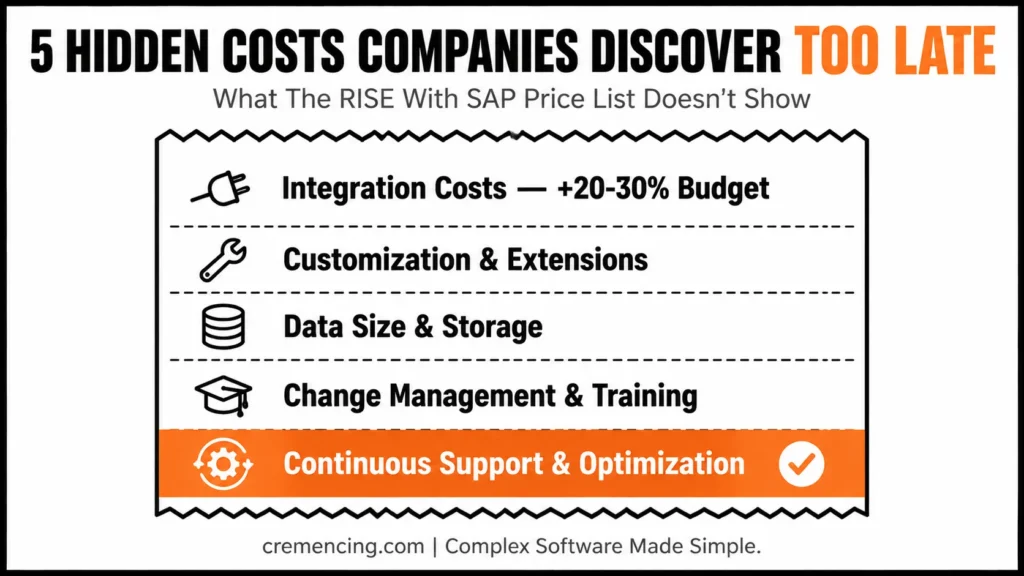
5 Hidden Cost Factors to Flag Early
- Integration (+20-30% typical)
- Customization & extensions
- Data storage & backup growth
- Change management & training
- Ongoing support & optimization
Step 1: Scope and User Base in SAP RISE Pricing
The first step to pricing is to define:
- Number of users (FUE model – Full User Equivalent)
- Business processes covered
- Required SAP modules
An increased number of users and a wider scope contribute to a high cost.
Step 2: Choose Deployment Model
RISE with SAP offers:
- Public cloud (less expensive, less tailoring)
- Private cloud (more expensive, more versatile)
The deployment of a private cloud, in most cases, raises the overall pricing because of the need to deploy infrastructure and management.
Step 3: Infrastructure Provider’s Impact on SAP RISE Pricing
You can choose:
- AWS
- Microsoft Azure
- Google Cloud
Each provider has different pricing models, impacting overall cost.
Step 4: Add SAP Services and Tools
Other services can be added:
- SAP BTP usage
- Analytics tools
- Integration services
Base pricing does not necessarily cover these entirely.
Step 5: Consider Implementation and Migration.
Initial costs include:
- System migration
- Data cleanup
- Customization
These are one-time but major expenses.
5 Hidden Cost Factors in SAP RISE Pricing
1. Integration Costs
To integrate SAP with other systems, it is necessary:
- Middlewares (SAP Integration Suite)
- API development
- Data transformation
Such expenses are not always properly estimated and can increase budgets by 20-30%.
2. Customization and Extensions
Business requirements might not all be satisfied by normal SAP solutions.
Customizations require:
- Development effort
- Testing and maintenance
Excessive customization adds to the initial and continuing expenses.
3. Data Size and Data Store.
Massive amounts of data grow:
- Storage costs
- Backup requirements
- Processing time
It is not a point that is brought to the fore in the initial pricing negotiations.
4. Change Management and Training.
RISE with SAP will need:
- Employee training
- Process changes
- Adoption support
These are indirect costs that may have a great effect on ROI.
5. Continuous Support and Optimization.
Post-implementation costs include:
- System monitoring
- Performance tuning
- Security updates
The recurrent costs are usually ignored. For more insight on SAP Rise, read our Blog
ROI and Benefits of Understanding SAP RISE Pricing
The pre-understanding of pricing allows business maximization of value.
1. Better Budget Planning
Costs can be clearly seen to avoid overruns.
To 25-40 percent higher accuracy of the budget.
2. Improved ROI
The avoidance of the hidden costs will guarantee quicker returns.
3. Reduced Financial Risk
Proper forecasting reduces unforeseen costs.
4. Smarter Decision Making
Businesses are able to select the appropriate deployment and services.
5. Optimized Resource Allocation
More effective allocation of funds across projects can be done.
Common Mistakes and Best Practices for SAP RISE Pricing
Common Mistakes
- To suppose that Pricing is Fully Inclusive.
Most firms assume that all is included but it is never the case. - Ignoring Integration Complexity
The costs of integration are usually underestimated. - Overlooking Long-Term Costs
The emphasis is usually laid on early pricing. - Failure to go through Contracts with caution.
Hidden terms can impact pricing significantly.
Best Practices
- Carry out an exhaustive cost analysis.
- Include integration and customization in the budget
- Anticipate long-term costs of operations.
- Work with experienced SAP consultants
- Inspect the rise with sap price list.
SAP RISE Pricing vs Traditional SAP Licensing
The majority of the content fails to explain how RISE pricing is compared to the traditional SAP licensing.
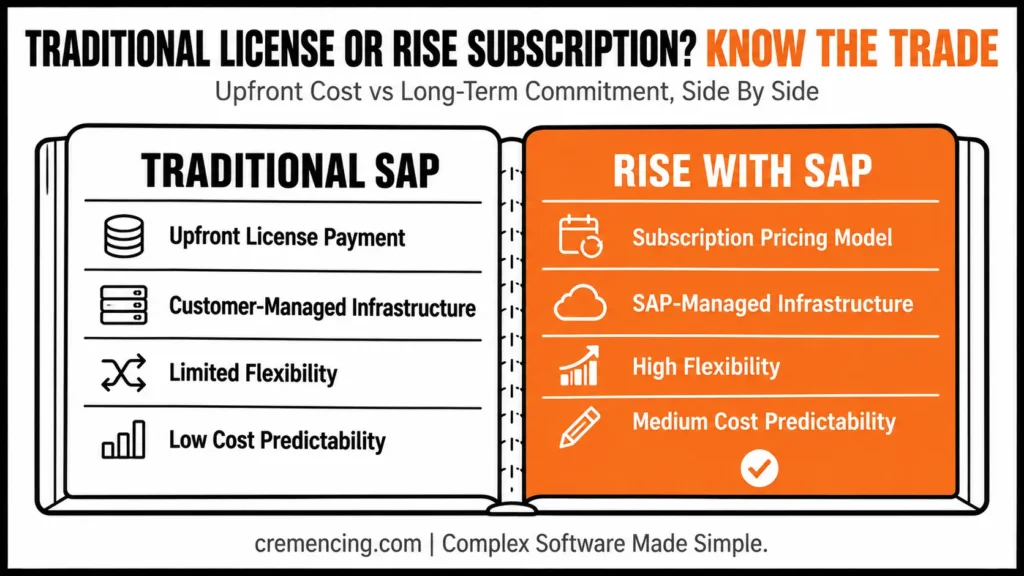
Key Differences: SAP RISE Pricing vs Traditional Licensing
| Aspect | Traditional SAP | RISE with SAP |
| Pricing Model | Upfront license | Subscription |
| Infrastructure | Customer-managed | SAP-managed |
| Flexibility | Limited | High |
| Cost Predictability | Low | Medium |
What This Means to Businesses.
- Lower upfront investment
- Increasing long-term commitments on subscriptions.
- Need for careful cost planning
Learning about this change will enable businesses to make wise choices.
Conclusion
Understanding SAP RISE Pricing means looking past the headline subscription number to the five cost factors that consistently catch companies off guard — integration, customization, data growth, training, and ongoing support. None of these are deal-breakers on their own, but together they can shift total cost of ownership significantly if they’re not budgeted for from day one.
The subscription model itself isn’t the problem. RISE genuinely lowers upfront investment compared to traditional licensing, and for many businesses that trade-off makes sense. The real issue is timing: companies that only discover these hidden costs after signing lose the leverage to negotiate them into the contract, and end up absorbing them as surprise line items months into the engagement.
The businesses that get the best ROI from RISE aren’t the ones who negotiate the lowest quote — they’re the ones who go in with a full picture of what the quote doesn’t include. Asking pointed questions about integration scope, customization limits, and post-implementation support before signing is what turns a projected ROI into an actual one, three years down the line.
FAQ Section
1. What is included in SAP RISE Pricing?
Basically, SAP RISE Pricing covers S/4HANA Cloud access, infrastructure, and core technical services. However, extra costs often arise from integrations and customizations that aren’t part of the base package. Therefore, businesses should never assume the quoted price is the final number.
2. How is SAP RISE Pricing calculated?
Generally speaking, pricing is based on the number of users, system size, deployment model, and additional services. In addition, factors like infrastructure provider and data volume also influence the final cost. Consequently, no two RISE contracts end up looking exactly the same.
3. Does SAP RISE Pricing cost less than traditional SAP licensing?
Initially, yes — RISE typically lowers upfront investment compared to traditional licensing. Over time, however, the subscription model can become more expensive due to long-term commitments. As a result, companies need to evaluate total cost over several years, not just year one.
4. What are the hidden costs in SAP RISE Pricing?
Specifically, integration, customization, data storage, training, and ongoing support are the most commonly overlooked costs. Moreover, these expenses often surface only after implementation begins. Hence, budgeting for them early prevents unpleasant surprises later.
5. How much can integration costs add to SAP RISE Pricing?
Typically, integration work — including middleware and API development — can increase budgets by 20 to 30 percent. Furthermore, this cost is rarely highlighted during initial pricing discussions. So, it’s essential to ask about integration scope upfront.
6. Why do companies underestimate SAP RISE Pricing?
Often, businesses assume the subscription fee is fully inclusive of everything they need. In reality, though, customization, training, and long-term support are usually billed separately. Thus, a lack of clarity during negotiations leads directly to budget overruns.
7. Does deployment model affect SAP RISE Pricing?
Yes, indeed — private cloud deployments generally cost more than public cloud options. This is because private cloud requires dedicated infrastructure and additional management. Meanwhile, public cloud offers a more predictable, lower-cost starting point.
8. How can businesses budget smarter for SAP RISE Pricing?
First and foremost, companies should conduct a thorough cost analysis before signing any contract. Additionally, integration and customization expenses should be built into the budget from day one. Ultimately, working with experienced SAP consultants helps avoid the most common pricing pitfalls.
9. What role does data size play in SAP RISE Pricing?
Naturally, larger data volumes increase storage costs, backup requirements, and processing time. Unfortunately, this factor is often left out of early pricing conversations. Consequently, businesses with large datasets should factor this in well before committing.
10. Is SAP RISE Pricing predictable over the long term?
Not entirely, since ongoing support, optimization, and scaling needs can shift costs year over year. Nevertheless, understanding the cost drivers in advance makes long-term forecasting far more accurate. Overall, proactive planning is what separates predictable RISE budgets from reactive ones.
Resources
https://www.sap.com/products/rise.html
https://help.sap.com/docs/rise-with-sap
https://www.sap.com/products/s4hana.html




One Response